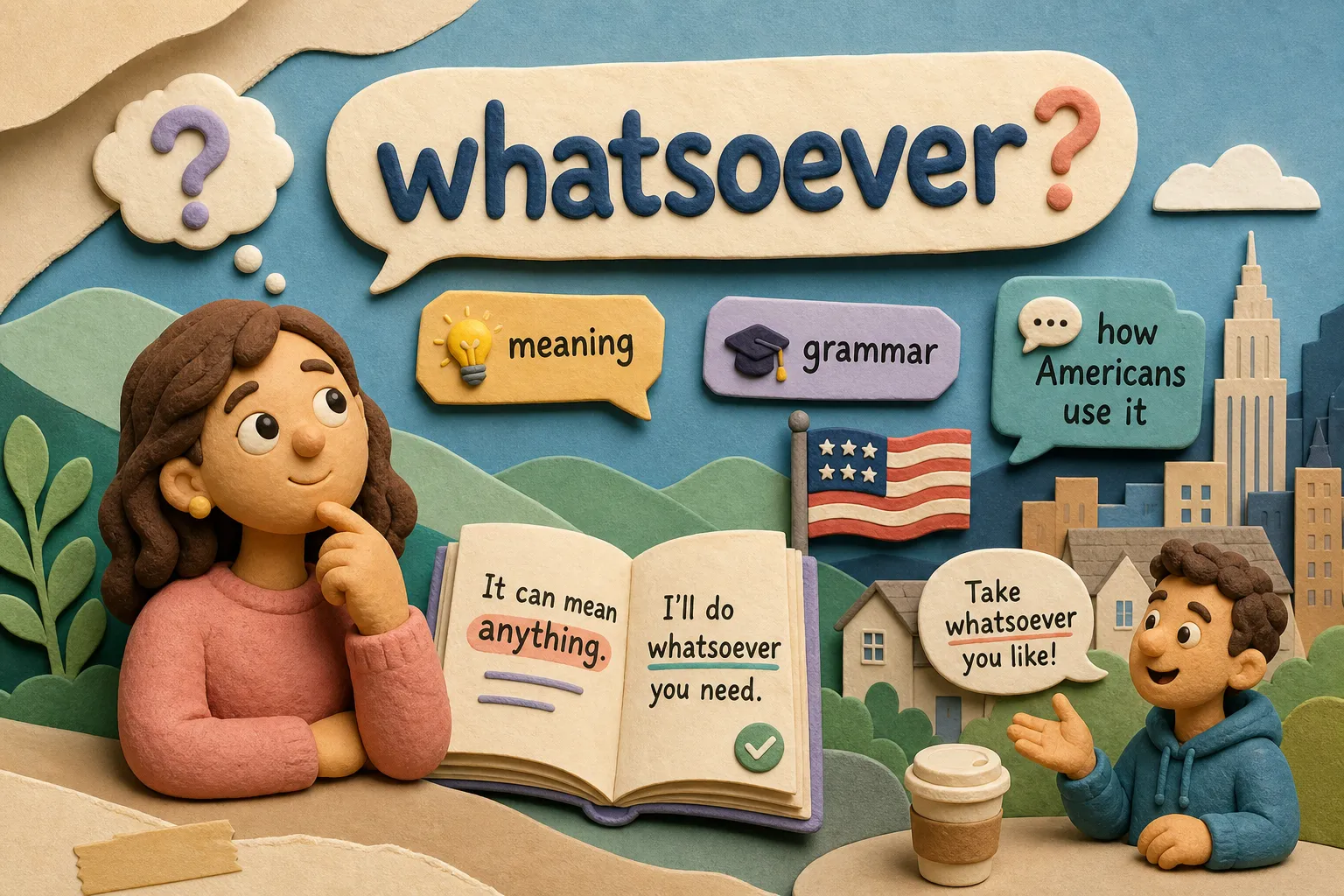
Imagine you’re watching an American TV show. A character looks right at the camera and says, “I have no idea whatsoever.” You understand each word. But something still feels unclear. What exactly is that word doing in that sentence? Why is it there? Could you remove it?
By the end of this article, you will know exactly what “whatsoever” means, how to place it correctly in a sentence, and when to choose a simpler option instead. You will also learn the rule that most learners miss: in modern American English, this word is used almost exclusively in negative sentences. This is the kind of real-world grammar detail that standard textbooks often skip, but that comes up constantly in American speech and writing.
What “whatsoever” actually means
The core definition
“Whatsoever” is an intensifier, a word that makes another word or idea stronger. In simple terms, it means “at all” or “in any way,” signaling zero, none, not even the smallest amount. So “no problem whatsoever” means “no problem at all, not even a small one.” The sentence works fine without it, but adding the word makes the negative feeling much stronger and more certain.
Where it sits in the sentence
“Whatsoever” is a postpositive modifier, meaning it comes after the word it modifies rather than before it. It almost always appears at the end of a noun phrase or clause, following a negative word. Look at these examples:
- “She had no patience whatsoever.”
- “There is no evidence whatsoever.”
- “I have no idea whatsoever.”
Notice the position each time: the word lands at the end, after the negative noun phrase. In modern American English, it almost always appears after the word or phrase it modifies rather than before it.
How it works in negative sentences
The negative sentence pattern
“Whatsoever” needs a negative trigger, usually a word like “no,” “none,” “not,” “nothing,” or “without.” Without one of these words, it does not fit naturally into the sentence.
Here are the most common structures in American English:
- No + noun + whatsoever: “She had no patience whatsoever.”
- None whatsoever (as a short answer): “Did he apologize?” “None whatsoever.”
- Nothing whatsoever: “I understood nothing whatsoever.”
- Not + any + noun + whatsoever: “There wasn’t any evidence whatsoever.”
Each sentence has a negative word first. That is the trigger. The intensifier then comes in to make the negative even stronger and more final.
A common mistake: using it in positive sentences
This is a very common error for ESL learners. In modern American English, “whatsoever” is overwhelmingly used in negative contexts; positive uses are rare and generally archaic or literary. If you drop it into a positive sentence, it sounds off to native speakers.
Study these two pairs:
Incorrect usage (do not use): “I have some interest whatsoever in that topic.”
Correct: “I have no interest whatsoever in that topic.”
Incorrect usage (do not use): “She made some progress whatsoever last month.”
Correct: “She made no progress whatsoever last month.”
The rule is simple: this word requires a negative trigger. Without one, leave it out of the sentence entirely.
“Whatsoever” vs. “at all” vs. “whatever”: what’s the difference?
Synonyms and close alternatives
Before comparing the three words, it helps to know that “whatsoever” shares its meaning with several everyday phrases. The most common synonyms and paraphrases include “at all,” “in any way,” “in the least,” and “not in the slightest.” Each of these can replace “whatsoever” in a negative sentence, though the level of formality differs. Knowing these options gives you flexibility and helps you recognize the pattern across different contexts.
“At all” is the casual version
“At all” and “whatsoever” often mean the same thing in negative sentences. “I have no interest at all” and “I have no interest whatsoever” carry the same basic meaning. The difference is tone and weight. Corpus data consistently shows “at all” is far more frequent in everyday American speech, while “whatsoever” is reserved for moments that call for added emphasis or formality.
“At all” sounds natural in everyday conversation. “Whatsoever” sounds stronger and more deliberate. Here is how that difference plays out in real speech:
“Are you nervous about the presentation?”
“Not at all.” (casual, relaxed)
“Not whatsoever.” (more emphatic, very confident)
Both are grammatically correct. But “at all” fits better in relaxed settings, while “whatsoever” works better when you want to sound very certain or very serious.
“Whatever” is a different word entirely
“Whatever” is NOT the same as “whatsoever.” They look similar, but they have very different jobs. “Whatever” means “anything” or “no matter what”, it expresses free choice or open conditions. “Whatsoever” is about negative emphasis. Using them in place of each other will change your meaning completely.
| Word | Core meaning | Example |
|---|---|---|
| whatsoever | at all; in any way (negative emphasis) | “I have no doubt whatsoever.” |
| at all | at all (casual negative emphasis) | “I have no doubt at all.” |
| whatever | anything; no matter what (choice or condition) | “Take whatever you want.” |
The “wh- + ever” family
Words like “whenever,” “wherever,” “whoever,” and “whichever” are all common in everyday American English and work in both positive and negative sentences. “Whatsoever” is the exception in this family. Over time, it moved almost completely into negative use only, which is why you need to treat it as its own special case.
Where did “whatsoever” come from?
Middle English origins
“Whatsoever” is a very old word, built from three Middle English parts: what + so + ever. In early English, “so” was used to make words more general, similar to how we use “-ever” today. The original form meant “whatever” in a broad sense and appeared in both positive and negative contexts.
How the meaning narrowed over time
Over several centuries, “whatever” became the everyday word for general use, while “whatsoever” slowly became more specialized. Today, native speakers use it mostly for negative emphasis. The older, broader meaning still appears in formal, legal, or religious writing, think the King James Bible or older legal documents, but it is rare in modern conversation.
This history explains why “whatsoever” can feel slightly formal or old-fashioned in casual speech. That quality comes from its long life as a literary and legal word. Knowing this background helps you judge when to reach for it and when “at all” is the better fit.
How formal is “whatsoever” in modern American English?
In formal and professional writing
“Whatsoever” is attested with some frequency in formal registers such as legal, academic, and business writing. “There is no liability whatsoever” sounds precise and confident. “There was no basis whatsoever for that decision” sounds authoritative and clear. In these contexts, the word signals seriousness and certainty in a way that “at all” typically does not.
You will also hear it in emphatic speech situations: news interviews, formal complaints, and public debates. When someone wants to make a very strong negative point in a serious context, it carries real weight and finality.
In everyday American conversation
In casual conversation, “at all” is more common. “I’m not worried at all” sounds more natural in everyday speech than “I’m not worried whatsoever.” Using the longer form in casual small talk can sound slightly stiff or overly serious.
However, “None whatsoever” as a short emphatic reply is very natural even in spoken American English. It sounds confident, not stiff. This is exactly the kind of nuance that makes a real difference in how you sound, knowing a word’s definition is only part of the work, because you also need to know which situations actually call for it.
Here is a simple register guide to keep in mind:
- Formal writing (legal, academic, business): sounds professional and precise.
- Emphatic speech (debates, interviews, strong complaints): adds weight and finality.
- Casual conversation (friends, small talk, everyday situations): “at all” is more natural and relaxed.
Try it yourself: practice exercises
Five example sentences to study
Read each sentence carefully. Notice the pattern it uses.
- “He showed no remorse whatsoever.” (no + noun + whatsoever)
- “There is no scientific basis whatsoever for that claim.” (no + noun phrase + whatsoever)
- “Did they offer any explanation?” “None whatsoever.” (none + whatsoever as a short reply)
- “She felt no pressure whatsoever going into the interview.” (no + noun + whatsoever)
- “I understood nothing whatsoever from that meeting.” (nothing + whatsoever)
Quick self-check prompts
Try completing these three sentences. Then check your answer by asking two questions: Is the sentence negative? Do I want to sound emphatic? If both answers are yes, “whatsoever” fits well.
- “He has no experience _______ in project management.” (whatsoever / at all / whatever)
- “Take _______ notes you think are helpful.” (whatsoever / at all / whatever)
- “She showed no emotion _______ during the presentation.” (whatsoever / at all / whatever)
Answers: 1) “whatsoever” or “at all”, both work, but “whatsoever” sounds more formal. 2) “whatever”, this is a positive sentence about free choice, so “whatsoever” does not fit. 3) “whatsoever” or “at all”, both work naturally here.
The best way to build your feel for this word is to notice it in real American content. Listen for it in news programs, interviews, and professional conversations. Each time you hear it, ask yourself: Is the sentence negative? Is the speaker being emphatic? You will start to recognize the pattern very quickly.
Wrapping up
“Whatsoever” means “at all.” It intensifies negative statements and follows the negative phrase, landing as more formal and emphatic than the casual alternative, “at all.” Those two facts cover most of what you need for everyday use.
The most important rule to take away: positive sentences do not use this word. If your sentence has no negative trigger, no “no,” “none,” “not,” or “nothing”, leave it out. If one of those is present, “whatsoever” can follow at the end to add strength and finality.
Understanding this word is one small example of how American English uses emphasis. Native speakers layer intensity into their language in specific, learnable patterns. The more you notice these patterns in real speech and writing, the more natural your own English will sound. If you want to keep building this kind of practical fluency, Your Daily American offers grammar and vocabulary lessons alongside pronunciation work you can put to use right away.