You’re at a seafood restaurant. The waiter asks what you’d like. You want to order three different kinds: salmon, tuna, and halibut. Suddenly, you freeze. Is it “three fish” or “three fishes”? You stare at the menu. You’re not sure.
If you’ve ever wondered about fish vs fishes, which plural is correct and when, you’re not alone. Many English learners find this one genuinely tricky, and it’s completely understandable. English has irregular plurals, and “fish” is one of the most interesting cases. The good news: the rule is simple once you see the full picture.
By the end of this lesson, you’ll know when to use “fish” as a plural, when “fishes” is the right choice, and what “fishes” means as a verb. You’ll also see some cultural examples where “fishes” appears in fixed phrases. No grammar jargon needed, just clear rules and real examples you can use right away.
Fish vs Fishes: The Everyday Plural vs the Species Plural
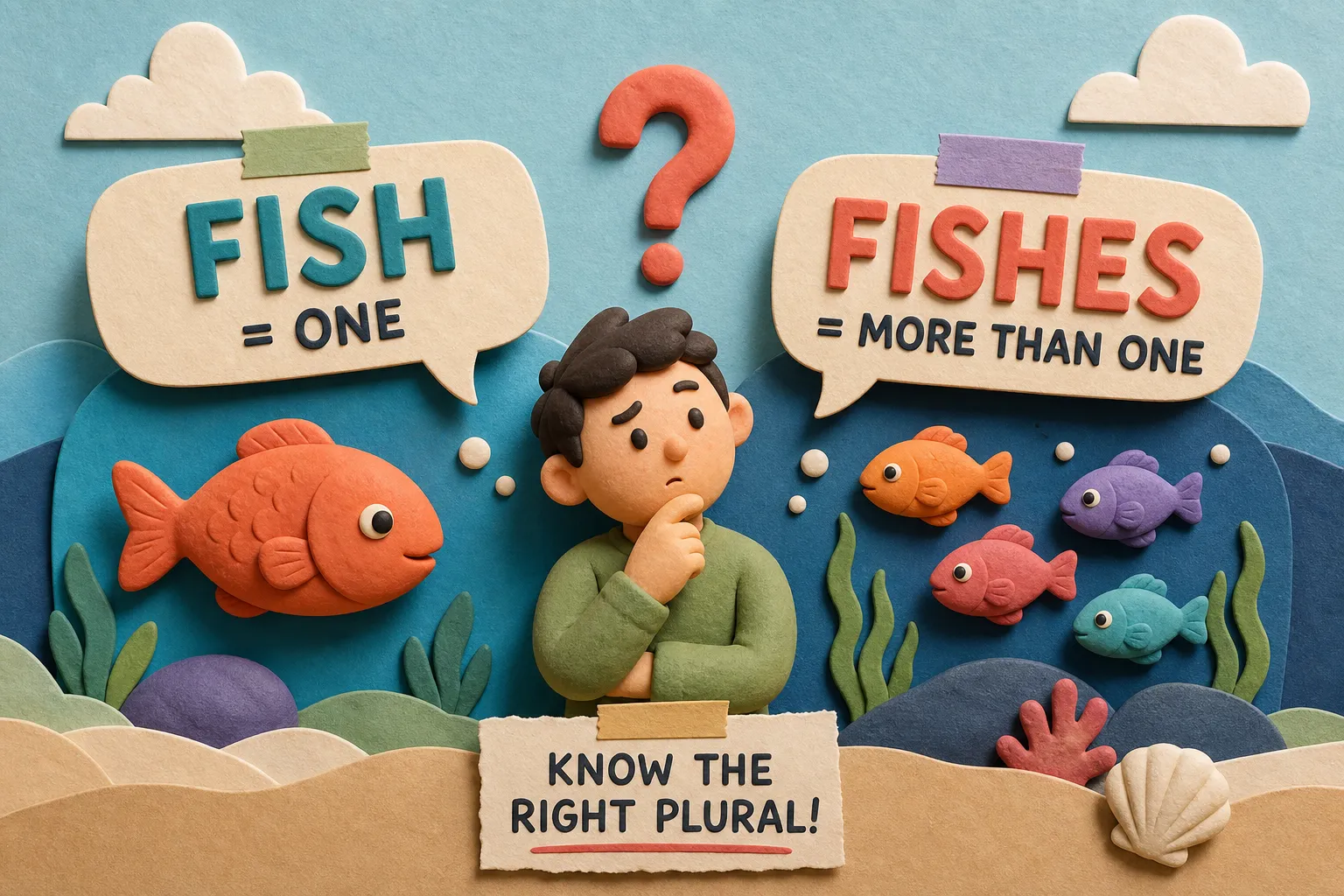
In everyday American English, “fish” works as both the singular and the plural. One fish. Two fish. Ten fish. This covers most everyday situations you’ll encounter, outside of scientific contexts where species-level distinctions matter.
This applies even when the fish are different kinds. If you have a salmon and a tuna in your aquarium, you still say “two fish.” In casual speech, Americans don’t switch to “fishes” just because the fish are different species. The word “fish” handles both cases without changing.
Here are some natural example sentences:
- “I caught five fish this morning.”
- “There are six fish in that tank.”
- “We bought fish at the market for dinner.”
- “How many fish did you see on the dive?”
Merriam-Webster lists “fish” as the standard plural form, and Cambridge follows the same approach in its learner dictionary. This is the form you’ll hear at the grocery store, on a fishing trip, or at the dinner table. When in doubt, “fish” is the right choice in everyday speech.
When to Use “Fishes”, Fish vs Fishes Explained
There is one important exception to the “fish” rule. When you are talking about multiple different species (a species is a type or kind of animal), “fishes” becomes the correct plural. This use is most common in scientific writing, biology textbooks, and nature content.
Think of it this way. “I saw ten fish in the river” tells us how many individual fish were there. “The book covers the freshwater fishes of North America” tells us the book discusses many different kinds of freshwater fish, not just one species. The word “fishes” signals that difference.
You will see this form in real scientific sources. The American Fisheries Society uses “fishes” in exactly this way in their research guidelines, which also note that vertebrate fishes include at least 27,000 known species. Aquarium exhibits and nature guides use phrases like “reef fishes” or “freshwater fishes” to show they are discussing a wide variety of species, not just individual animals.
More examples for clarity:
- “Researchers studied the different fishes found in the reef.”
- “The guide describes the native fishes of the Great Lakes.”
- “Three fish were swimming near the surface.” (individuals, not species)
- “The exhibit features fishes from five different ocean zones.” (multiple species)
The key question to ask yourself: Am I counting individual fish, or am I referring to different types of fish? If it’s types or species, “fishes” is correct. If it’s individuals, use “fish.”
“Fishes” as a Verb: A Completely Different Meaning
“Fishes” also works as a verb, and this has nothing to do with plural nouns. “To fish” means to go fishing. When the subject is he, she, or it, you add -s to the verb. That gives you “fishes.” This verb form rounds out the full fish vs fishes picture, the word shows up in three distinct roles in American English.
Here are examples of “fishes” as a verb, and a quick contrast to show the difference at a glance:
- “My grandfather fishes on the lake every weekend.” (verb: he goes fishing)
- “She fishes for trout in the spring.” (verb: she goes fishing)
- “He caught three fish last Saturday.” (noun plural: individual fish)
Now here is something useful to know for conversation. “Fish for” is also a phrasal verb, a verb-plus-preposition combination with a special meaning. In this case, “fish for” means to try to get something indirectly, without asking for it directly. When the subject is he, she, or it, this becomes “fishes for.”
“He always fishes for compliments after a presentation.” In this sentence, the man is not actually fishing. He is acting in a way that encourages other people to say something nice about him. “She fishes for information before she makes a decision” means she asks questions indirectly to learn what she wants to know. Common American Expressions covers similar phrasal verbs and idioms you’ll hear in American workplaces and daily speech. Dictionary entries for “fish for” confirm both the compliment and information collocations as established idiomatic uses. You will hear these phrasal verb forms in American workplaces and everyday conversation.
Literary, Religious, and Cultural Uses of “Fishes”
You may also see “fishes” in older texts, religious writing, and fixed cultural phrases. These uses don’t follow the modern species rule. They come from an older form of English where “fishes” was used as a general plural.
The most famous example is the phrase “loaves and fishes.” This comes from the Bible, specifically from stories about Jesus feeding large crowds with five loaves of bread and two fish. In the King James Version, Matthew 14:19 reads “the two fishes” and Matthew 15:36 reads “the fishes.” Today, “loaves and fishes” remains a fixed expression often used to describe doing a great deal with very little. Because it is a set phrase from the Bible, it keeps the old form. You don’t change it to “loaves and fish.”
Another cultural example is the zodiac sign Pisces, which is sometimes called “the Fishes.” The name Pisces comes from Latin and means “fishes.” In astrology, the symbol for Pisces is two fish. In American English today, most people just say “Pisces.” The phrase “the Fishes” appears mainly as an explanation of the Latin name. If you see it in a horoscope or a reference to astrology, you now know why.
How Americans Really Decide: Context and Register
Register means the level of formality in language. The same person uses different register in a text message to a friend and in a work email to a manager. Register plays a big role in the fish vs fishes decision.
In everyday American conversation, “fish” is the plural that native speakers use without thinking about it. At the grocery store, at the dinner table, in a text message, in a news article, “fish” is always the natural choice. If you say “fishes” in a casual conversation when you just mean “more than one fish,” it will sound unusual to most American ears. It may come across as overly technical or old-fashioned. For a concise explanation of how native usage typically treats these forms, see Grammarly’s guide on fish vs fishes.
In contrast, if you are writing a research paper on marine biology, a nature guide, or an exhibit description for an aquarium, “fishes” is expected when you discuss more than one species. In scientific writing, authors generally prefer “fishes” when referring to multiple species; using “fish” in that context may be questioned by peers or editors who follow the conventions of fields like ichthyology. In that register, “fishes” is the correct, professional choice.
Knowing not just the rule but when real speakers actually apply it, that’s the kind of practical grammar insight that Daily Grammar is built around. The lessons there focus on how American English works in real situations: professional emails, workplace conversations, everyday speech. When you understand register and context, you stop second-guessing yourself. You choose the right word because you understand why it’s right.
Put It Into Practice
Here is a quick summary of the fish vs fishes distinctions covered in this lesson:
- “Fish” is the everyday plural for one or more individual fish. Use it in almost every real-life situation.
- “Fishes” is the plural for multiple species of fish. Use it in scientific, academic, or nature writing.
- “Fishes” as a verb is the third-person singular present tense of “to fish” (he fishes, she fishes).
- “Fishes for” as a phrasal verb means to try to get something in an indirect way.
- Fixed phrases like “loaves and fishes” and “the Fishes” (Pisces) use the older form and don’t follow the modern rule.
Now try these practice sentences. Choose “fish” or “fishes” for each blank:
- “I saw three _____ at the aquarium.” (Answer: fish)
- “The scientist studied the reef _____ of the Pacific.” (Answer: fishes)
- “She always _____ for compliments after a presentation.” (Answer: fishes)
If you got all three right, you have a stronger handle on this distinction than many intermediate learners do. The fish vs fishes question isn’t complicated once you know what context you’re in. Use “fish” for individuals in daily life, “fishes” for species in a scientific context, and “fishes” as the verb form when he, she, or it is doing the fishing.
Grammar sticks when you learn it through real situations, not just rules on paper. For more lessons built around the English you actually use, at work, at home, or anywhere in between, explore the daily content at Your Daily American.