You open a meeting invite from your manager. The subject line says “Team All-Hands.” You scan the details: date, check. Time, check. Then you see “Location: TBD.” You understand something is missing, but you’re not completely sure what TBD means, or when you should use it yourself in an email or calendar entry.
This lesson will answer all of that. By the end, you’ll know exactly what TBD stands for, how it compares to TBA and TBC, and how to use it correctly in work emails, calendars, and everyday plans. American professional life runs on short abbreviations like this one. TBD is one of the most common abbreviations learners ask about here at Your Daily American, so let’s break it down step by step.
What TBD stands for
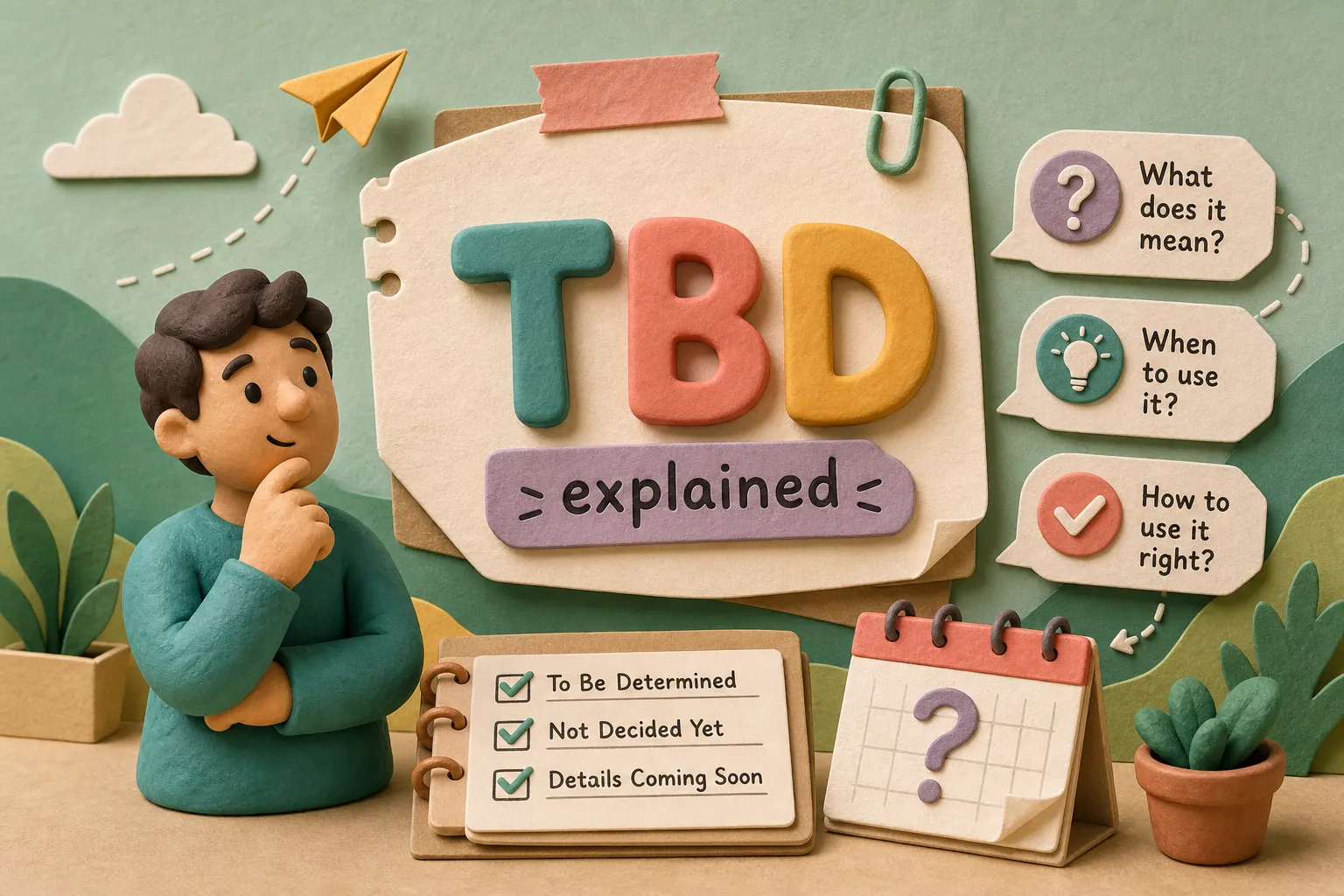
TBD stands for “to be determined.” Some people also read it as “to be decided.” Both versions mean the same thing in practice: a specific detail has not been settled yet, and someone will fill it in later. Major dictionaries including Merriam-Webster and Cambridge Dictionary define it this way, with Cambridge listing “to be decided” as an equally correct alternative.
When you write TBD next to a detail, you’re telling the reader: “This information is coming. We just don’t have it yet.”
How to write and say TBD
Always write TBD in all capital letters with no periods. The correct form is TBD, not “T.B.D.” and not “tbd.” When you speak it aloud, say each letter individually: “T-B-D.” You’ll hear Americans use it this way in meetings or on phone calls when referring to something unresolved.
The lowercase form (“tbd”) is informal and mostly shows up in text messages or casual group chats. In a work email, a calendar invite, or any professional document, always use the capitalized form.
Where Americans use TBD in real life
TBD appears in many situations, both at work and in personal life. Its job is always the same: it holds a spot for information that isn’t ready yet.
TBD in professional settings
In the workplace, TBD is a standard placeholder. You’ll see it in project timelines, meeting agendas, contracts, and status updates. It tells colleagues that a detail is still being worked out but will be confirmed later. A team planning a product launch before they’ve secured a venue might write “Launch event, date TBD” in a shared calendar. That reserves space and sets expectations without blocking progress on everything else.
TBD also appears regularly in contracts and proposals. If a price or delivery date hasn’t been set, the document might include “Final pricing: TBD pending supplier quotes.” This is clear, professional, and immediately understood.
TBD on calendars and event pages
Outside the office, TBD shows up on event invitations, school schedules, social media event pages, and calendar apps like Google Calendar and Outlook. A community fundraiser might list “Time and location: TBD” while organizers lock down the details. A wedding save-the-date might go out with “Venue: TBD” because the couple is still deciding. This is completely normal. It tells guests that the event is happening; the missing details will follow.
TBD vs. TBA vs. TBC: which one to use
These three abbreviations look similar and are often confused. Each one signals a different stage of the planning process.
- TBD (to be determined): the detail is not decided yet
- TBA (to be announced): the detail is already set but hasn’t been shared publicly
- TBC (to be confirmed): the detail is tentatively known but needs final approval before it’s official
Here’s a concrete example to help you remember. Imagine a company is planning a conference. The date hasn’t been picked yet: that’s TBD. The keynote speaker is booked but won’t be announced until next week: that’s TBA. The venue has been chosen but the contract isn’t signed yet: that’s TBC.
A simple rule: if you don’t know it yet, write TBD. If you know it but aren’t ready to share it, write TBA. If you know it but it could still change, write TBC. Of the three, TBD is by far the most common in American English, especially in everyday work communication and personal planning.
Real TBD examples you can use right now
Seeing TBD in context is the fastest way to understand how it works. Here are examples organized by situation.
TBD in work emails and professional documents
These sentences show how TBD appears naturally in professional writing:
- “The project budget is TBD pending approval from finance.”
- “Please save the date for our team offsite, exact location TBD.”
- “The final pricing will be TBD until we receive supplier quotes.”
- “The agenda is TBD, but we expect the meeting to last one hour.”
TBD in calendar entries and event listings
Calendar entries are short and direct. TBD fits naturally when one detail is still open:
- “Team Kickoff, Monday, July 14, time TBD”
- “Client Demo, Thursday 3:00 PM, room TBD”
- “Annual Conference, August, dates TBD”
- “Company Picnic, venue TBD, details to follow”
TBD in casual conversation
Americans also use TBD in informal spoken English and text messages. These examples show how it sounds in everyday situations:
- “We want to get together this weekend, but dinner plans are still TBD.”
- “I might join, but my schedule is TBD.”
- “The game got rained out. New date is TBD.”
- “She’s moving soon, but her exact start date is TBD.”
How to use TBD correctly and avoid common mistakes
Formatting rules to remember
Three simple rules apply: all caps, no periods, no spaces between letters. Write TBD, not T.B.D. and not T B D. Also avoid putting “the” directly before TBD, “the TBD” is incorrect. Say “the date is TBD” or “the location is TBD” instead.
TBD works best in written communication: emails, schedules, invitations, and documents. In spoken English, people more often say the full phrase “it’s still to be determined” rather than spelling out each letter. Both forms are correct, but the full phrase sounds more natural in conversation. For a quick style check, see ProWritingAid’s explanation of TBD.
When to replace TBD with real information
TBD is always a temporary placeholder, never a permanent answer. Once you have the information, replace TBD with the actual detail. Leaving TBD in a final, published document, a signed contract or a printed event program, for example, signals an error. Think of TBD as a working note. When the work is done, the note should be gone.
Other American workplace abbreviations worth knowing
TBD doesn’t live in isolation. You’ll see it alongside many other abbreviations in the same emails, calendars, and chat messages. Here are five of the most common ones, with an example sentence for each:
- FYI (for your information): “FYI, the meeting has been moved to 3:00 PM.”
- ETA (estimated time of arrival): “What’s the ETA on the final report?”
- OOO (out of office): “I’ll be OOO from June 20 to 25.”
- ASAP (as soon as possible): “Please send the files ASAP.”
- EOD (end of day): “I need your feedback by EOD Friday.”
Knowing these abbreviations makes a real difference. When you can read a work email and understand every part of it quickly, your confidence on the job grows. Your Daily American covers the full range of American English abbreviations, professional phrases, and workplace communication patterns you’ll actually encounter, and Everyday American English, Your Daily American is a great place to continue learning. For a longer list of common business acronyms, see Talaera’s guide to business acronyms.
What you learned and what to do next
TBD means “to be determined”, it signals that a detail is not yet decided, and it differs from TBA (not yet announced) and TBC (not yet confirmed) in meaningful ways. These three abbreviations are not interchangeable; each one tells the reader something specific about the status of the information.
TBD is one of the most practical abbreviations to know because it appears constantly in American professional and personal communication. You’ll see it in emails, calendars, contracts, event pages, and everyday conversations about plans that aren’t final yet.
Now try it yourself. Write two sentences using TBD, one in a work context (a project deadline, a meeting location, a budget decision) and one in a personal context (weekend plans, a trip, or an event you’re organizing). Writing your own examples is one of the most effective ways to move a new word or phrase from passive understanding to active use. The more you notice abbreviations like TBD in real American English, in emails, at work, in everyday life, the faster your professional fluency will grow.
Learn more about our approach on the About, Your Daily American page.