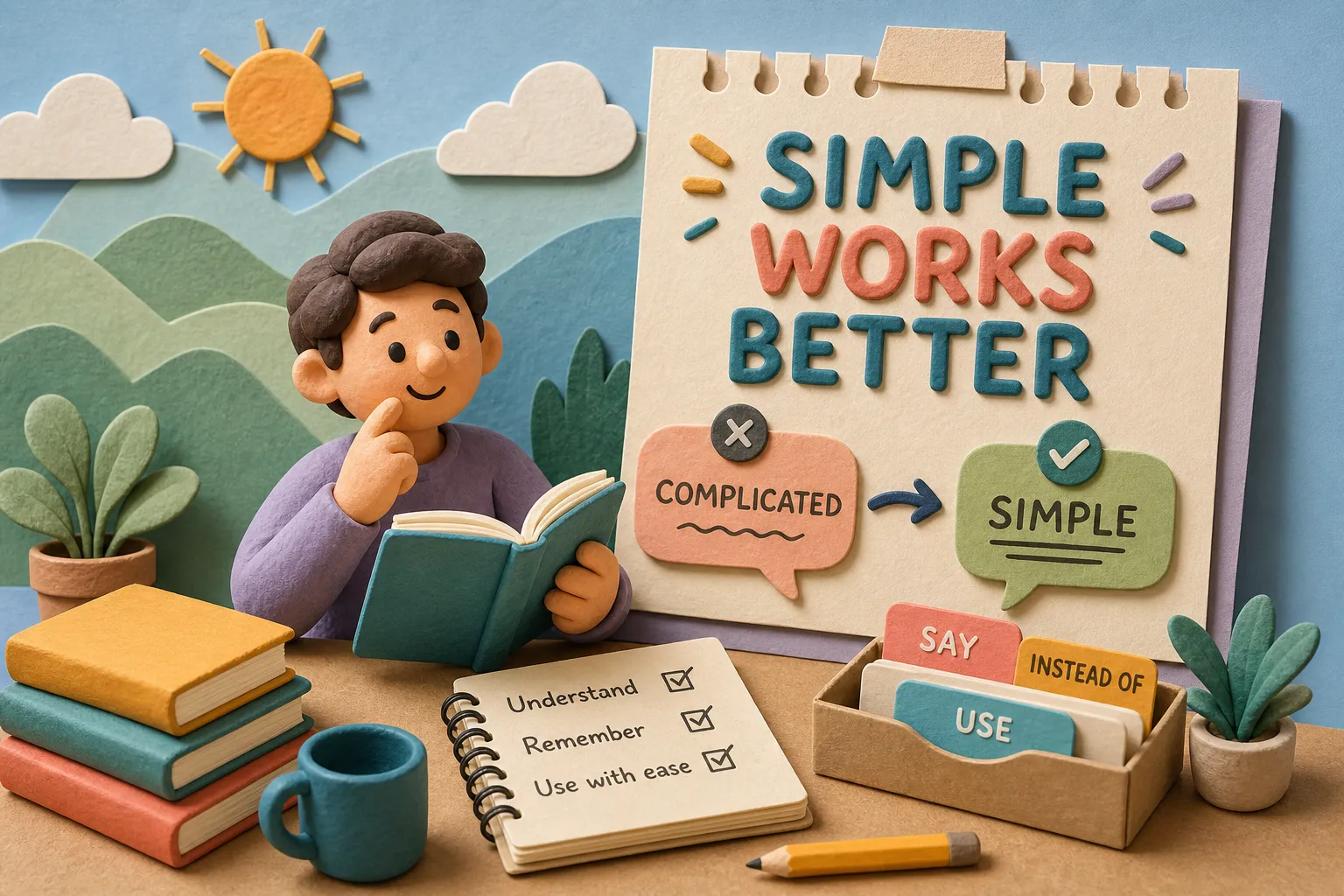
You spent time on that email. You chose words like “utilize,” “endeavor,” “subsequent,” and “please do not hesitate to contact me” because they felt professional. But when an American colleague opened that message, it felt slow, stiff, and a little hard to read. The problem wasn’t your grammar. The problem was word choice. Swapping out overcomplicated words for simplified words is one of the fastest ways to improve your professional writing in English.
This article gives you a practical set of word swaps for emails, presentations, and workplace messages. By the end, you’ll know exactly which formal words to replace, what to use instead, and how to do a quick check before you hit send. This is the kind of lesson Your Daily American is built on: not textbook English, but the real English that works in American offices, meetings, and inboxes.
Why complex words often hurt your professional writing
The “formal = complex” mistake many writers make
Many ESL learners believe that longer, more formal words show intelligence or professionalism. In American business writing, the opposite is true. Clarity and directness are the standard. A sentence with “utilize,” “facilitate,” and “endeavor” carries the exact same meaning as one with “use,” “help,” and “try.” The simpler version is faster to read and easier to understand.
Native English-speaking professionals don’t write the way formal grammar books teach. They write to be understood quickly. Directness isn’t laziness, it’s the actual standard in U.S. workplaces, from startups to large corporations.
What your reader actually wants from your message
Your reader is busy. When they open your email, they want the answer right away. Complex words slow that process down. They make a reader pause, re-read, or lose focus before reaching your main point.
Clear writing shows respect for the reader’s time. That is itself a professional skill. When you write clearly, you make it easy for the other person to say yes, take action, or reply. That’s the goal of every work email.
Simplified words for emails: overcomplicated verbs and phrases to swap out
Formal verbs you can replace right now
These verbs appear in work emails constantly. Each one has a shorter, more direct alternative that native speakers actually use. Here are the most common swaps, with a quick example sentence for each. Think of this as a starter kit to rewrite in simpler words, one verb at a time.
- utilize → use: “We can use this template for all future reports.”
- facilitate → help / make easier: “This tool helps the team share files faster.”
- commence → start: “The project will start on Monday.”
- endeavor → try: “We will try to send the report by Friday.”
- demonstrate → show: “The data shows a 20% increase.”
- ascertain → find out: “I’ll find out who is handling that account.”
- terminate → end: “The contract ends in December.”
Notice how each simplified word carries the same meaning with fewer syllables. Fewer syllables means faster reading and less mental effort for your reader. Even small swaps like these can measurably improve readability, texts written at a 7th, 8th grade Flesch reading level, for example, are consistently rated as clearer and more professional by business readers than those written at a college level.
Stiff phrases that add length but no meaning
Single words aren’t the only problem. Many common email phrases are long, formal, and unnecessary. Here are the most frequent ones, with direct replacements.
- “Per your request” → “As you asked”
- “Please do not hesitate to contact me” → “Feel free to reach out”
- “Attached herewith” → “Attached” or “I’ve attached”
- “In lieu of” → “Instead of”
- “In the event that” → “If”
- “At this point in time” → “Now”
- “Subsequent to” → “After”
- “Regarding” → “About”
Look at how much difference these swaps produce. Compare these two sentences: “Subsequent to our discussion, I would like to endeavor to ascertain the timeline regarding the subsequent deliverables.” Now read the plain-language version: “After our call, I’ll find out the timeline for the next deliverables.” Same message. About half the words. The second version sounds like a real professional.
How to use simplified words in presentations and messages
Words that slow down your slides and spoken delivery
In a presentation, long formal words hurt you twice. They take longer to say out loud, and they’re harder for your audience to process while watching your slides. Short words are faster to process in real time. This matters especially when your audience includes non-native English speakers.
These swaps work well in presentations:
- “Subsequently” → “Then” or “Next”
- “Leverage” (as a verb) → “Use”
- “In order to” → “To”
- “Approximately” → “About”
- “Implement” → “Put in place” or “Start”
The phrase “in order to” is one of the most common space-wasters in presentation language. “We need to update our process in order to reduce errors” becomes “We need to update our process to reduce errors.” You lose three words and gain nothing but clarity.
Cleaner alternatives for quick messages and workplace chat
Slack, Teams, and other workplace chat tools have their own feel. When you use very formal language in a quick message, it can make you seem distant or hard to work with. Overly formal chat messages can also slow down a conversation when a clear, direct reply is all that’s needed.
Instead of “I wanted to inquire as to whether you had an opportunity to review the document I forwarded to you,” write: “Did you get a chance to look at the document I sent?” The simplified version is friendlier and gets a faster response.
Instead of “Please be advised that the meeting has been rescheduled,” write: “Just a heads-up: the meeting time changed.” Using simplified words in messages doesn’t mean being sloppy. It means being clear and easy to respond to.
A quick self-check before you hit send
Signs your email is still too complex
Before you send any professional email, look for these patterns. Each one is a sign that your writing may be harder to read than it needs to be, and that it’s time to simplify vocabulary.
- You used a word with more than three syllables when a shorter word means the same thing. “Approximately” has five syllables. “About” has two. Fix: replace it.
- Your sentence is over 20 words and makes more than one point. Break it into two sentences. One sentence, one idea.
- You used a formal phrase out of habit without thinking whether a shorter one would work. “Per your request” is a good example. “As you asked” says the same thing in fewer words.
These checks take less than a minute but can make a real difference in how your message lands with a native English-speaking reader. Free readability tools, such as the Hemingway Editor or the Flesch-Kincaid calculator built into Microsoft Word, can also flag overly complex sentences in seconds and function as a basic text simplifier for your drafts.
A simple review habit to build over time
Before you send any professional email, read it once with one question in mind: is there any word or phrase I could make shorter? Circle anything that feels long or formal. Then replace it using the swaps from this article.
Over time, writing with simplified words becomes second nature. You won’t need to check the list every time. This works because of a learning method called active recall, pulling an answer from memory. Every time you catch “utilize” in your own writing and replace it with “use,” you strengthen that word pair in your memory. It becomes automatic faster than you expect.
Your Daily American: plain English is real professional English
Why clear language is at the heart of real American English
American English, especially in professional settings, has always valued directness. U.S. government plain-language guidelines (Plain Language Act, 2010) recommend using short, common words, active verbs, and direct phrasing. This isn’t a new trend, it’s how American business communication has worked for decades. Clear language is the professional standard, not the casual exception.
Your Daily American was built on exactly this idea. The English you need for work isn’t the formal, stiff language of old textbooks. It’s the clear, direct English that gets replies, builds trust, and moves conversations forward. The platform’s Professional English for the Modern Workplace section covers emails, meetings, presentations, and workplace communication using the kind of real-world language this article focuses on.
Where to go next on your English learning path
If you want to keep building your professional communication skills, Your Daily American’s professional English content covers How to Write a Professional Email in American English, Your Daily American, speaking in meetings, handling tricky workplace situations, and more. The free proficiency test, a CEFR-aligned assessment covering reading, listening, writing, and speaking, gives you a clear picture of your current level so you know exactly where to focus.
Choosing simplified words is one skill, but it connects to bigger ones: understanding how American professionals talk in meetings, Word Stress in American English: A Complete Guide, Your Daily American, and knowing when to be formal versus casual. All of that is available on the platform, at whatever level fits you.
Start with your next email
Short, clear, direct sentences are the habit you want to build. Real American professionals write short, clear, direct sentences. They reach for plain words over impressive-sounding ones every time. That’s not a style choice, it’s the standard that U.S. workplaces run on.
Using simplified words is a skill you can apply today. Open your next email draft and look for three words from the list in this article. Swap them out. Read the message again. You’ll feel the difference right away, and so will the person who reads it.
When you’re ready for more, visit Your Daily American for practical lessons on professional emails, workplace conversations, pronunciation, and the full range of skills that build real American English fluency.