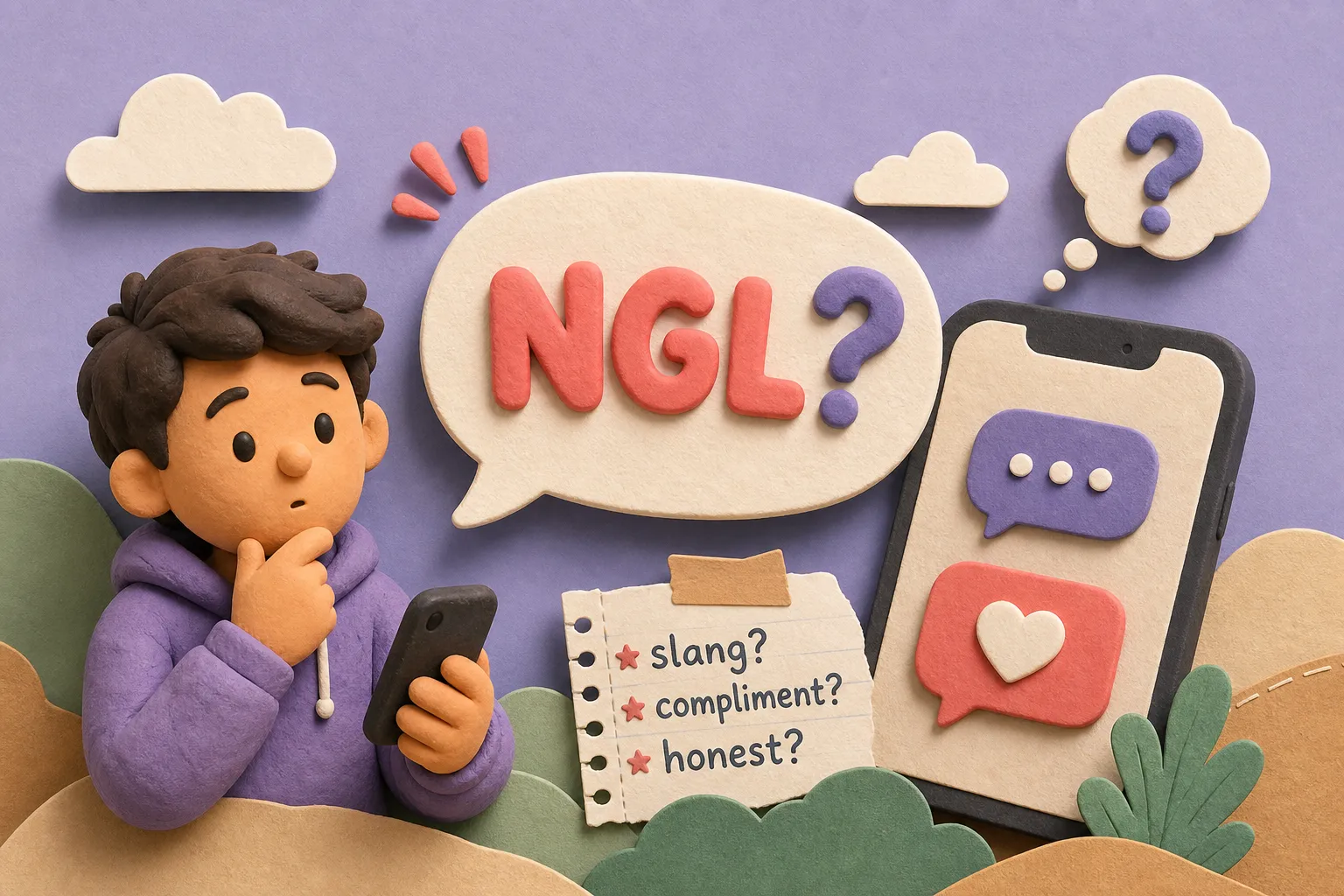
You’re scrolling through Instagram and you see a caption that says: “NGL, that was the best meal I’ve had in years.” You understand every word. But you’re not totally sure what NGL is adding to the sentence, or whether you could use it yourself without sounding awkward.
NGL stands for “not gonna lie.” It’s a short, casual phrase that Americans use to signal honesty, often before sharing a personal opinion, a mild confession, or an unexpected reaction. It’s not a throwaway abbreviation. It’s a small expression with real social work to do, and once you understand it, you’ll notice it everywhere: in texts, in comments, in captions, and in everyday spoken conversation.
By the end of this article, you’ll know what the abbreviation means, how to use it naturally, when to avoid it, and how it compares to similar phrases. You’ll also find a quick note on the NGL app, a separate product that shares the same name and that many learners encounter on Instagram.
What NGL Stands For and Why Americans Say It
NGL is short for “not gonna lie,” which is itself a casual spoken version of “not going to lie.” In writing and texting, people use the three-letter abbreviation. In speech, Americans say the full phrase out loud. You’ll rarely, if ever, hear someone say “N-G-L” letter by letter in a face-to-face conversation, people simply say “not gonna lie” instead. The abbreviation gained traction in the late 2000s and early 2010s alongside the rise of texting and social media. It first appeared on sites like Urban Dictionary as early as 2009 and grew especially popular among Gen Z throughout the 2010s.
The phrase isn’t accusing anyone of lying. It doesn’t suggest dishonesty. Instead, it works as a signal: “What I’m about to say is my real, honest opinion.” Think of it as a discourse marker, a small announcement that frames what follows as candid or confessional. It prepares the listener before you share something personal, vulnerable, or slightly surprising.
Compare these two sentences: “That pizza was amazing.” vs. “NGL, that pizza was amazing.” The second one feels warmer and more personal. It sounds like someone actually letting you in on how they felt, not just making a comment. That small difference is why the phrase became so popular in digital communication, where authenticity and personality matter a lot.
The Tone “Not Gonna Lie” Adds, and Why It Matters for Learners
When someone opens a sentence with “not gonna lie,” they’re flagging that what follows is a genuine personal opinion. The phrase appears most often before confessions, mild surprises, or reactions the speaker didn’t expect to have. For example: “NGL, I was nervous before that meeting.” Or: “NGL, I didn’t expect to like that show.” It gives the listener a moment to prepare for something honest.
The phrase also works as a tone softener. Without it, a strong opinion can sound blunt or even a little arrogant. With it, the same sentence feels humble and relatable. Compare: “I was the best one there.” vs. “NGL, I was pretty good up there.” The second version sounds more self-aware and easier to connect with. This is especially useful in American casual speech, where people generally want to sound confident but not too serious about themselves.
Americans also use it for humor and self-awareness. Admitting something small with a playful tone is very common on social media. “NGL, I’ve watched that video six times today.” That sentence lands because the person is being honest about something a little silly, and owning it.
Where Americans Use NGL in Real Life
Texting and Direct Messages
Texting is the most common context for the abbreviation. It appears in low-stakes, casual conversations between friends, almost always at the start of the sentence. Here’s a short example of how it sounds in a text exchange:
Alex: “Did you watch that new series?” Jamie: “NGL, I stayed up until 2am to finish it.”
That feels completely natural. Jamie is being honest about something slightly embarrassing, and the phrase fits perfectly in that informal context.
Instagram, TikTok, and Social Media
On Instagram and TikTok, “not gonna lie” appears regularly in captions and comments. Captions often follow short, direct patterns: “NGL, this was not easy.” or “NGL, best decision I made this year.” In comments, people use it to agree honestly with someone else: “NGL, same thing happened to me.” The phrase creates an authentic, relatable feeling that performs well on social platforms.
One related term worth knowing: an NGL link on Instagram usually refers to a link generated by the NGL app (covered below) that users share in their bio or Stories to collect anonymous messages. If you’ve seen someone post “send me something honest” with a link in their bio, that’s typically how the app works.
Spoken American English
In conversation, people say the full phrase “not gonna lie” out loud. It appears at the start of a sentence most often, but you’ll also hear it mid-sentence as a natural pause: “That presentation, not gonna lie, was really impressive.” Keep in mind the register: this is for casual settings, friendly conversations, and informal workplaces. You would not say it in a job interview or a formal presentation.
When NGL Sounds Natural vs. When It Sounds Off
The phrase fits well in casual, friendly situations, specifically when you’re sharing a genuine personal reaction, admitting something small in a self-aware way, or agreeing with someone in a comment. Here are a few examples that feel right:
- “NGL, that coffee was exactly what I needed.”
- “NGL, I didn’t think I’d enjoy the class.”
- “NGL, you were right about this place.”
But the phrase feels wrong in many other situations. Never use it in formal writing: emails to clients, cover letters, academic papers, or professional reports. It’s also a poor fit for presentations, job interviews, or any situation where you need to sound polished and credible. In serious or emotional conversations, like an apology or a difficult discussion, it can sound dismissive or too casual. The tone doesn’t match the moment.
A common mistake ESL learners make is carrying the phrase into professional writing because it “sounds natural” from social media. It does sound natural, but only in the right context. Another mistake is using it before a critical or negative comment without the right relationship and tone, it can come across as rude if the other person isn’t a close friend. If you’re unsure, “to be honest” is the safer choice. It carries a similar meaning, works across a wider range of situations, and doesn’t carry the same casual register.
One more thing worth noting: if you open every single sentence with “not gonna lie,” the phrase loses its impact. It works because it marks something as especially candid. Save it for moments when you actually have a genuine, honest reaction to share.
Related Phrases That Work the Same Way
“Not gonna lie” belongs to a family of casual American phrases that all signal honesty or emphasis. Knowing how they compare helps you choose the right one.
TBH (to be honest) is the closest match. Both signal that a personal, honest opinion is coming. TBH sounds slightly softer and is used across a wider age range. “TBH, I’m not sure.” and “NGL, I’m not sure.” mean nearly the same thing. The feeling is very slightly different; NGL can carry a tiny bit more surprise or confession, but in most sentences, they’re interchangeable. Americans sometimes even combine them: “TBH NGL, that was rough.”
A few other phrases live in the same casual register and are worth knowing:
- Lowkey means “a little bit” or “quietly/secretly”: “I’m lowkey obsessed with this song.” It softens the intensity of what you’re saying.
- Fr (for real) means “seriously” or “honestly”: “That was hard, fr.” It confirms or emphasizes something true.
- No cap means “no lie” or “genuinely”: “Best day ever, no cap.” It’s the strongest of the group, you’re insisting that something is absolutely true.
All of these phrases come from the same casual, expressive American digital speech. The key to using any of them well is context and relationship. Use them with people you know in informal settings, and pay attention to how they appear naturally in the videos, shows, and social media content you already consume. At Your Daily American , we cover real American slang like this regularly, so you can build a genuine feel for when and how to use these phrases, not just memorize definitions. You can also explore our guide to Most Common American Slang Words Used in Daily Life, Your Daily American for more examples and context.
For a quick external reference on the modern definitions and usage of internet abbreviations like this, see this concise explainer on the NGL meaning page.
A Quick Note on the NGL App
If you’ve searched “NGL” online and landed on something other than the slang term, you’ve likely encountered the NGL app, an anonymous Q&A app launched in November 2021 by NGL Labs LLC. The app lets users receive anonymous messages from followers, typically shared via an NGL link on Instagram Stories or in a bio. Users post a link, their followers send anonymous messages through it, and those messages appear in the user’s NGL inbox.
It’s important to know that the app and the slang are two separate things. The app borrowed its name from the “not gonna lie” phrase, playing on the idea of anonymous honesty. However, the NGL app has faced significant scrutiny: the U.S. Federal Trade Commission issued an FTC order related to child safety and privacy concerns, and the app’s privacy policy has been pointed to by critics for how it handles user data. If you’re a parent, a teacher, or simply cautious about privacy, it’s worth reading resources like what your teen means by NGL and checking official policies before using or recommending the app.
For the purposes of learning American English, the slang term “not gonna lie” is what you’ll encounter most often in everyday conversation and on social media.
Start Using “Not Gonna Lie” with Confidence
NGL stands for “not gonna lie.” It signals honest, personal, or vulnerable opinions. It belongs in casual texting, social media captions, and friendly spoken conversation. When you use it right, your English sounds real and natural. When you use it in the wrong setting, it feels out of place, so keep it for informal situations with people you know well.
Here’s a short practice to try right now. Read each situation below and write a sentence using NGL:
- You just watched a movie you didn’t expect to enjoy. How did you feel?
- You tried a new restaurant and the food was better than you thought.
- You were nervous before a test, but it went well.
Writing even one or two sentences on your own is the fastest way to make a phrase feel natural. Phrases like this one are the real language of American daily life. Understanding them is what moves you from “correct English” to “natural English.” That gap is exactly what Your Daily American is here to help you close, one real phrase at a time. If you’re also working on pronunciation and common learner pitfalls, see our article on English Words Non-Native Speakers Mispronounce Most Often, Your Daily American for tips.