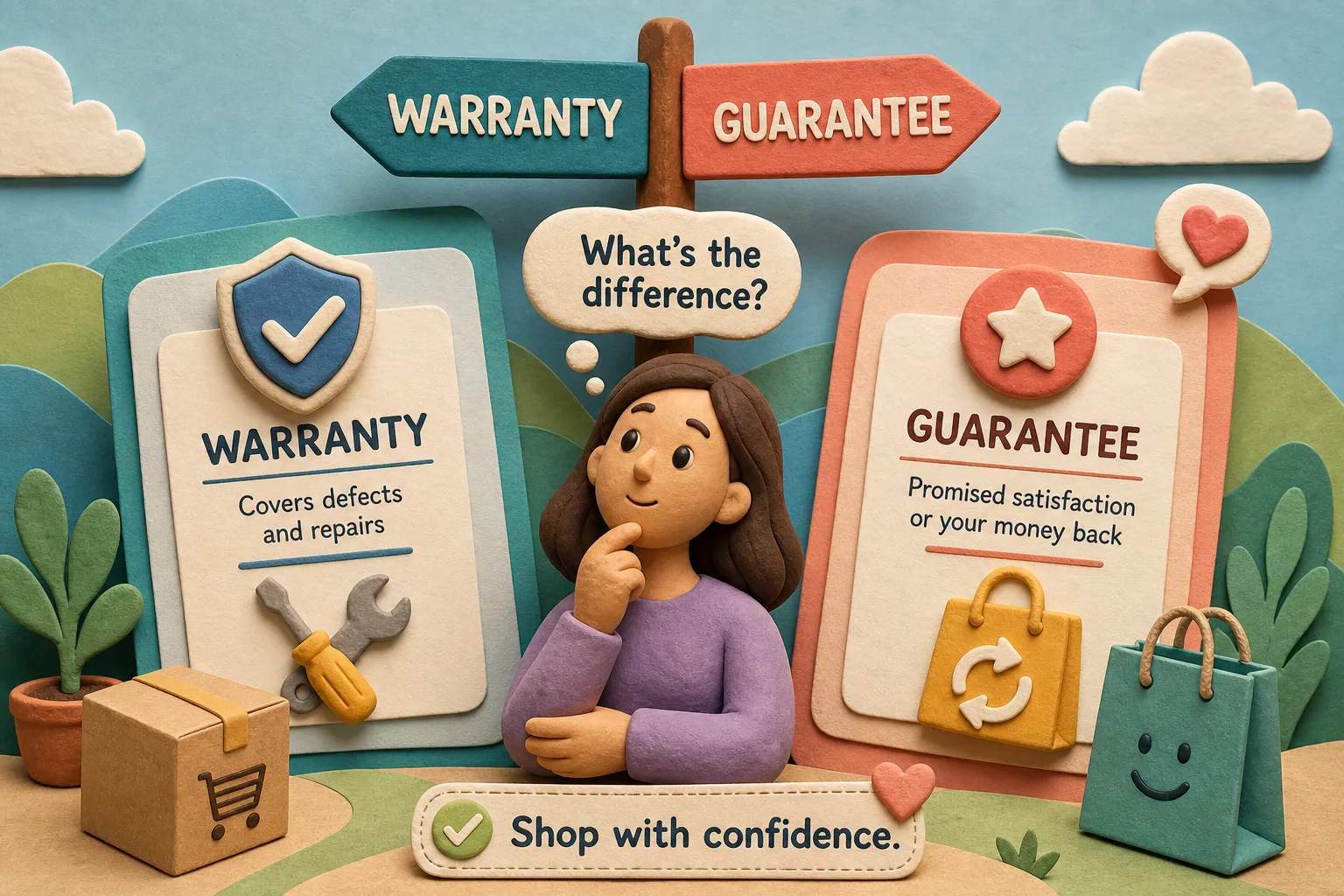
Imagine this: you buy a new laptop at an electronics store in the US. Three months later, the screen stops working. The salesperson says, “Don’t worry, it comes with a one-year warranty.” At a different store, a sign reads: “100% satisfaction guaranteed.” Are these the same thing? Do they protect you in the same way? Understanding the difference between a warranty and guarantee is one of those practical vocabulary skills that directly affects your money and your rights as a consumer in America.
Most English learners treat these two words as synonyms. They are not, and mixing them up can cost you. This article breaks down both terms clearly, so you know exactly what each word means, what you can ask for, and how to handle these conversations in real life.
Warranty and Guarantee: What They Actually Mean
A warranty is a formal promise from a seller or manufacturer that a product will work correctly for a specific period of time. Warranties come in two forms: written (or express) warranties, which spell out specific terms in a document, and implied warranties, which arise automatically under US law even when nothing is written down. In everyday retail, warranties usually come with conditions, you may need to register the product, keep your receipt, or avoid certain types of damage. “This refrigerator comes with a two-year manufacturer’s warranty,” for example, means the company promises to fix or replace it if it breaks within two years, provided you follow the terms.
One important law to know is the Magnuson-Moss Warranty Act, the US federal law that governs written warranties on consumer goods. It does not force companies to offer warranties, but if they do, the warranty must clearly explain what is covered, how long it lasts, and what the company will do if something goes wrong. The Federal Trade Commission (FTC) enforces these rules and publishes plain-English guidance for consumers at ftc.gov.
A guarantee is a promise that something will work, or that you will get your money back if it does not. Guarantees often have fewer stated conditions than warranties, “Satisfaction guaranteed or your money back” is a very common phrase in US retail, and some stores honor it with no questions asked. That said, guarantees can still include conditions, and verbal guarantees are harder to prove than written ones. The FTC recommends getting any promise in writing. Legally, the word “guarantee” does not have its own standalone definition under US federal law. When a company says a product is “guaranteed,” that promise is typically evaluated under the same rules as a warranty.
Here is a practical rule for everyday use: an express warranty is a specific written or spoken promise with defined terms; an implied warranty is a legal protection that exists automatically; and a guarantee is a broader commitment, sometimes backed by law, sometimes by store policy, that varies widely by retailer. The sections below give you the vocabulary and tools to read that context confidently.
The Two Types of Warranty Protection You Already Have
Many ESL learners are surprised to learn they have legal protection even when nothing is written down. US law provides two main types of warranty coverage, and knowing both can make a real difference when something goes wrong.
Express Warranty
An express warranty is a specific promise a seller makes, in writing or verbally, such as on a product box, in a brochure, on the manufacturer’s website, in the sales contract, or through a salesperson’s direct statement. Examples include: “One year of free repairs,” “Battery lasts 10 hours,” and “Waterproof up to 30 meters.” If a seller makes one of these promises and you buy the product because of it, that express warranty is legally binding. You will find express warranties on product packaging, receipts, instruction manuals, and online product listings.
Implied Warranty
An implied warranty is a legal protection that exists automatically under US law, even if the seller says nothing and writes nothing. There are two main kinds. The implied warranty of merchantability means a product must do what it is supposed to do, a toaster must toast bread, a phone must make calls. You do not need a written promise for this protection. The implied warranty of fitness for a particular purpose applies when a salesperson recommends a product for your specific need and you buy it based on that advice; the product must actually be suitable for that use.
Sellers can sometimes disclaim implied warranties, but under the Magnuson-Moss Warranty Act, they cannot do so if they also provide a written warranty. Implied warranty protections can last up to four years in some US states under the Uniform Commercial Code (UCC), often longer than most written warranties. In other words, you may have more protection than you realize. State rules vary, so it is worth checking your state’s consumer protection office for specifics.
The Warranty vs. Guarantee Difference in Real Remedies
When a product stops working during the warranty or guarantee period, you typically have three possible remedies.
- Repair: The company fixes the item at no cost to you. (“They sent a technician to fix the washing machine for free.”)
- Replacement: The company gives you a new item. (“They replaced my broken headphones with a new pair.”)
- Refund: The company returns your money. (“I returned the coffee maker and got a full refund.”)
Under US warranty law, the seller or manufacturer usually decides which remedy applies first. If they attempt to repair the product and it fails multiple times, you can ask for a replacement or a refund instead.
Standard written warranties on consumer electronics and appliances commonly run one year, though coverage can range from 90 days to 24 months depending on the product and brand. If you report a defect while the warranty is still active, the company must address it, even if the warranty expires before the repair is finished. Many consumers don’t know this rule, so keep it in mind.
There are also things most warranties do not cover. Damage you caused yourself, dropping a phone or getting a laptop wet, is usually excluded, as is normal wear and tear, like a battery that gradually loses capacity over time. Modifications, such as replacing parts yourself or using the product in ways the manual prohibits, will almost always void your warranty. Always read the “What is not covered” section before accepting any warranty terms.
Real Phrases and Conversations You Will Hear in the US
Knowing the vocabulary is just as important as knowing the law. Here are the phrases salespeople and customer service staff use most often, along with what they actually mean.
- “It comes with a one-year manufacturer’s warranty.” (The company that made it will cover defects for one year.)”That’s covered under warranty.” (You don’t have to pay for this repair.)
- “Do you want to add an extended warranty?” (Would you like to pay extra for protection beyond the standard period?)
- “We have a 30-day satisfaction guarantee.” (You can return it within 30 days if you’re not happy.)
When you call a company’s customer service line after a product breaks, keep your language clear and direct. Here is a short example of how that conversation sounds:
Customer: “I bought this blender two months ago and it stopped working. It’s still under warranty. What do I need to do to get it repaired or replaced?” Rep: “I can help you with that. Do you have your receipt and the model number?”
Key phrases to use when you have a problem: “It’s still under warranty,” “I’d like to file a warranty claim,” “Is this covered?” and “What are my options here?” These are plain, polite phrases. You don’t need to use legal language, clear and direct works best in American customer service.
You will also see certain written phrases on packaging and documents. “Limited warranty” means protection only for specific problems, not everything. “As-is” means the seller is not offering an express warranty; you accept the product exactly as it is, including any existing problems. Note that some states limit how far “as-is” disclaimers go, and implied warranty protections may still apply depending on where you live. This phrase appears most often at yard sales and thrift stores. “Void if…” means you lose the warranty if you do certain things, such as opening the device yourself.
How to Make a Warranty or Guarantee Claim, Step by Step
When something goes wrong, follow these steps. Having the right documents and using the right words makes the process much faster.
- Check your warranty terms. Find the document in the box, online, or in your email. Confirm the product is covered and the warranty period has not ended.
- Document the defect. Take photos or a short video showing exactly what is wrong. Write down when the problem started.
- Gather your documents. You need your proof of purchase (your receipt or order confirmation), the warranty document, and the product’s model number and serial number (the unique ID number printed on your product).
- Contact the seller first. Start with the store where you bought the product. Many stores resolve issues quickly at this stage.
- If the store cannot help, contact the manufacturer. Most manufacturers have a customer service line or an online claims page.
- Submit your claim with your documentation. Keep copies of everything, emails, photos, receipts, and any reference numbers the company gives you.
- Follow up in writing. If the company is slow to respond, send a follow-up email. The FTC recommends using certified mail when you need documented proof that your message was received. You can find their step-by-step consumer guidance atthe FTC’s consumer site on warranties.
- Know your next steps if the company refuses. You canfile a complaint with the FTCor with your state’s consumer protection office. For cars, check your state’s lemon law, a state law that gives buyers extra rights when a new vehicle has a defect that cannot be fixed after several repair attempts. Each state’s law differs, so verify the rules where you live.
If you need to escalate, these phrases work well: “I’d like to speak with a manager,” “I’d like to escalate this,” and “I’m going to file a complaint with the Better Business Bureau.” Saying these calmly and clearly signals that you know your rights.
Consumer Vocabulary That Helps You Beyond the Store
Warranty and guarantee conversations come with their own set of key terms. Knowing these words helps you read contracts, understand store policies, and speak confidently in any consumer situation.
- Warranty definition (quick reference): a formal promise, written or implied by law, that a product will work as described
- Guarantee meaning (quick reference): a broader commitment, often from a store’s return policy, that you will be satisfied or receive your money back
- Proof of purchase: your receipt or order confirmation, used to show when and where you bought the product
- Serial number: the unique ID number on your product, used to register warranties and file claims
- As-is: the seller is not providing an express warranty; you accept the product in its current condition
- Lemon law: a state law protecting new car buyers from defects that cannot be fixed after repeated attempts
- Extended warranty: paid protection you add on top of the standard warranty period
- Consumer rights: the legal protections the law gives you as a buyer
These are not advanced legal terms. They are everyday American words that appear on receipts, in store policies, and in product manuals. The more comfortable you are with them, the more confident you will be in any shopping or customer service situation.
Warranty and guarantee vocabulary is a good example of practical American English that most traditional courses skip entirely. The moment you start living, working, or shopping in the US, this language matters. That is exactly what Your Daily American is built for: lessons grounded in real situations, from reading a warranty card at an electronics store to handling a customer service call without second-guessing yourself. Check out the everyday English and vocabulary sections to keep building this kind of practical fluency.
Now You Know the Warranty and Guarantee Difference
Warranty and guarantee are not the same word, and in the US they are not interchangeable. An express warranty is a specific written or spoken promise with defined conditions. An implied warranty is a legal protection you have automatically, even without paperwork. A guarantee is a broader commitment, sometimes from the law, sometimes from store policy, whose terms vary by retailer.
When something goes wrong, you have three main options: repair, replacement, or refund. The process for making a claim is straightforward as long as you keep your documents and communicate clearly. Use the phrases in this article, you have the rights and the words to back them up.