If you’ve ever stood in an American grocery store staring at “Miller Lite” on a beer can, then opened a text message describing “light brown hair,” then downloaded “Facebook Lite” on your phone, all in the same afternoon, you’ve already experienced the lite vs. light question in real life. Three different contexts, one word that looks different each time. You might wonder whether someone made a spelling error, or whether these are genuinely two separate words with separate purposes.
They are separate, and neither one is a mistake. By the end of this article, you’ll know exactly when “light” is the right choice, when “lite” is acceptable, and how to spot the difference instantly. We’ll cover the full meaning of the standard spelling, the marketing origin of the informal variant, and a clear rule you can apply starting today.
What “light” means and why it’s the default spelling
The many meanings packed into one standard word
“Light” is the original, standard spelling recognized by every major dictionary, including Merriam-Webster and American Heritage. What makes it unusual is how many completely unrelated meanings it carries under the same spelling. Depending on the sentence, it can refer to illumination, physical weight, color shade, emotional tone, or degree of intensity.
Here are four quick examples showing that range:
- “She turned on the light in the hallway.” (illumination)
- “This laptop is surprisingly light for its size.” (weight)
- “He has light brown hair.” (color)
- “We kept the conversation light at dinner.” (emotional tone)
None of those meanings are connected to each other, but all of them use “light.” This is the word in its full, standard form, part of English for well over a thousand years.
When “light” is always the right choice
The rule is simple: in all formal writing, “light” is the only correct form. That includes business emails, academic papers, cover letters, reports, and professional presentations. If the meaning involves illumination, weight, color, or emotional tone, “light” is correct regardless of context.
Think of “light” as your safe default. You can never go wrong choosing it. “Lite” is a specific exception with narrow uses, and treating the two as interchangeable is one of the most common mistakes ESL learners make when they first encounter both spellings. One is the standard word; the other is a deliberate shortcut with a specific job. If you want a quick overview of the common confusion between the two, see Grammarly’s guide to light vs. lite.
Where “lite” came from and what it actually signals
The marketing origin of an informal spelling
“Lite” is not a typo. It’s a calculated choice rooted in American advertising and branding, not in any grammar rule. According to Merriam-Webster, its commercial use in product names dates to at least 1917, with early trademarked examples such as “Adjusto-Lite” for portable electric lamps. By 1962, it was recorded more broadly as an informal alternative spelling of “light” in commercial contexts. Advertisers favored it because it looked compact, modern, and eye-catching on packaging and signage.
Understanding this origin matters because it explains why the word exists at all. “Lite” wasn’t created to clarify meaning; it was created to sell products. That commercial DNA shapes every legitimate use of the word today.
The core idea “lite” communicates
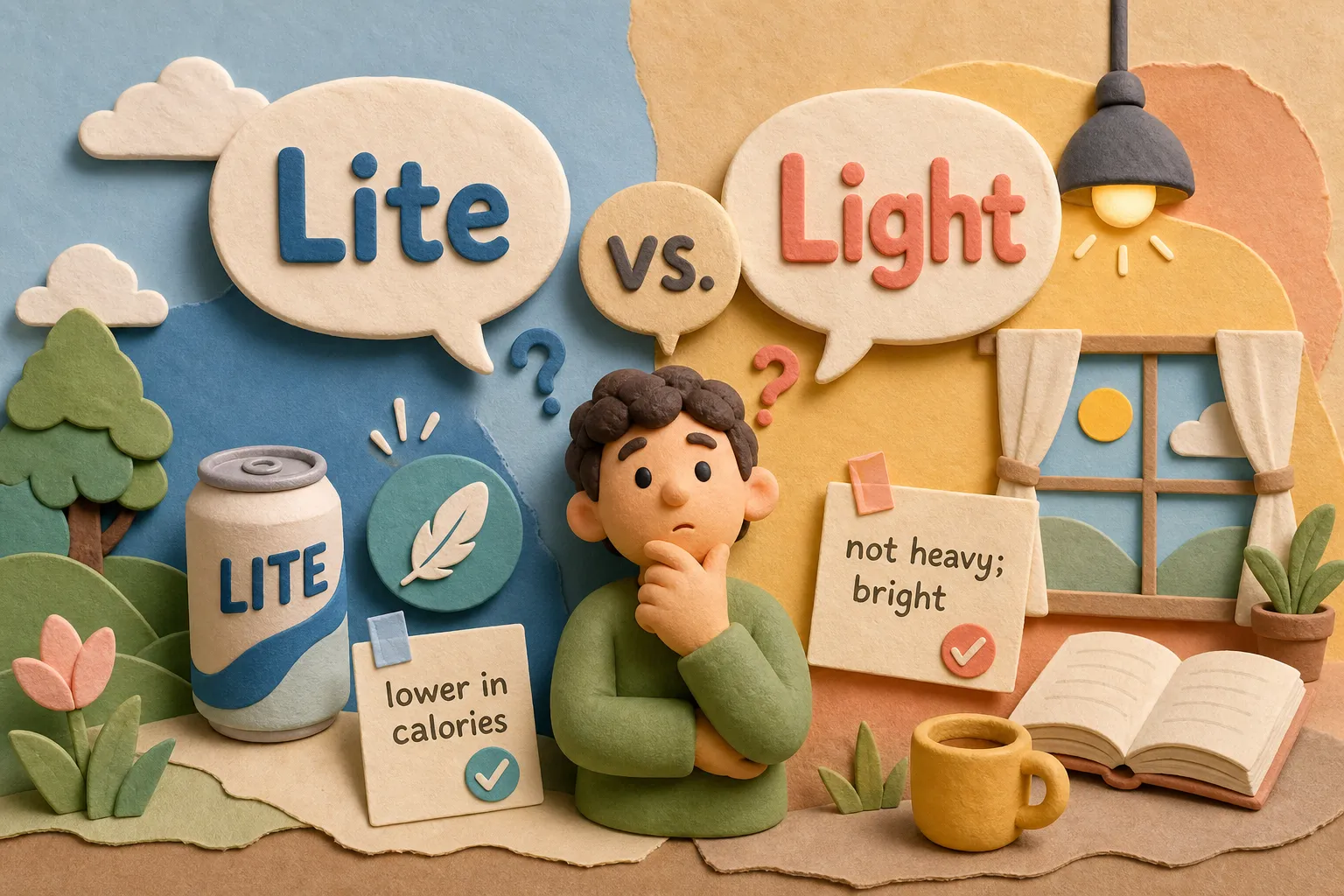
Whatever context you see “lite” in, it consistently signals one thing: reduced, simplified, or stripped-down compared to the full version. Merriam-Webster defines it as meaning either “low in calories or fat” or “lacking in substance or seriousness.” Both senses share the same underlying idea, less of something.
That’s the distinction that makes everything click. “Light brown hair” is about color. “A lite salad dressing” is about fewer calories. “Facebook Lite” is about fewer features. The spelling shift from “light” to “lite” signals that you’re in commercial, informal territory, and that something has been reduced or simplified from an original standard version.
Lite vs. light on food labels and in the grocery aisle
From lite beer to lite yogurt: the food packaging world
Walk through any American grocery store and you’ll see “lite” on food and beverage packaging regularly. Miller Lite is one of the most recognizable examples, but the pattern extends across the store: lite yogurt, lite salad dressing, lite beer as a general product category, and lite versions of crackers, syrups, and condiments. In every case, “lite” signals fewer calories, less fat, less sugar, less salt, or reduced alcohol compared to the standard product.
This usage is informal and commercial. The FDA uses “light” in its official food labeling regulations, and formal writing follows the same convention. On a product label or in an advertisement, though, “lite” is completely normal American usage. When you see it at a store, you don’t need to second-guess it, you just need to recognize what it means.
Tech products and apps: when software goes “lite”
“Lite” moved naturally from food marketing into technology branding, where it describes simplified or reduced-feature versions of software and devices. Facebook Lite and Twitter Lite were designed to run on older phones with slower connections, using less storage and fewer resources than their full counterparts. The Nintendo Switch Lite is a smaller, more portable version of the original console. In these contexts, “lite” doesn’t imply lower quality; it implies streamlined and accessible.
The pattern mirrors the food world exactly: a lite app is to the full app what a lite beer is to a regular beer. Something has been intentionally scaled down to serve a specific audience or use case. Once you understand that pattern, you’ll recognize it across industries without a second thought.
How “lite” works in casual American speech and informal writing
Using “lite” as an informal modifier in everyday language
Beyond product names, Americans use “lite” as a playful modifier in everyday speech and informal writing. This places “lite” after a noun to describe a watered-down or simplified version of something, and it’s often conversational or mildly humorous. You might hear someone say, “That documentary was history lite, pretty surface-level,” or “The meeting was basically management lite, just two people and a whiteboard.” This is a living, natural pattern in casual American English.
The key grammatical detail: “lite” typically appears after the noun it modifies in these informal cases, not before. “History lite” and “punditry lite” both follow that postpositive pattern. If you want to describe something as a simplified version of a concept, dropping “lite” after the noun is a distinctly American way to do it.
The cultural layer behind informal American spellings
American English has a well-established tradition of playful, informal respellings that show up on signs, menus, ads, and in casual text. “Thru” for “through,” “nite” for “night,” “donut” for “doughnut”, these aren’t errors; they’re cultural shorthand that signals a casual, commercial, or friendly tone. “Lite” belongs to that same tradition. Recognizing these forms is part of reading real American life fluently, not just navigating formal textbooks.
This is exactly the kind of cultural layer that Your Daily American is built to teach. For more examples of playful respellings and everyday forms, see Most Common American Slang Words Used in Daily Life, Your Daily American.
Real fluency means being comfortable with both, and that comfort comes when someone explains the cultural context behind the language, not just the rule. If you want to refine pronunciation and stress patterns, check out Word Stress in American English: A Complete Guide, Your Daily American.
Lite vs. light: the practical rule for when to use each
Formal writing, professional contexts, and clear default usage
In any formal or professional context, always write “light.” That means business emails, reports, academic papers, cover letters, and any writing where you want to appear polished and precise. Both the AP Stylebook and the Chicago Manual of Style default to conventional spelling in formal prose and do not endorse “lite” as standard usage. Using “lite” in a formal document won’t necessarily confuse anyone, but it will read as careless or overly casual.
For ESL learners building professional English skills, the safest habit is to treat “lite” as off-limits in writing until you’re confident a specific context calls for it. A polished cover letter or a clear business proposal shouldn’t look like a product label. For common pronunciation traps and frequently mispronounced items, see English Words Non-Native Speakers Mispronounce Most Often, Your Daily American.
Brand names, product labels, and intentional informal style
“Lite” is completely appropriate in product names, branding, food and beverage packaging, software naming, and casual or social media writing where an informal tone is intentional. One important rule about brand names: always use the brand’s own spelling. Write “Miller Lite,” not “Miller Light,” because that is the name of the product. Write “Nintendo Switch Lite,” not “Nintendo Switch Light.” The brand chose that spelling deliberately, and respecting it is part of using the name correctly.
Here are four quick examples showing the contrast in practice:
- “The light in the kitchen burned out.” (illumination, always “light”)
- “She ordered a lite beer with her burger.” (marketing category, “lite” works here)
- “He packed a light bag for the weekend.” (weight, always “light”)
- “They downloaded the lite version of the app.” (simplified product, “lite” is correct)
Quick practice: get your answer in three seconds
When you’re not sure which to use, run through this checklist:
- Is it a product name or brand that already uses “lite”? Match their spelling exactly.
- Is it formal writing of any kind? Use “light” without hesitation.
- Does the word describe illumination, physical weight, or color? Use “light” every time.
- Are you informally describing something as a simplified or reduced version of something, in casual speech or social media? “Lite” works there.
Before you move on, try writing one sentence using “light” in a non-marketing sense, and one sentence using “lite” the way an American brand or casual speaker would. Nailing both once will lock the distinction in place faster than any amount of re-reading, because production beats passive review every time.
Wrapping it up
“Light” is the full, standard word with a wide range of meanings that have nothing to do with marketing. “Lite” is a specific, informal variant that signals something reduced or simplified, rooted in American advertising culture since at least the early 20th century. They are not interchangeable, and the difference between them is real and functional. Keeping the lite vs. light distinction clear is a small but meaningful step toward sounding natural in American English.
Whenever you encounter two different spellings of what looks like the same word, that’s usually a sign that something cultural is happening beneath the surface. American English does this regularly, and understanding why a word looks a certain way in a specific context is what separates functional English from genuinely fluent English. At Your Daily American, that’s exactly the kind of real-world usage and cultural context we cover, because those are the details native speakers absorb naturally and learners need to be taught directly.
Next time you’re at the grocery store or downloading an app and you see that familiar spelling, you’ll know exactly what it means, where it came from, and why nobody made a mistake.