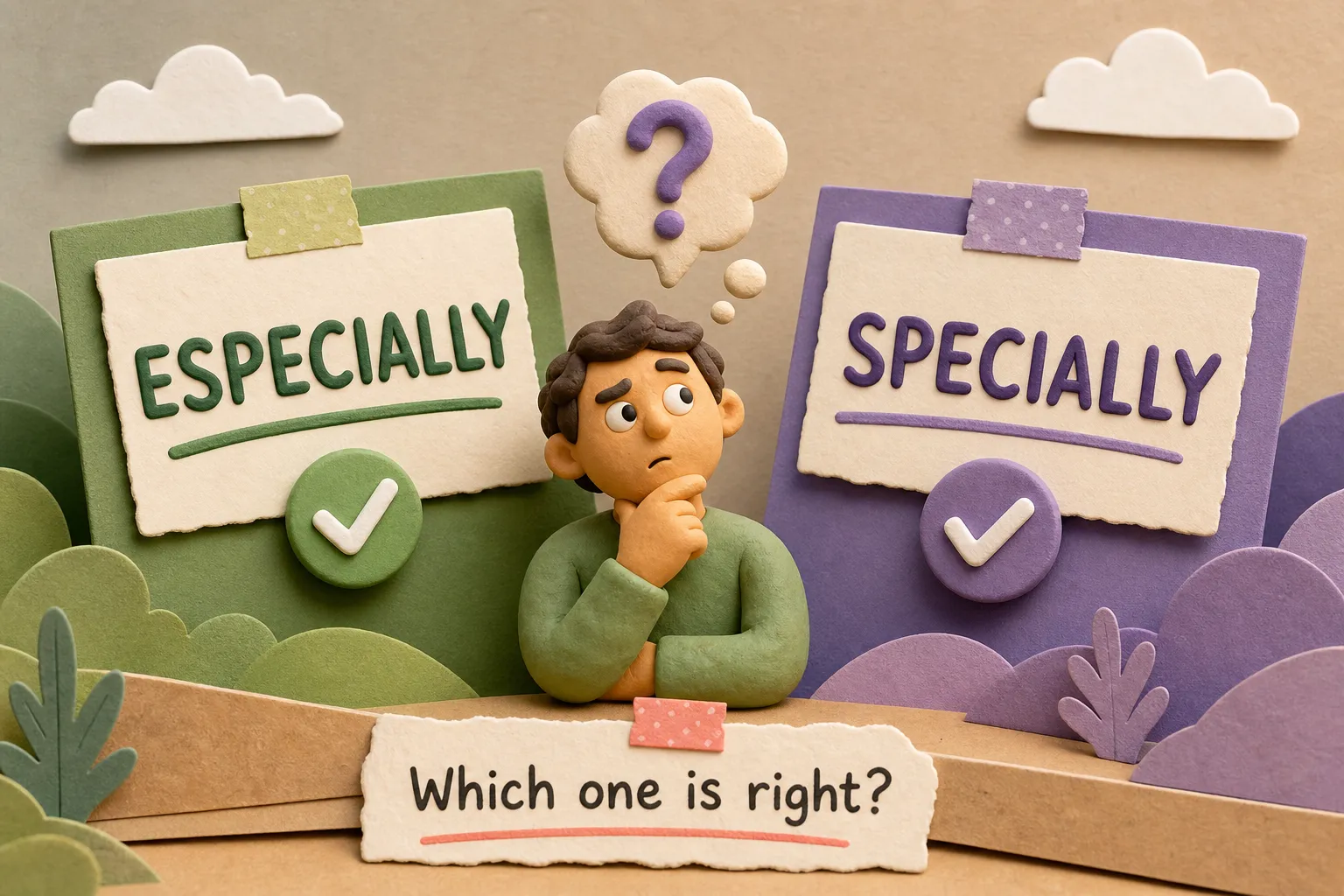
You’ve probably typed one of these words and paused, especially or specially ? They look almost identical, and even native English speakers mix them up without realizing it. If you’ve ever written “this was specially interesting” or “specially made for you” without being sure which was right, you’re in good company. Understanding the difference between especially vs specially comes down to one core distinction: emphasis versus purpose.
Here’s the key thing to understand: this isn’t a spelling problem. Both words are spelled correctly. The confusion is about meaning. These two adverbs have distinct primary uses, though there is a small overlap in certain contexts. Swapping one for the other either sounds wrong or quietly changes what you’re saying. By the end of this lesson, you’ll know which word belongs where, and you’ll have two fast tests to check yourself anytime you’re unsure.
This is the kind of word-pair distinction that Your Daily American weaves into its grammar and vocabulary tracks, because real fluency lives in the details. Knowing what a word means isn’t enough. You need to know when to use it, and that’s what we’re covering right now.
What “especially” actually means in American English
“Especially” is an adverb that singles something out. It points to one item as more notable, more true, or more important than the others around it. The closest synonyms are particularly and above all.
The singling-out function
Think of “especially” as a spotlight. You’re already talking about a group of things, and then you use it to shine extra light on one of them. “I love being outside in the summer, especially on cool mornings.” The speaker likes summer in general, but cool mornings get the spotlight.
Notice that “especially” answers an implied question: “More than what?” It works because there’s a contrast inside a category. It’s not just saying something is good; it’s saying it’s more good, or most good, relative to other things in the same group.
Pronunciation note: American speakers say “es-PEH-shuh-lee” (IPA: /ɪˈspɛʃəli/). The stress lands on the second syllable. In fast, natural speech, the middle vowels often reduce, so the word sounds closer to “es-PESH-lee”, a pattern you’ll catch in podcasts and everyday conversations. See Word Stress in American English: A Complete Guide, Your Daily American for a deeper look at stress patterns.
Real-life American English examples
Here’s how the word shows up across different situations:
- “Traffic is bad in this city, especially on Friday evenings.” (singling out a time)
- “She appreciated everyone’s help, especially her manager’s.” (singling out a person)
- “I feel anxious in crowds, especially at airports.” (singling out a place)
- “The meeting ran long, which was frustrating, especially because we had covered most of it by email.” (singling out a reason)
“Especially” can open a clause or sit in the middle of a sentence without changing its core job. Corpus data show it appears consistently across both casual speech and professional writing, making it one of the more versatile adverbs in American English. For a concise dictionary definition, see Merriam-Webster’s entry on “especially”.
When “especially” works as an intensifier
“Especially” doesn’t only single out nouns or list items. It also intensifies adjectives and adverbs on their own. “The traffic was especially bad this morning.” Here, the word isn’t comparing the traffic to other items in a group; it’s amplifying the adjective “bad.” Both uses belong to the same word doing slightly different work, so don’t let that second pattern confuse you.
What “specially” actually means (and its key collocations)
“Specially” is the word you need when something is done or made for a specific purpose. The meaning is closer to “for a special reason” or “in a customized way.” It’s about intent and design, not emphasis.
The purpose-driven meaning
“Specially” focuses on the why behind an action or creation. Something is “specially” done when it was built, arranged, or adapted with one particular goal in mind. “This wheelchair ramp was specially designed for the new entrance.” The sentence isn’t saying the ramp is more notable than other ramps; it’s telling you the ramp exists because of a specific purpose.
According to corpus data, “specially” is considerably less common than “especially” in American English overall. That’s actually useful information: when you encounter it, there’s almost always a purpose context attached. Its relative rarity gives it a precise, sometimes formal quality. Dictionary.com also explores this contrast in usage and examples: the Dictionary.com article on especially vs. specially.
The collocations that belong to “specially”
These phrases are the natural home of “specially” in American English:
- specially made: “This coffee blend was specially made for cold brewing.”
- specially designed: “The keyboard is specially designed for people with wrist injuries.”
- specially trained: “The staff are specially trained to work with elderly patients.”
- specially built: “The storage unit was specially built to fit under the stairs.”
- specially formulated: “This sunscreen is specially formulated for sensitive skin.”
Every phrase on that list describes something engineered or arranged with a specific outcome in mind. Nothing is being ranked or highlighted above other things. That’s the clearest signal you’re in “specially” territory.
Especially vs Specially: The Core Difference
Here’s the rule at the center of this whole lesson: “especially” is about emphasis, and “specially” is about purpose. Now let’s see what happens when you swap them.
Side-by-side sentence comparisons
“She likes all desserts, especially chocolate cake.” This works because you’re singling out one dessert from the group. Now try: “She likes all desserts, specially chocolate cake.” That sounds wrong. “Specially” implies the chocolate cake was custom-made or chosen for a reason, which doesn’t fit the meaning at all.
“This suit was specially made for the ceremony.” This works because the suit exists for a specific purpose. Now try: “This suit was especially made for the ceremony.” That sounds off. “Especially” would suggest the suit is more notable than other suits, but the sentence isn’t making a comparison, it’s describing intent.
“The app was specially designed for children under five.” That works; it’s a purpose context. “The app was especially designed for children under five.” Sounds awkward. You’re not comparing it to other apps; you’re talking about why it was built.
The one case where both words can work
There’s an honest edge case worth knowing about: “I bought this gift especially/specially for you.” Both are grammatically acceptable in American English. The difference is subtle but real. “Especially for you” stresses emotional singling-out: above all people, I chose you. “Specially for you” stresses purposeful customization: I selected or made this with you specifically in mind. American English usage tends to favor “especially” in this construction, though “specially” is not wrong. For further reading on subtle usage differences, see Cambridge’s note on especially vs. specially.
The overlap zone is narrow, and in the vast majority of sentences, context makes one word the clear winner. When in doubt, run either test below and the right choice will surface quickly.
Common Mistakes: Even Fluent Speakers Get This Wrong
You’re not alone if you’ve been using these words interchangeably. ESL research on learner errors points to predictable patterns, and knowing them can help you self-correct faster.
The most frequent error: using “especially” for purpose
The most common mistake is reaching for “especially” in a purpose context where “specially” belongs. “This was especially designed for outdoor use.” Most native American English speakers would write “specially designed” here. The purpose context calls for “specially,” not emphasis. The error rarely causes outright confusion, but it can make the writing feel slightly off to a native reader.
Mixing up “especially,” “specially,” and “particularly”
“Especially” and “particularly” are largely interchangeable in American English, and many learners already know this. The mistake comes when learners assume “specially” is also interchangeable with “particularly.” It isn’t. “I’m particularly tired today” works. “I’m especially tired today” works. But “I’m specially tired today” sounds wrong to native ears, because “specially” doesn’t carry the emphasis meaning.
This is where the confusion compounds for ESL learners: three words that seem related, but they don’t all overlap. “Especially” and “particularly” are true synonyms for emphasis, think of them as the especially vs particularly pair that always travels together. “Specially” stands apart and belongs only to the purpose category. If you’d like a practical, user-friendly breakdown of common confusions, Grammarly’s guide to especially vs. specially is a helpful companion.
Two Simple Tests to Always Pick the Right Word
These tests work in real time, whether you’re writing an email or speaking in a meeting. Run either one and the right choice becomes clear.
Test 1: the “particularly” swap
If you can swap your word with “particularly” or “above all” and the sentence still makes sense, use “especially.”
Try it: “I love sushi, especially the salmon rolls.” Can you say “I love sushi, particularly the salmon rolls”? Yes, that works. Use “especially.” Now try: “The gloves were specially made for rock climbing.” Can you say “The gloves were particularly made for rock climbing”? No, that sounds wrong. Don’t use “especially” here.
Test 2: the “for a specific purpose” swap
If you can rephrase your sentence using “for a specific purpose” or “in a specific way” without changing the meaning, use “specially.”
Try it: “This software was specially designed for remote teams.” Can you say it was designed “for a specific purpose”? Absolutely. Use “specially.” Now try: “She was especially nervous before the presentation.” Can you say she was nervous “for a specific purpose”? No, that’s meaningless. Use “especially.”
Learners who work through structured vocabulary tracks built around real usage patterns, rather than isolated definitions, tend to develop this instinct faster. The article Common American Expressions Every English Learner Should Know, Your Daily American follows that same approach, pairing words like these so the distinctions become automatic rather than forced.
Practice: test yourself before you go
Apply the two tests from the previous section to each sentence below. Choose “especially” or “specially.”
Choose the right word
- This protein bar was _______ formulated for athletes in training.
- The weather in November is cold, _______ in the mornings.
- She flew in from Chicago _______ to attend the meeting.
- The report was _______ long this quarter, which surprised everyone.
- The seat cushion is _______ designed for lower back support.
Answer key
- Specially: “formulated for athletes” is a purpose context. Test 2 passes: “formulated for a specific purpose.”
- Especially: singling out mornings from the group “November weather.” Test 1 passes: “particularly in the mornings.”
- Specially: the flight happened for a specific purpose. You could say “she flew in for a specific purpose.” Test 2 passes.
- Especially: intensifying the adjective “long.” Test 1 passes: “particularly long this quarter.”
- Specially: designed with one intent in mind. Test 2 passes: “designed for a specific purpose.”
Over the next week, keep an eye out for both words in American articles, podcasts, and work emails. You’ll start noticing how native speakers use them, and that real-world exposure will lock in the distinction faster than any drill.
The Difference Between Especially and Specially, In Plain Terms
“Especially” is for emphasis: it singles something out as more notable or more true than the rest. “Specially” is for purpose: it describes something made, designed, or done with a specific intent. Those two tests, the “particularly” swap and the “for a specific purpose” swap, are your go-to tools whenever you’re unsure about especially vs specially .
This kind of precision is what separates confident English from hesitant English. It’s not about knowing more words; it’s about knowing when each one fits. Native speakers don’t always explain this consciously, but they feel it when something sounds off.
“Especially” vs “specially” is one word pair among many. The learners who keep digging into these distinctions, one pair at a time, build an instinct that makes their spoken and written English sound genuinely natural. That’s the goal, and you just took another clear step toward it. For more lessons and practice, visit Your Daily American.