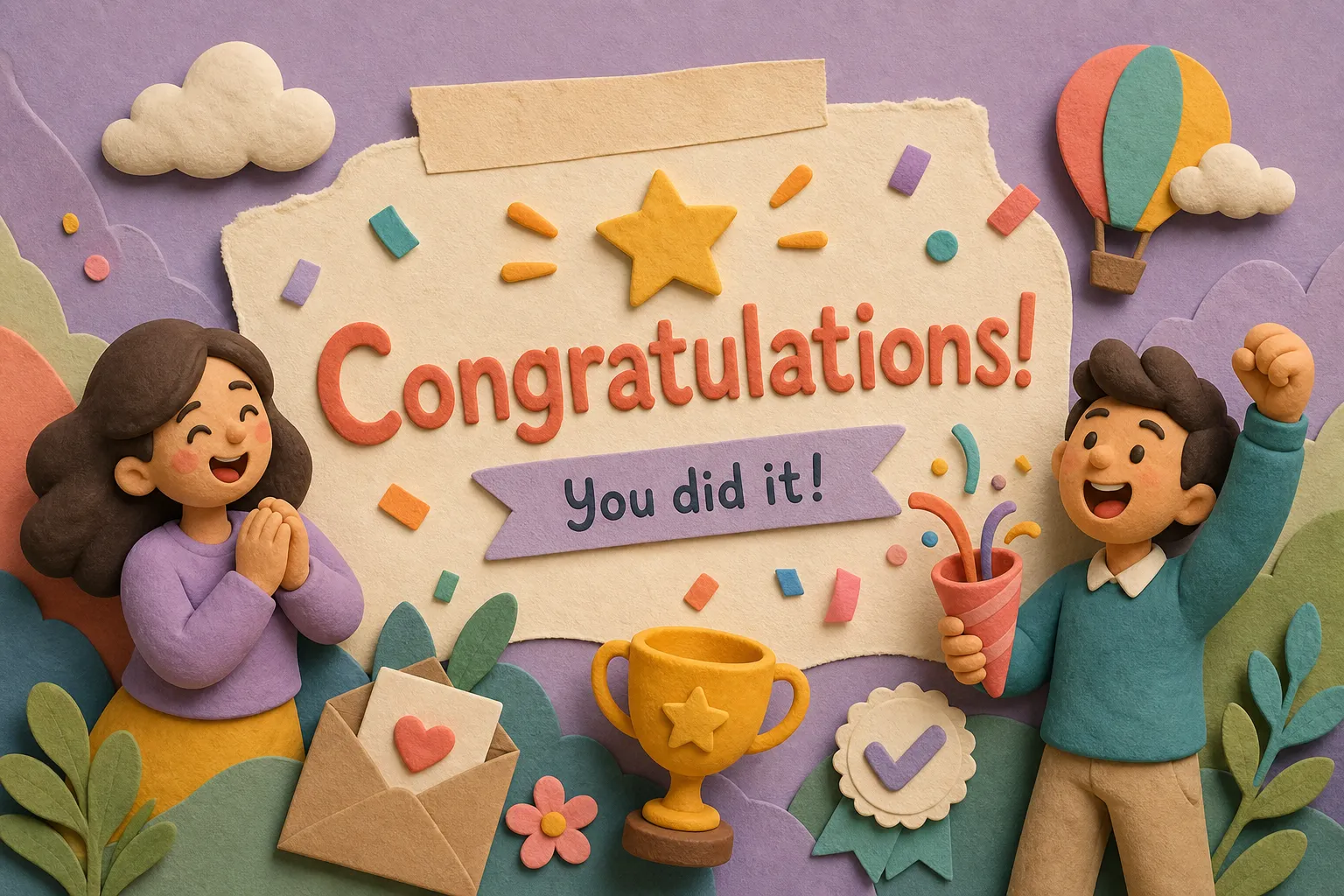
Knowing the word “congratulations” is the easy part, knowing the best congratulations messages to write next is harder. You hear exciting news, you want to respond warmly, and suddenly you’re staring at a blank screen wondering whether to keep it short, go heartfelt, or stay professional. That freeze is real, and it happens to native speakers too. For English learners, it’s especially common because many learners find that courses focus on vocabulary and grammar more than the cultural norms around tone and register.
By the end of this lesson, you’ll know which congratulatory message fits which occasion, how to match your tone to the relationship, and how to quickly personalize any message so it sounds natural and specific. You’ll also walk away with real examples, ready to use or adapt right now. This is the kind of practical, cultural knowledge that separates textbook English from the real thing. It’s exactly what we focus on at Your Daily American: not just what to say, but when to say it, how to say it, and what it signals to the people around you.
Why tone matters as much as the words you choose
What Americans expect in a congratulations moment
American culture tends to lean enthusiastic when it comes to celebrating others. When someone shares exciting news, a flat or overly formal response can come across as cold or distant, even if your grammar is perfect. Compare these two reactions to a friend’s promotion: “Congratulations on your accomplishment” versus “You did it! I’m so proud of you!” Both are grammatically correct. Only one feels warm. In American English, congratulatory messages carry real emotional weight, and that warmth is expected, not optional.
Matching your message to the relationship
There are three main registers to keep in mind. Casual works for texts, social media, and close friends: short, punchy, and expressive. Warm-personal works for family, best friends, and partners: longer, more heartfelt, and specific to the person. Formal-professional works for your boss, clients, and senior contacts: polished, brief, and achievement-focused.
Using the wrong register is one of the most common ESL mistakes in this area. Writing a stiff, corporate-sounding note to your best friend feels cold. Calling your manager “buddy” in a congratulations email feels inappropriate. The words matter less than whether the tone fits the relationship.
Card, text, or social post: does the format change things?
Yes, and mostly through length. Social media comments and texts should be short and immediate. A quick “You crushed it!” on someone’s Instagram post is perfect. Handwritten cards allow more warmth and length, typically one to four sentences depending on the occasion, with two to four sentences being common for bigger milestones like weddings or retirement. Professional emails should be brief, specific, and focused on the achievement. For more on crafting those messages, see our guide to How to Write a Professional Email in American English.
Short congratulations messages for texts and social media
One-liners that feel genuine
The most natural short messages Americans actually use aren’t just filler. They’re enthusiastic without being over-the-top, and they work because they feel personal even in one line. Here are some of the best congrats messages to keep on hand:
- “You did it!”
- “So proud of you!”
- “You nailed it!”
- “You crushed it!”
- “Way to go!”
- “You deserve this!”
- “Huge congrats!”
- “Cheers to you!”
Notice what these have in common: they center the person, not the achievement. That’s a key feature of American-style congratulations. The focus is on the person’s effort and success, not a formal acknowledgment of the event itself.
When short is exactly right
A one-liner is the right call for quick social media comments, group chats, and a fast text sent right after you hear the news. In these settings, brevity isn’t cold, it’s culturally normal and often preferred. A short message sent immediately often lands better than a long message sent three days later. Don’t overthink it, if you feel something, send it.
Professional congratulations messages for work settings
Messages for a boss or senior leader
Formal congratulatory messages should feel sincere without crossing professional boundaries. The key is specificity: naming the actual achievement makes it feel genuine rather than copied from a template. For workplace-specific examples and etiquette, check this guide on congratulations at work.
Here are sample congratulations texts that hit the right note:
- “Congratulations on your well-deserved success.”
- “Your hard work and dedication have clearly paid off. Congratulations.”
- “It’s a pleasure to congratulate you on this significant achievement.”
- “Congratulations on your promotion. I look forward to seeing your continued success in this new role.”
If you know the specific milestone, name it. “Congratulations on your promotion to Director” is better than a vague “Congratulations on everything.” Specificity signals that you were paying attention.
Messages for a colleague or coworker
With peers, you have a bit more warmth to work with while still staying professional. Colleague messages can reference shared experience without getting too personal. Try: “So happy to hear about your promotion. You’ve earned it!” or “Congratulations on landing that new role. The team is going to miss having you here.” Adding a line like “I’ve seen how hard you’ve worked for this” is exactly what separates a colleague message from a generic card.
Common mistakes to avoid at work
ESL learners often go too brief with senior contacts, which reads as dismissive rather than respectful. On the other side, emotional language that works with friends (“I love you, so happy for you!”) is genuinely awkward directed at a manager. One preposition to watch: Spanish and Portuguese speakers often write “congratulations for your success,” but in American English, the natural phrase is “congratulations on your success.” That small swap makes a big difference.
Heartfelt congratulations messages for family and close friends
Messages for a best friend or sibling
Close-relationship messages work best when they acknowledge the journey, not just the result. Anyone can say “Congrats.” Only someone who knows the person can say: “I’ve seen the effort, the setbacks, and the moments you kept going anyway. This success is so well-earned.” That kind of message lands because it shows you were paying attention. Generic praise is easy. Specific pride is meaningful.
Messages for a partner or spouse
A message to a romantic partner blends pride with shared love. A strong example: “I’m so proud of you, and I’m even more grateful to get to share this moment with you.” Partners often close with a forward-looking line, something like “I can’t wait to see what comes next for you,” which frames the achievement as a beginning rather than just an endpoint. That optimistic, future-oriented framing is very characteristic of American congratulatory culture.
Messages for a parent or child
For a parent, the tone is proud and a little reverent: “You’ve always inspired me, and this makes me even more proud.” For a child or younger family member, it’s celebratory and encouraging: “This is proof of what you’re capable of. We are so proud of you.” American parents in particular tend to emphasize effort and character in these messages, not just the outcome. “You worked so hard for this” lands better than “You’re so talented” because it acknowledges what the person actually did.
Ready-to-use congratulations messages for specific occasions
Graduation and new job
For graduation, keep the message enthusiastic and forward-looking: “Congratulations! Your hard work got you here. Enjoy every moment of this, and I can’t wait to see what you do next.” For a new job: “So excited for you and this next chapter. You’re going to do great things there.” Americans treat both graduation and a new job as exciting transitions, not just achievements to check off. Your message should match that energy. If you want more example lines, see these graduation message ideas and additional congratulations messages for inspiration.
Wedding, engagement, and new baby
These occasions call for warm wishes about the future, not just acknowledgment of the moment. Wedding: “Congratulations on your wedding. Wishing you both a lifetime of love and joy.” New baby: “Congratulations on your new arrival! Wishing your whole family so much happiness.” The word “wishing” is a natural cultural anchor in these messages. It shifts the focus from what just happened to what’s ahead, which is exactly right for life milestones like these.
Promotion, retirement, and new home
Promotion: “Congratulations on your promotion. This is so well-deserved!” Retirement: “Congratulations on your retirement. You’ve earned this next chapter.” New home: “Congrats on the new place! Wishing you so many happy memories there.” For retirement especially, notice the framing: American culture treats retirement as an exciting new beginning, not a farewell. Your message should be celebratory, not wistful. “You’ve earned this next chapter” captures that spirit perfectly.
How to personalize any congratulations message in 30 seconds
A three-part formula that reliably works
Any generic message becomes specific and meaningful with three moves. First, name the achievement directly (“Congratulations on your graduation”). Second, acknowledge the effort or journey (“I know how hard you worked for this”). Third, add a forward-looking wish or personal note (“I can’t wait to see what comes next for you”). Here’s the formula in action. Generic: “Congratulations on your success.” Personalized: “Congratulations on finishing your MBA, Juliana. I know the last two years weren’t easy, and I’m so proud of what you pushed through to get here.” The difference isn’t length. It’s specificity.
Sentence starters that sound natural in American English
These openers are warm without being dramatic, and they adapt to almost any occasion by swapping in the achievement:
- “I’m so happy for you…”
- “You worked so hard for this…”
- “I knew you could do it…”
- “You deserve every bit of this…”
- “This is such a well-earned success…”
- “So proud of you…”
Practice building one full message from these starters. Pick a person in your life right now who has accomplished something, choose a starter, add the achievement, and close with a wish. The whole thing takes less than a minute once you know the structure. For more common expressions learners use all the time, see our article on Common American Expressions Every English Learner Should Know.
One quick check before you hit send
Before sending any congratulatory message, run through this checklist: Does it name the specific occasion? Does the tone match your relationship with this person? Does it sound like something you’d actually say to them out loud? If the answer is yes to all three, send it. A short, specific message generally works better than a long, generic one, in most casual settings and many professional ones too.
What to write in a congratulations card or note
A congratulations card gives you slightly more space than a text, but that doesn’t mean you should fill it. The same three-part structure works here: name the achievement, acknowledge the effort, and close with a warm wish. For card wording inspiration, Hallmark offers practical examples of what to write in a congratulations card, and Adobe Express has helpful congratulations wording ideas you can adapt. For a congratulations note example at a graduation: “Congratulations on earning your degree. I know how much you sacrificed to get here, and I couldn’t be more proud. Wishing you every success in what comes next.” For a congratulations card at a retirement: “Congratulations on an incredible career. You’ve given so much, now it’s your turn to enjoy what you’ve built. Wishing you a retirement full of everything you love.” Keep the tone warm, keep the focus on the person, and let the occasion guide your length.
Put it into practice
The real skill here isn’t memorizing phrases. It’s developing a feel for tone, relationship, and occasion, and that feel comes from understanding the cultural context behind the language, not just the vocabulary. When you understand that Americans tend to be more openly enthusiastic in celebration than speakers of British or Australian English, you stop second-guessing whether your message is “too much.” When you understand what makes a colleague message different from a boss message, you stop playing it safe with one-size-fits-all phrasing. For additional practice writing messages in workplace contexts, see practical tips on congratulating coworkers and leaders at work.
Try this right now: think of one person in your life who recently accomplished something. Use the three-part formula to write them a message. Name the achievement, acknowledge their effort, and add a wish for what’s ahead. It doesn’t have to be long, it just has to be specific. Use these congratulations messages to respond with confidence: name the achievement, acknowledge the effort, and add a wish. If you want more quick conversational practice, try our list of 25 Small Talk Phrases Americans Use Every Day to help your messages sound even more natural in casual contexts.
If you want to keep building this kind of cultural and conversational fluency, Your Daily American is the place to do it. Every lesson is built around real American English as it’s actually spoken and written, from daily conversations to professional communication. The goal is always the same: give you the language you need to use it with confidence, today.