The difference between lose vs loose trips up even confident English speakers. You’re typing a message and you stop, is it “I always lose my keys” or “I always loose my keys”? One letter separates these two words, but that single letter changes everything: the meaning, the sound, the grammar, and the impression you make on the reader. Most people have spelled one of these wrong at some point, and the mistake is far more common than anyone likes to admit.
By the end of this lesson, you’ll know exactly what each word means, how they sound differently, when “to loose” actually works as a verb, and a memory trick that makes the right choice automatic. At Your Daily American, this kind of precision, knowing not just the big vocabulary but the small distinctions that native speakers get right every time, is exactly what separates intermediate English from confident, natural fluency.
Lose vs Loose: Spelling, Meaning, and a Quick Rule
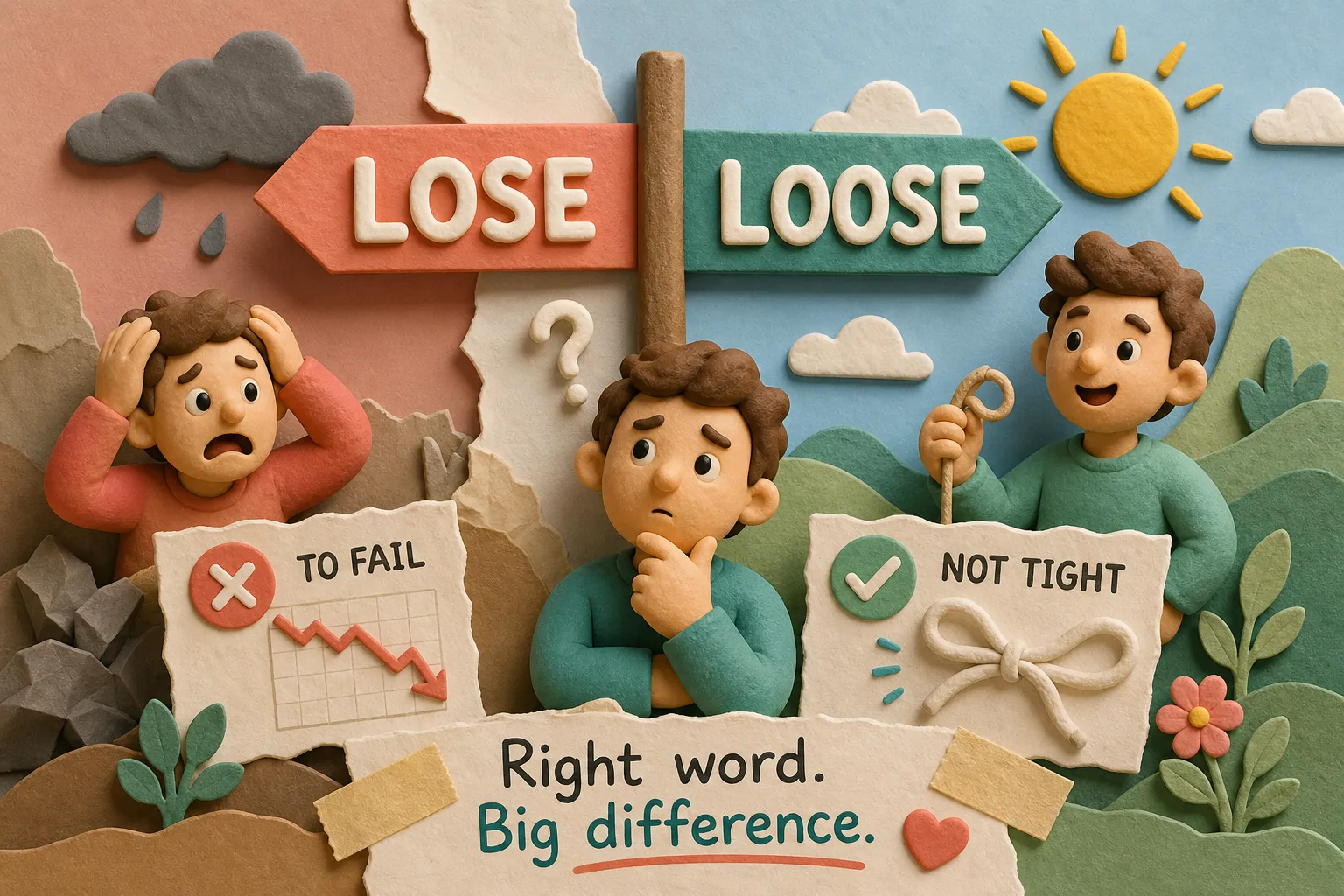
Start here. “Lose” has one “o” and is always a verb. “Loose” has two “o”s and is almost always an adjective. That’s the foundation. Everything else builds from it.
What “lose” means and how it works as a verb
“Lose” is a verb. It means to fail to keep something, to misplace it, or to not win. It always needs a subject and usually needs an object: you lose a game, you lose your keys, you lose your patience. The verb forms are: lose, loses, lost, and losing. Notice that the past tense is “lost,” not “losed”, that’s a separate thing to learn, but knowing the base verb is step one. For a concise dictionary definition, see the Cambridge Dictionary definition of “lose”.
What “loose” means and why it’s almost always an adjective
“Loose” is an adjective. It describes something that is not tight, not firmly fixed, or not held in place. A loose screw. Loose jeans. A loose grip. If you can replace the word with “not tight” or “not fixed” and the sentence still makes sense, you almost certainly want “loose.” It can occasionally function as a verb (covered in a later section), but in the vast majority of sentences you’ll encounter, “loose” is describing something.
The one-letter spelling rule to remember right now
One “o”: something is gone, missing, that’s lose . Two “o”s: there’s extra room, it’s not tight, that’s loose . Think of the extra “o” as extra space inside the word. This is the fastest mental anchor for spelling, and it connects directly to meaning, which makes it stick.
Lose vs Loose: Pronunciation and Sound
These words do not rhyme. Many learners assume they do, and that assumption is exactly what leads to spelling mistakes. Knowing the different sounds actually helps you lock in the different spellings.
Why “lose” sounds the way it does
“Lose” is pronounced /luːz/. It rhymes with news, shoes, blues, and choose. The phonetic respelling is LOOZ, notice that the final “s” produces a buzzing /z/ sound, like a bee. In American English, verbs like rise, please, and use follow the same pattern: the final letter looks like an “s” but sounds like a “z.”
Why “loose” sounds exactly like “moose” or “goose”
“Loose” is pronounced /luːs/. It rhymes with moose, goose, juice, and spruce. The phonetic respelling is LOOS. The final sound is a clean /s/, not a buzzing /z/. Here’s your shortcut: if you can say “moose” correctly, you can say “loose.” If you can say “choose,” you can say “lose.” Different endings, different sounds, and that sound difference is your first real clue when you’re unsure which spelling to use. You can listen to the word’s pronunciation at EasyPronunciation’s page for “loose” to confirm the clear /s/ ending.
Lose vs Loose Examples in Real Sentences
Definitions are useful. But examples are what make a word actually usable. Read through these slowly and notice how naturally each word fits into real American life.
“Lose” in everyday American life
These sentences use “lose” correctly across different situations:
- I always lose my keys right before I need to leave.
- We’re going to lose the game if we don’t start passing better.
- She’s been working out a lot and is trying to lose weight.
- I lose track of time whenever I start scrolling through my phone.
- He was afraid he’d lose his job after the company announced layoffs.
- Don’t lose your patience, the line is almost done moving.
Every sentence here uses “lose” as a verb, with a subject doing the losing and an object being lost. That grammatical pattern is your built-in check.
“Loose” describing the world around you
These sentences use “loose” correctly as an adjective:
- My shoelace is loose; I need to tie it before I trip.
- This screw is loose; do you have a screwdriver?
- His jeans look loose on him since he lost weight.
- The dog got loose when someone left the backyard gate open.
- The deadline is still fairly loose, so we have some flexibility.
- There’s some loose change at the bottom of my bag.
In every case, “loose” describes something: jeans, screws, deadlines, change. It answers the question “what kind?”, and that’s what adjectives do.
Sentences where both words appear together
These are the most powerful teaching examples, because you see the contrast in real time. Work through each one and notice why each word sits exactly where it does.
“If the cap is loose , you might lose the bottle.” Here, “loose” describes the cap (it’s not tight), and “lose” describes what could happen to the bottle (it could go missing). Two different jobs, two different words.
“The bolt is loose , so you could lose the part it holds together.” Same logic: “loose” describes the bolt’s condition; “lose” describes the risk of the part going missing. Notice how swapping the two words would make both sentences nonsensical.
“I lose track of my glasses whenever I set them on a loose pile of papers.” One “lose” as a verb (losing track), one “loose” as an adjective (the pile is not organized or tight). Two words, two jobs, zero overlap.
The verb “to loose”, when it actually comes up
Here’s something most people don’t know: “loose” can be a verb. It’s not common, but you’ll see it in certain contexts, and it’s worth knowing so you’re not caught off guard.
What “to loose” means as a verb
“To loose” means to release, free, or untie something. Historically, you could loose an arrow from a bow, loose a dog from its leash, or loose a knot. The meaning is about setting something free or letting something fly. Merriam-Webster’s usage guide on lose vs loose still lists this as a current verb sense, not an archaic one, though it is far less common in daily conversation than “lose.”
Is “to loose” still used in modern American English?
Rarely, and mostly in specific phrases or more formal writing. You’ll see it in literature, in idioms like “all hell broke loose,” or in news writing describing something being released or unleashed. In everyday speech and casual writing, it almost never appears as a verb. As an ESL learner, you don’t need to use it actively. But you should recognize it when you see it, and more importantly, if you ever find yourself wanting to use “loose” as a verb in an everyday sentence, stop and double-check. You almost certainly mean “lose.”
The Memory Trick for Lose vs Loose
Knowing the rule is one thing. Having a memory anchor is what keeps you from second-guessing yourself six months from now when you’re writing a quick email at work.
The “extra o = extra space” trick
“Loose” has an extra “o.” Think of that extra “o” as extra space. Things that are loose have room to move: a loose screw, a loose shirt, a loose lid. The word itself has room in it because it has an extra letter. Now flip it: “lose” has already lost a letter. It’s missing something, just like you’re missing your keys or missing a win. The word mirrors the meaning in its own spelling, that’s not a coincidence; it’s the most reliable mnemonic anchor you can build for this particular pair.
Reinforcing the pronunciation as a second memory hook
Pair the spelling trick with the sound. Two “o”s make a longer sound: LOOS, like moose, like goose. One “o” makes a buzzing sound: LOOZ, like choose, like news. When you’re genuinely unsure, say the word out loud and ask which rhyme fits the meaning you want. If you mean “not tight” and it sounds like moose, it’s “loose.” If you mean “misplace” and it sounds like choose, it’s “lose.”
This combination of a spelling anchor and a pronunciation check is exactly the kind of retention strategy covered in Word Stress in American English: A Complete Guide. Building small but specific memory hooks like these is how fluent speakers stop second-guessing themselves, not by memorizing rules in the abstract, but by connecting a word’s look and sound directly to its meaning.
Common mistakes and a quick self-check
The most frequent error: writing “loose” when you mean “lose.” “I always loose my phone” looks right to a lot of people because “loose” has that double “o” that feels big and strong, surely it makes the LOOZ sound, right? Wrong. That double “o” makes an S sound, not a Z sound, just like moose. The buzzing LOOZ sound belongs to “lose,” the shorter word. The extra “o” tricks the eye, and that’s exactly why this mistake is so widespread. For more on why these two words trip people up, see Grammarly’s guide to loose vs lose.
The second error runs the other way: using “lose” as an adjective. “My pants are lose ” is incorrect. “My pants are loose ” is correct. If you’re describing something, you need the adjective, and the adjective always has two “o”s. If you’re working on reducing pronunciation and word-choice errors more broadly, check our article English Words Non-Native Speakers Mispronounce Most Often for related traps learners face.
Try it yourself: a quick self-check
Read each sentence and choose the right word before looking at the answer. Don’t skip ahead, the practice is where the learning happens.
- “Don’t _____ hope. The game isn’t over.” (Answer: lose)
- “That button is _____. You should sew it back on.” (Answer: loose)
- “If the bolt is _____, you could _____ the wheel.” (Answer: loose / lose)
- “She always seems to _____ her train of thought in long meetings.” (Answer: lose)
Three or four out of four? You’ve got this. The goal isn’t to recite a rule, it’s to reach the point where the right word just feels obvious. That automatic recognition is what real fluency looks like.
Putting it all together
Here’s the short version of everything covered above. “Lose” is a verb with one “o”, it rhymes with “choose” and means to misplace something or fail to win. “Loose” is an adjective with two “o”s, it rhymes with “moose” and describes something that isn’t tight or firmly fixed. The extra “o” in “loose” represents extra space, because loose things have room to move. The word without the extra “o” has already lost something.
That’s the lose vs loose distinction in full. Mastering pairs like this one is what real American English fluency looks like in practice, not always learning big new vocabulary, but getting the familiar words exactly right in the texts, emails, and conversations you send every day. Native speakers don’t think twice about lose versus loose. With the right anchors, you won’t either.
If this kind of focused, practical English lesson is what you’re looking for, Your Daily American has a full library of lessons built around exactly this approach: real language in real context, with explanations that actually stick. Bookmark this article, run through the self-check again tomorrow, and learn more about us on the About, Your Daily American page.
Frequently Asked Questions: Lose vs Loose
How do you remember lose vs loose?
Use the “extra o = extra space” trick. “Loose” has an extra “o” because loose things have room to move. “Lose” is missing that letter, just like you’re missing whatever you lost. Pair that spelling anchor with sound: “loose” rhymes with moose (LOOS), while “lose” rhymes with choose (LOOZ). Together, these two hooks cover both spelling and pronunciation.
What is the difference between lose and loose in meaning?
“Lose” is always a verb, it means to misplace something, to be deprived of something, or to fail to win. “Loose” is almost always an adjective meaning not tight, not fixed, or not firmly held in place. They look similar, but they do completely different jobs in a sentence.
Can “loose” ever be used as a verb?
Yes, but rarely. “To loose” means to release or free something, think loosing an arrow or loosing a knot. You’ll see it in formal writing, literature, and certain idioms. In everyday American English, “loose” as a verb is uncommon enough that if you feel the urge to use it that way, you should double-check: you most likely mean “lose.”
Why do so many people confuse lose vs loose?
The double “o” in “loose” looks like it should make the same buzzing sound as “lose,” but it doesn’t. “Loose” sounds like moose; “lose” sounds like choose. That mismatch between appearance and sound is what creates the confusion, and why pronunciation practice is one of the best ways to lock in the correct spelling.