Writing a grammatically correct cover letter is one thing. Writing one that sounds like it belongs in an American workplace is another. If you’re preparing for the U.S. job market, understanding how to write a cover letter in American English is one of the most practical skills you can develop, and one of the least taught. The problem isn’t usually your grammar. It’s that American professional writing has a very specific tone that most ESL learners were never explicitly shown, and a cover letter is one of the places where that gap shows up most clearly.
At Your Daily American, readers preparing for the U.S. job market ask about this constantly. They want to know what to say, how formal to sound, and whether hiring managers even read cover letters anymore. This guide answers all of that. By the end, you’ll know how to write a cover letter that is concise, tailored to a real job posting, opens with a line that earns attention, and uses the tone American employers actually expect.
What American Employers Actually Expect from a Cover Letter
A cover letter is not a formal declaration. It isn’t a legal document or a ceremonial letter of intent. It’s a targeted pitch with a human voice, and understanding that changes everything about how you write it.
American professional writing sits in a specific range on the formality spectrum: warmer and more direct than the professional writing of many other cultures, but still clearly professional. First-person sentences, contractions like “I’m,” “I’ve,” and “I’d love to,” and specific enthusiasm are all normal and expected. ESL learners who write very stiffly, “I am writing to humbly express my sincere interest in the aforementioned position”, actually signal a lack of familiarity with American workplace culture, not respect for it.
As for whether hiring managers read cover letters: yes, but quickly. According to a 2023 Jobvite Recruiter Nation survey, 84% of hiring managers spend less than two minutes on a cover letter, and 36% skim for 30 seconds or less. The letter’s job is to prove fit, motivation, and context fast. Industries where cover letters carry the most weight include senior roles, career transitions, smaller companies, and academia. In those situations, a well-crafted cover letter does work the resume simply cannot.
On the practical side: keep it to one page, 250 to 400 words, 11 pt Calibri or Arial, 1-inch margins, left-aligned, and saved as a PDF. Name the file something like First-Last-Cover-Letter.pdf. These small details signal professionalism before anyone reads a single word.
The Structure of a Strong Cover Letter
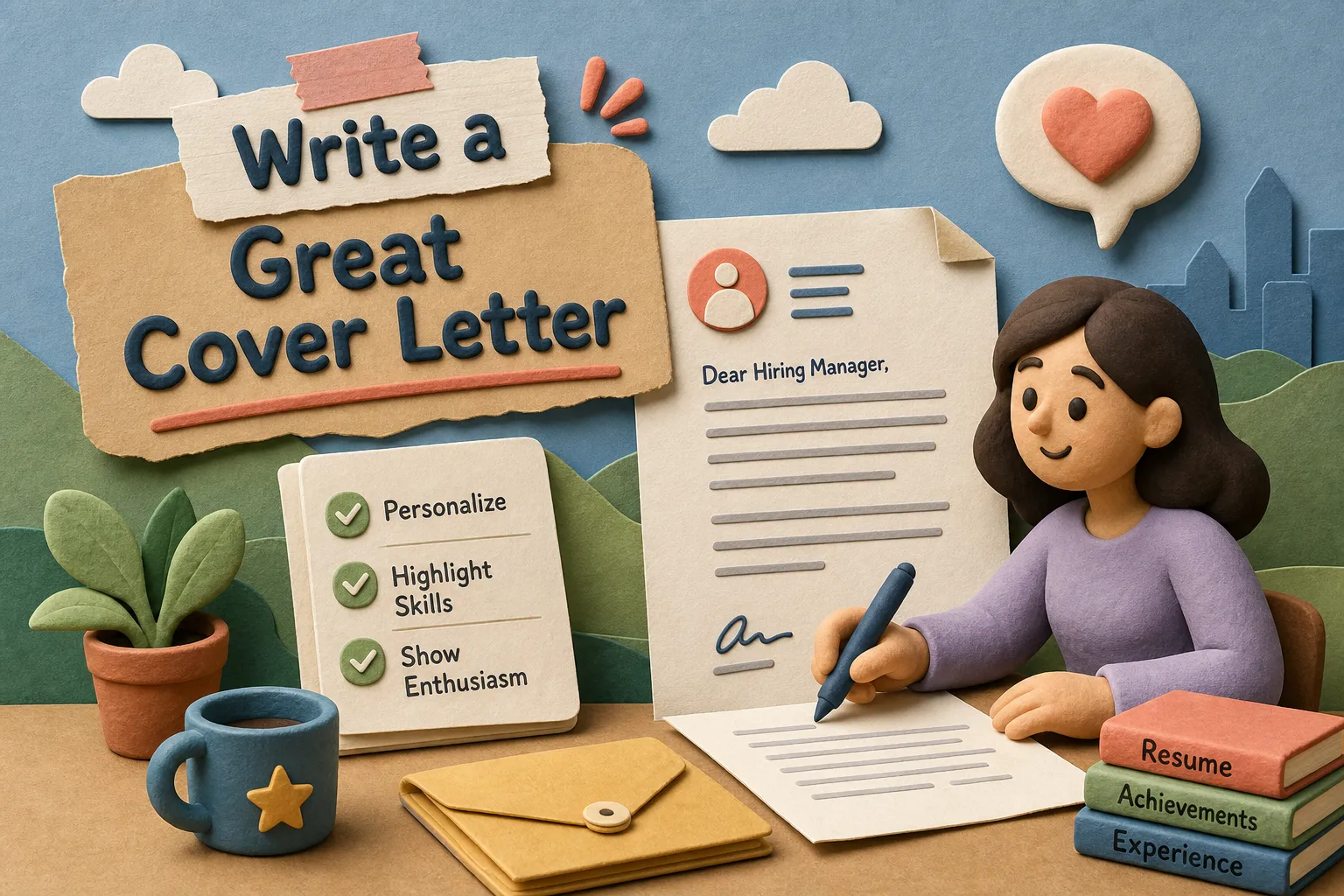
Every professional cover letter follows a five-part structure. Start with a header containing your contact information, the date, and the employer’s details. Follow that with a salutation, an opening paragraph, one or two body paragraphs, and a closing with a clear call to action. Each section carries a specific responsibility: the header signals professionalism, the salutation personalizes the letter, the opening earns attention, the body proves your fit, and the closing asks for the next step.
For the salutation, “Dear Hiring Manager” is the safe, widely accepted default in American professional writing. “To Whom It May Concern” is outdated and feels cold. When you can find the hiring manager’s name through LinkedIn, the job posting, or a quick call to reception, use it: “Dear Ms. Rodriguez” or “Dear Alex Kim.”
The body is where most cover letters succeed or fail. Use one to two paragraphs, each making a specific point about your fit. Connect your concrete accomplishments to the job’s specific requirements, and use the employer’s own language from the job description. This shows you read it carefully and helps with ATS compatibility. Never just describe your job duties. Show results: percentages, revenue, team size, timeframe. That’s what makes you memorable. How to Talk About Achievements in English During a Review, Your Daily American
A Simple Cover Letter Template to Follow
If you’re looking for a reliable cover letter template to start from, here is the professional cover letter format that works across most American industries:
- Header: Your name, phone number, email, LinkedIn (optional), city and state
- Date and employer details: Hiring manager’s name, title, company, address
- Salutation: “Dear [Name]” or “Dear Hiring Manager”
- Opening paragraph: One or two sentences, specific, role-focused, credible
- Body paragraph 1: Your strongest accomplishment connected to a key job requirement
- Body paragraph 2 (optional): Transferable skills, industry knowledge, or cultural fit
- Closing paragraph: Express enthusiasm, request a conversation, thank them for their time
- Sign-off: “Sincerely,” or “Best regards,” followed by your full name
How to Write a Cover Letter Opening Line That Keeps the Reader Engaged
Your first sentence has one job: give the hiring manager a compelling reason to read the second sentence. Strong cover letter opening lines are specific, role-focused, and credible. They signal immediately that this letter was written for this job, not sent to 50 companies with a single click.
The opening line that fails almost every time: “My name is [X] and I am writing to apply for the position of…” Career coaches consistently flag this opener as a signal that the applicant has nothing interesting to say. It’s generic, slow, and tells the reader nothing about fit.
Here are three opening formulas with real cover letter examples you can adapt:
- Role + enthusiasm + skills: “When I saw the listing for [job title], I immediately recognized how my background in [relevant area] could directly support [company goal].”
- Accomplishment-led: “Last year, I led a product launch that increased quarterly revenue by 40%, and I’d love to bring that same approach to [Company Name]’s team.”
- Referral-based: “I was excited to learn about this opening from my former colleague, [Name], who mentioned that [Company Name] is expanding its [relevant department].”
For more examples of strong opening lines and practical starter phrases, see The Muse’s opening lines examples and Coursera’s guide on how to start a cover letter.
One note for ESL learners: “I am excited to apply” is natural and appropriate in American professional writing. “I am writing to humbly express my sincere interest” is over-formal and sounds translated. When in doubt, read your opener aloud. If it sounds like something you would say to a real person, you’re in the right range. For spoken first-impression practice, also see How to Introduce Yourself in an American Job Interview, Your Daily American.
The Tone ESL Learners Struggle With Most, And How to Fix It
Most ESL learners were taught either very formal written English or very casual conversational English. American professional tone lives in between, and it’s deeply cultural. Grammar books don’t teach it. You internalize it through exposure to real professional American communication.
Small choices signal this tone. Contractions matter: “I’m confident” reads warmer and more natural than “I am confident.” Active verbs matter: “I led a team of eight” is cleaner and more direct than “responsibilities included oversight of a team.” For that third element, showing genuine interest, try being specific about this company, for this reason, rather than defaulting to “I believe I would be an excellent addition to your organization.”
Here’s a quick reference for what sounds right and what sounds off in a tailored cover letter:
- [x] Sounds natural: “I’d welcome the chance to discuss how I can contribute to your team.” / “I’m confident that my experience in makes me a strong fit for this role.”
- [ ] Too formal, sounds translated: “Enclosed herewith please find my application for the aforementioned position.” / “I humbly request your consideration of my candidacy.”
- [ ] Too casual: “I think I’d be great for this!” / “This job sounds awesome and I really want it.”
This formal-yet-personable register is the same one used in professional American emails, meeting follow-ups, and workplace messages. It takes deliberate practice to internalize. The Professional English for the Modern Workplace section at Your Daily American covers exactly this, everything from professional email writing to the tone shifts native speakers make without thinking. Building fluency in professional emails gives you a strong foundation for cover letter writing, because the skills transfer directly.
The Most Common Cover Letter Mistakes ESL Writers Make
The biggest structural mistake is treating the cover letter as a summary of the resume. The hiring manager already has your resume. The cover letter’s job is to explain the “why”: why this company, why this role, why your background connects to their specific needs in a way your resume can’t fully show. A career changer’s cover letter, for example, needs to explicitly address the transition. The resume alone won’t do that work.
Vague claims are the second most common problem. “I am a hard-working and dedicated professional” tells a hiring manager nothing. Every applicant says exactly that. Specificity builds credibility. “I managed a team of six and reduced onboarding time by 30%” is concrete and memorable. For entry-level writers with limited work experience, use class projects, internships, volunteer roles, or relevant coursework, and connect those experiences directly to something in the job description.
ESL writers also face some specific language pitfalls worth watching for:
- Article errors (missing “the” or “a” before nouns) are extremely common for speakers of Chinese, Japanese, Korean, and Arabic, all languages without articles.
- Overly long sentences that pack in too much information at once. Break them up. Two clear sentences are always better than one tangled one.
- Wrong company name or job title in the letter. This happens more often than you’d think, and it’s an immediate rejection trigger. Proofread once for content, once for grammar, and once specifically for the company name and role.
Cover Letter Examples for Three Common Situations
When you look at real cover letter examples across different career stages, one thing stays consistent: the five-part structure. What changes is what you emphasize in the body and how you frame your opening.
New Graduate or Entry-Level Applicant
If you’re a new graduate or entry-level applicant, lead with your education and any relevant projects, internships, campus leadership, or coursework. Use one body paragraph to show you researched this company specifically, and a second to connect a project or internship experience to a key requirement from the posting. Enthusiasm is your real asset here. A hiring manager knows you have limited experience. What they want to see is genuine interest, fast learning, and a clear sense of why this role fits you. For templates and practical examples targeted at interns and entry-level hires, see How to Write an Entry-Level Cover Letter With Examples.
Career Changer
If you’re making a career change, address the transition directly and early. Don’t try to hide it or bury it. Hiring managers will notice the gap between your background and the role, and silence on that point raises questions. Instead, frame transferable skills explicitly: “My five years in customer support taught me [X skill], which directly applies to [the new role] because…” Follow that with one concrete accomplishment from your previous field that demonstrates a quality the new role requires. Write with confidence, not apology. You’re not asking for a favor; you’re showing how your non-traditional background is actually an asset. For a focused guide on writing a career-change letter, see Coursera’s career change cover letter.
Experienced Hire
If you’re an experienced hire, lead with a strong achievement that establishes your level immediately. Focus on leadership, scope, and business impact: team size, budget, revenue, process improvements. Then connect your experience to where the company is headed, not just what the job description says. Senior cover letters should feel authoritative without being arrogant. The tone is “I know I can do this, and here’s the proof.”
Write Your Cover Letter One Step at a Time
Knowing how to write a cover letter in American English comes down to a few core moves: clear structure, a confident and specific tone, an opening line tailored to the role, and concrete proof of fit. Not a list of generic virtues or a resume summary, a targeted pitch with a human voice.
The biggest wins for ESL writers come from matching the formal-yet-personable register, cutting over-formal translated phrases, and writing for this job rather than every job. These shifts alone will move your cover letter from “grammatically correct” to sounding like someone who understands American professional culture.
Start small: write just your opening line today. Pick one of the three formulas from the section above, plug in your actual role and one real accomplishment, and read it out loud. If it sounds like something you’d say to a real person, you’re on the right track. When you’re ready to strengthen the professional English skills that support this kind of writing, the Professional English for the Modern Workplace section at Your Daily American is a practical place to continue, workplace communication, professional emails, and the register that shapes how American employers read you from the very first sentence.