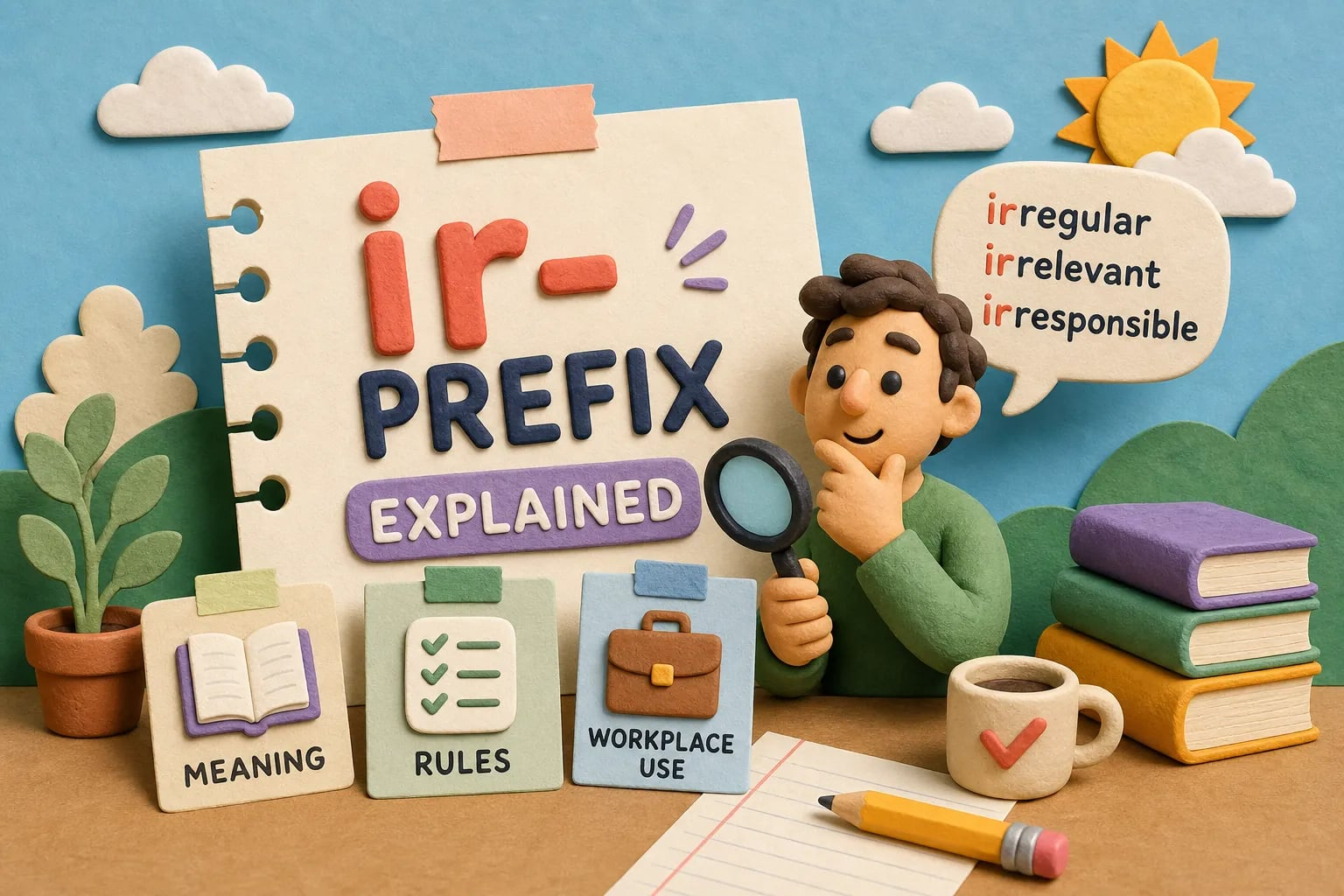
You’re in a meeting and your manager says, “That data is irrelevant to this quarter’s report.” You know the word relevant, but something at the front of the word flips its meaning entirely. Or you hear a colleague say a decision is “irreversible” and you feel the weight of that word, even if you can’t explain exactly why it works the way it does.
That small piece at the front is the ir prefix (written ir-), and it’s one of the most useful negative morphemes in professional English. By the end of this lesson, you’ll be able to state what it means, explain why it’s spelled with two r’s, identify these words correctly, and use them confidently in emails and meetings. At Your Daily American, questions about negative prefixes come up often, especially among learners who want to sound natural and polished at work. The good news: this is a small pattern, and once you see it, you’ll spot it everywhere.
What the ir- prefix means
The prefix ir- means “not.” That’s it. It makes a word mean the opposite of its root. Irrelevant means “not relevant,” irresponsible means “not responsible,” and irregular means “not regular.” The prefix doesn’t add any extra idea, it simply flips the meaning.
You’ll notice these words come up often in formal situations. That’s because words with this prefix come from Latin, and many formal English words are Latinate, derived from Latin. Business meetings, performance reviews, legal documents, and professional reports all use Latinate vocabulary regularly. Compare these two sentences: “This expense is relevant to the project budget” vs. “This expense is irrelevant to the project budget.” One word changes the entire meaning. Recognizing the prefix gives you the power to understand that shift immediately. If you’re curious about common Latinate adjective endings, see our guide to the -ic suffix.
You don’t need to study Latin to use these words correctly. You just need to see the pattern, and once you do, dozens of advanced vocabulary words become easy to read and understand, even on first encounter.
Why “in-” becomes “ir-” before the letter r
The real negative prefix in English is actually in-, which also means “not.” So why do we write irresponsible instead of inresponsible? The answer is pronunciation. When in- is placed before a word that starts with the letter r, the “n” sound changes to match the “r.” This process is called assimilation, when one sound shifts to sound more like the sound next to it. Try saying “in-responsible” out loud. It feels awkward. Now say “irresponsible.” It flows naturally. For a clear explanation of the negative prefix assimilation rule, see this practical guide to the negative prefix assimilation rule.
This assimilation rule has Latin in- etymology at its root and has stayed in English ever since. The “n” in in- becomes an “r” to make the word easier to say. The result is a word that starts with ir-, and because the root word also begins with r, you get a double r in the spelling. You can read more about assimilation in phonology here.
The double-r rule and why it matters for spelling
This is where many ESL learners make a common mistake, writing “iresponsible” with one r instead of two. The double r is not an accident. It comes directly from the structure of the word: through assimilation, the prefix surfaces as ir-, and because the root word itself begins with r, the result is always a double r in spelling. So ir- plus responsible gives you irresponsible; ir- plus rational gives you irrational; ir- plus relevant gives you irrelevant.
A simple way to check your spelling: identify the root word first. If you can see the root (like relevant), you know the prefix ends right before it, and two r’s follow naturally. Keep in mind, though, that this rule applies specifically to words built from the negative prefix in- attached to a root beginning with r. Not every English word that starts with the letters “ir” works this way, irony, iris, and iron, for example, are not negative-prefix words at all. When you’re unsure whether a word contains the negative prefix, checking a dictionary is always a good move; the Wiktionary entry for “ir” is a helpful quick reference. You can also consult Merriam-Webster’s list of words beginning with “ir” if you want examples.
The full family: ir-, il-, im-, and in-
The prefix ir- is part of a family of four forms. All four mean “not.” The spelling simply changes based on the first letter of the root word. Here’s the full pattern:
- ir- before r: irresponsible, irrational
- il- before l: illegal, illogical
- im- before m, p, or b: immature, impossible, imbalanced
- in- before all other letters: inaccurate, incomplete
The “n” in the original in- simply changes to match the first letter of the root. That’s assimilation in action, and it operates across all four forms.
Where un- fits in
Learners often ask: why do we say unreliable but irresponsible? Both mean “not” something, so why different prefixes? The answer is word history. The prefix un- has Germanic roots and attaches to words that came into English from Germanic languages: unhappy, unfair, unreliable. The prefix in- (and its forms ir-, il-, im-) came from Latin and attaches to words of Latin origin: responsible, rational, relevant. For more on the Germanic un-, see our guide to the Un- prefix: The Simplest Way to Expand Your Vocabulary.
You don’t need to memorize which words are Germanic and which are Latin. The most practical approach is to learn each word as a complete unit. When you see irresponsible, learn it as a whole word, not just “ir- plus responsible.” Over time, the pattern becomes natural. If you’d like to compare another negative prefix, see our article on the Mis- prefix: Meaning and the Key Words to Know. When in doubt, check, and expect to encounter exceptions and historical irregularities, because no prefix rule covers every case perfectly.
Common ir- words you’ll actually hear at work
Here are the words using this prefix that come up most often in workplace communication. Each one is followed by a clear definition and a realistic example sentence you might hear in a meeting or read in a professional email.
- Irrelevant (not connected to the topic): “Please keep comments relevant; irrelevant points slow the meeting down.”
- Irresponsible (not careful; not doing what is expected): “Sending that email without approval was irresponsible.”
- Irregular (not normal or consistent): “The report shows irregular charges on the account.”
- Irrational (not based on reason): “The team felt the deadline was irrational given the scope of work.”
- Irreversible (cannot be undone): “Once the contract is signed, the decision is irreversible.”
- Irreconcilable (impossible to make compatible or agree): “The two departments had irreconcilable differences on the budget.”
- Irreplaceable (too valuable to be replaced): “Her knowledge of the system is irreplaceable.”
- Irrefutable (impossible to argue against): “The data provided irrefutable evidence of the error.”
- Irreparable (damage that cannot be fixed): “The delay caused irreparable harm to the client relationship.”
- Irrevocable (cannot be changed or canceled): “This is an irrevocable decision. There is no going back.”
Notice something important about these words: they often signal that something is serious or final. When a manager says a decision is “irrevocable” or damage is “irreparable,” they’re using strong, formal language to close a conversation. Understanding these words helps you read the tone of a situation, not just the meaning of the sentence.
Seeing them in context: short workplace dialogues
Here are two short exchanges that show how these words appear in real professional conversations.
Dialogue 1:
Manager: “The expense report shows some irregular charges. Can you explain them?”
Employee: “Of course. I’ll review those entries and send you a correction today.”
Dialogue 2:
Colleague: “Is there any way to reverse this decision?”
Director: “No. The client contract makes this irreversible at this stage.”
In both cases, the word carries real weight. Practicing with dialogues like these helps you connect vocabulary to situations you’ll actually face at work.
A simple rule to remember which prefix to use
The guideline is straightforward: look at the first letter of the root word. That letter tells you which form of the negative prefix to use. This works reliably with Latinate roots, though there are historical exceptions, so checking a dictionary when you’re unsure is always smart.
- Root starts with r: use ir- (responsible → irresponsible)
- Root starts with l: use il- (logical → illogical)
- Root starts with m or p: use im- (possible → impossible)
- Root starts with anything else: use in- (accurate → inaccurate)
Apply the rule now with a few root words. “Relevant” starts with r, so the prefix is ir- and the word is irrelevant. “Logical” starts with l, so the prefix is il- and the word is illogical. “Perfect” starts with p, so the prefix is im- and the word is imperfect. The first letter does all the work.
Quick self-check
Build the negative form for each of these root words before reading the answers:
- relevant
- logical
- perfect
Answers: irrelevant, illogical, imperfect. If you got all three right, the rule is working. If you missed one, go back to the first-letter method and check which letter the root starts with. At Your Daily American, the professional English section covers vocabulary patterns like this one across real workplace topics, from meeting language to formal emails, so you can see these words in context again and again.
You now have a tool, not just a lesson
Three things to take away from this lesson: the ir prefix means “not,” it’s the form of in- that appears before the letter r, and it always produces a double r in spelling because both the prefix and the root begin with r.
Knowing this prefix unlocks dozens of formal English words you’ll hear in professional settings. When someone says “that’s irreversible” in a meeting, you now understand both the word and the system behind it. That gives you confidence, not just comprehension.
Your next step: find one word with this prefix in something you read or hear at work today, an email, a report, a conversation. Write it down, identify the root, and confirm you can see the double r. Small practice steps like this build real vocabulary over time, and that vocabulary goes directly into your professional communication.