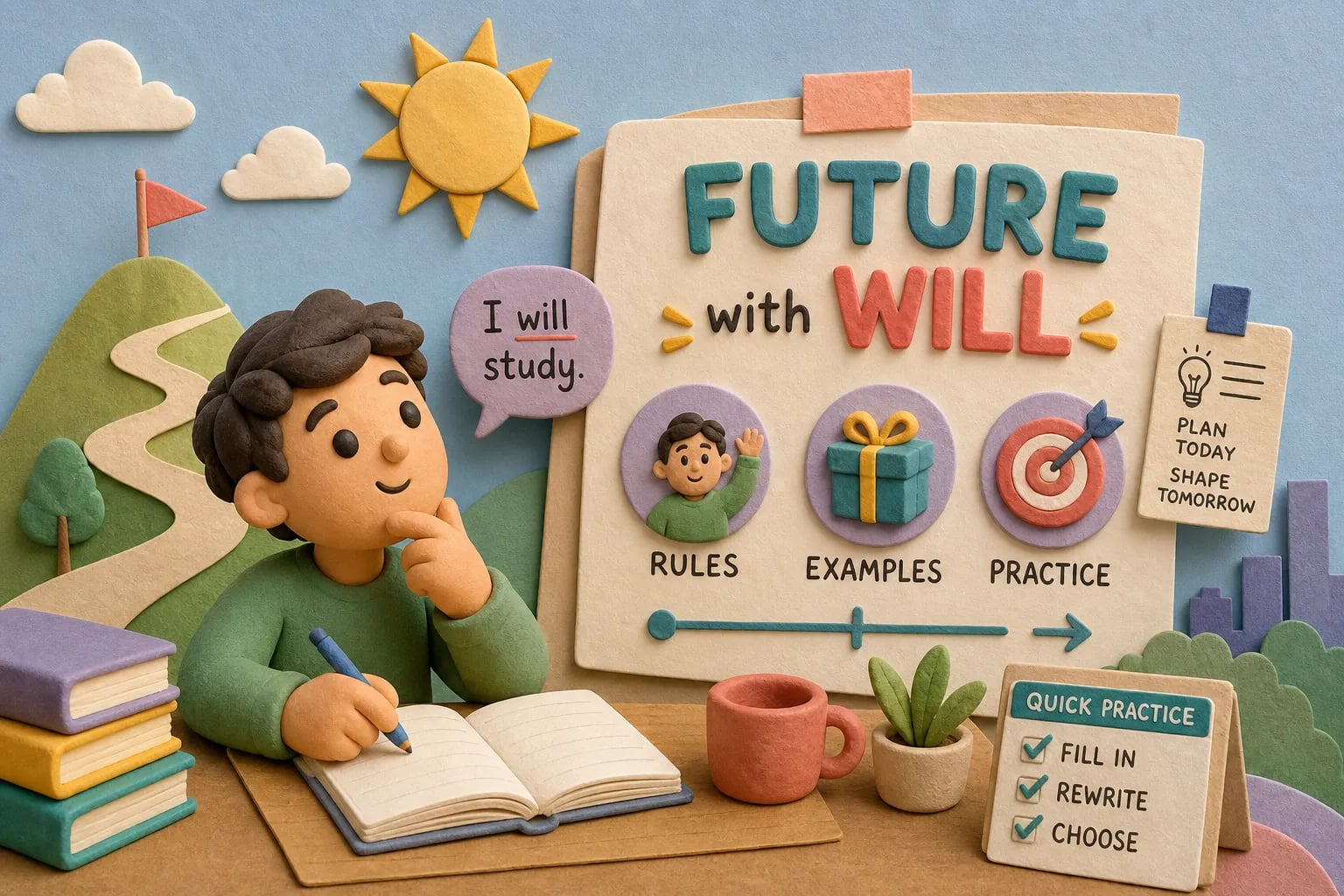
Your coworker asks if you can send a file. Without stopping to think, you say, “Sure, I’ll send it right now.” That one sentence is the future with “will” working exactly as it should: fast, natural, and clear. Most learners already use “will” in basic sentences. The goal of this lesson is to make sure you use it correctly every time.
By the end of this article, you will know how to form affirmative, negative, and question sentences with “will.” You will also understand the four main situations where “will” is the right choice, see how it differs from “be going to,” and practice with short exercises. At Your Daily American, every grammar lesson connects to real situations, so let’s start with the structure.
Future with “will”: how to build a sentence
“Will” is a modal verb, a helping verb that adds meaning to the main verb. Like all modal verbs, it follows specific rules. The main verb always stays in the base form. You say “he will go,” not “he wills go” or “he will going.” This rule holds in every standard use of “will.”
Here are three basic affirmative examples:
- I will call you later.
- She will arrive at noon.
- They will help us with the project.
For negative sentences, add “not” directly after “will.” The contraction is “won’t” (will + not). One important note: “willn’t” does not exist in English. If you write or say “willn’t,” it will immediately signal an error. Use “won’t” every time.
For questions, swap “will” and the subject. You do not use “do” or “does” with “will.” The structure is: Will + subject + base verb. Compare these two paired examples: “I won’t be late.” / “Will you be late?” Notice how simple the switch is. For a clear reference on forming affirmative, interrogative, and negative forms, see this guide on affirmative, interrogative, and negative forms.
The contraction ‘ll: how Americans say it
In spoken American English, “will” very commonly becomes “‘ll” in positive sentences. You will hear “I’ll, you’ll, she’ll, we’ll, they’ll” far more often than the full “will” in everyday conversation. The contraction blends directly with the pronoun, though the exact sound can vary with speech rate and stress. In relaxed speech, “I’ll” sounds close to “all,” “we’ll” sounds like “wheel,” and “she’ll” sounds like “sheel”, though in faster or unstressed speech, the vowels reduce further.
When you want to sound firm or serious, use the full form “I will.” In a promise or a firm commitment, “I will” carries more weight than “I’ll.” In casual speech, “‘ll” is the natural, comfortable choice. If you want more tips on common conversational patterns that include contractions and linking words, check out Filler Phrases Every American English Learners Should Know.
When to use the future with “will”: four key situations
There are four core situations where using “will” for the future is the right call. Once you recognize them, choosing between “will” and other future forms becomes much easier.
1. Spontaneous decisions
A spontaneous decision is one you make at the exact moment of speaking, not something you planned in advance. Here is a short example:
Server: “What would you like to drink?”
Customer: “I think I’ll have the iced tea.”
The customer did not decide before sitting down. The decision happened right then. That is the signal to use “will,” not “be going to.”
2. Predictions
Use “will” when you say what you think or believe will happen. These predictions are based on your opinion, not on visible evidence in front of you. Signal words like “I think,” “I’m sure,” and “probably” often appear with “will” in these sentences.
- “I think it’ll rain tonight.”
- “She’ll probably be a great manager one day.”
- “I’m sure the team will do well.”
3. Promises
A promise is a personal commitment to do something in the future. “Will” is the natural choice here. “I’ll call you tonight, I promise.” / “I won’t tell anyone, I promise.” In professional settings, promises with “will” are very common: “I’ll send you the report by Friday.”
4. Offers
When you offer to help someone, “will” shows your willingness. “I’ll carry that for you.” / “I’ll take notes in the meeting today.” These offers often sound even more natural when you add “if you like” or “if you want” at the end, a common pattern in American conversation.
“Will” in real American English conversations
Here are two short dialogues that show the future with “will” working naturally in everyday situations.
At home:
Maya: “I forgot to buy milk.”
Jake: “That’s okay. I’ll stop at the store on my way home.”
Maya: “Really? Thanks. I’ll make dinner while you’re out.”
Both speakers make spontaneous decisions and offers. Neither person planned these actions before the conversation started.
At work:
Manager: “Who can send the client the update?”
David: “I’ll do it. I’ll send it before 3 PM.”
Manager: “Perfect. Let me know when it’s done.”
David makes a spontaneous offer and then a promise, two of the most common uses of “will” in professional conversations.
Building this kind of confident, natural workplace communication takes more than grammar rules. Your Daily American’s Professional English content is designed to help you practice these real exchanges, from emails to meetings, so the language feels automatic when you need it.
“Will” vs. “be going to”: how to choose the right one
This is the most common point of confusion for learners at this level. The core difference is straightforward: “will” is for decisions made right now, and “be going to” is for plans made before the conversation.
Compare these two sentences:
- “I’ll get the door.” (You just heard a knock. Instant decision.)
- “I’m going to visit my sister next weekend.” (You planned this earlier.)
The first happens in the moment. The second describes something already decided. A workplace example makes the same contrast clear: “I’ll write the report” (you just offered) vs. “I’m going to write the report” (you told your manager yesterday). For a clear grammatical contrast, see this explanation of the difference between will and be going to.
Three common mistakes and how to fix them
These are real errors that English learners make often. Check each one and memorize the correction.
-
Using “will” for a plan already made.
Wrong: “I will have a meeting tomorrow.”
Right: “I’m going to have a meeting tomorrow.” or “I have a meeting tomorrow.”
Why: The meeting was scheduled before now. It’s a plan, not a new decision. -
Using “will” inside an “if” clause.
Wrong: “If it will rain, we’ll cancel the event.”
Right: “If it rains, we’ll cancel the event.”
Why: In standard conditional sentences, the “if” clause uses the present simple, not “will.” (Note: rare pragmatic exceptions like “If you will sign here…” exist, but they carry a different meaning and are not the pattern you’ll use in everyday speech.) -
Using “will” when “be going to” shows a clear intention.
Wrong: “I will study harder.” (when you already decided this yesterday)
Right: “I’m going to study harder.”
Why: “Will” here sounds like you just thought of it. “Be going to” shows it was already your plan.
Quick practice: try it yourself
Read each sentence and choose “will / ‘ll” or “won’t” to complete it correctly. Think about the situation before you answer.
- Your phone rings during dinner. You say: “I _____ call you back in ten minutes.” (promise)
- You look at dark clouds in the sky. You think: “It _____ probably rain this afternoon.” (prediction)
- A friend is carrying too many bags. You say: “Here, I _____ take one of those for you.” (offer)
- You ask your roommate: “_____ you be home for dinner tonight?” (question)
- You don’t want to share a secret. You say: “Don’t worry. I _____ tell anyone.” (negative promise)
Check your answers
- I’ll call you back in ten minutes. This is a promise made in the moment.
- It’ll probably rain this afternoon. This is a prediction based on what you believe.
- I’ll take one of those for you. This is a spontaneous offer.
- Will you be home for dinner tonight? “Will” comes before the subject in questions. No “do” needed.
- I won’t tell anyone. The negative contraction of “will not” is “won’t,” not “willn’t.”
Bonus speaking exercise: Say two sentences out loud. Make a promise to a friend using “will,” then describe something you plan to do next week using “be going to.” Hearing yourself say both back-to-back helps your brain absorb the difference in a way that reading alone doesn’t. For additional practice and examples of how native speakers use “will,” you can consult this clear guide on how to use will.
What you can do now
You can now build affirmative, negative, and question sentences with “will,” identify the four situations where it fits best, and tell it apart from “be going to.” Those three skills cover the core of forming the future tense with “will” in American English. If you want a compact reference for all the major English verb tenses, see the 12 English Verb Tenses: A Pocket Guide for Non-Native Speakers.
“Will” is a very common marker of future reference in spoken and written American English, you’ll encounter it in casual offers between coworkers, firm commitments in emails, and everyday predictions. For more background on the related auxiliary verbs and historical usage (including differences with “shall”), see the Shall and will page.
Your Daily American’s Professional English content connects grammar like this directly to workplace situations, so you practice the language you’ll actually need. Try using “will” in a real conversation today, even one sentence is a solid start.