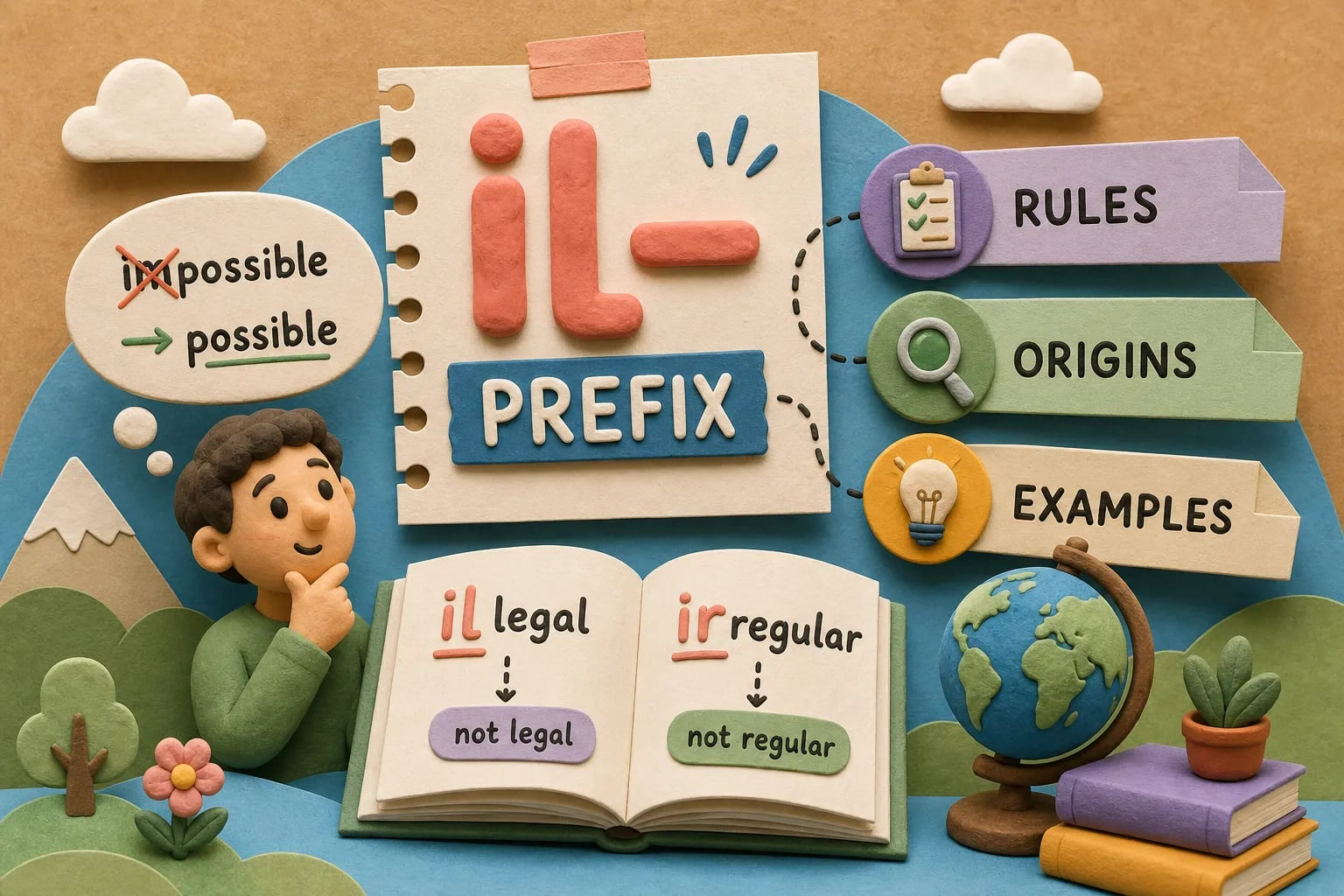
You’ve probably seen the word illegal hundreds of times. You’ve read illogical in books and heard it in arguments. But here’s a question worth pausing on: why does the prefix start with “il-” instead of “in-“? Is it a typo? A spelling exception? Or is there a real rule behind it?
There is a real rule, and once you learn it, it applies to a surprisingly large set of common English words. By the end of this article, you’ll know exactly why the il- prefix exists, which words use it, how to tell it apart from look-alike words that don’t follow the same pattern, and one simple trick to remember the whole system. You’ll find this kind of structured vocabulary lesson throughout Your Daily American, where the goal is always to help you understand the real patterns behind American English, not just memorize lists.
Where the il- prefix comes from
“Il-” is not its own independent prefix. It is a changed form of the Latin prefix “in-,” which means “not.” Latin speakers used “in-” the same way English speakers use “not” today: attach it to a word to flip its meaning. When English borrowed Latin words, it kept the prefix too. So “in-” is the original form, and “il-” is one version of it, a variant that linguists call an allomorph.
The change happened because of a process called assimilation (also known as phonological assimilation), where one sound shifts to match the sound next to it because it’s easier to say. Try saying “in-legal” out loud right now. It feels awkward. Your mouth naturally slides toward “illegal” instead. Latin speakers made the exact same adjustment thousands of years ago, and the spelling stayed that way when English inherited these words. Assimilation is not random, it follows a predictable pattern, which is good news for learners.
The rule: when in- becomes il-, im-, or ir-
When the prefix “in-” (meaning “not”) comes before a root word that starts with L, the “n” changes to “l,” giving you “il-.” So in- + legal = illegal, and in- + logical = illogical. The prefix meaning doesn’t change, it still means “not.” Only the spelling shifts to match the first letter of the root.
You’ll notice that these words are spelled with two L’s: illegal, illogical. In spoken American English, those two L’s merge into one longer L sound, you don’t stop and restart between them. It’s one smooth sound, and that’s exactly what makes it easier to say than “in-legal.”
“Il-” is not a special case by itself. It belongs to a small family of prefix forms that all come from the same “in-” source. This phenomenon is sometimes called prefix allomorphy. Here is the full pattern:
| Prefix form | Used before | Examples |
|---|---|---|
| il- | L | illegal, illogical, illiterate |
| im- | M, P, B | immature, impossible, imbalance |
| ir- | R | irregular, irresponsible, irrelevant |
| in- | All other letters | invisible, inactive, incomplete |
All four forms mean “not.” The spelling just shifts to match the first letter of the root word. Learn this one table and you have a tool that works across hundreds of common English words. (For a concise reference on the form itself, see the Wiktionary entry for “il-“.)
The most common il- words and how Americans use them
The four words you’ll encounter most often are illegal, illogical, illiterate, and illegible. Each one appears in a specific type of situation, so it helps to see them in context.
Illegal means not allowed by law. “Driving without a valid license is illegal.” You’ll hear this word in news reports, legal conversations, and everyday discussions about rules and laws. Illogical means not based on clear thinking. “That argument sounds illogical, the two facts don’t connect.” Americans use this word in debates, problem-solving discussions, and whenever someone’s reasoning doesn’t hold up. Both words appear in ordinary daily conversation. For larger lists and examples of words that begin with “il-,” consult the Merriam-Webster wordfinder for “il-“.
Illiterate means unable to read or write. “The program helps adults who are functionally illiterate find jobs.” This word appears most often in education policy discussions and social topics, less common in casual conversation, more common in formal writing and news. Illegible means impossible to read because of bad handwriting or poor printing. “The doctor’s handwriting was so illegible that the pharmacist had to call the office.” This one shows up in everyday situations as well as professional and administrative contexts.
One more word is worth knowing: illicit, which means not permitted by law or social rules. It often suggests something secretive or morally wrong, beyond simply breaking a written rule. “Illicit funds” or “an illicit relationship” carry a stronger sense of wrongdoing than “illegal” does.
That distinction is easy to blur, so note it carefully: illegal refers to law specifically, while illicit has a broader sense of what is not permitted or not acceptable, socially as well as legally. You’ll see illicit regularly in American news and formal writing.
When il- is not a negative prefix: false positives to watch for
Not every word that starts with “il” contains the negative prefix. Some of the most common examples are illusion, illustrate, and illustration. In these words, “il-” traces back to a Latin prefix meaning “into” or “upon,” not “not.” The root is related to the Latin lūstrāre (“to light up” or “to illuminate”), so illustrate originally carried the sense of shedding light on something, making it clear or vivid. These words do not mean “not + base word.” (For the precise classical morphology, see entries in the American Heritage Dictionary or the Oxford Latin Dictionary.)
A quick test helps here: remove “il-” and ask whether the remaining string is a real English word that the longer word means “not.” With illegal, yes, legal is a real word, and illegal means “not legal.” With illustrate, no, there is no common English word “lustrate” that illustrate negates. If the meaning test fails, “il-” is not functioning as the negative prefix. That meaning check is usually faster and more reliable than any spelling rule alone. For more on how negative prefixes assimilate before different consonants, see this practical explanation of the in-/im-/il-/ir- negative prefix assimilation rule.
The word “ill” itself is another false positive. “Ill” meaning sick or bad comes from Old Norse, not Latin, it is a root word on its own, not a prefix. Words like illness, ill-advised, and ill-fated use “ill” as a modifier meaning “bad,” similar to the way “well” functions as its opposite. These are completely separate from the “in-” prefix family and follow different patterns entirely. For a broader look at how roots and prefixes work together, this resource on common word roots can be helpful: Membean’s rootcast on assimilation.
A quick way to remember and practice the rule
Before you write the prefix, look at the first letter of the base word. Ask yourself: is it L? Write “il-.” Is it M, P, or B? Write “im-.” Is it R? Write “ir-.” Is it any other letter? Write “in-.” That’s the whole system. Jot this down in your study notebook right now:
L gets il-. R gets ir-. M / P / B get im-. Everything else gets in-.
A common mistake among ESL learners is writing “in-” before words that start with L or R, for example, “inlogical” instead of illogical, or “inresponsible” instead of irresponsible. The spelling jumps out as wrong to native speakers immediately. The “first letter” method stops that error before it starts. If you want extra practice and teaching ideas for assimilated prefixes, see this classroom-friendly guide: Membean’s discussion of prefix assimilation.
Try it yourself: a short self-check
Look at each base word below and write the correct prefixed form before reading the answers. Just add the right version of “in-” to make the word mean “not.”
- rational → ?
- legible → ?
- mature → ?
- relevant → ?
- complete → ?
Here are the answers:
- Irrational, the base starts with R, so you use “ir-.”
- Illegible, the base starts with L, so you use “il-.”
- Immature, the base starts with M, so you use “im-.”
- Irrelevant, the base starts with R again, so “ir-.”
- Incomplete, the base starts with C, which is not L, R, M, P, or B, so you use “in-.”
If this kind of vocabulary lesson clicks for you, Your Daily American has an entire Prefixes and Suffixes: Unlock Thousands of English Words built on the same approach: real rules, real American English examples, and straight explanations of when and why the language works the way it does. It’s built for learners who want to actually understand English, not just pass a memorization quiz.
Related articles you may find useful: Filler Phrases Every American English Learner Should Know, and English Words Non-Native Speakers Mispronounce Most Often, Your Daily American.
What you can take away right now
The il- prefix comes from the Latin prefix “in-,” which means “not.” It appears before root words that start with L, and it belongs to a small, predictable family: il- before L, im- before M, P, or B, ir- before R, and in- before everything else. All four forms carry the same meaning, only the spelling changes to make the word easier to say.
Keep the false positive check in your back pocket: if a word starting with “il” does not mean “not + a recognizable base word,” then the “il” is part of the root itself, not the negative prefix. Words like illusion and illustrate are the clearest examples of this. For another concise explanation of negative prefixes and their behavior, this short guide to negative prefixes may be helpful: Membean’s rootcast on assimilation.
The best way to lock in this rule is to use it immediately. In your next reading session, notice every word that starts with il-, im-, ir-, or in- and ask: what is the base word, and what does the prefix add? One pattern like this unlocks a wide range of high-frequency English words, and that is exactly how efficient vocabulary growth works.