Many platforms claim to be the best place to learn English online, but the best online English schools for one person can be the wrong choice for another. Your goal, your schedule, and your budget all change the answer completely. This article compares the top online English schools and platforms in 2026 across pricing, lesson formats, and focus areas so you can make a fast, confident decision without wasting money.
Before you choose any platform, there is one important first step that many learners overlook: finding your current level. Skipping it is one of the most common, and costly, mistakes English learners make. The next section explains why, and how to do it in minutes.
What really separates one online English school from another
Your learning goal is the starting point
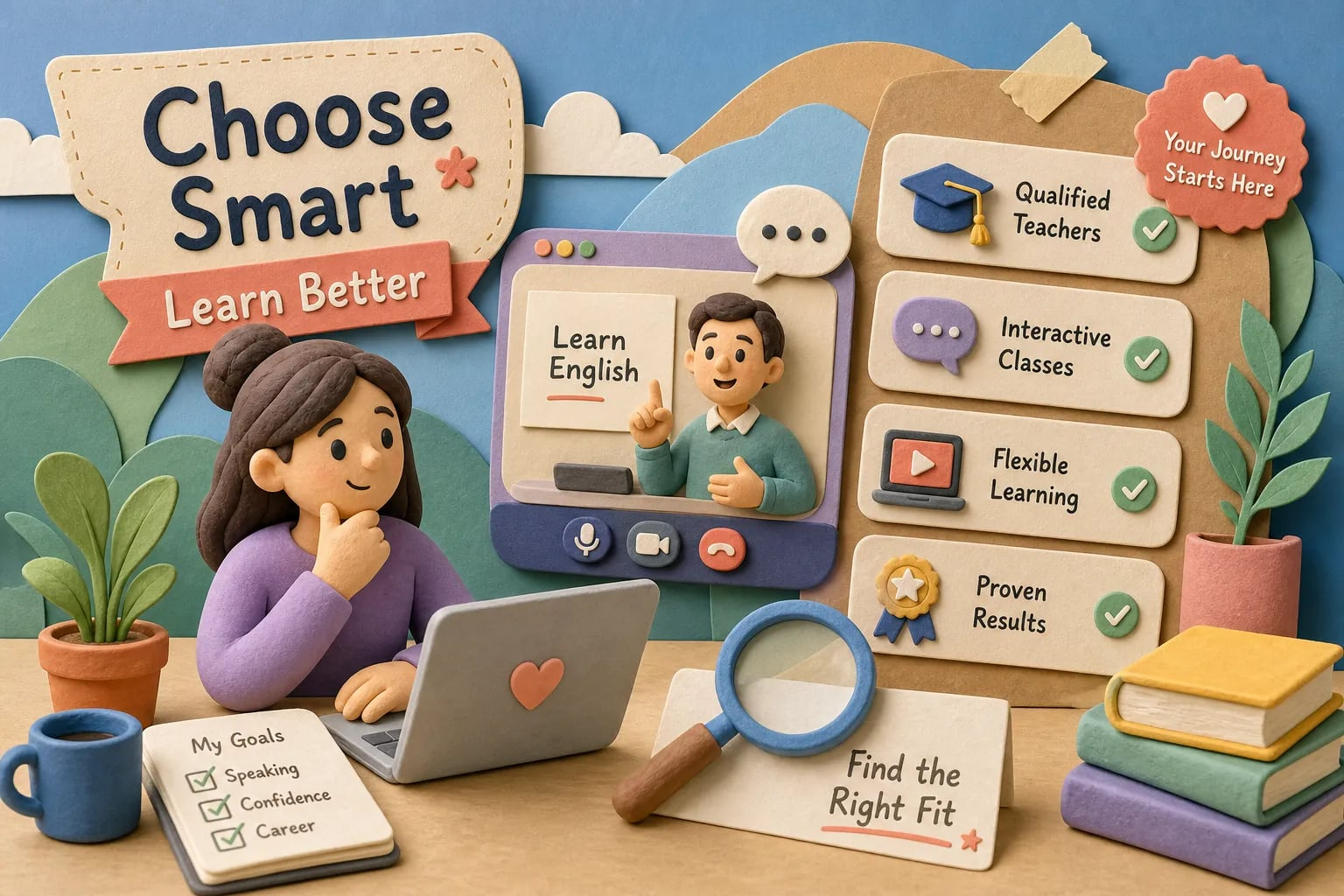
Most learners treat all English platforms as the same. They are not. There are four main goal types, and each one points to a different kind of platform.
- Everyday conversation: You need live practice with native or fluent speakers. Real-time feedback matters more than a structured curriculum.
- Professional or business English: You need content focused on meetings, emails, and workplace communication, not just grammar drills.
- Exam preparation (IELTS, TOEFL): You need a structured curriculum with timed practice, writing feedback, and scored mock tests.
- Pronunciation improvement: You need a platform that teaches sounds, stress, and connected speech, not one that only corrects vocabulary mistakes.
Matching your goal to the right format is one of the most consequential decisions you will make as a learner. Getting this wrong means paying for lessons that feel too easy or impossibly hard, and making slow progress as a result.
American English or British English: why this choice matters
Platforms vary widely in which variety of English they emphasize. Some focus on British patterns, others on American pronunciation, and many teach a general blend. American and British English differ meaningfully in pronunciation, vocabulary, and cultural context. The /t/ sound in American English often becomes a soft flap, so “water” sounds like “WAH-der.” Words like “apartment,” “elevator,” and “vacation” are American; British speakers say “flat,” “lift,” and “holiday.” Spelling also differs: “color” vs. “colour,” “center” vs. “centre.”
If your goal is to work with U.S. companies, understand American media, or live in the United States, look for a platform built specifically around American English. A general platform may not give you the cultural context, the pronunciation patterns, or the idioms that native American speakers actually use in everyday conversation.
Lesson format: live tutoring, structured classes, or self-paced
Live one-on-one tutoring gives you immediate feedback and flexible scheduling, it works best for busy professionals who want to practice speaking on their own schedule. Structured group classes follow a fixed curriculum and meet on a regular schedule, which helps learners who need external accountability. Self-paced courses let you move at your own speed, making them ideal for self-directed learners who prefer to study independently at a lower cost. Knowing which format fits your life before you sign up will save you both time and money.
The step many learners skip: finding your level before you sign up
Why your CEFR level changes every decision
CEFR stands for Common European Framework of Reference for Languages. It is an international scale that runs from A1 (complete beginner) to C2 (near-native fluency). Most reputable platforms use it to place learners into the right course or match them with the right tutor. Signing up without knowing your level is a common and costly mistake: if the program is too easy, you stop growing; if it is too hard, you feel stuck and lose motivation.
Your level also affects your budget. A B2 learner focusing on professional English does not need beginner materials or a general conversation tutor. Knowing your exact level helps you spend your money on the right thing from day one.
How Your Daily American’s free proficiency test saves you time
Your Daily American is a free American English learning platform that includes a CEFR-aligned proficiency test designed to help you identify where you stand before committing to any paid program. The test covers reading, listening, writing, and speaking, and it gives you a personalized result along with guidance on which skills to focus on first. It takes only a few minutes to complete.
This makes it a practical first step regardless of which platform you eventually choose. Take the test, learn your level, then pick the platform that fits. You will avoid overpaying for lessons that are too easy or too advanced.
Best online English schools for live lessons in 2026
italki: flexible, pay-per-lesson tutoring
italki is a marketplace where you choose your own tutor and pay per lesson, no required subscription. Community tutors typically charge $4, $20 per hour. Professional teachers with recognized qualifications generally charge $10, $40 or more. With over 10 million learners and 30,000-plus teachers, the selection is enormous.
italki works best for learners who want control over their schedule and budget. Many teachers offer discounted introductory lessons, so you can test a few tutors before committing to regular sessions. The pay-per-lesson model means you are never locked into a subscription, which makes it one of the most accessible options among online ESL schools.
Preply: structured recurring lessons with a satisfaction guarantee
Preply uses a subscription model. You choose a tutor, select how many lessons per week you want, and are billed every 28 days. Prices range from about $10, $40 per 50-minute lesson depending on your tutor. The platform lists nearly 17,000 English tutors, and Preply reports an average rating of 4.94 out of 5 across its English teachers.
The first lesson comes with a satisfaction guarantee: if you are not happy, Preply will match you with a different tutor or issue a refund. Cancellation is free up to 12 hours before a lesson. Preply works best for learners who need a consistent weekly routine and accountability, including those focused on business English.
Cambly: on-demand conversation with native speakers
Cambly connects you to native English speakers on demand. You subscribe by time rather than by lesson, and pricing works out to roughly $12, $19 per lesson equivalent depending on your billing period. There is no need to schedule sessions in advance, which makes it convenient for irregular schedules.
Cambly works best for intermediate learners who need frequent speaking practice. It is not structured around a curriculum, so it is better suited to conversation fluency than exam preparation. Cambly Kids is a separate option for younger learners.
Lingoda: classroom-style group and private lessons
Lingoda offers monthly class packages with a fixed schedule. Group classes cost about $6, $17 each depending on the volume you buy, and private classes range from about $13, $42. Classes run 60 minutes and follow a set curriculum, giving them a genuine school feel. Lingoda also runs occasional Sprint challenges, completion-based incentive programs that can refund a portion of your fees, which sets it apart from most other live-lesson platforms. It works well for learners who prefer structure and a classroom experience, but it may feel rigid if you need a highly flexible schedule.
Best online English courses for self-paced and structured learning
Duolingo: daily habits and vocabulary building
Duolingo has approximately 100 million monthly active users. For absolute beginners, it is genuinely effective at building a daily study habit, introducing core vocabulary, and making practice feel low-pressure. The free model and short lesson format keep the barrier to entry minimal. That said, speaking practice is limited and it does not prepare you for professional communication or advanced conversation, so most learners will eventually need to supplement it with a more structured platform.
EF English Live: a full online school experience
EF English Live combines live group classes (including 24/7 sessions), private lessons, and self-study content in one subscription. Plans cost roughly $89, $139 per month. This is the closest thing to a full online school on this list. It works best for learners who want multiple lesson formats, structured progression, and the convenience of one platform for everything.
Coursera and edX: professional English and exam preparation
Coursera and edX offer self-paced online English courses built by universities, often with completion certificates. They are not live tutoring platforms; live instructor interaction is not included, and engagement happens primarily through peer forums. Both are strong for professional English and exam prep (IELTS, TOEFL) through structured, academic-style content. They work best for professionals who want a credential and prefer studying on their own schedule.
Your Daily American: a free resource for real-world American English
What makes American English a specialty on its own
American English has pronunciation patterns that many platforms rarely teach in depth. T-flapping (the soft /d/ sound in “butter” and “water”), connected speech (running words together naturally), and common reductions (saying “gonna” instead of “going to”) all define how Americans actually speak. Without learning these patterns, you can study English for years and still struggle to follow native speakers in real conversations.
American idioms and cultural context add another layer. Phrases like “hit the ground running,” “under the radar,” or “ballpark figure” appear constantly in workplaces and media. A platform built around American English teaches these in context, so you understand not just what they mean, but when and why people use them. Of the platforms reviewed here, italki and Cambly give you the easiest access to American-accent tutors, while Your Daily American focuses the content itself specifically on American usage.
What you get at Your Daily American, for free
Your Daily American covers five content areas: everyday conversational English, professional and workplace communication, pronunciation and listening, grammar, and study methods. Content is organized into thematic tracks so learners at any level can find a clear starting point and build steadily, you are not dropped into a random collection of lessons.
The free CEFR-aligned proficiency test is a standout feature of the platform. It covers reading, listening, writing, and speaking, then gives you a personalized result and guidance on where to focus next. Use it before you sign up for any paid platform on this list to make sure your money goes toward the right level and format.
Who benefits most from this platform
Your Daily American is built for intermediate-to-advanced learners who want to sound natural in American English. This includes immigrants and expats living in the U.S., international professionals working with American companies, and learners focused specifically on pronunciation. It works as a solid standalone path for self-directed learners, or as a useful companion resource alongside any paid platform on this list.
How to match a platform to your budget and next steps
A quick pricing comparison across the top platforms
Use this table to compare the best online English schools and courses at a glance before committing to a plan.
| Platform | Model | Typical price | Trial or guarantee |
|---|---|---|---|
| italki | Pay per lesson | $4, $40/lesson | Discounted intro lessons (tutor-set) |
| Preply | Weekly subscription | $10, $40/lesson | First-lesson satisfaction guarantee |
| Cambly | Time-based subscription | $12, $19/lesson equiv. | No standard trial |
| Lingoda | Monthly class package | $6, $42/class | No standard trial |
| EF English Live | Monthly subscription | $89, $139/month | Varies by plan |
| Your Daily American | Free platform | Free | Free CEFR proficiency test |
The right platform by learner profile
- Tight budget or just starting out: italki community tutors or Your Daily American (free).
- Need accountability and regular lessons: Preply.
- Want to practice speaking anytime: Cambly.
- Prefer a classroom structure: Lingoda or EF English Live.
- Focused on American English pronunciation and real-world fluency: Your Daily American.
Your next step
The right choice among the best online English schools is not the most popular option or the most expensive one, it is the one that matches your goal, your preferred format, and your budget. A busy professional who needs business English needs a different platform than a beginner who wants daily vocabulary practice. Getting this match right is what separates slow, frustrating progress from real, consistent improvement.
Before you spend a dollar on any paid program, take the free CEFR proficiency test at Your Daily American. It covers all four skills, takes only a few minutes, and tells you exactly where you stand. Start there, confirm your level, and then choose from the best online English schools that align with your goals. That is the fastest path to real, confident American English fluency.