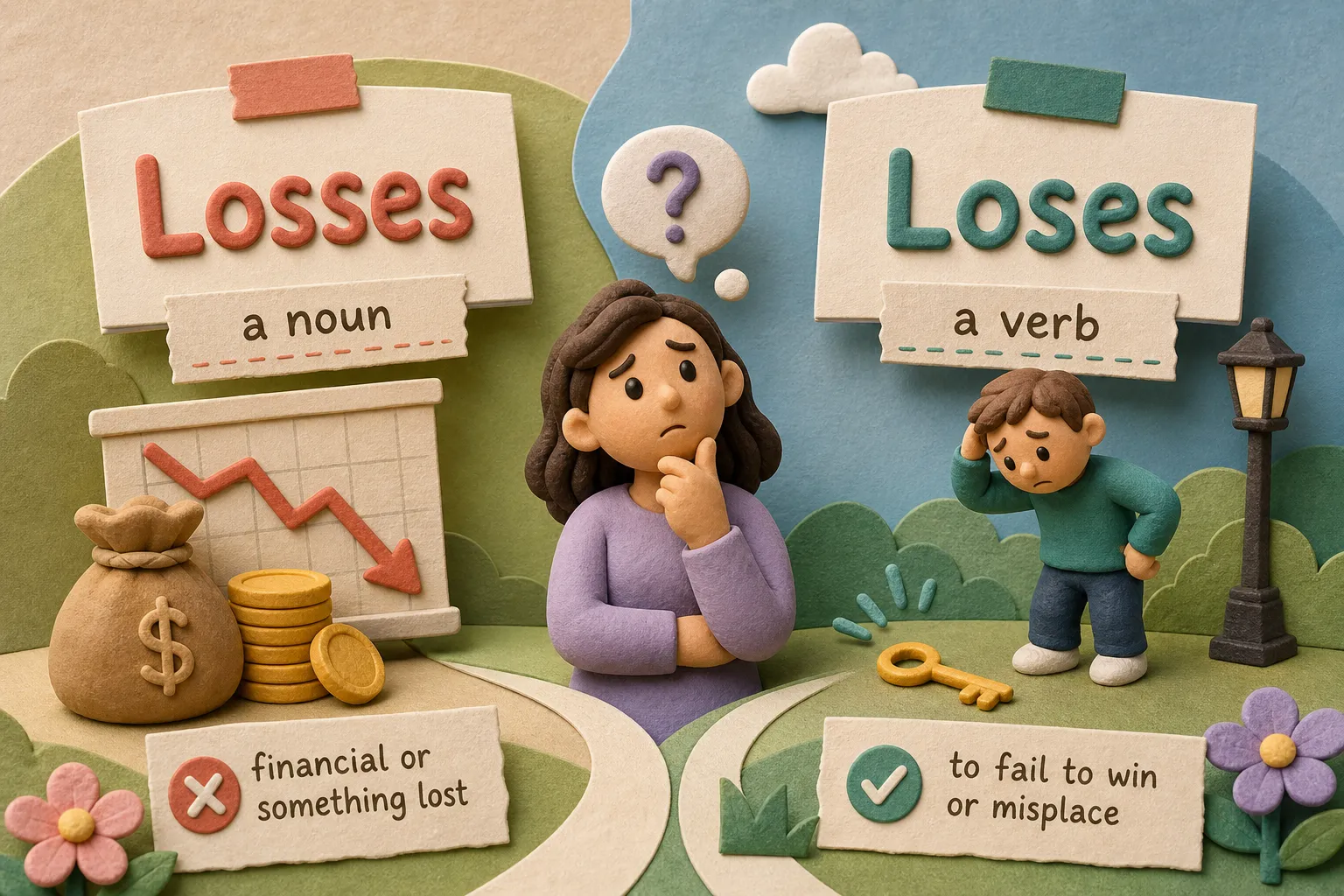
You’re writing a business email and you stop. Should it be “the company loses money every quarter” or “the company losses money every quarter”? You know something is wrong with one of them, but you’re not sure which. This losses vs. loses confusion trips up many English learners, and it makes complete sense, the two words look almost identical.
By the end of this lesson, you will know exactly when to use loses and when to use losses, in any sentence, in any situation. The key is understanding that these two words are different parts of speech. One is a verb. The other is a noun. That one difference explains everything.
At Your Daily American, we focus on exactly this kind of practical distinction: the grammar and word choices that matter most in real professional writing. Getting loses versus losses right is a small decision that makes your emails and reports sound clear and confident.
What “Loses” Means and How It Works in a Sentence
“Loses” is a verb. It describes an action, specifically, the action of failing to keep something, failing to win, or ceasing to have something. It comes from the verb “lose,” and it is the third-person singular present tense form. That means you use “loses” when your subject is “he,” “she,” or “it.”
Think about other verbs that work the same way: “runs,” “takes,” “finds.” These all end in “-s” or “-es” in the third-person singular. “Loses” works exactly the same way. The “-es” ending marks the third-person singular present tense, signaling habitual or current actions.
When to Use “Loses” (the Subject Clue)
The fastest way to check whether you need “loses” is to look at your subject. If your subject is “he,” “she,” “it,” or a single person or thing, “loses” is the right choice. Here are clear examples:
- He loses his keys every morning.
- The team loses when it makes too many errors.
- She loses focus if the meeting runs too long.
Each sentence describes an action happening regularly. The subject is doing something, or rather, failing to do something. The verb “loses” carries that meaning.
How “Loses” Sounds in Spoken American English
“Loses” is pronounced /ˈluːzɪz/, say it as “LOO-ziz” (Merriam-Webster). The middle vowel is long and the word ends with a /z/ sound. It rhymes with “uses” and “chooses.” When you hear this word in a business conversation or a sports broadcast, that long “oo” sound is your clue that you are hearing the verb, not the noun.
What “Losses” Means and How It Works in a Sentence
“Losses” is a noun. It is the plural of “loss.” A noun names a thing, and “losses” names multiple instances of losing. It does not describe an action, it describes a result, an amount, or a quantity that can be counted.
You can use “losses” the same way you use other plural nouns: after numbers, after words like “many” or “several,” and after articles like “the.” It refers to something that already happened or exists, not something that is being done at this moment.
Counting Losses Like Any Other Noun
Notice how “losses”, the plural of loss, behaves just like any other countable noun in these sentences:
- The company reported significant losses last quarter.
- The team finished the season with twelve wins and five losses.
- Job losses increased during the economic slowdown.
You could replace “losses” in each sentence with another plural noun like “results” or “defeats,” and the sentence structure would still work. When another noun can step in cleanly, you are looking at a noun.
How “Losses” Sounds Differently from “Loses”
“Losses” is commonly pronounced /ˈlɑːsɪz/ or /ˈlɔːsɪz/ depending on dialect, say it as “LAH-siz” (Cambridge Dictionary). The vowel in the middle is shorter and more open, like the “a” in “father.” The word ends with a voiceless /s/ sound, not the /z/ you hear in “loses.” It rhymes with “bosses” and “crosses.” In financial news or a sports report, that shorter vowel and the /s/ ending will help you hear the difference.
Losses vs. Loses: The One Test That Tells You Which Word to Use
Here is the core rule: ask yourself whether the word is performing an action or naming a thing. If the word describes an action that a subject is performing, use “loses.” If the word names a thing that can be counted or referred to, use “losses.” This verb-or-noun test will identify the correct form in virtually all standard usages. If you encounter an unusual construction, check the word’s role in the sentence or consult a dictionary.
The Sentence Frame Method
Two simple frames make this test very fast. Try fitting your word into one of these:
- Frame 1: “He/she/it ___ something.” → If this works, you need a verb: use loses.
- Frame 2: “There were many ___ .” or “The ___ were significant.” → If this works, you need a noun: use losses.
Try it with a real example: “The business ___ clients when prices go up.” Frame 1 fits: “It loses clients.” So the answer is “loses.” Now try: “The report listed the financial ___ from last year.” Frame 2 fits: “The losses were significant.” So the answer is “losses.”
Why the “-es” Ending Confuses Learners
Both words end in “-es,” and that is exactly why learners mix them up. In “loses,” the “-es” is a verb suffix that marks the third-person singular, just like in “uses” or “chooses.” In “losses,” the “-es” is a plural suffix that marks more than one, just like in “classes” or “bosses.” Looking at the spelling alone will not help you. You need to think about what the word is doing in the sentence.
Workplace Sentences Using Both Words Correctly
Seeing both words in real professional contexts will help you remember the rule and use it naturally. Below are three common workplace settings where you will find “loses” and “losses”, sometimes in the same document or conversation.
In Financial Reports and Business Emails
Financial writing uses these two words often, and the distinction matters. Study these examples carefully:
- The quarterly report showed net losses of $2 million.
- We need to reduce our losses before the next review cycle.
- If the company loses market share this year, the board will meet in October.
Notice the pattern: “losses” appears when the writing refers to a result or a number, something that already happened. “Loses” appears when the sentence describes an ongoing action. Financial reports typically follow this noun/verb distinction carefully, so reading reputable financial writing is useful practice.
In Sports Commentary and Team Updates
Sports media uses both words regularly, often in the same article or broadcast segment. These examples show both forms in natural context:
- If the team loses on Friday, they are out of the playoffs.
- The team’s losses this season have been very close games.
- He loses the ball too often in the second half.
Sports reports are useful reading practice for spotting this difference. The two words appear frequently and naturally side by side, making it easy to compare them directly.
In Workplace Conversations and Meeting Notes
You will also see these words in internal emails, project updates, and meeting notes. Here are natural examples from everyday professional communication:
- When a client loses confidence in the team, it takes time to rebuild trust.
- We discussed the losses from last month’s project during the review.
- The department that loses the most budget requests will need to adjust its plan.
These examples show that the verb/noun distinction matters in day-to-day professional communication, not just in formal financial reports. Getting it right in an email or meeting note signals real command of the language.
Common Mistakes and Two Quick Memory Tricks
Most learners make one of two errors: using “losses” where a verb is needed, or using “loses” where a noun is needed. Both mistakes come from the same source, applying the wrong word form to the sentence.
The Two Most Common Errors
Wrong: He losses his phone all the time.
Right: He loses his phone all the time.
“He” needs a verb. “Losses” is a noun and cannot serve as one. Use “loses”, the verb form.
Wrong: The company had many loses last year.
Right: The company had many losses last year.
“Many” comes before a noun. “Loses” is a verb and cannot fill that role. Use “losses”, the plural noun.
Grammarly’s guide to losses vs. loses and other usage notes document how frequently learners substitute verb forms for nouns and vice versa. Once you know the verb-or-noun rule, you will catch both mistakes quickly on your own.
Losses vs. Loses: Two Memory Tricks That Work
The rhyme trick: “Loses” rhymes with “uses”, both are verbs. “Losses” rhymes with “bosses”, both are nouns. Say it out loud: “He uses, he loses.” “The bosses, the losses.” Many learners find this mnemonic helpful for a quick check when they are unsure.
The replace trick: Try swapping the word for another noun or verb. If “defeats” or “mistakes” fits naturally in the same spot, you need “losses.” If a verb like “wins” or “gains” fits when you reverse the meaning, you need “loses.” For example: “The company had many defeats last year”, that works, so use “losses.” “She loses every time she skips preparation”, that is a verb action with “she,” so “loses” is correct.
Test Yourself Before You Go
Here is the rule in one sentence: loses is a verb that describes an action performed by he, she, or it; losses is the plural noun form of “loss” that names something you can count. Use the sentence frame test any time you are not sure, and use the rhyme trick to double-check your choice.
Now try these sentences on your own. Choose “loses” or “losses” for each blank:
- The investor ___ money every time he buys at the wrong time.
- The report listed the company’s financial ___ for the past three years.
- When a business ___ a key employee, it can take months to recover.
(Answers: 1. loses, 2. losses, 3. loses)
If you got all three right, you have the rule. If one surprised you, go back to the sentence frame method and try again. Small distinctions like the losses vs. loses difference, noun vs. verb, make a real difference in professional emails, reports, and presentations. They show that you understand not just words, but how words work.
At Your Daily American, we cover many more distinctions like this one: the grammar, vocabulary, and word choices that matter most in real business writing and everyday conversation. If communicating in American English with confidence is your goal, building precision one rule at a time is exactly how you get there.