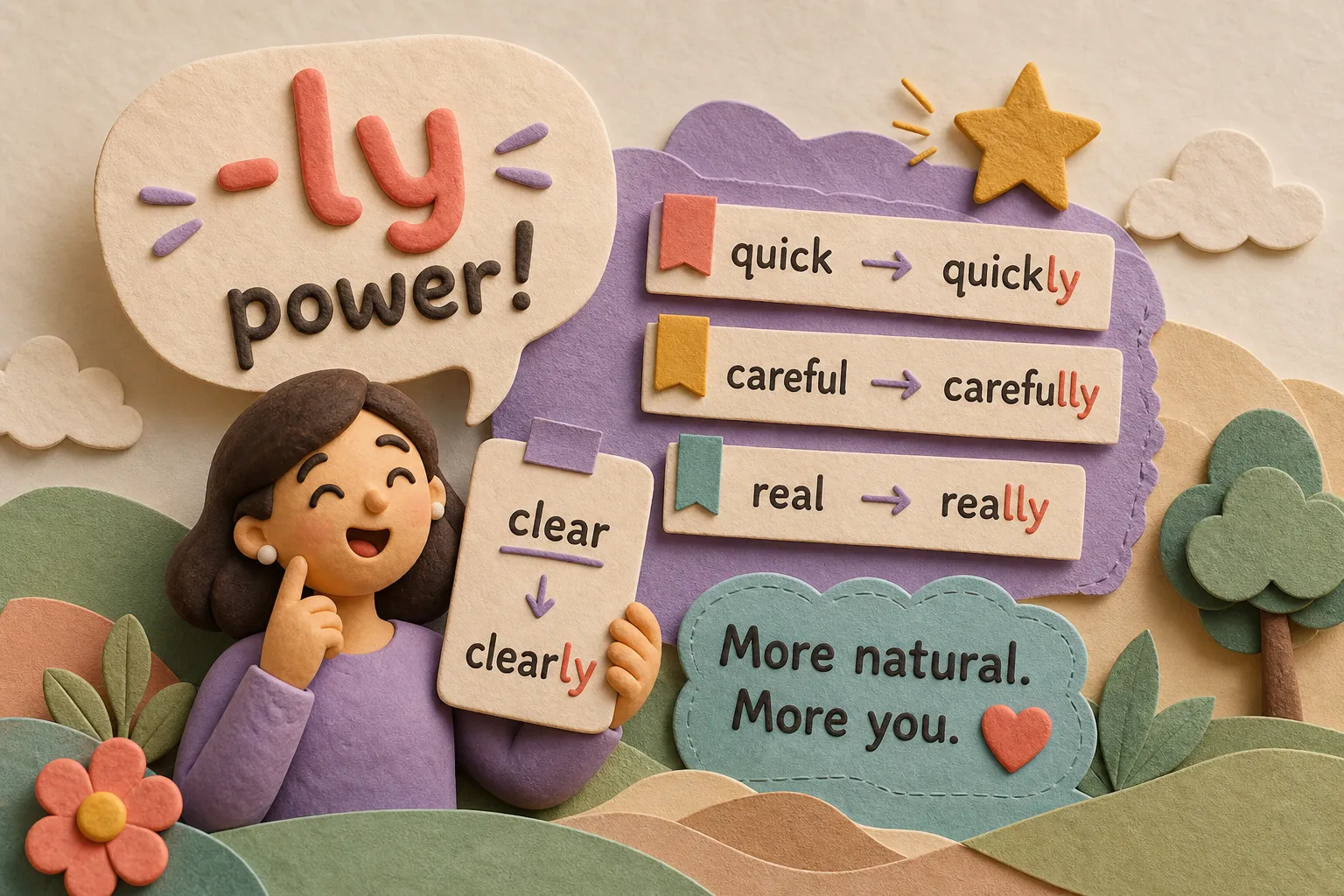
Compare these two sentences: “She spoke in a quiet voice” and “She spoke quietly.” Both sentences carry the same meaning. But native speakers of American English almost always choose the second version. It sounds natural, clear, and direct. The first version feels a little heavy, like a translation. That small difference comes from the ly suffix: the -ly suffix converts adjectives into adverbs, and it is one of the most practical tools in English grammar.
By the end of this lesson, you will know exactly what the -ly suffix does, how to spell it correctly, which exceptions to watch for, and how to use it in both casual conversation and professional writing. This is a grammar pattern that shows up constantly in real American English. At Your Daily American, lessons like this are built around real conversations and everyday contexts, so you learn grammar the way it actually works, not as a set of abstract rules.
What the -ly suffix does to a word
How adjectives become adverbs
An adjective is a word that describes a noun. An adverb is a word that describes a verb, an adjective, or another adverb. The -ly suffix is a derivational suffix that turns adjectives into adverbs. The new word answers the question “how?” (For a quick look at the etymology of -ly see the historical entry on Etymonline.)
Here is the basic transformation: slow (adjective) becomes slowly (adverb). Look at how the part of speech shifts in a real sentence. “He is a careful driver” uses careful as an adjective describing the noun driver. “He drives carefully” uses carefully as an adverb describing the verb drives.
Why this matters for how you sound
Native speakers use -ly adverbs constantly. Without them, sentences feel heavy or unnatural. Compare “She answered in a quick way” with “She answered quickly.” The second version is what Americans actually say. The adverb does the same job in fewer words.
Adverbs also help you add detail and emotion without making your sentence longer than it needs to be. “He left” tells you what happened. “He left suddenly” tells you how. That one word changes the whole picture. This is one of the most common patterns in both spoken and written American English, so getting it right makes a real difference.
Spelling rules for the -ly suffix
The standard rule and the -y ending
Most of the time, you simply add -ly to the adjective. For example: slow → slowly, loud → loudly, and clear → clearly. That covers the majority of cases you will see.
When an adjective ends in a consonant followed by the letter y, change the y to i before adding -ly. So happy becomes happily, easy becomes easily, and angry becomes angrily. Writing “happyly” is one of the most common spelling mistakes learners make. Remember: change the y, then add -ly.
The -ic and silent -e endings
Adjectives that end in -ic almost always take -ally, not just -ly. So basic → basically, tragic → tragically, and realistic → realistically. There is one important exception: public → publicly, not “publically.” That one is worth memorizing on its own.
Some adjectives ending in a silent -e drop that letter before adding -ly. True → truly and due → duly are the most common examples. Writing “truely” is a frequent mistake, so keep this pair in mind. The good news is that most -ly words follow the simple add-ly rule. These four patterns, the standard rule, the -y change, the -ic rule, and the silent -e drop, cover almost every case you will meet. For a clear overview of English spelling guidance, see Grammarist’s spelling notes.
Common exceptions that trip up learners
Irregular adverbs and flat adverbs
The most important irregular pair is good → well. “She sings good” is a very common mistake. The correct form is “She sings well.” This error appears so often in spoken English that some native speakers use it too, but in writing and professional settings, “well” is the right choice.
Some words work as both adjectives and adverbs without any change. These are called flat adverbs. Common examples are fast, hard, early, late, and daily. “He runs fast” is already an adverb. The word “fastly” does not exist in English, so never add -ly to these words. (If you want a concise explanation of how to form adverbs from adjectives, this guide gives helpful examples.)
Here is a point that confuses many intermediate learners: hardly and lately exist, but they do not mean the same thing as hard and late. Hardly means “almost not.” Lately means “recently.” “I have hardly slept” means you got almost no sleep. “I have been busy lately” means you have been busy recently. These words carry completely different meanings, so treat them as separate vocabulary items.
Words ending in -ly that are actually adjectives
Not every word that ends in -ly is an adverb. Some -ly words describe nouns, which makes them adjectives. Common examples include friendly, lovely, lonely, lively, elderly, costly, likely, and orderly.
You can say “a friendly smile” or “a lovely day.” In both phrases, the -ly word is an adjective modifying a noun. The key question to ask is: does this word describe a noun, or does it describe a verb or adjective? If it describes a noun, it is an adjective. If it describes a verb or adjective, it is an adverb. That one question will guide you correctly almost every time. For a quick reference to usage and definitions, see the Dictionary.com entry for -ly.
How the -ly suffix shows up in everyday American conversation
The adverbs you’ll hear every day
In casual American speech, a core group of -ly adverbs appears again and again: basically, seriously, honestly, actually, quickly, quietly, suddenly, clearly, really, probably. You will hear them in coffee shops, at the office, and on podcasts. Learning them gives you immediate listening comprehension improvements.
Here are some short examples of how these words sound in natural conversation:
- “Honestly, I had no idea.”
- “She basically told him the meeting was canceled.”
- “He left really quickly.”
- “Seriously? I didn’t hear about that.”
Notice that these adverbs do more than add information. They also signal tone. “Seriously?” as a question expresses surprise or disbelief. “I mean it seriously” expresses emphasis. The same word can carry very different feelings depending on how you use it.
Using -ly to sound more expressive
When you replace longer phrases with precise adverbs, your speech sounds more fluent. Compare “He talked in a loud way all night” with “He talked loudly all night.” Both sentences are grammatically correct, but native speakers say the second one. The -ly adverb is shorter, cleaner, and more natural.
At Your Daily American, this kind of pattern is practiced through real situational dialogues and everyday conversations. Instead of drilling isolated grammar rules, you hear and use these adverbs in realistic contexts, which helps the pattern become automatic much faster.
How -ly adverbs work in professional English and email writing
-ly in workplace conversations and meetings
In professional settings, -ly adverbs signal precision and confidence. They make your communication cleaner and more direct. Consider the difference between “I agree a lot” and “I strongly agree.” Both express agreement, but the second sounds more polished and professional.
Common workplace adverbs include: promptly, formally, directly, professionally, effectively, briefly, sincerely, strongly, thoroughly, clearly, consistently. In a meeting, you might say “I’d like to briefly review the numbers” or “She clearly explained the process.” These phrases sound natural, confident, and competent, exactly the impression you want to make. If you want help with pronunciation and emphasis in spoken meetings, check our Word Stress in American English: A Complete Guide.
-ly in American business emails
Email writing is where the -ly adverb suffix becomes especially useful for managing tone. It helps you sound professional without coming across as cold or distant. Here are some real email phrases you can use directly:
- “I sincerely appreciate your time.”
- “Please respond promptly at your earliest convenience.”
- “I’m formally requesting an extension.”
- “We strongly encourage all team members to attend.”
- “Thank you for clearly outlining the next steps.”
These phrases follow a simple structure: an -ly adverb placed before or after a verb. Once you recognize that pattern, you can build many similar phrases on your own. “I strongly recommend,” “I briefly wanted to follow up,” “I sincerely apologize”, all of these use the same structure, and all of them sound natural in American professional writing.
Quick practice: try it yourself
Word transformation warm-up
Look at the adjectives below and form the -ly adverb for each one. Try to do it before reading the answers.
- happy → happily (change y to i)
- basic → basically (add -ally for -ic endings)
- true → truly (drop the silent -e)
- friendly → no standard -ly adverb form (friendly is already an adjective; use “in a friendly way” instead)
- public → publicly (exception to the -ic rule; no -ally here)
- sudden → suddenly (standard rule)
- full → fully (standard rule; keep both l’s)
Try it in a sentence
Now use what you have learned. Write out these three sentences on paper or in a document. Using your hand to write, not just reading, helps the pattern stick.
- Write one sentence about how you do something at work or school. Example: “I usually arrive early and quickly check my messages.”
- Write the opening line of a professional email using at least one -ly adverb. Example: “I sincerely appreciate you taking the time to meet with me.”
- Describe how a person you know does something, using two -ly adverbs. Example: “She speaks clearly and always explains things patiently.”
Practicing in real sentences, not just studying rules, is what makes these patterns automatic. The more you write and speak with -ly adverbs in context, the more naturally they will come to you.
Keep building from here
The -ly suffix follows a clear set of rules. You add -ly to most adjectives, change a final y to i before adding -ly, use -ally after -ic endings, and drop the silent -e when needed. There are a small number of exceptions worth knowing: good → well, flat adverbs like fast and hard, the separate meanings of hardly and lately, and -ly adjectives like friendly and lovely that describe nouns rather than verbs.
The real value of learning this pattern goes beyond avoiding grammar mistakes. It is the ability to express yourself with greater detail and precision while sounding more natural in any situation. Whether you are chatting casually or writing a work email, the -ly suffix helps you come across as someone who is truly comfortable in English.
Once you start noticing -ly adverbs in what you read and hear, you will see them everywhere. That kind of awareness is a sign that you are moving from studying English to actually using it. If you want to keep building that awareness, Your Daily American is where grammar patterns like this one appear in real American conversations, professional email examples, and practical writing, so the language becomes something you use with confidence, not something you simply memorize.
Find more lessons and exercises in our Daily Grammar section.