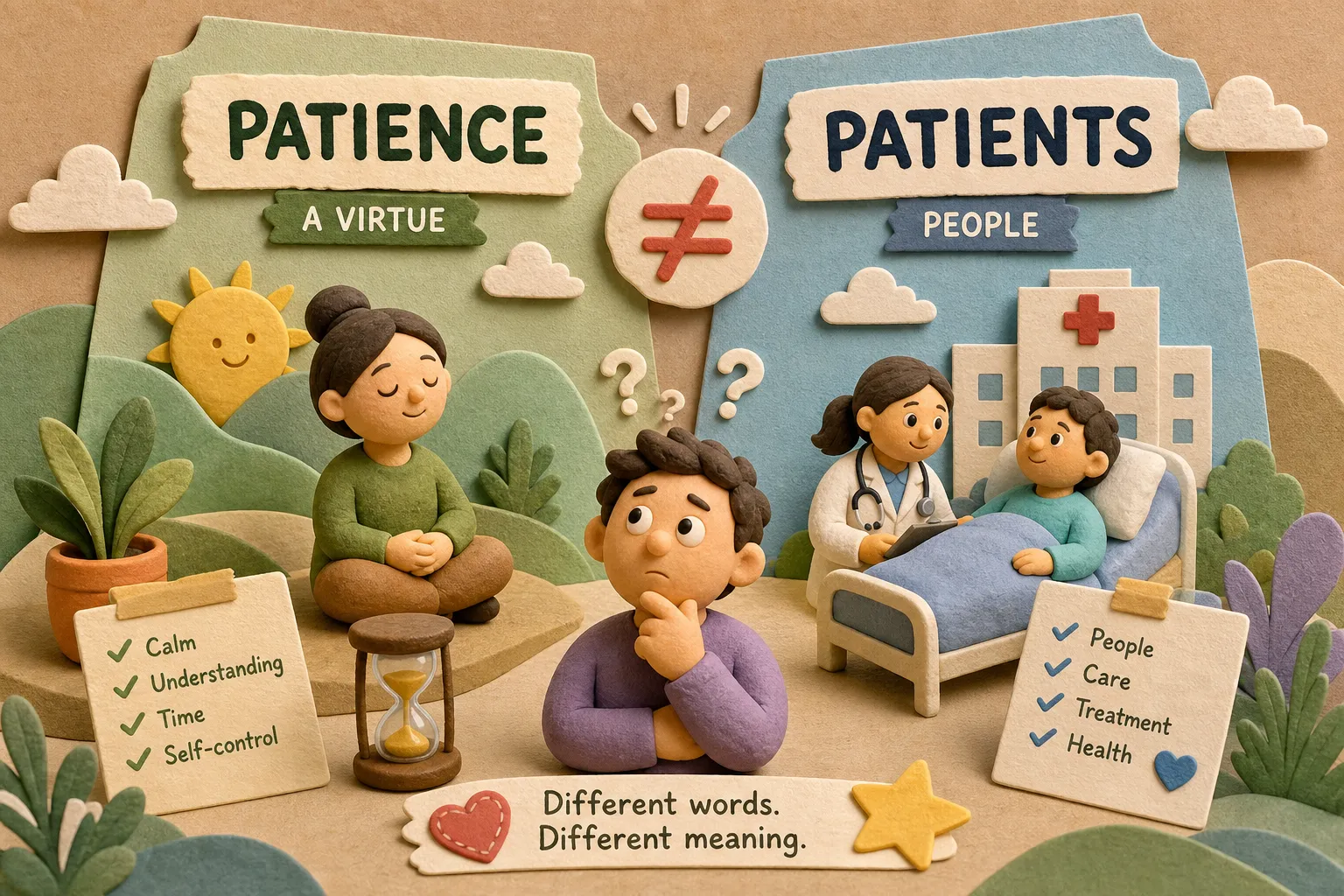
Patience vs. patients is one of those vocabulary mix-ups that trips up even careful writers, and it’s easy to see why. Both words are pronounced exactly the same, yet in writing they mean completely different things. Using the wrong one changes the meaning of your sentence in a significant way.
This error often arises from homophone confusion rather than any overall weakness in your English. Homophones are words that sound identical but carry different spellings and meanings, and they require you to think about meaning rather than sound. That’s the real challenge here, and the fix is simpler than you might expect.
By the end of this guide, you will know what each word means, how to use both correctly in a sentence, and two practical memory tricks to help you get it right every time. At Your Daily American, vocabulary lessons go beyond dictionary definitions. They show you how words actually work in real American English: which part of speech they are, which verbs they pair with, and which grammar mistakes to avoid.
Patience vs. patients: meaning and examples
Patience: a noun that names a quality
Patience is a noun. It describes the ability to stay calm while waiting or dealing with something difficult. It is not a person, a place, or a thing you can touch. It is a quality, something you have, show, lose, or need. Notice the verbs that naturally pair with this word: have patience, show patience, need patience, lose patience, require patience. All of them treat the quality as something that exists inside a person. For a quick dictionary definition you can check the Dictionary.com definition of patience.
Patients: a noun that names people
Patients is the plural form of the noun patient. A patient is a person receiving medical care, at a hospital, a clinic, or a doctor’s office. So patients means more than one of those people. A doctor sees patients. A hospital has patients. Nurses take care of patients. In most everyday contexts, the word refers to real people in a medical setting.
Same word family, different jobs
Both words share the same root, and that connection is part of what makes the mix-up so easy. Patient works as an adjective (“she is very patient”). Patience is the noun that names the quality of being patient. Patients is a plural noun that names people. They are related, but they do completely different jobs in a sentence. Understanding that connection helps you see the logic behind the words rather than simply memorizing them. If you’d like another example of a confusing pair, read Peak vs Peek: How to Use Each Word Correctly.
Patience vs. patients pronunciation: why they sound identical
How both words are pronounced
Both patience and patients are pronounced /ˈpeɪ.ʃəns/, in plain terms: PAY-shunss. The vowel sound matches the word day. Then comes a sh sound, followed by a soft, unstressed ending: unss. There is no difference in sound between the two words. Zero. Say them out loud right now and they are identical. You can also listen to the pronunciation on the Cambridge pronunciation page for “patience” if you want an audio example.
Why identical pronunciation creates real confusion
Because these words sound the same in speech, the confusion tends to happen in writing rather than in listening. When someone says “the doctor needed a lot of PAY-shunss,” context makes the meaning clear. But when you sit down to write, your brain must choose the spelling, and that’s where the mistake happens. This is not a sign of poor English. It is a spelling and meaning challenge that many learners face, regardless of their level. The solution isn’t to study harder. It’s to understand what each word means and run a quick check before you write.
How to use each word in real sentences
Patience in everyday situations
Read each sentence below and notice that the word names a quality, not a person.
- Learning a language takes a lot of patience.
- She showed great patience when her flight was delayed for three hours.
- Her teacher had the patience to explain the same grammar rule five different ways.
- You need patience when you are waiting for results.
In every sentence above, the word names a quality. It follows verbs like take, show, have, and need. You could swap in a similar quality word, confidence or resilience, and the sentence structure would still hold.
Patients in medical and professional settings
Now look at these sentences and notice that every one is about real people receiving care.
- The doctor had ten patients before noon.
- The nurses checked on all the patients after surgery.
- There were forty patients waiting in the emergency room.
- The clinic takes care of over 200 patients every week.
In medical contexts, patients typically answers the question “who?” It names a group of people. If you can replace the word with “people” or “individuals” and the sentence still makes sense in a medical setting, the plural form is the right choice.
The “be patience” mistake: why it happens and how to fix it
Why “be patience” doesn’t work in English
This is a frequent error among ESL learners, and the reason is straightforward: patience is a noun, and the verb be needs an adjective after it, not a noun. “Be patience” breaks the basic grammar rule for how be works in English. Many languages express this idea differently, which makes it easy to transfer the wrong structure.
Here is the direct fix:
- Wrong: “Be patience.”
- Right: “Be patient.”
Patient (the adjective) is the form that works with be. Think of similar structures: “Be careful.” “Be calm.” “Be patient.” In each case, the word after be is an adjective that describes a state or quality.
“Be patient” vs. “have patience”: which to use when
“Be patient” is the more natural, everyday choice in American English. Use it when giving direct advice or an instruction. “Have patience” is also correct, but it sounds slightly more formal, it treats the quality as something you possess, like a resource. Both are grammatically correct and naturally used by American English speakers. For a clear explanation of the common confusions around these forms, see Grammarly’s guide to patience vs. patients.
- “Be patient. The results take time.” (direct advice)
- “Just be patient with yourself while you learn.” (encouraging someone)
- “Have patience with the process.” (slightly more formal)
- “She has the patience to work through every problem carefully.” (describing a quality)
And here are the forms that are always wrong: “be patience,” “have patient” (in the sense of the quality), and “be patients” (unless you are literally referring to medical patients). These mix up word classes and make your sentence unclear or grammatically incorrect.
Two memory tricks that make this click
Trick 1: the S in “patients” stands for several people
Patients ends in -s because it is a plural. That s can remind you of several people. Before you write the word, ask yourself one question: “Am I talking about people?” If the answer is yes, you are writing about people in a hospital or clinic, use patients (with the s). If the answer is no, you are writing about the quality of waiting calmly, use patience (no s).
This check takes about two seconds. Once it becomes a habit, you will rarely confuse the two words in writing again. The question “Am I talking about people?” is simple, fast, and consistently reliable.
Trick 2: the -ce in “patience” signals a characteristic
Patience ends in -ce, and so do many English words that name personal qualities: confidence, resilience, independence, persistence. That -ce ending signals that the word names an abstract quality, not a person or thing. When you see or write a word with that ending, ask yourself: “Is this naming a quality or a characteristic?” If yes, the -ce ending belongs there.
Try this swap test: replace patience with confidence in your sentence. “She showed great confidence.” “She showed great patience.” Both work because both are nouns naming personal qualities, which confirms that patience (with the -ce) is correct. If the swap doesn’t work, take another look at your word choice.
A quick self-check before you go
Common grammar mistakes: patience vs. patients
Read each sentence below and decide: should it be patience or patients? Think about the meaning before you check the answers.
- The hospital had more than 50 ________ waiting for test results.
- Learning to cook takes time and ________.
- Please be ________, the system is loading. (Careful: this one is a different form.)
Here are the answers: (1) patients, these are real people in a hospital. (2) patience, this is the quality of waiting calmly. (3) patient (the adjective), after be, you need the adjective, not the noun. If you wrote “be patience” for number 3, now you know why that form does not work in English.
Where to find more vocabulary guides like this
English has many word pairs like this one, words where a single spelling difference changes the entire meaning. At Your Daily American, the vocabulary guides go beyond simple definitions. They show you how words behave in real American English, with example sentences, grammar notes, and practical checks like the ones in this article. For other practical guides, see Numbers in English: The Complete Practical Guide and English Words Non-Native Speakers Mispronounce Most Often, Your Daily American. Keep building sharp vocabulary knowledge there.
What to remember about patience vs. patients
Patience is a noun that names a quality, the ability to stay calm while waiting or dealing with difficulty. Patients is a plural noun that names people receiving medical care. The words sound identical in speech: both are pronounced PAY-shunss. In writing, though, the meaning is entirely different.
Use the two memory tricks: the s in patients reminds you of several people, and the -ce in patience signals a personal characteristic. Correct the most common error by saying “be patient,” not “be patience.” And reach for “have patience” when you want a slightly more formal phrasing of the same idea. For an additional discussion comparing usage and common mistakes, you can consult Dictionary.com or the Cambridge Dictionary entries.
Getting the difference between patience and patients right is exactly the kind of practical vocabulary knowledge that makes your written English clearer and more confident. It is also the kind of detail that gives your writing a noticeably more polished feel. Keep exploring vocabulary guides like this one. Each small correction you make builds a stronger foundation for real fluency.