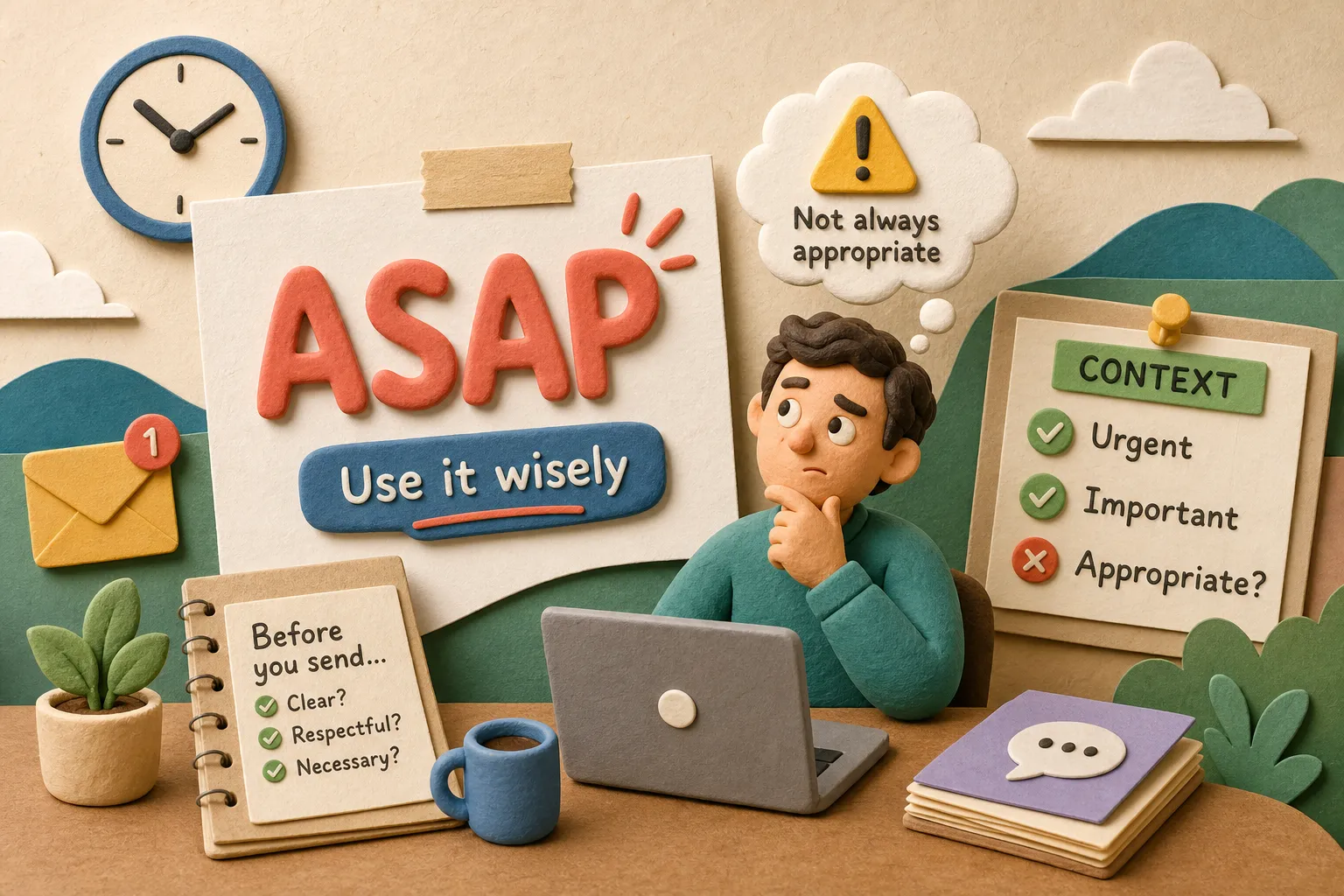
You open a message from your manager. It says: “Can you send me the updated report ASAP?” If you’ve ever wondered about the ASAP meaning, does it mean right now, in an hour, or by end of day?, you’re not alone. ASAP is a very common abbreviation in American English, and it shows up everywhere: text messages, work emails, Slack notifications, and spoken requests. But its actual urgency level is not always obvious.
By the end of this lesson, you’ll know exactly what ASAP means, where it came from, how urgent it really is depending on the situation, and which phrases to use instead when you need to sound more professional. This is the kind of cultural English knowledge that goes beyond the dictionary definition. It’s what Your Daily American is built around: helping you understand not just what words mean, but how and when Americans actually use them.
ASAP Meaning and Origin
ASAP is an abbreviation for “as soon as possible.” Dictionary.com lists it as an adverb meaning “without delay” or “promptly.” Cambridge gives a simple example: “Please reply ASAP.” The meaning is clear: do this before other things, with no unnecessary waiting.
The first recorded use of ASAP in American English dates back to 1920, in a dental-office guide that listed abbreviations for secretaries. By the 1950s, it had become common in U.S. military writing. This abbreviation has been part of standard American English for over 100 years.
For pronunciation, Americans use it two ways. Spelled out letter by letter: “A-S-A-P” (IPA: /ˌeɪ ɛs eɪ piː/ or “ay-ess-ay-PEE”). Said as a single word: “AY-sap” (IPA: /ˈeɪsæp/). In careful or professional speech, the letter-by-letter version is more common. In casual conversation, you’ll often hear “AY-sap.”
ASAP Meaning in Practice: How Urgent Is It, Really?
Literally, “as soon as possible” means “without delay” or “promptly”, though how that plays out in practice depends heavily on context. The real urgency level shifts based on who says it, where they say it, and what situation you’re in.
A manager sending “ASAP” in a Slack message to a teammate often means “today, when you get to it,” not “drop everything right now.” Context matters, a doctor asking for test results ASAP, a client facing a contract deadline, or a safety situation at work. In those cases, ASAP means immediately. The difference is context, not just the word itself.
Americans use ASAP so frequently in everyday communication that its urgency signal has softened in many informal settings. When someone genuinely needs immediate action, they usually add a reason: “Our client is on hold, I need this ASAP.” Without that extra context, a bare “ASAP” is a reasonable default to read as “high priority today,” not “right this second”, though team norms and relationship dynamics always play a role. At Your Daily American, you’ll find many more lessons on how cultural context shapes the meaning of common American expressions like this one.
Casual vs. Professional: How Context Changes the Tone of ASAP
The same abbreviation reads very differently depending on where you use it. This is about register, the level of formality in language. Learning to adjust your register is one of the most useful skills in American professional English, and ASAP etiquette is a perfect example of why it matters.
ASAP works well in these situations:
- Text messages with friends or family: “Call me ASAP!” sounds natural and friendly.
- Casual internal team chats (Slack, Microsoft Teams): “Can you send me that file ASAP?” is fine between colleagues who know each other well.
- Informal spoken requests among coworkers: “I need this done ASAP” is very common in everyday American speech.
ASAP can sound too direct or unprofessional in these situations:
- Formal emails to clients, new contacts, or senior colleagues you don’t know well.
- Written requests where no deadline is given, which can feel vague and demanding at the same time.
- External communication, where tone and formality carry more weight.
A useful rule: the more formal the relationship, the less appropriate ASAP becomes. It’s not about being rude; it’s about matching the right level of language to the right situation. When in doubt, spell it out and add a specific time.
ASAP in Real Sentences: Informal, Neutral, and Formal
The same request sounds very different depending on register, here are three versions side by side. Seeing them together makes the contrast much clearer.
Informal (texts and casual messages):
- “Text me ASAP when you land.”
- “We need to talk ASAP. Call me tonight.”
- “Can you fix this ASAP? The client is waiting.”
Notice how the informal register pairs ASAP with short, punchy sentences. The urgency feels immediate because the phrasing is stripped down. That directness works between people who have an established relationship, it would feel abrupt in a first email to a new contact.
Neutral (standard workplace messages):
- “Please send me the updated report as soon as possible.”
- “Let me know your availability as soon as possible so we can schedule the call.”
Formal (professional emails, external communication):
- “Please provide your feedback as soon as possible, ideally by Thursday morning.”
- “Kindly confirm your availability as soon as possible so we can proceed.”
Notice that in neutral and formal writing, “ASAP” is replaced with the full phrase “as soon as possible.” That spelling choice alone makes the request sound more professional. Even better: pair it with a real deadline, as in the first formal example. “By Thursday morning” tells the reader exactly what you need, which is always clearer than “as soon as possible” alone.
One more tip for ASAP in email: if you receive “ASAP” in a formal message from someone in a senior role, treat it as real urgency. When people in formal settings reach for informal language, they usually have a strong reason for it.
ASAP Alternatives: Professional Options When ASAP Sounds Too Direct
The single best upgrade you can make to any urgent request is to replace ASAP with a specific time or date. “Could you send this by Thursday at 3 p.m.?” is clearer, more respectful, and more professional than “send this ASAP.” It shows you’ve thought about the request and gives the reader a clear target. For more tips on how to express urgency in email without sounding rude, follow guidelines that emphasize clarity and deadlines.
Here are five phrases you can use right away, with short notes on when each one works best:
- “At your earliest convenience”: polite and slightly formal. Good for non-urgent requests when you still want a reasonably fast response.
- “When you have a chance”: friendly and low-pressure. Good for internal requests between colleagues.
- “I would appreciate a quick response”: professional and direct, without sounding demanding. Works well in emails to clients or managers.
- “Please treat this as a priority”: firm and clear. Use this when the urgency is real and you need to communicate it without being rude.
- “This is time-sensitive. Could you please [task] by [date]?”: combines urgency with specificity. This is your strongest professional option.
For ASAP in email subject lines, avoid writing “ASAP” in the subject field entirely. It can read as informal or even alarming. Better options: “Action needed by Friday,” “Response requested by [date],” or “Please review by Thursday at noon.” These signal urgency clearly, without sounding casual or aggressive. If you want a full checklist for workplace messaging and email etiquette, follow well-established professional rules about subject lines, tone, and deadlines.
A common mistake when adjusting to American workplace communication is being either too direct or too soft when expressing urgency in professional emails. Writing “reply ASAP” without context can sound abrupt. Writing “whenever you can” when you actually need something today sends the wrong message. The best approach is always to state the action, the deadline, and a brief reason in plain language. That combination works better than any urgency word or abbreviation on its own.
What You Now Know About ASAP
Here’s a quick recap of the ASAP meaning and what this lesson covered. ASAP stands for “as soon as possible”, an abbreviation that has been part of American English since at least 1920, long before the internet age. Its actual urgency depends on context: who sends it, where they send it, and whether they include a reason.
In casual settings, ASAP is perfectly natural. In formal professional writing, it can sound vague, abrupt, or too informal. Now that you understand the cultural layer behind the abbreviation, you can read it with more confidence and make smarter choices about when to use it yourself. This week, try one small practice step: find an email or message draft that includes “ASAP” and rewrite it using a specific deadline or one of the polite phrases from this lesson. That single change will make your professional English sound much more natural.
If you want to keep building this kind of practical American English fluency, Your Daily American covers hundreds of everyday expressions, workplace phrases, and cultural patterns just like this one. Every lesson is designed to help you use the language in real situations, not just understand it on paper. For focused guidance on creating clear, professional messages, see our guide on How to Write a Professional Email in American English, Your Daily American.