You already know words like comfortable, reliable and reasonable. What you may not realize is that all three follow the same pattern: a base word plus the able suffix (written -able), a word ending added to a verb or noun to create a new adjective. The able suffix is one of the most productive word-building tools in English. Once you see the pattern clearly, you can recognize hundreds of English words at a glance and even build new ones on your own.
By the end of this lesson, you’ll know exactly what the -able suffix means, how to spell words ending in -able correctly, how to tell it apart from -ible, and how to use high-frequency -able words in both daily conversation and professional emails. At Your Daily American, we believe vocabulary makes the most sense when you learn it in real situations, not just in a list. That’s the approach this lesson takes.
What the able suffix means and how it works
The -able suffix comes from the Latin ending -abilis, which traveled into English through Old French. That Latin root matters because it explains the core meaning: “capable of” or “fit to be.” So readable means “able to be read,” and drinkable means “fit to drink.” The origin is why this pattern stays so consistent across so many words.
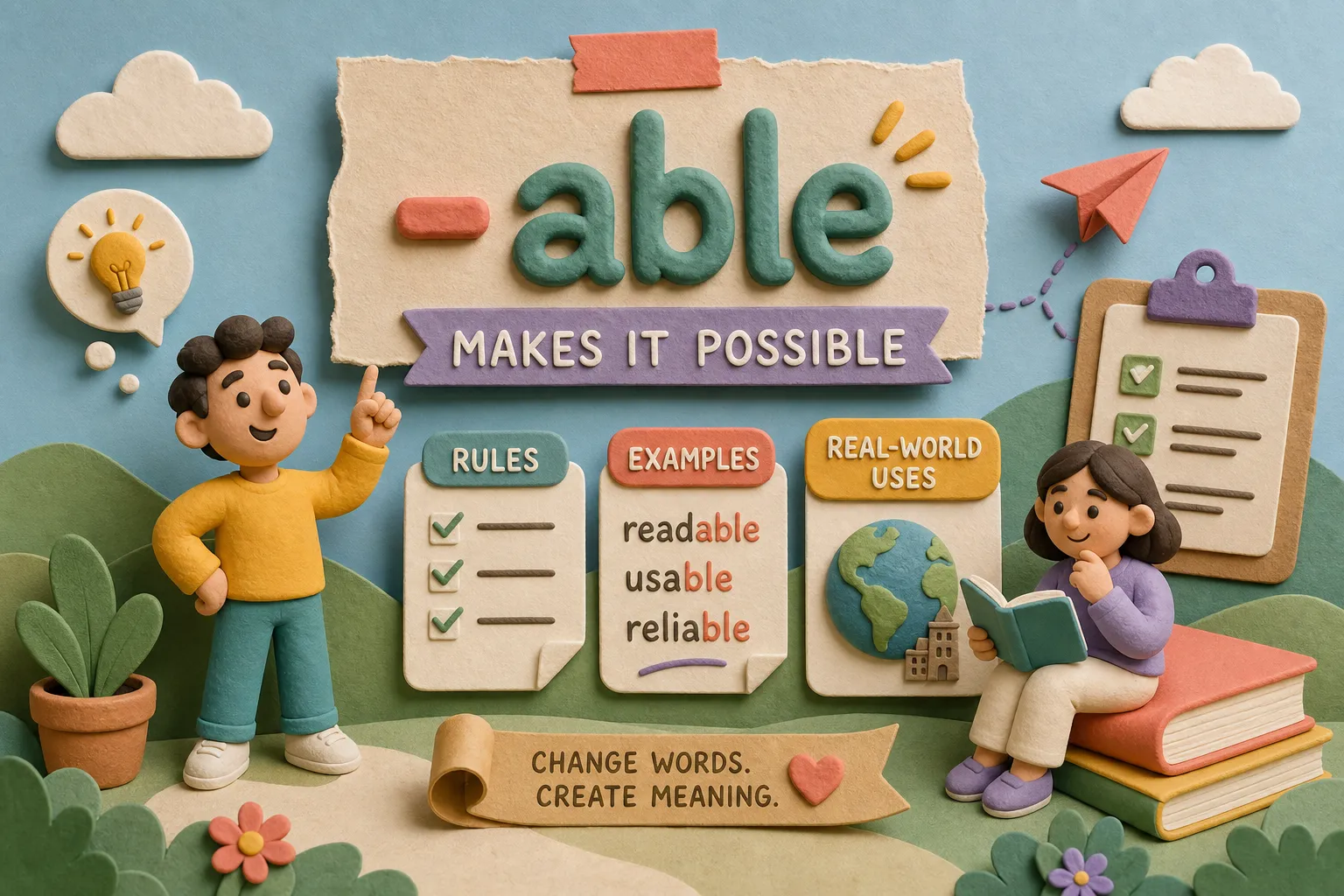
The main job of the -able suffix is to take a verb (an action word) and turn it into an adjective (a describing word). This is called an adjective-forming suffix. Look at these transformations:
- rely → reliable (can be relied on)
- manage → manageable (can be managed)
- achieve → achievable (can be achieved)
The pattern is almost always the same: [base word] + -able = “can be [base word]ed.” Once you internalize this formula, you can decode words you’ve never seen before. If you come across recyclable for the first time, the pattern does the work for you. Knowing one suffix gives you access to hundreds of words at once.
How to spell -able words without making mistakes
The silent -e rule: drop it before adding -able
Most base words that end in a silent -e simply drop that -e before you add -able. This happens because -able already starts with a vowel, so the -e no longer needs to do its job. Here are three clear examples: love → lovable, imagine → imaginable, advise → advisable.
There are two important exceptions, though. When a base word ends in -ce or -ge, you keep the silent -e to protect the soft consonant sound. Drop the -e from notice and the “c” would sound hard, like a “k.” So you write noticeable, not noticable. The same rule applies to manageable and changeable: the -e keeps the soft /dʒ/ sound in “manage.”
For a quick practical explanation of the “drop the final e” idea, see this short guide on dropping the final e.
When to double the final consonant
Short, one-syllable words that end in a consonant-vowel-consonant (CVC) pattern sometimes double the final consonant before adding -able. For example: run → runnable. Most everyday -able words don’t follow this rule, though, because their base forms already end in -e or in two consonants: print → printable, agree → agreeable. Don’t worry about this rule too much; it affects very few common words.
For another brief explanation about keeping or dropping final letters when adding endings, this article on dropping the final e is a helpful quick reference.
The -y rule: change -y to -i
When a base word ends in consonant + y , change the y to i before adding -able. This is a small but consistent spelling change. Here are four examples with sentences so you can see each word in action:
- rely → reliable : “She is a reliable employee who always meets deadlines.”
- justify → justifiable: “His decision was justifiable given the circumstances.”
- identify → identifiable: “The problem is easily identifiable if you look at the data.”
- rectify → rectifiable: “This is a rectifiable mistake, so don’t worry.”
-able vs. -ible: how to choose the right spelling
The default spelling rule for -able
-able is the standard choice for modern English verbs and new words. If you can clearly see a familiar English verb at the root of the word, -able is almost always correct: washable, breakable, readable , searchable. This spelling rule for -able covers the large majority of cases and is the most practical starting point for ESL learners.
There is also a helpful clue with nouns ending in -ation. When a related noun ends in -ation, the adjective usually takes -able: action → actionable, reason → reasonable, admiration → admirable. The pattern has exceptions, but it holds up well across most common words.
Clues that point to -ible instead
Words with -ible are mostly older, more Latinate vocabulary with no clear standalone verb base in modern English: possible , responsible, horrible, flexible, visible. A practical test: remove the suffix and ask yourself if what’s left is a recognizable English verb. If the answer is no, -ible is likely correct. Poss- and respons- are not English verbs, so the correct forms are possible and responsible.
There is one more useful signal. When a related word ends in -ion or -sion, the adjective often uses -ible: permission → permissible; comprehension → comprehensible. This pattern won’t cover every word, but it helps narrow down your choices.
High-frequency -ible words worth memorizing
Rather than guessing every time, learn the most common -ible words as a fixed group. Everything else defaults to -able. Here are ten high-frequency -ible words with short example sentences:
- possible : “Is it possible to reschedule the meeting?”
- responsible: “She is responsible for the project.”
- incredible: “The team did an incredible job.”
- flexible: “We need a flexible schedule this week.”
- visible: “The results are visible in the report.”
- accessible: “The building is accessible by train.”
- terrible: “The weather was terrible yesterday.”
- compatible: “These two systems are not compatible.”
- sensible: “That is a sensible solution.”
- eligible: “Are you eligible for the discount?”
If you want a ready-made list of words with -able and -ible suffixes to study from, that page is a convenient resource to review common examples.
Common -able words in everyday American conversations
Words you’ll hear in daily life
These -able adjectives come up constantly in casual American English. Grouping them by category makes them easier to remember and easier to reach for in the right moment:
- People: likable (“He’s very likable; everyone enjoys working with him.”), adorable (“Your dog is so adorable!”), irritable (“I get irritable when I don’t sleep enough.”)
- Things: comfortable (“This chair is really comfortable.”), durable (“These shoes are durable, they’ll last years.”), affordable (“The apartment is affordable for the area.”)
- Situations: avoidable (“Most of the delays were avoidable.”), believable (“That excuse isn’t very believable.”), manageable (“The workload is manageable if we plan ahead.”)
Seeing -able words in short dialogues
Reading a word in isolation is one thing. Hearing it in a real exchange is another. These short conversations show how -able adjectives appear naturally in spoken American English. Notice how each one slots into the sentence without sounding forced:
Ordering food: “Is the pasta portion shareable for two people?” “Definitely, it’s very generous.”
Describing a product: “How durable is this backpack?” “It’s washable, lightweight, and adjustable. It should last a long time.”
Reacting to news: “Did you hear they found a solution?” “Finally! I knew it was fixable.”
One pronunciation note worth remembering: in natural, fast American speech, comfortable sounds like “KUMF-ter-bul”, not “KUM-for-tuh-bul.” The middle syllable gets reduced. Listen for this when you watch American TV or speak with native speakers. For a deeper look at stress and rhythm in American English, see Word Stress in American English: A Complete Guide, Your Daily American.
-able words in professional emails and workplace English
Why -able adjectives are everywhere in work writing
Professional American English relies heavily on -able adjectives. Words like actionable, measurable, reliable , sustainable, reasonable, manageable , and adaptable appear in emails, reports, and meetings every day. They are efficient because they pack a full idea into one compact word. Here are four sentences drawn from common workplace email situations:
- Requesting: “Please let us know if the proposed timeline is workable for your team.”
- Confirming: “The budget is reasonable, and we’re ready to move forward.”
- Describing a plan: “We’ve broken the project into manageable phases.”
- Replying to feedback: “Your suggestions are actionable and we’ll implement them this week.”
How to use them to sound more natural at work
One of the fastest ways to improve your professional writing is to replace weak, vague phrases with precise -able adjectives. Compare these before-and-after rewrites:
- Before: “We can do this.” → After: “This is doable within the timeline.”
- Before: “The goal is not too hard.” → After: “The goal is manageable if we start early.”
- Before: “This data can be used.” → After: “This data is searchable and downloadable from the dashboard.”
The “after” versions are more specific, more confident, and more natural to a native American English reader. Your Daily American, Your Daily American puts these adjectives to work inside real email templates, meeting phrases, and business vocabulary guides, so you can practice them in the contexts where they actually matter.
Try it yourself
Before you practice, here is a quick recap of what this lesson covered. The able suffix means “capable of” or “fit to be”; it turns a verb into an adjective. The main spelling rule when adding -able to verbs is to drop the silent -e (but keep it after -ce and -ge). And if you can see a clear English verb at the root of a word, -able is almost always the right choice. If the root is not a recognizable English verb, check for -ible instead. These three guidelines cover the large majority of words you’ll encounter.
Now practice. Turn these five verbs into -able adjectives, then write one sentence using each new word:
- afford → ?
- read → ?
- believe → ?
- manage → ?
- recycle → ?
Answers: affordable , readable , believable , manageable , recyclable . If you wrote a sentence for each one, you’ve already started building real memory for these words, not just recognizing them, but using them.
For extra practice and longer word lists you can use offline, see this word list of -able and -ible words to test yourself with more examples.
For more word-building lessons like this one, visit the Vocabulary section at Your Daily American, Your Daily American. If you want to put the -able suffix to work in professional settings, the Professional English category has email templates, meeting language, and workplace vocabulary guides built around the words that actually show up in American work environments. You might also find our article Essential Phrasal Verbs You Must Know, Your Daily American useful for expanding your conversational toolkit.