By the end of this lesson, you will be able to use “if I had” correctly in two different sentence structures. You will know which one fits the present and which one fits the past. You will also sound more natural when you speak and write in American English.
Here is the interesting part: this phrase looks simple, but it works in two very different ways. Most learners know one of them but miss the other completely. Look at these two sentences:
- If I had more time, I would learn a new skill.
- If I’d started earlier, I would have finished by now.
Both sentences open with the same two words. But they carry different meanings, follow different structures, and use different verb forms after that opening. At Your Daily American, every grammar lesson is built around how English is actually spoken, not abstract rules. This guide follows the same approach.
Note: This article focuses on English grammar. If you are looking for the Eminem song “If I Had” from 1999, this is not that page, but keep reading if you want to understand the grammar behind the phrase.
Two meanings of “if I had”
Present and future hypotheticals
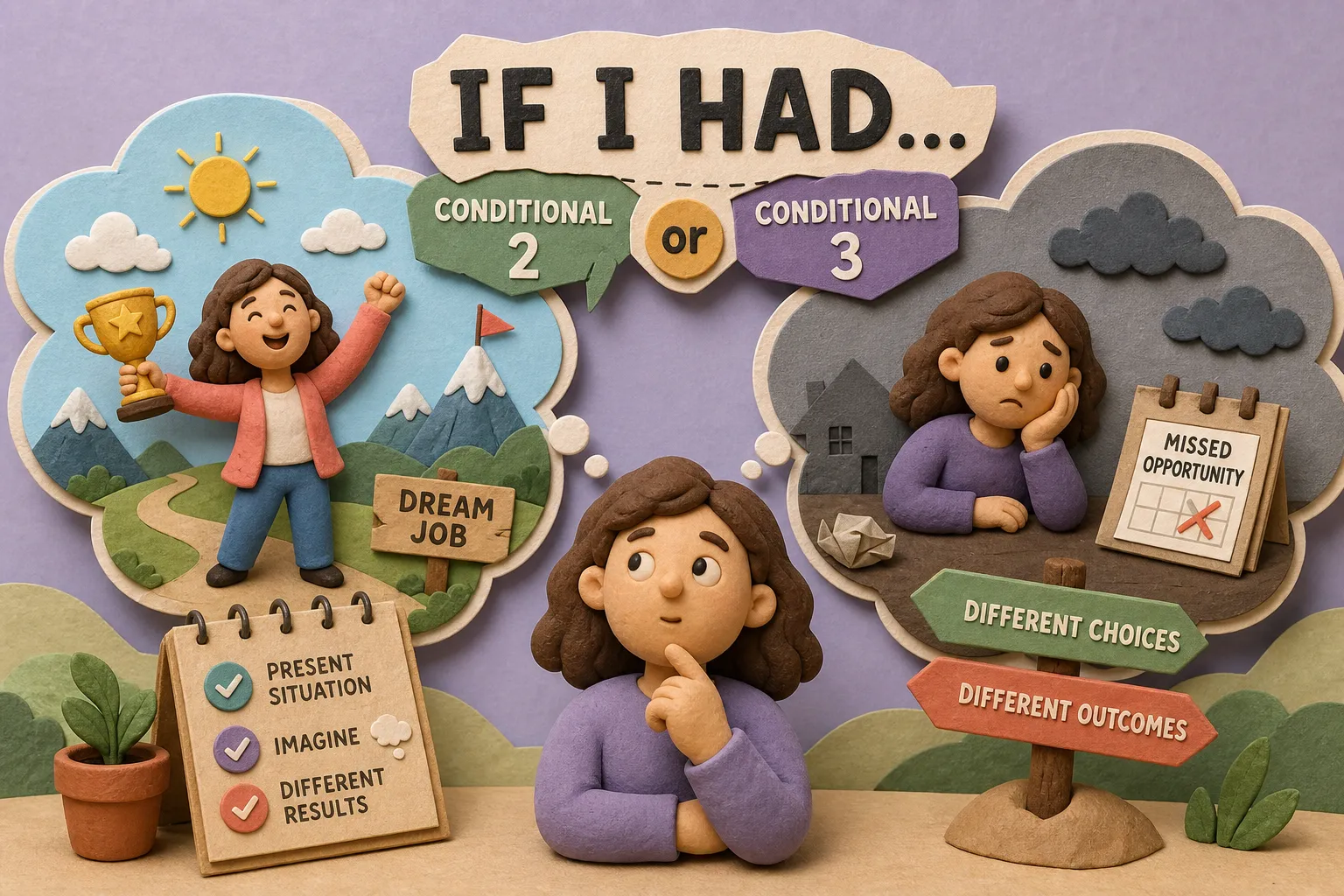
The first pattern is: If I had + noun or noun phrase + right now, I would… This is called the second conditional. It describes an imaginary situation in the present or future, something that is not true today. The speaker is not reporting a fact. They are imagining a different reality.
For example: If I had a better computer, I would work faster. The speaker does not have a better computer right now. This is a wish or a hypothetical idea.
Looking back at a past that didn’t happen
The second pattern is: If I had + past participle… This is called the third conditional. A past participle, a verb form like “known,” “done,” or “said”, is the key signal. The situation already happened, or did not happen, and the speaker is imagining a different past.
For example: If I had known about the meeting, I would have joined. The meeting already happened. The speaker did not know about it. This sentence expresses a past regret. The rule is straightforward: a noun after that opening phrase points to the second conditional; a past participle points to the third.
Second conditional: imagining a different present or future
The basic formula
The structure looks like this: If I had + [noun or thing], I would + [base verb]. The word “would” signals a result in an imaginary world, not a real plan. You are describing what would happen if something were true, even though it is not true right now.
Here is a clean example: If I had a car, I would drive to work. The speaker has no car today. “Would drive” is the imagined result.
Everyday American examples
Native speakers use this structure constantly in daily conversation. Here are five natural examples at different levels of formality:
- If I had more money, I’d move to a bigger apartment. (casual)
- With extra time this weekend, I would visit my parents. (neutral)
- If I had a better internet connection, I’d take more online courses. (casual)
- If I had the resources, I would expand the project. (professional)
- A different skill set would have me applying for that job. (professional)
Notice that in casual speech, “I would” almost always contracts to “I’d.” You will hear If I had the money, I’d do it far more often than the full form in everyday conversation. For other common spoken words and fillers, see Filler Phrases Every American English Learner Should Know.
One common point of confusion: “was” vs. “were”
You may have seen sentences like “If I were you, I would reconsider.” In formal American English, many speakers use “were” instead of “was” after “if” to signal a hypothetical situation. This is called the subjunctive mood. In casual speech, “was” is common and widely accepted. For writing and professional settings, “were” is the safer choice. For a clear explanation of the difference between if I was and if I were, see if I was vs if I were.
Third conditional: talking about a past that didn’t happen
The basic formula
The structure looks like this: If I had + [past participle], I would have + [past participle]. Both the “if” clause and the result use past forms because both refer to a finished moment in time. Here is one clean example: If I’d left earlier, I would have caught the train. The speaker did not leave early. They missed the train. Both facts are in the past.
How Americans express regret and missed chances
This structure comes up naturally when people talk about decisions, mistakes, or moments they wish had gone differently. Here are five real-life examples:
- If I’d studied harder, I would have passed the exam.
- With more savings last year, I wouldn’t have had to borrow.
- Asking for directions would have kept me from getting lost.
- If I had accepted that job offer, I would have moved to New York.
- Had I checked my email, I would have seen your message.
The emotion behind the sentence can shift its meaning slightly. Regret sounds different from curiosity or relief, even when the grammar is identical. Context and tone carry that weight for you. If you want more on expressing emotion in American English, read How to Use “Scared” and “Afraid” in American English.
How it sounds in fast American speech
In spoken American English, “I had” often reduces to “I’d,” and “would have” often sounds like “would’ve.” So If I had known, I would have called becomes If I’d known, I would’ve called. You should be able to recognize these reductions when listening. When you start speaking, it is fine to use the full forms first, clarity matters more than speed at the beginning. (For a compact video explanation of similar examples, see EngVid’s lesson on “If I had”.)
Real casual American conversations
Between friends and family
Here is a short, natural dialogue between two friends:
Ana: “Ugh, I’m so tired of taking the bus. If I had a car, I’d save so much time.“
Marco: “I know what you mean. If I’d saved up back when I was working full time, I would have bought one by now.“
Ana’s line is second conditional, she is imagining a different present. Marco’s line is third conditional, he is reflecting on a past decision he wishes he had made differently. Both structures feel completely natural in one short exchange.
Mixing both forms in one conversation
A native speaker often moves between both structures in the same conversation. For example: “If I had more savings right now, I’d travel more. But if I’d started saving earlier, I’d be in a much better position today.” The first sentence describes the present situation. The second looks back at the past. This combination is very common in real American English and sounds fluent and natural.
Using these conditionals in professional and workplace English
In meetings, presentations, and interviews
Both conditional forms appear regularly in work settings. The second conditional is useful for suggesting ideas or proposing solutions: “If I had more team members, I would finish the report by Friday.” Or: “If I had direct access to the data, I could give you a more accurate forecast.” The third conditional fits well when you reflect on past decisions. In a job interview, you might say: “If I’d handled that client differently, I would have kept the account. I learned a lot from that experience.”
This kind of answer shows self-awareness and professional maturity. American interviewers respond well to candidates who can reflect honestly on past situations using clear, confident language.
In professional emails and written communication
The third conditional appears often in written professional English, in apologies, follow-ups, and project reviews. Here are two examples:
- If I had received your message sooner, I would have responded before the deadline.
- Had I known about the change, I would have updated the document right away.
In writing, contractions are less common. Use “I would have” instead of “I would’ve” in emails and reports. Spoken and written English follow different conventions, and adjusting between them is a real professional skill.
Common mistakes and a quick practice check
The three most frequent errors
Here are the top three mistakes ESL learners make with this conditional structure, along with the corrections:
1. Putting “would” inside the “if” clause.
Wrong: If I would have had more time, I would have finished.
Correct: If I’d had more time, I would have finished.
Never use “would” in the “if” part of the sentence. Use “had” only. For a focused explanation on this specific error, see If I would have vs If I had.
2. Forgetting “have” in the result clause of the third conditional.
Wrong: If I had known, I would called you.
Correct: If I had known, I would have called you.
The third conditional result always needs “would have + past participle.”
3. Using the wrong conditional for the time reference.
Wrong: If I had more money last year, I would buy a laptop. (mixing past and present)
Correct: If I’d had more money last year, I would have bought a laptop.
Past situation? Use the third conditional, both clauses use past forms.
Try it yourself: three practice prompts
Write one sentence for each prompt. Check your verb forms using the formulas above.
- Think of something you do not have right now. Write a second conditional sentence about what you would do if you had it.
- Think of a past decision you made. Write a third conditional sentence about what would have happened if you had chosen differently.
- Think of a work or school situation. Write a third conditional sentence about a different outcome you wish had happened.
For more grammar lessons built on real American usage, visit the grammar section of Your Daily American. Every lesson is designed to help you move from understanding English to actually using it with confidence. If you’re ever unsure whether to use “if” or “whether” in complex sentences, read “If” or “Whether”? What’s the Difference?.
Two structures, one strong foundation
Here are the two key points to remember. A noun right after “if I had” signals a present or future hypothetical, that is the second conditional. A past participle right after “if I had” signals a past situation that did not happen, that is the third conditional. The word that follows those first three words is your clearest signal for which structure you are in.
Both structures are everywhere in American English. You will hear them in conversations with friends, in business meetings, and in professional emails. Start noticing them the next time you watch an American show or read a message from a colleague. You will be surprised how often they appear. For additional notes on common learner errors and alternative explanations, the LanguageTool and Preply pages linked above offer useful comparisons and exercises.
Grammar becomes natural when you practice it in real situations. Your Daily American is built to help you do exactly that, with lessons grounded in everyday American life and the language as it is actually spoken.