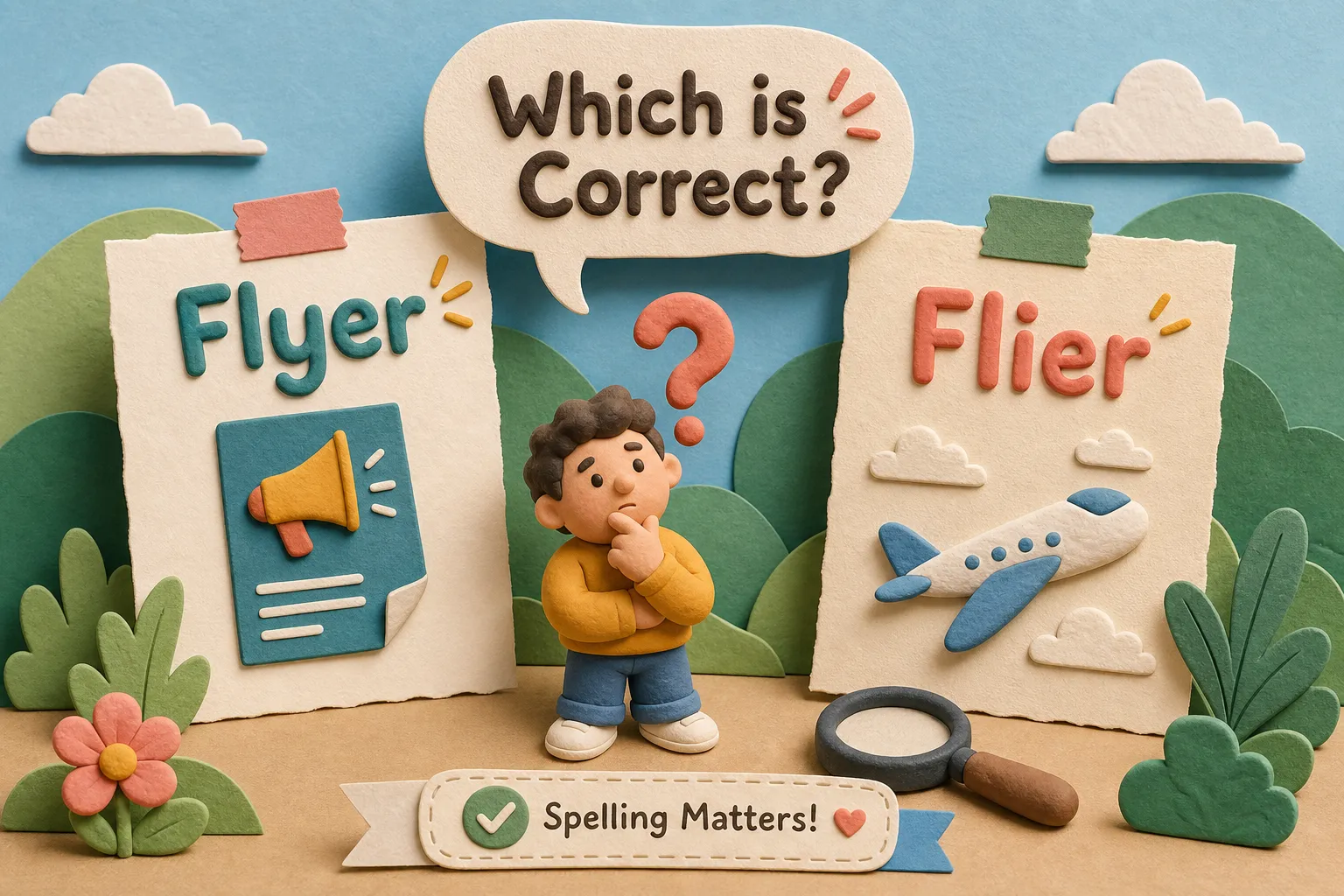
You’re typing an event announcement. You write the word out, stop, and stare at it. Is it “flyer” or “flier”? Both look correct. Both appear in real American publications. You do a quick search, find sources pointing in two different directions, and end up more confused than when you started. The flyer vs. flier question is one of the most common American English spelling debates, and it has a clear, practical answer.
Here’s the short version: in most American English writing today, “flyer” is the preferred spelling. But “flier” is still correct in one specific, common phrase. By the end of this article, you’ll know exactly which spelling to use, what major style guides say, and the one exception worth memorizing.
Knowing not just what a word means, but how Americans actually spell and use it, is what separates confident writing from hesitant writing. Here’s how it breaks down.
What “flyer” and “flier” actually mean
Both words come from the verb “fly” and function as agent nouns, meaning a person or thing that performs an action. Think of “teacher” (one who teaches) or “runner” (one who runs). “Flyer” and “flier” both mean “one who flies” in the same way. Neither spelling is a mistake, and they have existed as variants for well over 100 years.
Both spellings share three main meanings: a person or thing that flies; a printed advertising sheet or handout; and a risky or speculative attempt, as in the phrase “take a flier.” These are not two different words with different meanings. They are two spellings of the same noun, used in slightly different contexts by convention.
As aviation and mass printing grew in the late 1800s and early 1900s, usage began to separate. “Flyer” became the more common choice for printed handouts, while “flier” held on in the risk-taking phrase. But the split was never strict, and even today dictionaries and style guides don’t fully agree, which is exactly why this pair causes so much confusion.
What American style guides say today
The AP Style update
The most important update came in 2017, when the Associated Press Stylebook changed its official rule. Before that year, AP preferred “flier” for most uses. In 2017, the Stylebook reversed that decision.
The updated AP wording reads: “Flyer is the preferred term for a person flying in an aircraft, and for handbills: He used his frequent flyer miles; they put up flyers announcing the show. Use flier in the phrase take a flier, meaning to take a big risk.” This is now the standard in US journalism, professional communications, and most business writing, and because AP Style guides the writing decisions of millions of writers across the country, that 2017 update carries real weight.
What Merriam-Webster says
Merriam-Webster takes a slightly different position. The dictionary lists “flier” as the primary headword for “one that flies” and describes “flyer” as a less common variant in that general sense. However, for the advertising handout meaning specifically, Merriam-Webster notes it is “usually flyer.” So while MW treats “flier” as the broader base form, it points toward “flyer” for the printed sheet. The practical result is the same: “flyer” is the safer and more current choice for most everyday American writing.
Flyer spelling: printed ads and promotional materials
When most Americans say they’re making a “flyer,” they mean a printed or digital promotional sheet for an event, a business, or a sale. This usage appears everywhere: community bulletin boards, school events, social media posts, and small business promotions. “Flyer” is the standard spelling in all of these contexts.
Some natural examples:
- “She designed a flyer for the school fundraiser.”
- “Can you hand out flyers at the farmers market on Saturday?”
- “The store emailed a digital promotional sheet with this week’s discounts.”
- “We put up flyers around the neighborhood to find our lost dog.”
Notice that “flyers” is the natural plural here. Writing “fliers” for this meaning won’t confuse anyone, but the spelling will look slightly off to many American readers. When you’re promoting an event or product, stick with the “yer” ending.
Frequent flyer or frequent flier: the airline question
The answer is straightforward: “frequent flyer” is the correct and current form. AP Style confirms this directly, and the phrase appears in travel writing, airline communications, and professional contexts every day.
Examples for travel and work contexts:
- “She earned enough miles to upgrade through the frequent flyer program.”
- “As a frequent flyer, he always checks in online the night before.”
- “The airline sent all passengers a notice about the gate change.”
Worth noting: major US airlines brand their loyalty programs with proprietary names like “AAdvantage” or “SkyMiles,” so you won’t usually see the words “frequent flyer” in an official program title. But when writers and journalists describe these programs, “frequent flyer” is the standard phrase. If you encounter “frequent flier” in an older article, it was likely written before 2017 or the publication follows a different house style.
The one place “flier” still belongs
There is one clear exception to the “use flyer” rule: the American idiom “take a flier.” This phrase means to take a risk or try something uncertain, and AP Style specifically preserves the “flier” spelling for this expression even after the 2017 update. Outside of this fixed phrase, “flyer” covers almost every other situation you’ll encounter.
Examples of the phrase in context:
- “She decided to take a flier on the new restaurant downtown.”
- “He took a flier on a small tech startup and it paid off.”
- “The company took a flier on an unproven technology, and it changed the industry.”
“Take a flier” is an informal American English expression you’ll hear most often in business and casual conversation when someone is describing a risky decision. It comes up regularly in American workplaces and news articles, so it’s worth knowing both the spelling and the meaning.
Some older publications and in-house style guides still use “flier” for a pilot or aircraft passenger. That usage isn’t wrong, but it is less common in current American writing. If your workplace or school follows a specific style guide, check their preference. Otherwise, “flyer” is the safer choice in almost every situation.
A quick cheat sheet: flyer vs. flier
Use “flyer” for printed handouts and ads, airline loyalty programs (frequent flyer), and a person flying or traveling by air. Use “flier” only for the idiom “take a flier,” meaning to take a risk. That covers about 95% of real writing situations. When you’re not sure, write “flyer.”
Knowing not just what a word means, but how Americans actually spell and use it in context, is what moves a writer from “grammatically correct” to “sounds natural.” For more examples of commonly confused word pairs, see our guide Breath vs Breathe: Spelling, Sound, and Usage.
Try it yourself: Write three sentences, one about a printed handout for an event, one about an airline loyalty program, and one using the risk-taking phrase. Check your spelling against the rule above. That short exercise will help the pattern stick.
The bottom line
The flyer vs. flier question has a clear answer for modern American English: “flyer” is the default. AP Style has endorsed it since 2017, Merriam-Webster flags it as the standard choice for printed handouts, and it’s the form you’ll see in most American publications and business writing today. “Flier” is not wrong, it simply has one reliable job left, and that’s the idiom “take a flier.” Usage trends can also be explored with the Google Books Ngram Viewer.
The next time you type out a promotional sheet or describe an airline loyalty program, you’ll know exactly which spelling to reach for, and why. If usage questions like this come up often in your writing, explore more American English guides on Your Daily American. There are plenty more pairs like this one worth knowing: Lite vs Light: What’s the Difference in American English? and Less or Fewer? How to Choose the Right Word. These practical details help you communicate clearly and confidently in everyday American life.