You’re writing an email to a client and you stop mid-sentence. Should you write “I will be happy to help” or “I would be happy to help”? Both feel almost right. That pause is exactly what this lesson fixes, and understanding would vs will is the key to clearing it up for good.
By the end, you’ll know when to use each one: for future plans, conditional sentences, polite requests, and reported speech. No guessing. No hesitation before you hit send.
At Your Daily American, we teach grammar through real situations, not abstract rules. The goal is for you to feel the right answer when you’re speaking or writing, not just to memorize a pattern and hope it sticks. Here is how each one works.
What “will” does in everyday American English
Talking about the future and making predictions
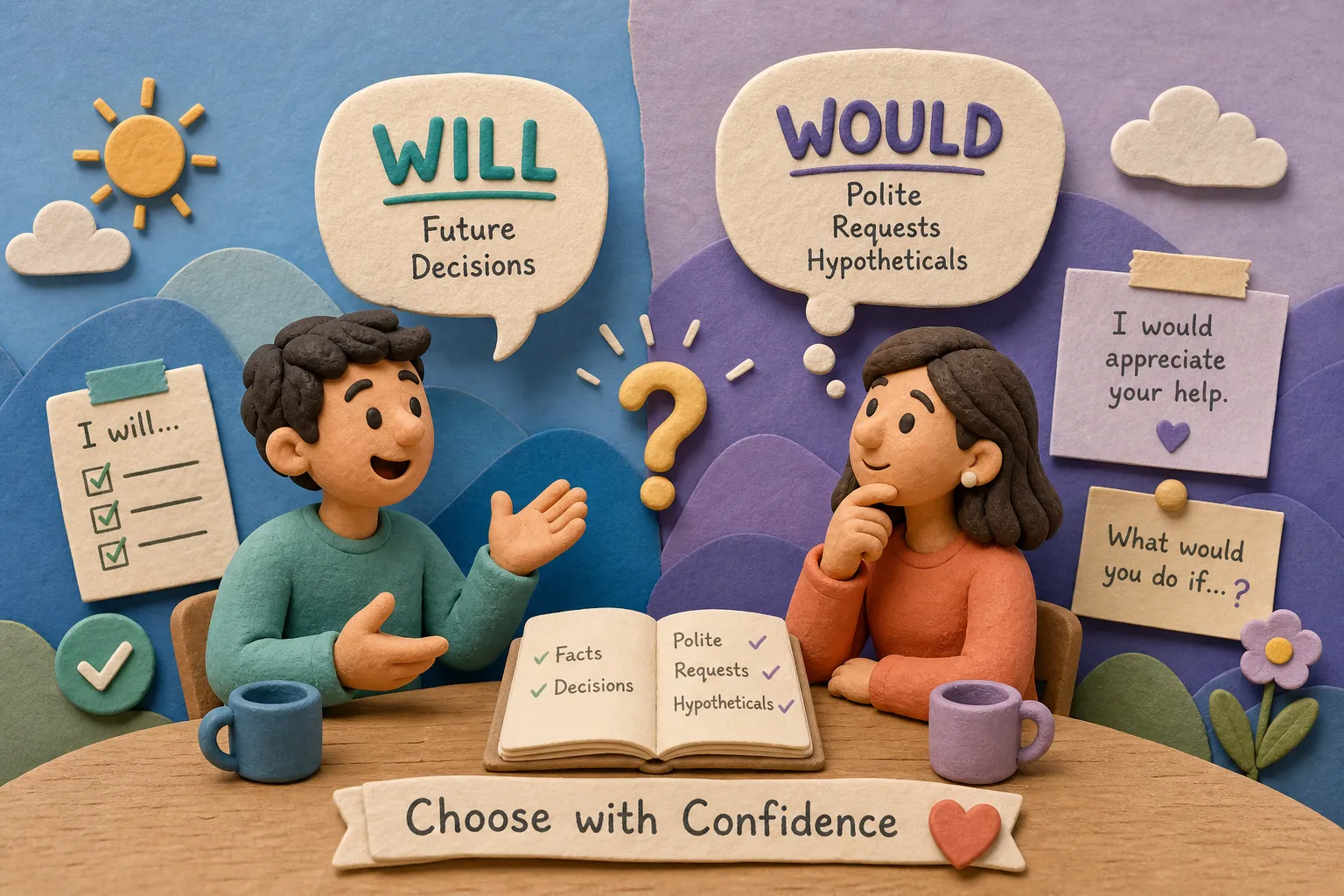
“Will” is one of the primary words for talking about the future in American English. You use it for predictions and things you expect to happen, particularly decisions made in the moment or future events you’re fairly certain about.
- “I’ll call you after lunch.”
- “It will probably rain this afternoon.”
- “The meeting will start at 10.”
“Will” also works for spontaneous decisions, ones you make at that exact moment. If you’re hungry and decide right now to eat, you say: “I’ll make a sandwich.” This is different from a trip you planned last week. For something already arranged, you’d say: “I’m going to New York on Friday” or “I’m flying to New York on Friday.”
Promises, offers, and direct requests
“Will” carries a sense of certainty and commitment. When you promise something, you use “will.”
- “I’ll finish the report by Friday.” (promise)
- “I’ll get the door for you.” (offer)
- “Will you send me that file?” (direct request)
Notice that “Will you send me that file?” sounds strong and direct. It’s not rude, but it puts pressure on the other person. In professional settings, you’ll often want a softer word. That’s where “would” comes in.
What “would” does in everyday American English
Hypothetical and unreal situations
“Would” signals a situation that is imagined, not real. Think of it as one step away from reality.
For an authoritative explanation, see the Cambridge Dictionary’s guide to “would”.
- “If I had more time, I would read more.”
- “If I lived in a big city, I would walk everywhere.”
“Would” does more than mark the past. It describes distance from reality. That’s why it feels softer and less certain than “will.” When you say “I would,” you’re imagining, not committing.
Past habits and future-in-the-past
“Would” also describes repeated actions in the past, similar to “used to.” There is one important difference, though. “Used to” works for both past habits and past states, situations that were true but are no longer. “Would” works only for repeated actions.
- Correct: “I used to live in Mexico.” (state: where you lived)
- Correct: “We would play outside after school.” (repeated action)
- Incorrect: “I would live in Mexico.” (live is a state, not a repeated action)
“Would” also appears in what teachers call future in the past: looking forward from a past moment. “She knew the meeting would start at 9.” From her point of view in the past, the meeting was still in the future. “I thought he would arrive late” works the same way.
Would vs Will in conditional sentences
This is where many learners feel confused. The rule becomes clear once you see the pattern: real situations use “will,” imaginary situations use “would.”
First conditional: real situations use “will”
A first conditional sentence describes something that is possible and likely. The pattern is: if + present simple, will + base verb.
- “If I finish early, I will text you.”
- “If she applies for the job, she will get an interview.”
One rule many learners miss: in standard first conditionals, you normally use the present simple in the “if” part of the sentence, not “will.” Say “If it rains tomorrow,” not “If it will rain tomorrow.” There are exceptions (for example, when “will” expresses willingness: “If you will hold still, I can finish the bandage”), but in most everyday situations, keep “will” out of the if-clause.
Second conditional: unreal situations use “would”
A second conditional sentence describes something imaginary or very unlikely right now. The pattern is: if + past simple, would + base verb.
- “If I lived in New York, I would take the subway every day.”
- “If he had a car, he would drive to work.”
The contrast with the first conditional is straightforward: first conditional means there’s a real chance it will happen; second conditional means you’re imagining a situation that isn’t true right now. Native speakers also shift their intonation slightly between the two, the second conditional tends to sound more tentative and reflective.
Third conditional: past unreal situations use “would have”
The third conditional describes something that did not happen in the past. The pattern is: if + past perfect, would have + past participle.
- “If she had studied more, she would have passed.”
- “If we had left earlier, we would have caught the train.”
Nothing can change these situations now. They are done. “Would have” signals that the result was also impossible, and native speakers often use this form to express regret or to gently point out a missed opportunity.
For more on conditionals and their patterns, see the Cambridge Dictionary conditionals guide.
Would vs Will, Polite requests and offers
Why “would” sounds softer and more professional
“Would” creates a small amount of distance. That distance makes a request feel less like a demand. Compare these two sentences:
- “Will you send me the document?”
- “Would you send me the document?”
Same request. Very different tone. “Will” sounds direct. “Would” sounds professional and respectful. In American workplaces, emails, and meetings, “would” is often the preferred choice for professional requests because it signals both confidence and courtesy.
Many learners avoid “would” because they think it sounds too formal. It doesn’t. It’s natural, everyday American English, and native speakers use it constantly. One more note: “Would you like…?” is the correct form for polite offers. “Will you like…?” is not correct for offers.
Common patterns with “would” in professional and daily contexts
Here are patterns you can use right away:
- “Would you mind + verb-ing…?” (polite request): “Would you mind reviewing this before the meeting?”
- “Would you like + noun or infinitive?” (offer): “Would you like me to send the report?”
- “I would appreciate it if…” (formal request): “I would appreciate it if you could reply by Thursday.”
Here’s a short workplace example:
Manager: “Would you mind putting together a summary of this week’s results?”
Colleague: “Of course. Would you like me to send it this afternoon?”
This kind of professional language is exactly what Your Daily American covers in its Professional English, Your Daily American and everyday expression lessons. The goal is to feel when “would” is the right choice, not just to know the rule on paper.
Reported speech: when “will” becomes “would”
How backshifting works in spoken American English
Backshifting, moving a verb one step back in time, is what happens in reported speech. When you report what someone said in the past, “will” typically shifts to “would.”
- Direct speech: “I will call you tomorrow.”
- Reported speech: “She said she would call me the next day.”
The reason: the reporting verb is in the past (“said,” “told,” “thought”), so the time frame moves back one step, and “will” becomes “would.” Worth noting, backshifting can be optional when the original statement is still true at the time of reporting (for example, “She said the office is on Fifth Avenue” is also acceptable if it still is).
Short examples showing the shift in context
These come from everyday life and work:
- “The doctor said the test results would be ready on Friday.”
- “My manager said the meeting would start at 10.”
- “He told me he would bring the files.”
The “would” here is not hypothetical. It is the past form of “will,” and context makes the meaning clear. A practical tip: listen for reporting verbs like “said,” “told,” “thought,” “knew,” and “mentioned.” When you hear one of those, “would” in the sentence is most likely the backshifted form of “will.”
Would vs Will: common mistakes and a quick self-check
The mistakes most learners make
These four errors come up again and again, even at the intermediate level.
Mistake 1: Using “will” in the if-clause.
Wrong: “If it will rain, I’ll stay home.”
Right: “If it rains, I’ll stay home.”
Mistake 2: Using “will” in a second conditional.
Wrong: “If I had more money, I will travel.”
Right: “If I had more money, I would travel.”
Mistake 3: Using “would” for a certain, real future plan.
Wrong: “I would meet you tomorrow at 3.”
Right: “I will meet you tomorrow at 3.” (This is real and confirmed.)
Mistake 4: Avoiding “would” in requests because it seems too formal.
“Would” is not overly formal. It is natural American English, and it is what native speakers use in professional settings every day.
A quick self-check
When you are writing or speaking, run through this short check:
- Is this a real, certain future event? Use will.
- Is this imaginary, unreal, or hypothetical? Use would.
- Are you making a polite request or offer? Use would.
These questions cover most situations you will face in daily life and at work. Once you internalize them, choosing between “would vs will” becomes fast and natural.
Put it into practice
The big pattern is simple: use “will” for real, certain things and “would” for hypothetical, polite, and reported situations. Every specific rule in this article comes from those two core ideas, and keeping that would vs will distinction in mind is the fastest way to stop second-guessing yourself.
Here is a short practice suggestion. Take one email you need to write this week or one conversation you will have. Every time you want to use “will” or “would,” pause for a moment and run through the self-check above. Decide which one fits and why. That small habit builds real understanding quickly.
For exercises and a clear reference to support these tips, check the British Council’s will/would reference.
The more you see and hear these two words in real American English, the more natural your choices become. Your Daily American’s Professional English, Your Daily American and everyday expression content puts grammar exactly where it belongs, in real situations, with real sentences you can use right away. That’s where the understanding sticks.
Find more drills and short lessons in our Daily Grammar, Your Daily American section.
Learn more About, Your Daily American.