You’re sitting in a work meeting. Your manager looks at the group and says, “Let’s circle back on this before Friday.” You understood every single word, but what does the whole phrase actually mean? Are you supposed to do something now? Is the topic finished? This kind of moment is very common for English learners in American workplaces, and it’s exactly the kind of real language gap that Your Daily American helps you close.
By the end of this article, you’ll know exactly what “circle back” means, where it sits on the formality scale, how to use it in meetings and emails, and which mistakes to avoid. You’ll also leave with a few ready-to-use phrases for your next professional conversation.
Quick summary: “Circle back” means to return to a topic or conversation at a later time. It’s semi-formal, common in American business settings, and works in both spoken and written communication. Keep reading for examples, email templates, and the mistakes to avoid.
What “circle back” means in American English
The plain meaning
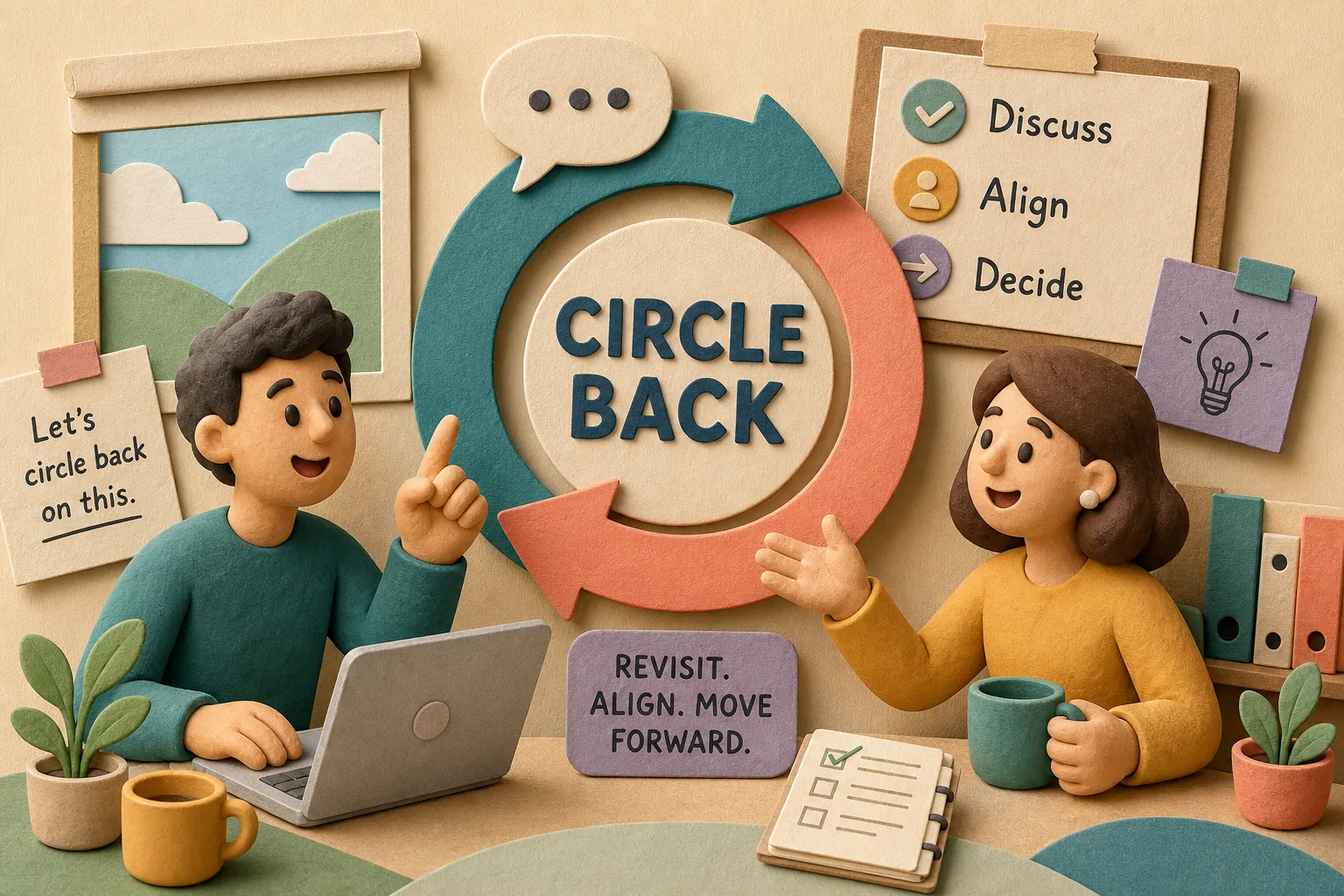
“Circle back” means to return to a topic or conversation later. According to standard business English usage, it tells the other person: we are not dealing with this right now, but we will come back to it. The phrase doesn’t mean the topic is cancelled or forgotten, it just means it’s on pause. (See a short explanation of what circling back really means.)
Here are two clear examples: “Let’s revisit the budget question tomorrow.” “I’ll circle back with you after I check the numbers.” In both cases, the speaker is making a promise to return to the subject at a future point.
Where this phrase fits on the formality scale
The expression is semi-formal. It’s too polished for a casual chat with a close friend, but it fits very well in workplace situations: team meetings, professional emails, Slack messages, and business calls. It’s commonly used in many American office settings across a wide range of industries.
Worth noting: language commentators and workplace surveys often classify it as corporate jargon, not slang, but not neutral formal language either. Many people find it overused. Think of it as a phrase that professionals reach for naturally every day, which is exactly why it’s worth learning, and worth using thoughtfully.
How it compares to “follow up”
“Circle back” and “follow up” are similar, but they’re not exactly the same. “Circle back” usually refers to returning to a specific conversation or topic. “Follow up” is broader, it often means checking on a task, a response, or an action item. You might follow up on a job application or a project deadline. You’d return to a question that wasn’t answered in a meeting. Understanding this distinction helps you pick the right phrase in the right moment.
The tone behind “circle back”: polite, professional, or evasive?
When it sounds professional and helpful
In most workplace situations, the phrase sounds organized and considerate. It tells your colleagues that you’re managing the agenda carefully, not ignoring their point. For example: “That’s a great question. Let’s revisit that after the product team shares their update.” This shows you’re listening and planning ahead.
When it can sound like a polite delay
Honestly, the expression is sometimes used to avoid giving a direct answer. Many native speakers recognize this pattern. If someone says “I’ll get back to you on that” and then never does, it creates frustration, and the same applies here. The phrase can start to feel like an empty promise. To avoid this, always pair it with a specific time frame when you can. “I’ll circle back with you by Thursday” is much stronger than a vague “I’ll circle back on that.” Several usage guides and commentary discuss how the phrase can feel evasive in some contexts; for one such usage note, see LanguageTool’s discussion of “circle back”.
The difference in spoken vs. written use
In spoken English, the phrase sounds natural and easy. People use it to move a conversation forward without losing track of a point. In written emails, it works best when you add a clear next step or a date alongside it. Without that detail, it can read as vague or even dismissive. The expression is fine to use in writing, just add specifics to make it land well.
How to use “circle back” naturally in meetings
Redirecting a conversation mid-meeting
Meetings often go off-topic. This phrase gives you a polite, professional way to bring the group back to the main agenda. Try this line: “That’s a good point. Let’s return to that after we get through the main agenda items.” This keeps the meeting on track without making anyone feel shut down.
Closing a topic without resolving it
The phrase also works when you don’t have enough information to decide something yet. You can use it to park the discussion until you’re ready. Example: “We don’t have all the data yet. Can we revisit this before the end of the week?” This signals to the group that the topic is on hold, not forgotten.
Short practice dialogues
Read these two short dialogues out loud to practice the phrase in context.
Dialogue 1: Manager and team member
- Manager: “We need to finalize the project timeline. Do you have the updated estimates?”
- Team member: “Not yet. I’m waiting on one more response from the vendor.”
- Manager: “No problem. Let’s circle back on this tomorrow morning once you have the numbers.”
- Team member: “Sounds good. I’ll send you an update by 9 a.m.”
Dialogue 2: Two colleagues on a project call
- Colleague A: “What’s the plan for the client presentation next week?”
- Colleague B: “I have some ideas, but I need to check with the design team first.”
- Colleague A: “Makes sense. Let’s touch base on this Thursday after you talk to them.”
- Colleague B: “Perfect. I’ll set up a quick call for us then.”
Writing “circle back” in follow-up emails
Opening a follow-up email
“I wanted to circle back on…” is a common way to open a professional follow-up email in American workplaces. It reminds the reader of the previous conversation without sounding pushy or aggressive. Example: “Hi Sarah, I wanted to circle back on the proposal we discussed last Tuesday.” Simple, clear, and professional.
Using it to reference a past conversation
A second useful pattern is: “As we discussed, I’ll follow up with you once the report is ready.” This sets a clear expectation for both sides. Adding a time reference makes the phrase even more effective: “I’ll circle back with you by Thursday afternoon.” The reader knows exactly when to expect your message.
Sample follow-up emails
Here are two short, realistic follow-up emails. Notice how the phrase anchors the opening and pairs with a clear next step.
Email 1, Subject: Following up on the Q3 marketing budget
Greeting: Hi Marcus,
Opening: I wanted to circle back on the Q3 marketing budget we discussed in Monday’s meeting.
Context and next step: I’ve pulled together the updated numbers and I’m ready to walk you through them whenever works for you. I can send the spreadsheet now or we can go over it together on a quick call.
Time reference: I’ll follow up by Wednesday if I don’t hear from you before then.
Closing: Thanks, and have a great week., Jamie
Email 2, Subject: Revisiting our onboarding timeline
Greeting: Hi Priya,
Opening: I wanted to return to the onboarding timeline we touched on briefly in last week’s call.
Context and next step: I’ve outlined a draft schedule that addresses the gaps we flagged. Happy to share it ahead of our next sync or walk through it live, whatever is easier for you.
Time reference: Let me know by end of day Friday, and I’ll circle back with a calendar invite.
Closing: Looking forward to it., Devon
Common mistakes ESL learners make with “circle back”
Getting the preposition wrong
The most common grammar mistake is using the wrong preposition, or leaving it out entirely. Here are the patterns you’ll hear most often:
- “Circle back to [a topic]”, Let’s circle back to the pricing question.
- “Circle back with [a person]”, I’ll circle back with you tomorrow.
- “Circle back on [an issue]”, Can we circle back on this later?
A common error is saying “I will circle back you” (missing the preposition entirely) or “I circle back on this” (wrong tense). In most cases you’ll want “to,” “with,” or “on” after the phrase, though “I’ll circle back” with no object is also used when the topic is already clear from context. When in doubt, add a preposition to keep your meaning precise.
Using it in the wrong register
This expression belongs in professional contexts. If you use it with a close friend in a casual conversation, it will sound stiff and out of place. For casual English, say “let’s talk about this later” or “I’ll get back to you” instead. For more on conversational fillers and casual alternatives, see Filler Phrases Every American English Learner Should Know.
Saying it without a follow-through plan
This is a practical mistake, not just a grammar one. When you tell someone you’ll revisit something, they expect you to actually do it. Native speakers notice when someone uses this phrase and then disappears. Whenever you commit to following up, try to give a specific time frame. It shows professionalism and builds trust with your colleagues.
More American business phrases to add to your vocabulary
Phrases that work alongside “circle back”
In the same meetings and emails where you use this phrase, you’ll also hear these expressions regularly. Learning them together, and spread across different types of interactions, helps you sound more natural overall.
- Touch base, to make brief contact with someone. “Let’s touch base before the client call.”
- Take this offline, to move a detailed discussion out of the group meeting. “Let’s take this offline and set up a separate call.”
- Loop someone in, to include someone in a conversation or email thread. “Can you loop in the finance team on this?”
- Get the ball rolling, to start something. “Let’s get the ball rolling on the proposal this week.”
- Close the loop, to finish an open task or confirm a result. “I’ll close the loop with the client once I have the final answer.”
You might also want to study 25 Small Talk Phrases Americans Use Every Day to help with casual work conversations and quick check-ins. You might also use meeting notes or a task tracker to flag items you need to revisit later, keeping a written record is one practical way to make sure you actually follow through when you commit to returning to a topic.
Why learning these phrases in context matters
Memorizing individual words is not enough for real professional communication. Business English phrases carry tone, cultural expectations, and specific situational cues. “Circle back” doesn’t just mean “return.” It signals how you manage conversations, how organized you are, and how reliable you appear to your colleagues. The context is just as important as the words themselves.
Building your full toolkit with Your Daily American
If you want to go beyond single phrases and build a complete vocabulary for the American workplace, Your Daily American is designed with exactly that goal in mind. The platform covers professional communication, meetings, emails, pronunciation, and more, all grounded in real, everyday American English. The site also offers a free proficiency assessment to help you identify your current level and map out what to study next. For a broader set of expressions you can learn next, see Common American Expressions Every English Learner Should Know. Every phrase you add to your toolkit is one step closer to communicating with real confidence at work.
Frequently asked questions about “circle back”
Is “circle back” formal or informal?
It’s semi-formal. Many language commentators classify it as corporate jargon, common and widely understood in professional settings, but out of place in casual conversation. Use it in meetings, emails, and business calls; reach for something simpler with friends.
How do you say “circle back” more politely?
If you want a softer or more direct alternative, try: “I’d like to revisit this once I have more information,” “Let’s follow up on this by [date],” or “Can we set some time to return to this topic?” Adding a specific time frame always makes the commitment feel more genuine. For additional alternatives and email phrasing tips, see work email phrases to stop using (and what to say instead).
Can you say “I’ll circle back” without a preposition?
Yes. “I’ll circle back” on its own is perfectly natural when the topic is already clear from context. That said, adding “to,” “with,” or “on” sharpens your meaning and is usually the safer choice in professional writing.
Is “circle back” overused in American workplaces?
It can be. Workplace surveys and language commentators frequently list it among the most overused business buzzwords. That doesn’t mean you should avoid it, it just means using it with intention and pairing it with a concrete next step so it doesn’t sound like filler.
Putting it all together
You now know what “circle back” means, where it fits in American workplace communication, and how to use it correctly in meetings and emails. You’ve seen the grammar patterns (“circle back to,” “circle back with,” “circle back on”), learned when the phrase lands well and when it doesn’t, and picked up a set of related business expressions to round out your vocabulary. That’s a lot of practical ground covered in one article.
Here’s your challenge for this week: use the phrase at least once in a real work situation, in a meeting, a Slack message, or a follow-up email. The more you practice in real context, the faster it becomes natural. And when you’re ready to keep building your American English skills, Your Daily American is here for every step of that journey. Every phrase you add to your toolkit moves you closer to the fluent, confident communication you’re working toward.