You’re on a video call with your American team. Your manager says, “We need to get the SME involved before the deadline.” You nod, but you’re not sure what that means. Is “SME” a job title? A department? A type of company?
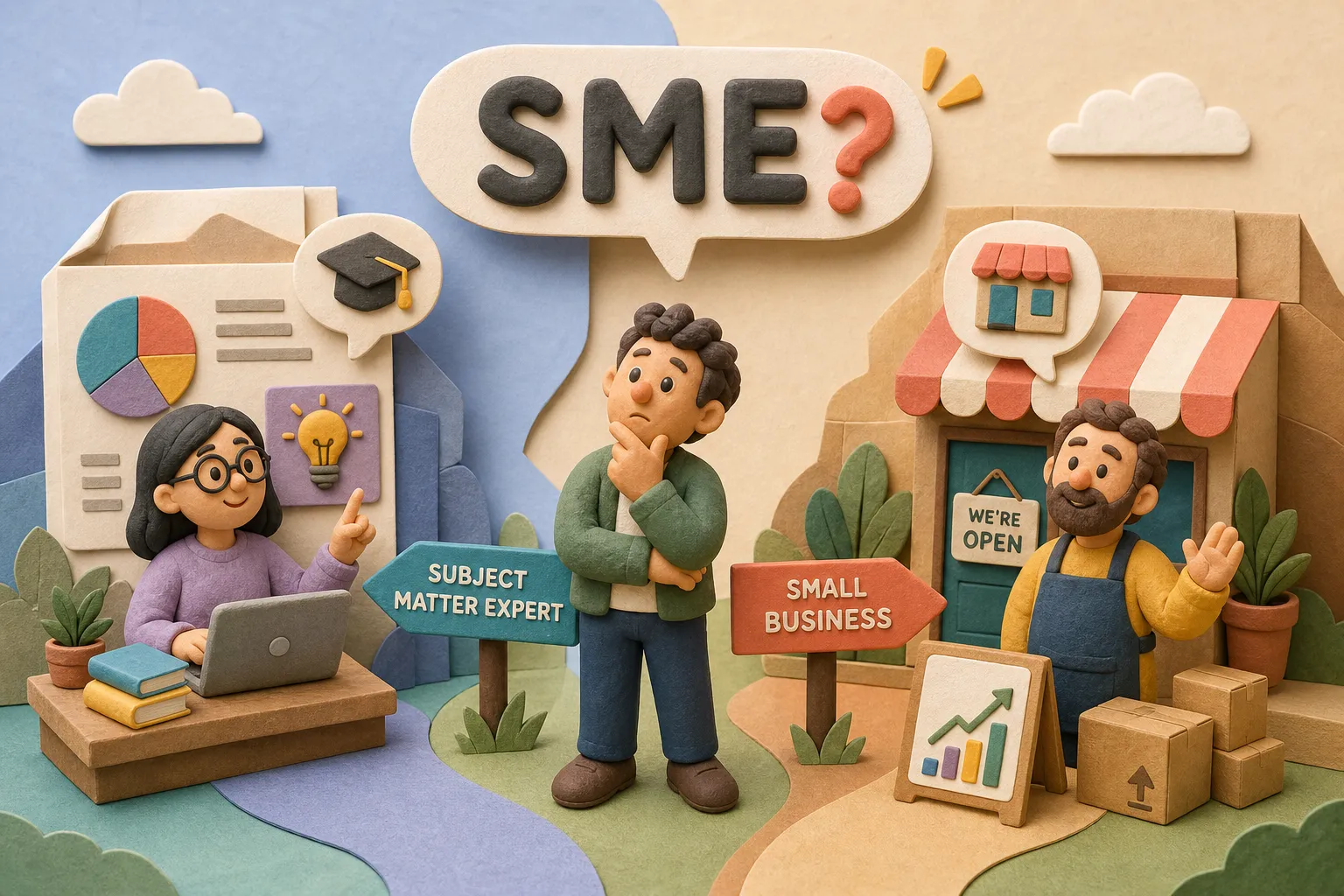
If you’re trying to work out SME meaning, you’re not alone. This confusion is very common for international professionals working in English. The acronym SME has two very different meanings, and the right one depends entirely on context. This article breaks down both meanings clearly, shows you how each one sounds in real workplace situations, and gives you simple tools to recognize which one applies the moment you see or hear it.
Platforms like Your Daily American exist for exactly these moments: when one unfamiliar acronym stops you from fully following a conversation. That clarity starts here.
SME meaning: two definitions, one acronym, how to tell them apart fast
The fastest way to understand SME is to know that the two meanings tend to appear in very different contexts. One belongs primarily to the workplace. The other belongs to government, finance, and business policy, though overlap does exist. A large company, for example, might use “SME” to mean a subject matter expert internally while also discussing SMEs (small and medium-sized enterprises) in their supply-chain reports. Context and audience are your best guides.
The workplace meaning: subject matter expert
Inside companies, SME almost always means “subject matter expert.” A subject matter expert is a person who knows one specific topic extremely well and advises others on it. You’ll hear this meaning in project meetings, internal emails, training sessions, and team chats. When a colleague says “ask the SME,” they mean: go talk to the person with the deepest knowledge on this subject.
The business category meaning: small and medium-sized enterprise
In government, policy, finance, and international business documents, SME means “small and medium-sized enterprise.” This refers to a company that meets certain size limits, based on employee count and annual revenue. You’ll see this meaning in grant applications, procurement rules, government websites, and global business news. If a document is talking about company size, funding programs, or economic policy, “SME” almost certainly means enterprise, not expert.
A quick test you can use right now
Look at the context and who is using the word. A manager or colleague using “SME” in a project conversation means subject matter expert. A government agency, a bank, or an official policy document using “SME” means small and medium-sized enterprise. “Get the SME on the call” is about a person. “SMEs in the EU” is about company size. That one check will get it right almost every time.
What a subject matter expert actually does at work
An SME is the person a team calls when a specific question is too technical or too specialized for a general answer. They’re not always a manager. They’re simply the person who knows the most about one particular area and helps others make better decisions because of that knowledge. For a concise definition of the role, see the external reference on subject-matter experts.
Core responsibilities of an SME in a team or project
An SME reviews work for accuracy, answers technical questions, and gives specialized input at key points in a project. Common tasks include validating decisions, reviewing documents, advising on risks, and contributing to training materials. In project settings, SMEs help confirm that deliverables meet standards, policies, and the actual needs of the people using them. For a practical guide to the SME role and how it fits into teams, read the Coursera article on subject-matter experts.
What qualifications an SME usually has
Most SMEs have deep, hands-on experience in their field, not just academic knowledge. In industries like healthcare, law, and finance, formal credentials or licenses may be required. In tech, operations, and sales, years of direct experience doing the work is usually enough. The key quality is this: an SME can explain not just what is done, but why it’s done that way, and what to do when exceptions appear.
SME meaning in job descriptions: where you’ll see the title
The SME role is common in product development, project management, quality assurance, learning and development, and sales support. You’ll sometimes see titles like “Technical SME,” “Process SME,” or “Project SME,” which indicate the specific area of expertise. Many people play the SME role without having that title on their business card. Being called an SME is often informal, based on who others go to for answers.
Real examples of SME in workplace conversations and emails
Seeing a word in real sentences is one of the most effective ways to lock in its meaning. Below are examples drawn from common workplace scenarios, the kind you can listen for and use right away.
How SME sounds in spoken American English
In conversation, “SME” is commonly pronounced as three separate letters: S-M-E. You’ll hear it like this:
- “Before we finalize this, let’s get the SME on the call to review the process.”
- “Talk to Dana, she’s our SME on compliance issues.”
- “I flagged this for the SME team to validate before we move forward.”
Notice how the word always refers to a specific person or team. It signals expertise, not authority. The SME isn’t necessarily your boss; they’re the person who knows the answer.
How SME appears in professional emails
In emails, SME is typically used without explanation because writers assume the reader already knows the term, which is exactly why international professionals need to recognize it fast. Here are two realistic examples:
- “Hi Carlos, I’m looping in our SME, Priya, who can answer your technical questions directly.”
- Subject line: “SME Review Needed: Data Migration Plan”
Both examples show a common pattern: the SME is being brought in to check something important. When you see “SME review” in a subject line, it means someone with specialized knowledge needs to look at the document before it moves forward.
A note on regional variation
“SME” as subject matter expert is most common in North American workplaces, especially in tech, consulting, and large corporate environments. In other countries or industries, the same person might be called a “specialist,” “technical lead,” or “domain expert.” The role is the same; only the label changes.
Other workplace acronyms you’ll hear alongside SME
American corporate communication runs on acronyms. Learning the most common ones will help you follow emails and meetings much more easily.
Common acronyms in business emails and messages
- POC (point of contact): the main person to reach for a specific topic. “Who’s the POC for this project?”
- EOD (end of day): a deadline marker. “Please send the report by EOD.”
- ETA (estimated time of arrival): used to ask when something will be ready. “What’s the ETA on the final draft?”
- KPI (key performance indicator): a goal you measure to track success. “Our main KPI this quarter is customer retention.”
- OOO (out of office): used when someone is away. “I’ll be OOO next Friday, please contact Mark.”
- TL;DR (too long, didn’t read): a short summary placed at the top or bottom of a long message. Common in Slack and informal emails.
- FYI (for your information): used to share information that doesn’t require action. “FYI, the meeting has been moved to 3 PM.”
How to learn new workplace acronyms quickly
When you see an unfamiliar acronym, look at the context first. Who sent it? What topic is being discussed? What action is being requested? Those three clues usually give you enough to work out the meaning.
It’s always appropriate to ask a colleague: “Just to confirm, what does that acronym mean here?” Native speakers ask this too. Building a personal list of acronyms you encounter at work is a simple habit that pays off fast. For short, effective alternatives and clearer phrasing, check out Learn Simplified Words That Work Better.
SME as a business size category: when the other meaning applies
When you step outside office conversations and into the world of government policy, finance, and global business, SME meaning shifts completely. Here it refers to company size, not individual expertise.
How different regions define an SME by company size
The thresholds are not the same in every country, so always check which definition the document is using.
European Union: Under European Commission Recommendation 2003/361/EC, a company is an SME if it has fewer than 250 employees and either annual turnover of €50 million or less, or a balance sheet total of €43 million or less. The EU divides SMEs into three groups: micro (under 10 employees, up to €2 million turnover), small (under 50 employees, up to €10 million turnover), and medium (under 250 employees, up to €50 million turnover). See the translated EU SME definition for details.
United Kingdom: Under the Procurement Act 2023, an SME has fewer than 250 staff and annual turnover of £44 million or less, or a balance sheet total of £38 million or less. The structure is similar to the EU definition but uses different financial figures.
United States: There is no single universal SME definition in the U.S. The Small Business Administration (SBA) sets size limits that vary by industry. For most sectors, companies with 500 employees or fewer qualify as small businesses, but exact thresholds depend on the type of business. If you’re applying for a U.S. program, always check the SBA size standards for your specific industry.
SME meaning vs. SMB: what’s the difference?
In the United States, you’ll also encounter the term SMB, small and medium-sized business. SMB and SME are often used interchangeably, especially in American tech and marketing contexts. The practical difference is mostly regional: “SME” is the standard term in EU and UK policy documents, while “SMB” is more common in U.S. business writing and software sales. Either way, both refer to companies that fall below the large-enterprise threshold.
Why company size classification matters for funding and contracts
Many government grants, loans, and procurement contracts are only available to businesses that qualify as SMEs. In the EU, roughly 99% of all businesses fall into the SME category, so these programs affect nearly the entire business community. In the UK, the figure is similarly high. In the U.S., the SBA reports that approximately 99.9% of American businesses qualify as small businesses under its definitions, making SME-equivalent programs the norm, not the exception. For context on U.S. small business numbers, see the SBA report on small businesses.
If you work in finance, business development, or grants management, knowing the correct thresholds for your region is practical and necessary. Applying for a program with the wrong size classification can disqualify your company immediately.
How to keep up when workplace jargon keeps changing
SME is just one example of a word that means different things depending on where you hear it. American workplace English is full of abbreviations, acronyms, and informal terms that native speakers use without thinking twice. For international professionals, these terms create a real gap between understanding the language and fully participating in it.
Workplace jargon creates concrete problems. When you don’t recognize a term in a meeting, you lose the thread of the conversation. When an unfamiliar acronym appears in an email, the whole message can become unclear. These aren’t small frustrations, they affect your confidence, your performance, and how you come across to colleagues.
Dictionaries give you definitions. What you actually need is context: how a word sounds in a real meeting, what tone it carries, and when it’s appropriate to use it. That kind of learning looks different from a vocabulary list.
Your Daily American is an American English learning platform focused on real-world professional and everyday use. The content covers workplace communication in practice: emails, meetings, and the vocabulary that native speakers assume everyone already knows. For focused lessons on communication skills, see Professional English for the Modern Workplace. For international professionals who want to do more than follow along, who want to contribute confidently and sound natural at work, it’s a resource built around exactly those situations.
Frequently asked questions about SME meaning
What does SME mean?
SME has two common meanings. In workplace settings, it stands for “subject matter expert”, the person on a team with the deepest knowledge of a specific topic. In business, government, and policy documents, it stands for “small and medium-sized enterprise”, a company that falls below certain size thresholds set by employee count and annual revenue.
What is SME meaning in the EU, UK, and U.S.?
In the EU, an SME has fewer than 250 employees and meets specific turnover or balance sheet limits (European Commission Recommendation 2003/361/EC). In the UK, the Procurement Act 2023 sets similar thresholds. In the U.S., the SBA uses industry-specific size standards rather than a single universal definition. The 500-employee benchmark is commonly cited for most sectors, but always verify the rule for your specific industry.
What is the difference between SME meaning and SMB meaning?
SME (small and medium-sized enterprise) and SMB (small and medium-sized business) refer to the same general concept. SME is standard in EU and UK policy language; SMB is more common in U.S. business and technology contexts. The terms are often interchangeable in practice.
Does SME eligibility affect funding applications?
Yes. Many government grants, loans, and procurement programs are exclusively available to companies that qualify as SMEs. The exact criteria vary by region and program, so checking the specific thresholds before applying is essential. Submitting with the wrong size classification can result in immediate disqualification.
You now know what SME means, in both contexts
To sum up SME meaning: in workplace conversations, it refers to a subject matter expert, the person others turn to for specialized knowledge. In business, finance, and policy documents, it refers to a small and medium-sized enterprise, a company that meets defined size limits. Context is your guide every time. Look at who is using the word and what they’re discussing, and the right meaning becomes clear immediately.
Workplace English is full of acronyms like this one. Each one you learn removes a small barrier between you and full participation in professional conversations. Over time, those gains build into something real, meetings you can follow without guessing, emails that sound natural, and the confidence to speak up when it matters.
The vocabulary you build today makes tomorrow’s conversation easier. Visit Professional English, Your Daily American to keep building the practical American English skills you use every day at work and beyond.