“Breath” and “breathe” look almost identical on the page. One tiny letter at the end is the only visible difference, and that is exactly why this pair causes so much trouble for English learners at every level, beginners and advanced students alike. Understanding the breath vs breathe distinction comes down to two things: the grammar and the sound.
At Your Daily American, this is a frequently asked question, and the good news is it has a clear answer once you understand those two things. By the end of this article, you will know which word is a noun and which is a verb, and how to pronounce each one correctly, they sound noticeably different. You will also have ten ready-to-use model sentences to guide your writing and speaking starting today. Most explanations stop at spelling. This one goes further.
Breath vs Breathe: One Is a Thing, One Is an Action
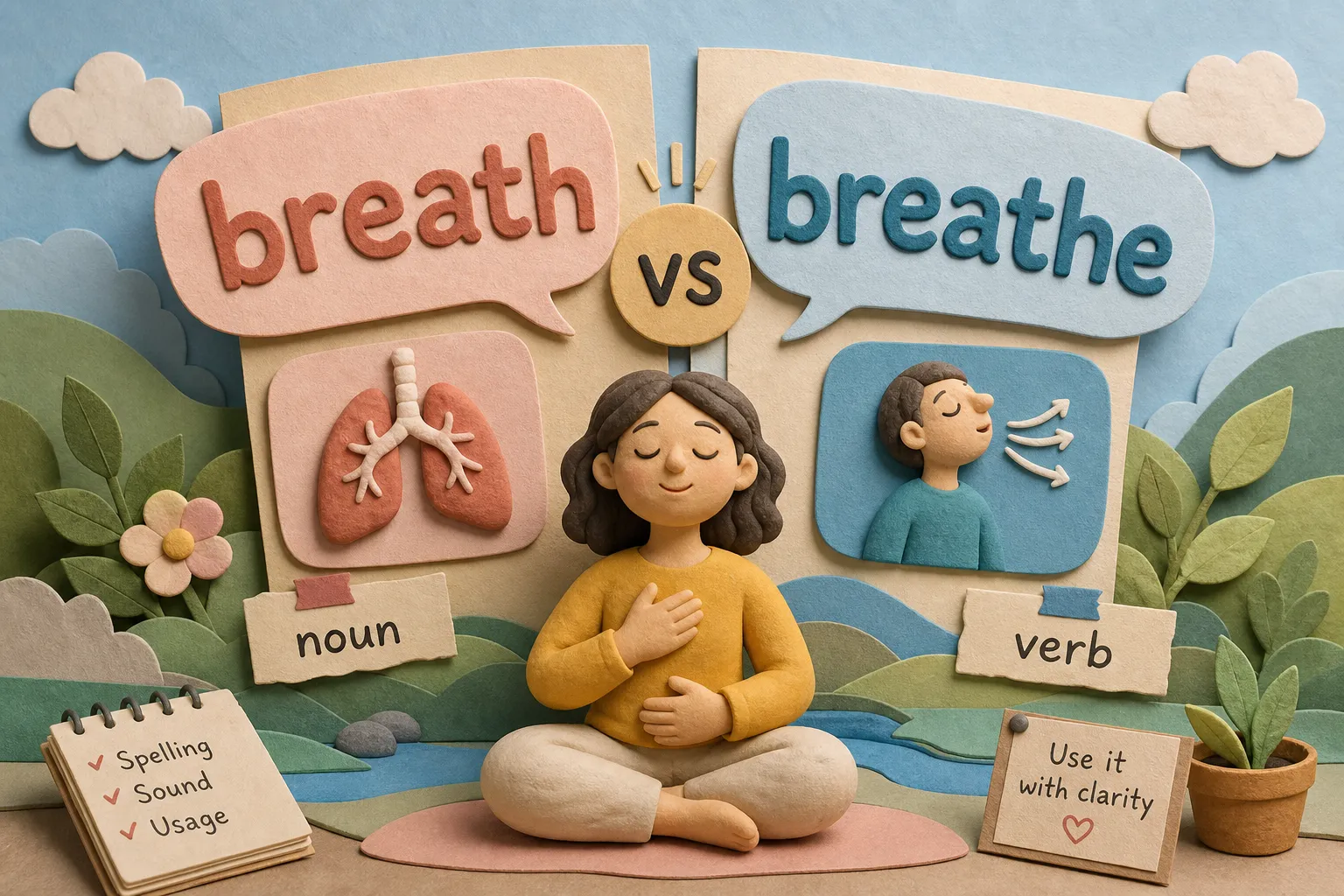
The grammatical split here is clean and simple. “Breath” is a noun. “Breathe” is a verb. One names something you can hold, take, or count. The other describes what your lungs do. Once you see the pair through that lens, the right choice usually becomes obvious.
“Breath” names the air itself
“Breath” is a noun. It refers to a single unit of air you inhale or exhale, or to the act of breathing seen as a countable thing. Because it is a noun, it behaves exactly like other nouns in a sentence: it can follow articles, adjectives, and possessives. You take a breath. You hold your breath. You catch your breath after a hard run. In each of those phrases, the word acts as the object of a verb, the thing being acted on, not the action itself.
“Breathe” describes the action of inhaling and exhaling
“Breathe” is a verb. It names what a subject does with their lungs. It conjugates the same way other action verbs do: I breathe, she breathes, they were breathing, we breathed. In a sentence, it fills the verb slot: “Please breathe slowly.” “He couldn’t breathe in the smoke.” “She was breathing heavily after the race.” The word shows an action happening, not a thing that exists.
How Breath and Breathe Actually Sound
Many grammar articles focus on spelling without fully addressing pronunciation, and yet this is the section that matters most for spoken fluency. These two words do not just look different on paper; they sound noticeably different in two separate ways: the vowel inside the word and the final consonant. Knowing both distinctions means you will recognize each word when you hear it and produce it clearly when you speak.
The sound inside “breath”: short vowel, voiceless “th”
According to Merriam-Webster, “breath” is transcribed in IPA as /brɛθ/. The vowel is short, exactly like the “e” in “bed,” “red,” or “ten.” The final sound is the voiceless “th”, the same sound that starts “think,” “thin,” and “thunder.” To make it, place the tip of your tongue lightly at your upper front teeth, let air pass through, and keep your throat completely silent. No buzzing, no vibration. A simple phonetic respelling to say aloud: BRETH. You can also check the Oxford Learner’s Dictionary definition of “breath” for an additional pronunciation reference and example sentences.
The sound inside “breathe”: long vowel, voiced “th”
Merriam-Webster transcribes “breathe” as /briːð/. The vowel is long, the “ee” sound you hear in “tree,” “free,” and “see.” The final sound is the voiced “th,” the same sound in “this,” “that,” “the,” and “them.” The tongue position is identical to the voiceless version, but this time your vocal cords stay switched on through the ending. You will feel a slight buzz in your throat and around your tongue. Phonetic respelling: BREETH. Say both words aloud right now, one after the other, and pay attention to that shift in your throat. The difference is real and physical. For an IPA transcription and audio example, see the Cambridge Dictionary entry for “breathe”.
Why This Pair Trips Up So Many Learners
Confusing these two words is not careless. It is a predictable result of how English spelling works, which, as you probably know, is not always logical. There are two common traps that catch many ESL learners, and both are worth naming directly.
The silent “e” is doing more than one job
Most learners know that a silent “e” at the end of an English word usually makes the vowel long: “mad” becomes “made,” “hop” becomes “hope.” That rule holds in “breathe”, the silent “e” stretches the vowel from /ɛ/ to /iː/. But what many learners do not expect is that the same silent “e” also changes the final consonant from voiceless /θ/ to voiced /ð/. Two changes for the price of one letter. This rule is genuinely non-obvious, not something most spelling guides flag, and it is worth knowing explicitly. For a clear grammar-side explanation of the difference, see ProWritingAid’s breath vs. breathe guide.
Two “th” sounds that look the same on paper
Because both words are spelled with “th,” many learners assume they end with the same sound. In American English, there are two distinct “th” sounds, and this word pair demonstrates the difference perfectly: one ends in /θ/ and one ends in /ð/. For speakers of Spanish, Portuguese, Mandarin, and many other languages, neither sound exists natively, so both are challenging to produce and distinguish. If you find yourself defaulting to a “t,” “d,” or “s” at the end of these words, that is among the most widely documented ESL substitutions for English “th,” and it is something you can correct with targeted practice. For a full, practical explanation of those two sounds, read How to Pronounce TH in American English (θ and ð): Full Guide, Your Daily American.
Breath and Breathe in Everyday American English Sentences
Rules become fluency only when you see them working in real sentences. Here are ten model sentences, five for each word, drawn from everyday American contexts: a doctor’s office, a yoga class, a cold morning, a stressful work situation, and casual conversation.
Five sentences using “breath” correctly
-
“Take a deep breath before you walk into the interview.”
“Breath” follows the adjective “deep” and the article “a,” which marks it clearly as a noun. -
“It was so cold outside that she could see her own breath.”
“Breath” is the object of “see,” naming the visible puff of air. -
“He was so out of breath after the stairs that he had to sit down.”
“Out of breath” is a fixed American phrase; “breath” is the noun in the prepositional phrase. -
“I held my breath while the doctor read the results.”
“Breath” is the object of “held”; it is the thing being held. -
“She said it quietly, almost under her breath.”
“Under her breath” is a set idiom meaning spoken too softly for others to hear.
Five sentences using “breathe” correctly
-
“The yoga instructor told us to breathe in through the nose and out through the mouth.”
“Breathe” is an infinitive verb following “told us to.” -
“It was so crowded on the subway that it was hard to breathe.”
“Breathe” fills the infinitive slot after “hard to,” describing the action. -
“She breathed slowly and felt her shoulders relax.”
Past tense: “breathed” shows the completed action. -
“He’s been so stressed at work that he barely has time to breathe.”
“Breathe” is figurative here, meaning to relax or have a moment to rest, a natural American usage. -
“Just breathe, you know this material.”
Direct command form; “breathe” is the imperative verb telling someone what to do.
A Quick Trick to Always Get It Right
Every learner has that half-second of hesitation, noun or verb?, right before they write or speak. A reliable memory hook eliminates that pause. Here is one you can use in real time, whether you are composing an email or mid-conversation.
The “e = exhale” memory hook
The longer word, “breathe,” has the extra “e,” and that extra letter signals the verb, the action. When you picture yourself exhaling, actively doing something, you need “breathe.” When you are naming the air itself, the thing that comes out, you need “breath.” There is also a built-in sound clue that reinforces this: the longer word has the longer vowel. “Breathe” has more letters and its vowel sound stretches longer (BREETH). “Breath” is shorter in both spelling and sound (BRETH). The word’s shape and its sound are telling you the same thing.
A two-second self-check before you write or speak
Ask yourself one question: is this a thing or an action? If it is a thing, something you can hold, take, catch, or see, use “breath.” If it is an action, something a subject is doing, use “breathe.” You can also run a quick sound check: if the vowel in your head sounds like “ee” (as in “tree”), it is “breathe,” the verb. If the vowel sounds like “e” (as in “bed”), it is “breath,” the noun. Two questions, two seconds, right answer every time.
Spelling and Sound: Why You Need Both to Truly Own a Word
Most grammar resources give you the rule and stop there. They tell you “breath is a noun and breathe is a verb”, and that helps for writing. But what happens when you are speaking? Or when you hear a native speaker say one of these words fast in a sentence and need to understand it instantly? That is where knowing the pronunciation becomes just as essential as knowing the grammar.
At Your Daily American, every word lesson covers not just what a word means or how it is used, but how it actually sounds in American English: the vowel, the consonant, the stress pattern, and the way it connects to surrounding words in natural speech. For a pair like this one, that means understanding the short versus long vowel, the voiceless versus voiced “th,” and how to produce both clearly so native speakers understand you without effort. We also cover related American sound patterns, including differences in other tricky sounds, in articles like The American R: Why It Sounds So Different, Your Daily American, which many learners find helpful when tuning the rest of their pronunciation.
If you want to go deeper on American English sounds, including the two “th” sounds, connected speech patterns, and the spelling-to-sound rules that trip up many ESL learners, Pronunciation & Listening, Your Daily American is built exactly for that. It takes you from “I understand the rule” to “I use it automatically,” working through sounds systematically at your own pace.
Put It into Practice
Here is a recap of the breath vs breathe distinction in two sentences: “breath” is a noun with a short /ɛ/ vowel and a voiceless /θ/ at the end; “breathe” is a verb with a long /iː/ vowel and a voiced /ð/ at the end. The longer word has the longer sound, and the extra “e” marks the action.
Your practice prompt: write three sentences using “breath” and three using “breathe.” Then say each one aloud, paying attention to the vowel shift between the two words. After that, spend the next few days noticing both words in context, in TV shows, podcasts, conversations, articles. Recognizing them in natural, fast American speech is the final step to owning them completely. That moment when you hear “take a deep breath” and instantly register “noun” and “BRETH” without thinking, that is fluency doing its job. For another clear, learner-focused comparison of these two forms, see Scribbr’s breathe vs. breath comparison.
Frequently Asked Questions
Which word is the noun, breath or breathe?
“Breath” (no final “e”) is the noun. It names a unit of air you inhale or exhale, as in “take a deep breath.” “Breathe” (with a final “e”) is the verb, describing the action your lungs perform.
How do you pronounce “breathe”?
“Breathe” is pronounced /briːð/, rhymes with “seethe.” The vowel is a long “ee” sound, and the final consonant is a voiced “th” (the same sound as in “this” or “the”). A simple way to remember it: BREETH. For another short learner-friendly explanation of the pair, consult ProWritingAid’s guide.
How do you pronounce “breath”?
“Breath” is pronounced /brɛθ/, rhymes with “death.” The vowel is a short “e” sound, and the final consonant is a voiceless “th” (the same sound as in “think”). Phonetic respelling: BRETH. You can also hear examples and listen to audio at the Cambridge Dictionary entry for “breathe” and the Oxford Learner’s Dictionary definition of “breath”.
What are some examples of breath vs breathe in a sentence?
Noun: “She took a slow breath before answering.” Verb: “He couldn’t breathe through his nose.” A quick test, if you can place “a” or “the” in front of it, you want the noun form: “a breath.” If it follows a subject as the action word, you want the verb: “I breathe, she breathes.”
Is “breathe” ever used as a noun?
No. “Breathe” functions only as a verb in standard American English. The noun form is always “breath.” Common inflections of the verb include: breathes (third-person singular), breathed (past tense), and breathing (present participle).