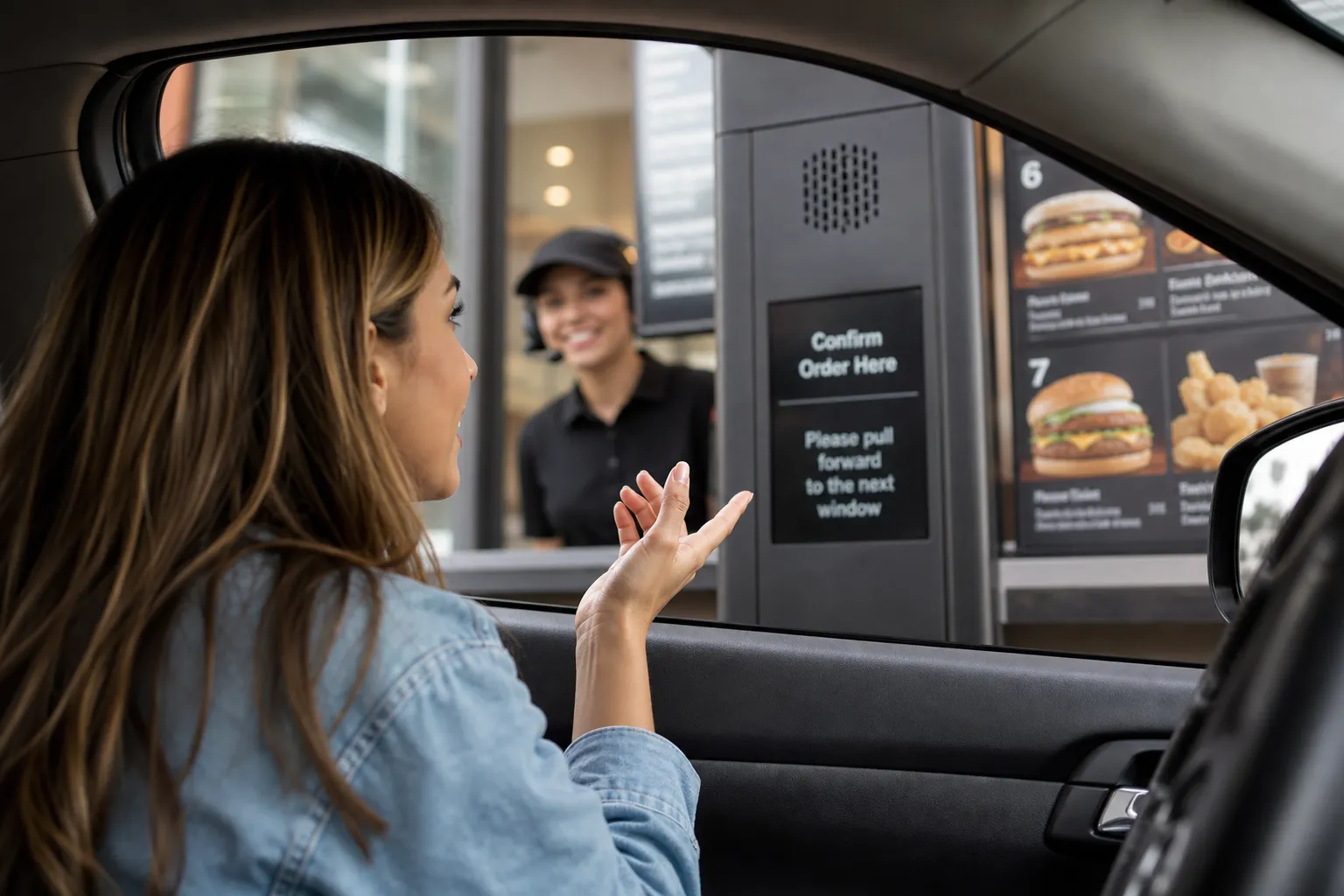
The speaker crackles. A voice comes through, fast and a little muffled, saying, “Hi, can I take your order?” You’re not quite ready. There’s a car behind you. Your mind goes blank. For a lot of ESL learners, this moment at the drive-through speaker is genuinely stressful, and not because English is hard. It’s because the audio is distorted, the pacing is fast, and the situation feels like a timed test with an audience.
By the end of this lesson, you’ll know what to actually say at a drive through so the whole interaction moves smoothly, from the speaker to the pickup window. You’ll be able to place a clear, natural-sounding order at any American drive-through, handle modifications and corrections without panic, and decode what the worker is saying even through the static. This isn’t about sounding perfect. It’s about having the right words ready when that speaker clicks on.
What happens before you reach the speaker
Know your order before the speaker clicks on
Drive-through workers start a timer the moment your car pulls up to the speaker. Arriving at the box mid-decision creates hesitation, and hesitation leads to mumbling, which leads to errors. Do yourself a favor: read the menu board while you’re still in the lane. Use those 30 to 60 seconds to make your decision so that when the speaker activates, you’re ready to talk.
If you’re not ready, that’s fine too. You have permission to say this:
“Hi, give me just a moment, I’m still deciding.”
That one sentence buys you time without being rude. Workers hear it constantly and it’s completely normal.
What the worker will say first (and what it means)
The opening line varies by location and employee, but you’ll almost always hear one of these versions:
- “Hi, can I take your order?”
- “Welcome to [restaurant name], go ahead when you’re ready.”
- “What can I get for you today?”
- “Are you ready to order?”
Pay attention to “go ahead.” This does not mean pull the car forward. It means start talking. This is a small but genuinely confusing phrase for learners, and knowing it in advance makes those first two seconds much less startling.
What to actually say at a drive through: core phrases and scripts
The phrase pattern that works every time
There’s a simple formula that covers almost every order: greeting + “Can I get” or “I’ll have” + item(s) + “please.” Between those two openers, “Can I get” is the more natural American choice at a drive-through. “I want” works, but it sounds slightly blunt. “Give me” is even more casual and can come across as curt. “Can I get” hits the right note, direct, clear, and polite without being stiff.
Here’s the formula in action:
“Hi, can I get a number three with a Coke, please?”
“I’ll have a grilled chicken sandwich, no mayo, and a medium fries.”
Drive-thru order scripts for real situations
Script 1: Ordering for yourself, simple combo
This is the most common scenario, one person, one combo, no complications. Keep it brief and end with “please.”
“Hi, can I get the number five with a medium lemonade, please?”
Script 2: Ordering for two people
Sequence items clearly, one person’s order at a time, and pause between them. This gives the worker time to enter each item accurately before you move on.
“Hi, I’ll have a cheeseburger combo, large, with a Sprite. And then a crispy chicken sandwich, medium fries, and a water. That’s it.”
Script 3: When you have a question about the menu
“Hi, quick question, what comes with the number four?” Wait for the answer, then order: “Okay, I’ll take that with a sweet tea, please.”
One technique that reduces back-and-forth significantly: pause briefly between items instead of rushing everything out in one breath. Then finish with “That’s everything” or “That’s all.” This signals you’re done, and the worker doesn’t have to guess or interrupt.
Ordering modifications without confusing the crew
The item-first method for customizations
There’s a specific technique that makes modifications easier to process: state the item first, then the change. “Burger, no pickles” is faster and clearer than “Can you make sure there are no pickles on my burger?” The item anchors the modification, so the worker knows exactly what you’re talking about before you get to the change.
Compare these two approaches side by side:
Hard to process: “I don’t want any onions, and can you add extra cheese, and maybe light sauce?”
Easy to process: “Cheeseburger, extra cheese, light sauce, no onions.”
One quick pronunciation note: “extra” in fast American speech sounds like “EK-struh,” not “EK-trah.” Native speakers don’t slow down for modifications, so practicing that reduction will help you sound natural and be understood clearly.
What to say when the repeat-back is wrong
After you order, the worker will usually read your items back to confirm. Listen for your modifications specifically. If something is wrong, correct it right there at the speaker, not at the window. Fixing an error at the window is slower for everyone and more likely to result in the wrong item anyway.
Use this script to correct politely:
“Actually, I said no pickles, not extra pickles, sorry about that.”
“Actually” is the natural American softener for this kind of gentle correction. It doesn’t sound rude. It signals you’re clarifying something, not complaining, so stick with “Actually” over “Excuse me” or “No, that’s wrong,” both of which feel more confrontational in this context.
Decoding fast, muffled drive-through speech
Why the speaker sounds so distorted (and what to listen for)
Drive-through headsets compress speech, strip background noise, and transmit mostly mid-range audio frequencies. On top of that, workers speak quickly because they’re managing multiple screens, timers, and sometimes two or three orders at once. When the audio sounds garbled, that is not a hearing problem on your end. It’s the kind of operational issue many drive-thru guides describe, hardware, software, and workflow all change how clearly speech comes through.
The fast, reduced patterns you hear at the speaker are the same features of everyday American speech you’d hear in any quick conversation. A few of the most common:
- “Whaddya want?” = “What do you want?”
- “Thatit?” = “Is that it?”
- “Pullforward” = “Pull forward”
- “Yertotal” = “Your total”
- “Cashercredit?” = “Cash or credit?”
Once you know what to expect, those compressed phrases stop sounding like a foreign language and start sounding like normal fast speech.
How to ask for a repeat without losing your place
If you didn’t catch something, ask for it again immediately and without embarrassment. These phrases handle it perfectly:
“Sorry, I didn’t catch that, could you say it again?”
“One more time, please?”
Both are natural and completely expected. Workers repeat themselves regularly for every kind of customer. If you want to practice recognizing connected and reduced American speech beyond the drive-through, The Fastest Way to Become Fluent in American English, Your Daily American has pronunciation and listening guides that break down exactly how native speakers compress words in real-life conversations, from fast food counters to work meetings.
What to actually say at a drive through: paying and picking up
Drive-thru etiquette at the payment window
The payment window interaction is brief and transactional. A few phrases cover nearly everything you’ll need to say:
- “Here’s my card.” / “Here’s [amount in cash].”
- “Do you need exact change?” (useful when paying cash and you’re unsure)
- “Can I get a receipt, please?”
- “Is contactless okay?” (if you’re tapping a phone or card)
Have your card or cash ready before the window opens. Reaching the window and then searching your bag or wallet for payment creates a small but real delay. Having payment in hand when the window slides open is part of drive-thru etiquette, and it signals comfort and experience even when your words are minimal.
Checking your order and saying a good goodbye
At the pickup window, do a quick bag check before you pull away. According to QSR Magazine’s annual drive-through performance study, roughly 1 in 7 drive-through orders contains at least one error, and the easiest time to fix one is right there at the window. Here’s a phrase that’s friendly and efficient:
“Can I just double-check? I had the sandwich with no mayo.”
For the sign-off, skip “goodbye.” Americans at service counters almost never say it. These closers are what you’ll actually hear and what you should use:
- “Thanks so much.”
- Have a good one.
- “Appreciate it.”
- “Thanks, have a great day.”
“Have a good one” is casual, warm, and used far more often than any formal farewell in American service interactions. It’s the right register for this situation every time.
Funny lines at the drive-through: when they land and when they don’t
Drive-thru one-liners that are actually safe to use
Light humor is genuinely welcome at the drive-through sometimes, especially during a slow period or when you’re at a spot you visit regularly. The key word is “light.” Comments that acknowledge the worker as a person without creating confusion or slowing the line are always the right call. These tend to work well:
- “You’re doing great out there.” (Said at the window, with a smile.)
- “This is the only decision I’ve been confident about all day.” (Self-deprecating, low-stakes.)
- “I’ll have the usual.” (Works even as a first-timer if you say it with obvious humor.)
Each of these is brief, doesn’t require the worker to respond in any complicated way, and treats the interaction as a human moment rather than a transaction.
Why timing matters more than the joke itself
There’s one rule that overrides everything else: never try humor at the speaker during a lunch or dinner rush. The speaker is for orders. The window, during a natural pause in the handoff, is the right moment for anything light or friendly. A busy speaker line with cars stacked behind you is the wrong time for any joke, no matter how harmless.
For ESL learners specifically, one more thing is worth knowing. A joke that lands easily in your first language can fall flat or seem rude in American English because tone and timing carry most of the meaning. When in doubt, a sincere “thank you” and a warm smile land better than any one-liner. Save the humor for when the moment feels right rather than forcing it.
You’re ready, now practice it for real
Think back to that opening moment: the crackle, the “Can I take your order?” Now you have the full toolkit. You know the core formula (greeting + “Can I get” + your order + “please”), the item-first method for modifications, and two phrases that handle any listening gap without embarrassment. You also know what “go ahead” means, when “actually” softens a correction, and why “have a good one” is the right way to say goodbye.
Real American English is learned through real situations, and the drive-through is one of the most frequent ones you’ll encounter in daily life. It’s short, predictable, and full of patterns that repeat every single time, which makes it one of the best low-stakes environments to practice spoken English with real consequences.
Here’s your practice prompt: at your next drive-through visit, place your order using only the scripts from this lesson. Notice which phrases feel natural and which ones you hesitate on. Those hesitations are exactly what to practice next. Now you know what to actually say at a drive through, and when you’re ready to go deeper on fast speech, everyday expressions, and the connected-speech patterns you hear everywhere, you’ll find a full library of practical lessons at Your Daily American.