You stop someone on a sidewalk in a small American town and ask how to get to the nearest grocery store. They look at you, point down the road, and say: “Head down this road about two miles, turn left at the Walmart, and you’ll hit it.” No street name. No compass bearing. Just a giant retail store and a rough estimate. If you’ve ever felt puzzled by that kind of answer, you’re not alone. Understanding how Americans give directions, and why GPS changed everything about it, will help you navigate real American conversations with confidence. By the end of this article, you’ll recognize the old-school phrases still alive in everyday speech, understand the GPS vocabulary that has crossed into casual conversation, and know exactly how to ask a stranger for help without freezing up.
Direction-giving in American English is a window into how the culture thinks about space, distance, and shared knowledge. It’s not random. There’s a logic behind every “you can’t miss it” and every “just follow the GPS,” and once you see that logic, the language clicks into place.
How Americans Give Directions: Landmarks, Cardinal Points, and TripTik Maps
Why landmarks ruled the road before GPS
Before smartphones and navigation apps, Americans navigated with paper road atlases, handwritten notes, and directions passed along by word of mouth. Landmarks were the anchor points of this system because they were visible, memorable, and recognizable to anyone who knew the area. A friend might tell you: “Turn left at the red barn,” “Go past the old drugstore on the corner,” or “You’ll see a water tower on your right, that’s when you know you’re close.” These weren’t vague instructions. They were precise, as long as you knew what a local knew.
For longer road trips, organizations like AAA produced pre-planned route packets called TripTik maps: booklets of map pages and step-by-step driving instructions tailored to your specific journey. The Official Automobile Blue Book served a similar purpose, listing mileage, turns, local landmarks, hotels, and even road conditions. Getting somewhere required preparation, map-reading ability, and a willingness to ask strangers if things went wrong.
Cardinal directions and the American grid
If you’ve ever heard an American say “head north about three blocks” or “the park is just east of downtown,” you’ve encountered the compass-based system that runs alongside landmark navigation. This isn’t just a quirk. It reflects how many American cities were actually built. The U.S. Land Ordinance of 1785 established a national grid system, and towns across the Midwest and West were laid out on that grid, meaning streets run roughly north-south and east-west. In those places, telling someone to “go north” can be just as clear as telling them to “go straight.” People who grew up in grid cities often reach for cardinal directions first, because their hometowns were literally designed with a compass in mind.
Map literacy reinforced this habit. Americans who learned to read paper maps in school, orienting the page, finding north, tracing a route, carried that compass-based thinking into everyday conversation. When you’ve oriented a road atlas before every family road trip, saying “head east on the highway” feels completely natural.
Pre-GPS phrases you’ll still hear today
These expressions were born in the pre-GPS era, but they never died. Real Americans still use them, and you need to recognize them:
- “You can’t miss it.”
- “It’s right past the [landmark].”
- “Just keep going until you hit [major road].”
- “It’s about two miles down on your left.”
- “When you see [landmark], you’ve gone too far.”
Treat these as Common American Expressions Every English Learner Should Know, Your Daily American, not museum pieces. You’ll hear them at gas stations, from neighbors, and from anyone who learned to navigate before there was an app for it, which describes a significant portion of the driving population.
Why Americans Say “Turn at the Walmart” Instead of “Take Elm Street”
Local knowledge as a social signal
When someone gives you landmark-based directions, they’re doing more than pointing you toward a destination. They’re drawing on shared local knowledge and quietly signaling that they belong to this place. “Turn at the Walmart” works because both the speaker and the listener are expected to know that Walmart, it’s big, it’s visible, and it doesn’t move. Big-box stores, gas stations, bridges, and highway exits became the default reference points for this exact reason: they’re impossible to miss and they persist over time. A street name on a sign might be easy to overlook at 40 mph. A Walmart is not.
This is also why landmark-based wayfinding persists even in the GPS era. It’s faster to say and easier to picture than a formal street address. People reach for what works, and for decades, visible anchors worked very well.
Geographic scale and the American mindset around distance
In many parts of the U.S., especially rural and suburban areas, long drives are a normal part of daily life. This shapes how people think and talk about distance. “About two miles,” “just down the highway,” and “maybe 20 minutes” are far more common than precise measurements, because American drivers are comfortable working within that kind of range. Saying “it’s about half a mile” is a helpful data point, not a cop-out. It sets the right expectation without requiring a measuring tape.
This comfort with approximate distance extends to the directions themselves. “Keep going for a bit” and “it’s just around the corner” reflect a culture where the road is familiar territory and a little ambiguity is acceptable. For learners used to precise public transit maps or dense urban grids, this can feel uncomfortable at first. But once you hear it enough, it becomes readable.
How GPS Changed the Way Americans Give Directions
From landmarks to “in 500 feet, turn right”
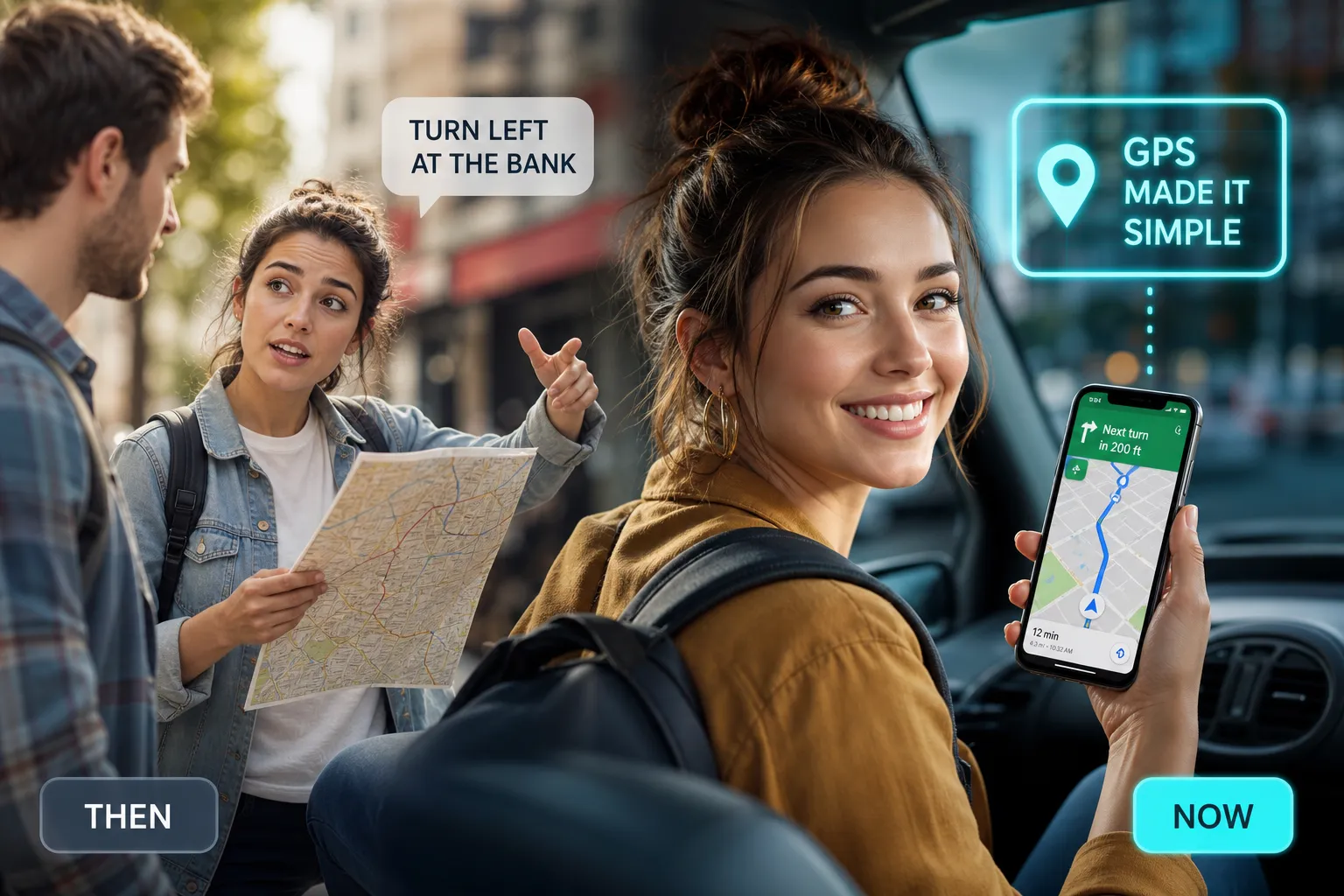
The shift happened in stages. President Clinton ended GPS Selective Availability in May 2000, making civilian signals roughly ten times more accurate overnight. Consumer GPS devices followed quickly, and then in 2008, the iPhone added GPS to the smartphone, making turn-by-turn navigation widely available in a personal device for the first time. Google Maps and Waze became the tools Americans reach for before starting the car. The language of navigation changed with the technology: instead of “turn at the church,” the prompt became “turn right onto Church Street in 300 feet.” Distance, maneuver, and road name replaced narrative and local knowledge within a single generation, a transformation roughly 25 years in the making, depending on whether you mark the start from the Global Positioning System or from the smartphone boom of 2008. For a concise overview of the technology’s development, see this article on the history of GPS.
Today, surveys and studies suggest a large majority of American drivers rely on GPS or navigation apps for everyday travel, while very few still use a paper map. By some estimates, one in five Americans has never used a paper map at all. That’s a dramatic cultural shift in a remarkably short time.
How turn-by-turn audio changed what Americans say out loud
Here’s what makes this genuinely interesting for English learners: GPS didn’t just change how people get around, it changed how people talk. Americans now casually drop phrases into conversation that would have been meaningless 20 years ago. You’ll hear: “Google Maps says take the next exit,” “Just follow the GPS,” “It’ll route you around the traffic,” and “I’ll text you the location.” The vocabulary of navigation has fully absorbed GPS culture, and these phrases show up in everyday conversation, not just in the car.
There’s also a well-documented irony here. Research published in npj Digital Medicine and other academic sources links heavy reliance on turn-by-turn GPS to weaker spatial memory and less accurate mental maps over time. People who grew up navigating by GPS often genuinely cannot give directions the old way, because they never built a mental map of their own neighborhood. The phrase “just follow the GPS” isn’t always laziness; for many Americans who have only ever navigated by app, it’s simply the honest answer.
The Real Direction Phrases You’ll Actually Hear Today
Classic landmark phrases still alive in everyday speech
Real Americans blend old habits with new tools constantly. You’ll encounter these in genuine conversation, and you need to be ready for them: “Take a left at the CVS,” “It’s right across from the Target,” “When you pass the overpass, you’re almost there,” and “Just stay on the highway till you see the sign for exit 14.” These aren’t nostalgic, they’re current. Most Americans giving casual directions will reach for at least one of them.
GPS-era phrases that have crossed into conversation
These are the newer expressions you’ll hear, drawn directly from the experience of using navigation apps. Knowing what they mean, and when to use them, is part of sounding natural in American English today:
- “Just drop the pin.” (Share your exact location through a map app.)
- “I’ll text you the location.” (Send a map link via message.)
- “GPS had me going the back way.” (The app chose an unusual route.)
- “It’s like a 10-minute drive according to Maps.” (Google Maps estimates the travel time.)
- “It’s recalculating.” (Used humorously to mean someone or something is adjusting after going off course.)
When Americans mix both styles
Most real direction conversations blend the two systems without any effort. Imagine two friends helping a third person find a restaurant: one says, “Just put it in Google Maps, it’s maybe 12 minutes from here,” and the other adds, “Yeah, but when you get off the highway, don’t trust the GPS. Turn left at the gas station on the corner, not where the app says.” That’s authentic American English in action, technology is the starting point, and local knowledge fills in the gaps. As a learner, you need to be ready for both layers in the same sentence.
How to Ask a Stranger for Directions (The Phrases, the Tone, and What to Do When You’re Lost)
Opening the conversation naturally
Stopping a stranger on the street is a small social event in American culture, and there’s a reliable formula for it. You open with a brief, apologetic softener, then ask your question directly. These openers work in almost any situation:
- “Hey, sorry to bother you, do you know where [place] is?”
- “Excuse me, I’m a little lost, can you point me toward [place]?”
- “Quick question, am I heading the right way for [place]?”
- “Excuse me, could you tell me how to get to [place]?”
“Sorry to bother you” is a genuine American politeness formula, widely recognized in studies of American conversational pragmatics. It signals that you know you’re interrupting someone’s day and keeps the interaction low-pressure. Don’t skip it thinking it sounds unnecessary, it’s doing real social work in the conversation.
What to say when you don’t understand the answer
This is where many learners get stuck. Someone gives you directions, you nod along, and then you have no idea what they just said. These rescue phrases exist for exactly that moment: “Sorry, could you say that again?” works for any unclear answer. “I’m not from around here, which way is that?” signals that you need a simpler frame of reference. “Is there a landmark I should look for?” redirects the person toward the visual cues that are easiest to follow.
“Would it be easier to just show me on my phone?” is a completely natural request that most Americans are happy to fulfill, you hand them your phone, they drop a pin, and the problem is solved without either of you needing to decode a string of street names.
When the conversation goes beyond directions
Americans often turn a brief direction exchange into a short, friendly interaction. Someone might ask where you’re headed, offer an extra tip about parking, or mention that the place you’re looking for recently moved. These moments are unscripted and completely real. They happen at street corners, gas stations, parking lots, and coffee shop counters. Handling them confidently takes a kind of practical American English fluency that most grammar textbooks never cover. That contextual fluency, real situations, real phrases, and the cultural knowledge that ties them together, is what Your Daily American focuses on.
What You Can Do With This Now
Now you know how Americans give directions and why GPS changed everything about the way they talk and navigate. The culture behind it runs deep: geography, history, and a shared comfort with approximate, visual, landmark-based language all shaped the system you hear on the street today. GPS accelerated a shift that was already underway, and now the two systems run side by side, landmark phrases and navigation app vocabulary living in the same conversation, sometimes in the same sentence.
The cultural knowledge matters as much as the vocabulary. Knowing that “you can’t miss it” is confident reassurance rather than a guarantee, that “about two miles” is functional rather than lazy, and that “sorry to bother you” opens a door rather than just filling space, that’s the kind of contextual fluency that makes your English feel natural rather than just grammatically correct.
Try it yourself: Write out how you would stop a stranger and ask for directions to a coffee shop near you. Use at least two phrases from this article in your opener. Then write a response the way a typical American might answer, include one landmark reference and one approximate distance. Read both parts out loud. This two-step exercise locks in both the vocabulary and the cultural frame at the same time, which is exactly how real fluency is built.