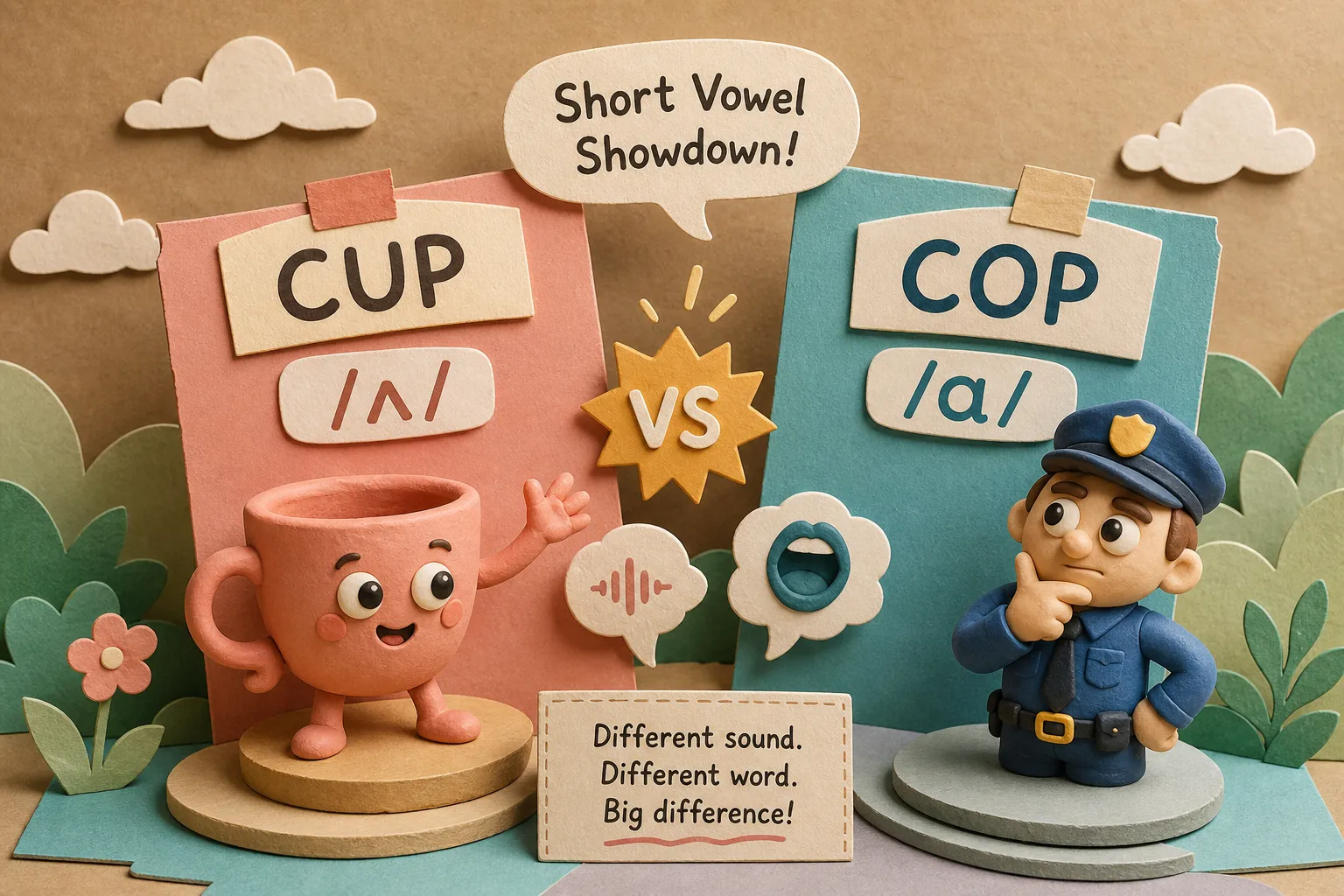
Picture this: you’re at a coffee shop, you ask for “a cup,” and the person behind you tenses up because they heard “cop.” Or you’re telling a story about seeing a police officer nearby, and your coworker starts looking at your empty mug. The cup vs cop mix-up is real, and it happens to confident, intermediate-level English speakers every day. The two vowels involved, /ʌ/ as in cup and /ɑ/ as in cop, sit close enough in sound to genuinely fool both speakers and listeners.
By the end of this lesson, you’ll be able to hear and produce the cup vs cop distinction clearly, and you’ll know which mistakes to watch for based on your first language. The fix isn’t complicated, but it does require understanding what’s actually happening inside your mouth. Many learners never receive a clear articulatory explanation for this contrast. At Your Daily American, we build pronunciation content around exactly this kind of close vowel pair, because that’s where real fluency lives: in the small distinctions that textbooks skip over.
Cup vs Cop: Why They Sound Almost Identical to Non-Native Ears
The honest answer is that these two vowels are genuinely close. In American English, both /ʌ/ and /ɑ/ are unrounded in General American, meaning neither one involves any rounding of the lips. That removes the most obvious visual cue a learner might use to tell them apart. In British Received Pronunciation, by contrast, “cop” uses the rounded vowel /ɒ/, which gives listeners a visible lip-rounding cue that simply doesn’t exist in American speech. Without that cue, the real distinction relies entirely on tongue height and jaw opening, subtle, internal movements you can’t see from the outside.
This matters practically for learners who studied British English first. If you learned with BBC content or British teachers, you may have been using a slight “o” lip shape for words like hot, stop, and cop. In American English, that rounding disappears completely. So you’re not just learning a new sound; you’re unlearning a visual cue you’ve been relying on.
The cost of mixing these up goes beyond accent. If you say “cup” with an /ɑ/ vowel, a native listener may hear “cop.” That matters in real life. “I saw a cup on the counter” and “I saw a cop on the corner” are very different stories. “My bus is late” and “My boss is late” send entirely different messages at work. The cup vs cop contrast deserves five focused minutes of your attention, and this lesson delivers exactly that.
How Your Mouth Makes Each Sound: Articulation Breakdown
The /ʌ/ Sound: Relaxed Center (cup, cut, bus)
The /ʌ/ vowel (phonetic respelling: UH) is a mid-central vowel. Your jaw is partly open, not wide, not tight. Your tongue sits in the middle of your mouth at a mid height, not pushed to the front or pulled to the back, just resting. Your lips stay neutral and relaxed, neither spread nor rounded.
Think of it as the sound your mouth makes when it’s genuinely at rest. A useful anchor: /ʌ/ sounds similar to the schwa /ə/, the unstressed vowel in the word “the”, though they are distinct sounds. The schwa is fully unstressed and neutral; /ʌ/ carries a bit more prominence in stressed syllables. They’re close cousins, not identical twins. Here are common words where you’ll hear /ʌ/:
- cup /kʌp/
- cut /kʌt/
- bus /bʌs/
- luck /lʌk/
- done /dʌn/
Practice tip: say “UH” the way you would if someone asked you a question and you needed a second to think. That flat, central, relaxed sound is exactly right. For more practice exercises on distinguishing minimal sounds like these, check out a concise guide to minimal pairs.
The /ɑ/ Sound: Open Back, Wide Jaw (cop, cot, boss)
The /ɑ/ vowel (phonetic respelling: AH) is a low back vowel. Your jaw drops noticeably more than for /ʌ/. Your tongue moves back and sits low in your mouth. Your lips stay unrounded, but your mouth is significantly wider open. The easiest way to find this sound: it’s the exact “AH” a doctor asks for when checking your throat. Open your jaw wide, pull your tongue back and down, and say “AH.” That’s /ɑ/.
Here are common words where you’ll hear /ɑ/:
- cop /kɑp/
- cot /kɑt/
- boss /bɑs/
- not /nɑt/
- stop /stɑp/
The key physical difference to memorize: /ʌ/ is central and mid-height, /ɑ/ is back and low. The distinction actually involves two coordinated cues, jaw opening and tongue backness. When you move from “cup” to “cop,” your jaw should drop and your tongue should pull back. Both movements together create the contrast. For a focused comparison of the “uh” vs. “ah” distinction, this explanation is helpful: uh vs. ah.
American English vs. British: Why “Cop” Sounds Different Depending on the Accent
/ɑ/ in General American vs. /ɒ/ in British English
In British Received Pronunciation (RP), “cop” uses /ɒ/, a vowel that is low and back like /ɑ/, but also rounded. British speakers form a slight “o” lip shape while producing it. If you’ve spent significant time with BBC content or British teachers, you’ve been hearing a rounded version of this vowel for years.
Side by side, the contrast looks like this:
- British “cop”: /kɒp/, low back + rounded lips (slight “o” shape)
- American “cop”: /kɑp/, low back + completely unrounded lips (wide open, no shape)
This affects a whole set of common words: hot, stop, got, job, not, drop. In American English, all of these use /ɑ/ with no lip rounding at all. For an overview of the American vowel system and how these sounds are categorized, see this practical guide to the vowels of American English.
What This Means for Learners Moving Between Accents
If you learned British English first, you may hear an American say “cop” with a wide, open “AH” and think it sounds wrong, or even mistake it for a different word. The recalibration is straightforward once you know what to do: whenever you’d use a rounded short-o in British English, drop the lip rounding completely and open your jaw wider. The tongue position stays roughly the same; the lips relax. That one adjustment brings your American “cop” vowel into place.
Cup vs Cop Minimal Pair Drills to Train Your Ear and Mouth
Word-Level Pairs: Hear the Contrast First
Say each pair aloud slowly. Focus on the jaw: it should drop noticeably when you move from the /ʌ/ word to the /ɑ/ word. If your jaw isn’t moving, you’re probably not making the cup vs cop contrast clearly enough.
- cup /kʌp/, cop /kɑp/
- cut /kʌt/, cot /kɑt/
- cuff /kʌf/, cough /kɑf/
- bus /bʌs/, boss /bɑs/
- pup /pʌp/, pop /pɑp/
- luck /lʌk/, lock /lɑk/
- duck /dʌk/, dock /dɑk/
- shut /ʃʌt/, shot /ʃɑt/
- lung /lʌŋ/, long /lɑŋ/
- bun /bʌn/, bon /bɑn/
Go through the list three times. On the first pass, say each word slowly. On the second, speed up to a natural pace. On the third, close your eyes and focus entirely on the physical sensation: the smaller, centered jaw for /ʌ/, the wider, more open jaw for /ɑ/.
Sentence-Level Practice: Put the Words in Context
Read each sentence pair aloud three times, alternating between the two vowels. Then repeat with your eyes closed to focus on what you feel, not what you read.
- “I need a cup.” / “I need a cop.”
- “She cut the tape.” / “She found the cot.”
- “The bus is late.” / “My boss is late.”
- “Fix the cuff.” / “Stop the cough.”
- “The duck swam past.” / “The dock was wet.”
- “Good luck!” / “Open the lock.”
- “Please shut the door.” / “He took a shot.”
- “The pup barked.” / “The balloon went pop.”
Five minutes of this every day for one to two weeks can produce measurable results. Learners who practice short, structured daily drills consistently report noticeable improvement in vowel discrimination, and the research on perceptual learning supports the idea that brief, repeated exposure outperforms a single long session. For academic evidence on identification and discrimination training effects, see this study on identification vs. discrimination training. Consistency is the key variable: keep the sessions short and do them daily.
L1 Traps: Where Learners from Specific Backgrounds Go Wrong
Spanish Speakers: The Merged Vowel Problem
Spanish has five core vowel sounds, and neither /ʌ/ nor /ɑ/ maps cleanly onto them. Learners from this background often produce something in between the two English sounds, a kind of default /a/ that works for neither vowel precisely. The result is intelligible but imprecise, and native listeners may need a beat to process what they’re hearing.
The practical fix is to treat these as two entirely separate articulatory movements, not just two versions of the same sound. For /ʌ/: start from the schwa, the neutral, unstressed sound in the middle of “the”, and say it with a bit more stress. That centered, relaxed position is your /ʌ/. For /ɑ/: use the doctor’s “AH,” opening your jaw as wide as it naturally goes. Drill cut/cot and cup/cop with a mirror until the jaw movement for /ɑ/ feels noticeably and consistently bigger.
Mandarin and Other East Asian Language Speakers: Quality vs. Category Confusion
For Mandarin speakers, both /ʌ/ and /ɑ/ often fall into a single perceptual category. The distinction doesn’t feel meaningful yet, which makes it hard to hear before it becomes hard to produce. This isn’t a hearing problem; it’s a category problem. Your brain is filing both sounds under the same label.
The fix starts with perception, not production. Listen to ten cup/cop minimal pair examples and classify each as “UH” or “AH” before you try to say anything. Once you can reliably identify the difference by ear, move to shadowing: play a native speaker model, then immediately repeat what you heard while focusing on matching the jaw position. A mirror helps here because the jaw drop for /ɑ/ is visible, and watching yourself produces useful physical feedback that builds muscle memory faster.
A 10-Minute Routine to Make the Difference Automatic
The Listen-Repeat Cycle: 3 Rounds in 10 Minutes
This routine is designed for daily practice over five to seven days. The timing for each round is a practical guideline based on the evidence that short, frequent drills build discrimination faster than longer, infrequent sessions. After a week or so, your vowel discrimination for the cup vs cop contrast will be automatic enough that you’ll start noticing these sounds in native speech without trying.
Round 1 (2 minutes): Stand in front of a mirror. Say /ʌ/ five times slowly, checking that your jaw is only partly open and your tongue is centered. Then say /ɑ/ five times, checking that your jaw drops visibly lower and your tongue pulls back. Alternate between them: UH, AH, UH, AH. The jaw movement should be clear and consistent.
Round 2 (4 minutes): Work through the ten minimal pairs from the word-level drill above. Say each pair three times aloud at a slow, deliberate pace. Keep your focus entirely on the jaw: smaller and centered for /ʌ/, wider and lower for /ɑ/.
Round 3 (4 minutes): Read the eight carrier sentences from the sentence-level drill at a natural conversational pace. Don’t slow down for the target words; let the jaw do the work automatically. If you catch yourself hesitating on a pair, repeat that pair three extra times before moving on.
Try It Yourself: Your Practice Prompt
Before you close this page, try these right now. Say “I need a cup” and “I need a cop” aloud and ask yourself: does your jaw drop noticeably more on “cop”? Record yourself saying the cut/cot and bus/boss pairs and play it back. Does the /ɑ/ vowel sound open and “AH”-like, or does it blend into the /ʌ/? If it blends, go back to the mirror drill in Round 1 until the physical difference feels reliable.
At Your Daily American, our full vowel curriculum follows this same sound-by-sound method, covering not just the cup vs cop pronunciation contrast but the full range of American vowel sounds, connected speech, and accent patterns. Every lesson is built to give you something you can use immediately, not just read about. If you want guided steps to improve your American English pronunciation like a native, start there, and explore our Pronunciation & Listening resources for more drills and lessons.
The Takeaway: Small Differences, Real Impact
The cup vs cop contrast comes down to two coordinated physical cues: jaw height and tongue position. The /ʌ/ vowel is mid, central, and relaxed. The /ɑ/ vowel is low, back, and wide open. Once you feel that distinction in your mouth, you can’t unfeel it. The pair stops being a problem. For more on how vowel contrasts interact with stress patterns, see Word Stress in American English: A Complete Guide, Your Daily American.
Use the 10-minute routine every day for the next week. Pay attention to both sounds when you watch American movies or listen to podcasts, you’ll start noticing them in natural speech faster than you expect. Small vowel contrasts like this one are where listening confidence gets built, one sound at a time, and that confidence carries directly into every real conversation you have.