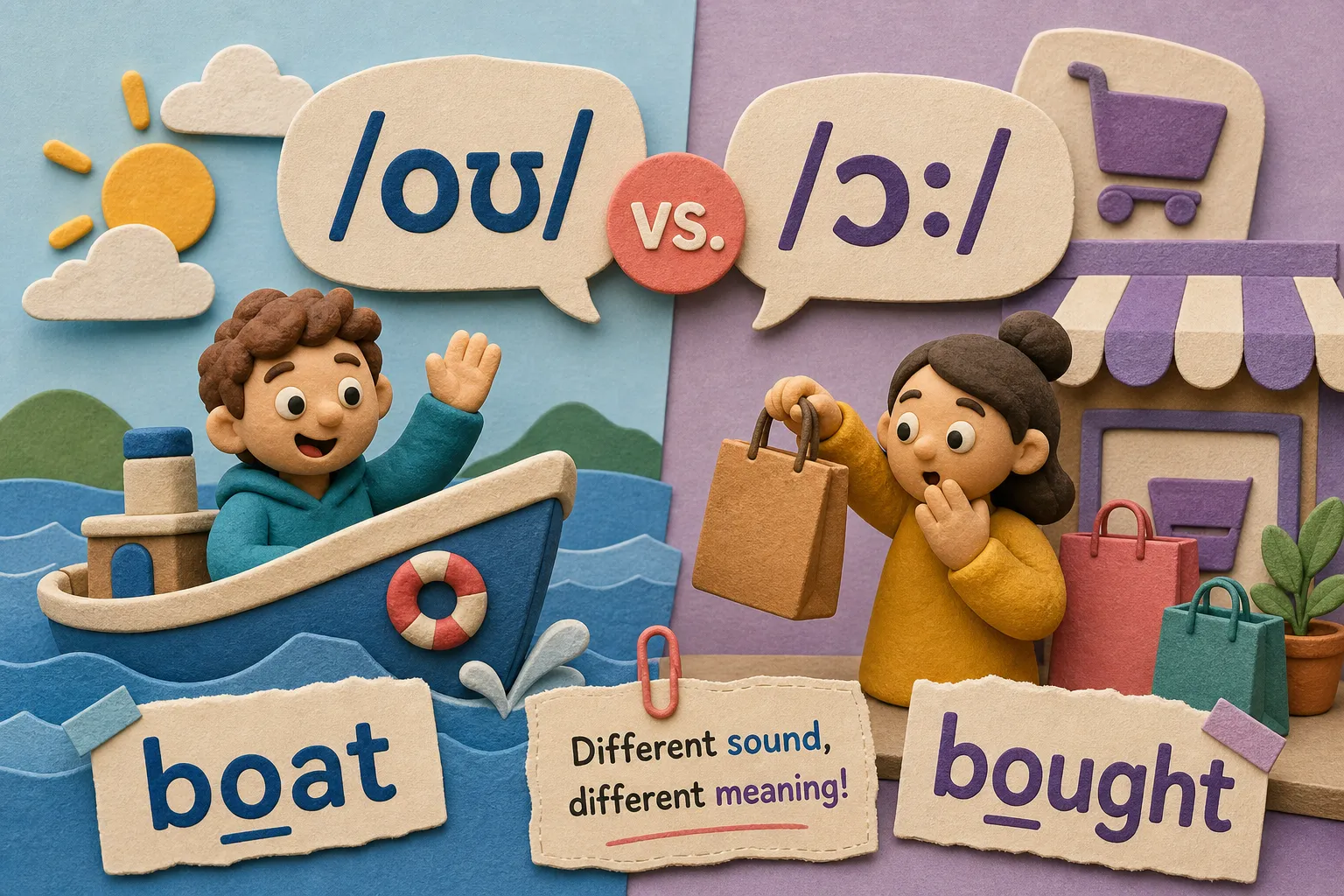
You hear an American say “boat” and then “bought,” and for a moment, you’re not sure they said two different words. The vowels feel close enough that your brain files them together and moves on. That confusion is completely normal, and it has a specific cause: one of these vowels moves inside your mouth, and the other one doesn’t. This lesson focuses on the boat vs bought contrast so you can hear and produce the difference reliably, and once you can feel it physically, you’ll stop guessing and start catching it every time.
By the end of this lesson, you’ll know the IPA symbols for both sounds and understand exactly how to shape your mouth for each one. You’ll also recognize which common words belong to each pattern and have five targeted drills to build the contrast into your muscle memory. This is the kind of phonetic detail that separates a learner who sounds “correct” from one who sounds genuinely natural, and it’s exactly the work we focus on at Your Daily American.
Boat vs Bought: What Actually Separates Them
The entire difference between these two words lives in one concept: one vowel moves, and the other stays still. In phonetics, a vowel that glides between two positions is called a diphthong, and a vowel that holds a single steady shape is called a monophthong. That’s it. That’s the whole story.
In General American English, “boat” is transcribed as /boʊt/ and “bought” as /bɔt/. IPA (the International Phonetic Alphabet) is simply a system where each symbol represents exactly one sound, so you always know what you’re getting regardless of spelling quirks. The /oʊ/ tells you there’s a glide happening, and the /ɔ/ tells you the vowel stays put. British RP transcribes these as /bəʊt/ and /bɔːt/, note that RP uses the length marker /ɔː/ to signal a notably longer vowel in “bought,” but in General American the vowel is shorter and that length marker drops. Throughout this guide, /ɔ/ refers to the General American realization.
/oʊ/: the vowel that glides
The /oʊ/ sound starts at an “oh” position and slides toward an “oo” position before the word is finished. Because your mouth is moving between two targets, you’ll notice a subtle but real shift in lip shape as the vowel plays out. The word “go” shows this clearly: start it with a relaxed “oh” shape and feel yourself naturally rounding toward “oo” at the end. That movement is the sound.
/ɔ/: the vowel that holds steady
The /ɔ/ sound is a single, stable target. Your mouth opens into one position and simply stays there for the full duration of the vowel. You’ll hear this same steady quality in “law,” “call,” and “thought.” No glide, no second target, no movement. The stillness is the point.
How to Position Your Mouth for Each Sound
Grab a mirror for this section. Reading about mouth position is useful, but watching yourself produces results much faster. You’re training motor memory here, not just knowledge.
Producing /oʊ/: the “oh-to-oo” glide
Start with your lips rounded in a moderate “oh” shape and your jaw slightly open. As you hold the vowel, let your lips narrow and pucker slightly while your tongue rises from a mid-back position toward a higher position. The jaw closes just a little as the glide finishes. Think of it as slowly saying “oh” and then easing into “oo” without a hard break between them. That continuous movement from start to finish is exactly what /oʊ/ requires.
Producing /ɔ/: the open oval
Shape your lips into a relaxed, slightly rounded oval, not a tight pucker, and not wide open like a yawn. Your jaw is more open than for /oʊ/, your tongue sits low and back, and nothing moves. You’re holding one steady shape for the entire vowel. If your lips are drifting or your tongue is rising, you’ve slipped into /oʊ/ territory. Lock the shape in and hold it.
The mirror test
Say “boat” and watch your lips in the mirror. They should start rounded and then narrow slightly as the word ends. Now say “bought” and confirm that your lips stay in one steady oval shape from the first moment to the last. If you see movement in “bought,” you’re adding a glide that isn’t supposed to be there. Run this check every few days during your practice sessions until the correct shapes feel automatic.
Common Words That Follow Each Vowel Pattern
Phonetics becomes useful the moment you connect sounds to real vocabulary. The goal here is to build two clear mental buckets so you stop guessing every time a new word comes up.
Words with the /oʊ/ sound
These words all carry that gliding diphthong: go, no, know, show, coat, road, bone, home, phone, cold, told, old, both. The spelling patterns that most reliably predict this sound are “o” at the end of a syllable (go, no), “oa” (coat, road), “ow” (show, know), and “o + consonant + e” (bone, home). Learning these patterns means you can make a confident first guess when you meet an unfamiliar word. For a focused guide to this quality, see the long-O vowel diphthong guide on LearnEnglishSounds: long-O vowel diphthong guide.
Words with the /ɔ/ sound
These words carry the steady monophthong: law, call, walk, talk, thought, caught, floor, more, door, also, small. The spelling patterns here are “aw,” “au,” “ough,” and “or.” Keep in mind that some items, “water,” for instance, vary noticeably by region and speaker, so treat the list as a reliable starting point rather than a universal rule. Pay special attention to “thought” and “caught”: the spelling gives you almost no useful clue, so these words trip up learners who rely on spelling to predict pronunciation. Memorize them as a group and you’ll be set. You can practice these contrasts with targeted exercises such as the minimal pairs for /oʊ/ and /ɔ/ on EnglishClub.
The Cot-Caught Merger: When Americans Blur “Bought”
Here’s something that confuses a lot of learners: you study the /ɔ/ sound carefully, then you listen to an American from California or Oregon, and they don’t seem to use it at all. You didn’t learn the wrong thing. You ran into the cot, caught merger.
Where the merger happens in the U.S.
The merger is most common in the Western United States and Canada, and it also appears in parts of New England, including Boston. Speakers in these regions pronounce “cot” and “caught” with the same vowel, often realized as /ɑ/ (or a similar low back vowel) for many merged speakers, resembling the open sound in “father,” though the exact quality varies by community. For them, “bought” and “cot” are homophones, sounding something like “baht.” In contrast, speakers in the Inland North, the Northeast Corridor from Baltimore through New York and Providence, and much of the South still keep “cot” and “caught” clearly distinct.
Boat vs Bought: Why “Boat” Stays Consistent
The key point is that the /oʊ/ diphthong in “boat” remains distinct in every American dialect, merged or not. A speaker from Los Angeles might say “bought” and “cot” with the same vowel, but they will not confuse “boat” with either of those words. This gives you a clean, reliable rule: if you hear that gliding “oh-to-oo” quality, it’s an /oʊ/ word like “boat,” no matter where the speaker is from. For background on the term diphthong itself, see the Wikipedia entry on diphthong.
Five Drills to Lock In the Contrast
Pronunciation changes stick when you train your ear and your mouth together in a specific sequence: passive listening first, then careful production, then natural conversation. These five drills follow that logic.
Drills 1 and 2: train your ear first
Drill 1 (discrimination): Say the minimal pair aloud slowly, “boat… bought… boat… bought”, and focus entirely on hearing the glide in /oʊ/ versus the stillness in /ɔ/. Then expand to other pairs that use the same contrast: coat/caught, know/gnaw, mow/more, low/law. The contrast sharpens with each new pair you add. Do five minutes of this before you try to produce anything.
Drill 2 (forced choice): Record yourself saying one word from a pair at random, then play it back and identify which word you said. If you have a study partner, have them say one word from the pair while you identify it. This forced-choice format is one of the most effective ear-training techniques available because it requires a real decision, not just passive listening.
Drills 3 and 4: move to production
Drill 3 (word-level): Alternate the pairs ten times each at a slow, exaggerated pace. Make the glide in /oʊ/ obvious and make the stillness in /ɔ/ equally obvious. You’re not trying to sound natural yet; you’re training your articulators to feel the difference. Once the contrast feels clear at slow speed, bring it back to normal pace.
Drill 4 (sentence drills): Move into full sentences using real, natural examples. “I bought a new coat.” “The boat came in late.” “We talked about going home.” “She called to know the road conditions.” Some of these sentences contain both sounds, which forces you to switch between vowel shapes mid-sentence. That switching is exactly the skill you need in live conversation.
Drill 5: real conversation practice
Write two or three questions that naturally require both sounds in your answer, then record yourself responding on your phone. A good prompt: “Did you walk to the store, or take the road by the boat docks?” Play the recording back and listen specifically for the glide in /oʊ/ words and the steady oval in /ɔ/ words. Recording yourself is non-negotiable. Your brain filters your own speech in real time, so you often can’t hear your errors while you’re producing them. The recording doesn’t lie.
A Clear Path to Mastering the Full American Vowel System
The boat vs bought contrast is one of several key vowel distinctions that define General American pronunciation. Getting this pair right is a genuine achievement, but the system goes deeper. There’s the /æ/ vs. /ɑ/ contrast (cat vs. cot), the /ɪ/ vs. /iː/ contrast (sit vs. seat), the schwa that appears in almost every unstressed syllable, and the way connected speech patterns compress and alter vowels in fast, natural conversation. For a focused look at stress patterns across American English, see Word Stress in American English: A Complete Guide, Your Daily American.
At Your Daily American, the pronunciation guides are built to walk you through each of these distinctions in the same format you just used: IPA plus mouth coaching plus real-word vocabulary plus targeted drills. The guides are organized by sound, so you can go directly to your weakest area without jumping randomly between topics. The pronunciation section is the natural next step from this lesson, and it picks up exactly where these two vowels leave off. If you want a wider plan for sounding more like a native speaker, follow How to Improve Your American English Pronunciation Like a Native, Your Daily American. If consonant problems are also on your list, check our full guide to How to Pronounce TH in American English (θ and ð): Full Guide, Your Daily American.
You Now Have the Tools, Use Them Today
The entire difference between “boat” and “bought” comes down to one principle: /oʊ/ moves and /ɔ/ holds still. Those two IPA symbols are your anchors, and the physical sensation of the glide versus the steady oval is how you’ll know you’re producing them correctly. Most of the confusion learners feel around these vowels disappears as soon as they get out of their head and into their mouth, literally feeling the difference rather than just reading about it.
Regional variation is real, and the cot-caught merger means some Americans won’t give you a clear /ɔ/ model for “bought.” That’s fine. You now know why it happens, and you know that “boat” stays consistent across dialects. Use that stability as your anchor when accents feel unpredictable.
The boat vs bought contrast is one of the more learnable distinctions in American English once you know what to listen for. Start with Drill 5 today: record yourself answering a question that uses both sounds, play it back, and listen honestly. That one habit, done consistently, will move your pronunciation forward faster than any amount of passive reading.