Waive vs. wave, one extra letter, one completely different meaning. Imagine sending a professional email that says: “I wave my right to an attorney.” The person reading it might picture you literally waving your hand instead of giving up a legal right. This mistake happens more often than you’d expect, and it happens because “waive” and “wave” sound exactly the same.
By the end of this lesson, you will know exactly which word to use, when to use it, and how to remember the difference without second-guessing yourself. You will learn each word’s meaning, the grammar rules behind them, the common phrases they appear in, and two simple memory tricks. This is the kind of small vocabulary detail that protects your credibility in professional writing, and it’s exactly the type of real-world decision that Your Daily American is built around.
Why waive and wave confuse so many learners
Both words are pronounced exactly the same way: /weɪv/ (say it like “WAY-v”). Because there is no sound difference at all, you cannot rely on your ear to choose the right word. This makes “waive” and “wave” a homophone pair, two words that sound identical but have different spellings and meanings.
The confusion goes deeper because the words play very different grammar roles. “Waive” is always a verb, and it always needs an object. You must waive something specific, like a right or a fee. “Wave,” on the other hand, can be a verb or a noun. As a verb, it does not always need an object, you can simply wave, with nothing after it. This grammar difference is one of the clearest ways to tell them apart in writing.
What “waive” means and how to use it
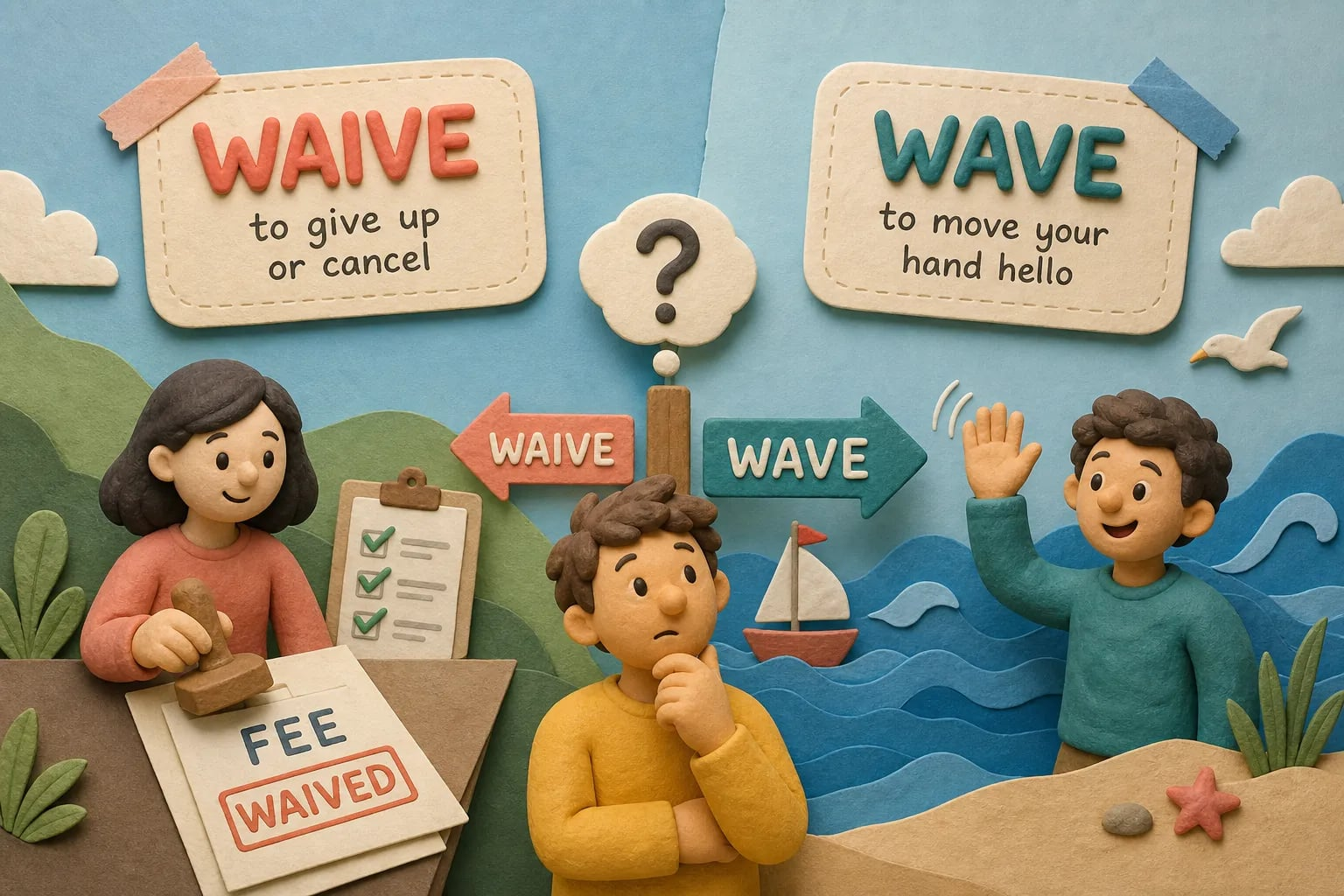
To waive something means to voluntarily give up a right, rule, or claim that you are legally or officially entitled to. It is a formal word used mostly in legal, business, and professional writing. When someone waives something, they are choosing not to exercise a right or benefit they are entitled to. For a quick dictionary definition, see waive on Dictionary.com.
Common phrases with “waive” include: waive your rights, waive a fee, waive a penalty, waive the application requirement, and waive the cancellation fee. The following are illustrative examples of each in context:
- “The company waived the late fee for customers who requested it in writing.”
- “She waived her right to remain silent before speaking to the police.”
- “The university waives the application fee for students from low-income families.”
In professional emails and HR documents, “waive” appears often. A hiring manager might write: “We are happy to waive the experience requirement for strong candidates.” A customer service agent might say: “We can waive the cancellation fee this one time.” In every case, someone is giving something up or choosing not to enforce a rule. The object, the specific thing being relinquished, always follows the verb directly.
Waive vs. Wave: How to Tell Them Apart by Meaning
As a verb, “wave” describes a back-and-forth hand motion used to greet someone, get their attention, or signal something. Common collocations include: wave goodbye, wave at someone, wave hello, wave down a taxi, and wave someone over. You can also wave someone off, meaning to signal that they should go away or that something is dismissed.
Here are some clear examples. “She waved at her colleague across the room.” The gesture shifts from social to official in the next two: “He waved goodbye as the train pulled away.” “The officer waved the car through the checkpoint.” In each sentence, someone is making a physical motion with their hand, no right is being given up, and no formal decision is being made.
As a noun, “wave” describes a moving ridge of water, a hand gesture, or a transfer of energy, such as sound waves or radio waves. Americans also use “wave” in figurative expressions like “a wave of layoffs” or “a wave of support,” meaning a sudden, large surge of something. This noun form has no connection to “waive” at all. If the word you need is a noun, you always spell it “wave.”
“Wave off” vs. “waive off”: one is wrong
Many learners write “waive off” to mean a dismissive gesture, but this is not standard American English. The correct phrase is “wave off.” “The referee waved off the goal” is correct. “The referee waived off the goal” is not. For guidance on this commonly confused pair, see this waive vs. wave explanation from Grammarly.
The reason “waive off” does not work is straightforward. “Waive” already means to give something up completely, so adding “off” is redundant. You waive a right, you do not waive it off. The word “off” belongs with “wave,” not “waive.” One additional note: in some varieties of English, most notably Indian English, “waive off” sometimes appears in informal writing. It is not standard in American English, so avoid it if you are writing for U.S. colleagues or professional contexts.
A quick test helps here. Ask yourself: is someone making a physical gesture, or are they voluntarily giving up a right or claim? Physical gesture? Use “wave” or “wave off.” Giving up a formal right or fee? Use “waive” with no “off” after it. Side-by-side: “The coach waved off the substitution request” shows a physical signal. “The player waived his right to contest the decision” shows a formal legal action. These two sentences cannot be swapped.
Two memory tricks that actually work
The first trick is the letter “i” trick. Look at the spelling: “waive” has the letter “i” in the middle. Use this to remember: the “i” stands for invisible rights. When someone waives something, they are giving up something important that you cannot see, like a legal right or a fee exemption. “Wave” has no “i.” It describes something you can see: a hand moving, water moving, a physical action. No “i” in the word? Then it is “wave.”
Grammar check: before you write either word, ask whether the sentence needs an object and whether someone is giving up something specific. If yes, use “waive.” Try it now: “She _____ the crowd.” No specific right is being given up, just a gesture. Answer: waved. “He _____ his right to appeal.” A specific legal right is being given up. Answer: waived. Run this two-second check every time you feel uncertain, and you will almost never mix them up again.
Waive vs. Wave: Quick Practice
Test yourself with these sentences. Cover the answers first and try each one on your own. Active recall, pulling the answer from memory yourself, helps the rule stick far longer than passive reading. If you’d like a quick practice lesson from another teaching resource, try this short using wave vs. waive lesson.
- “The bank agreed to _____ the overdraft fee.” (waive)
- “He _____ goodbye as the plane took off.” (waved)
- “The referee _____ off the play.” (waved)
- “She _____ her right to remain silent.” (waived)
- “The manager _____ at the new employee from across the hall.” (waved)
Check your answers against these. If one or two felt uncertain, return to the two tricks: “i” for invisible rights, and the grammar check for objects. A few more rounds of practice will make the distinction automatic.
You are ready to use these words correctly
When it comes to waive vs. wave, the distinctions are clear once you know where to look. “Waive” always needs an object, belongs in formal and professional contexts, and means giving something up voluntarily. “Wave” covers gestures, water, and figurative surges, it is the flexible, physical option. Use the letter “i” trick and the grammar check every time you feel unsure, and you will choose the right word with confidence. For another quick reference definition, see Cambridge’s definition of waive.
Word pairs like this one show up constantly in professional American English, and getting them right makes a real difference in how you come across. At Your Daily American, you will find structured vocabulary lessons and professional English guides built around exactly these kinds of choices, from common homophones to workplace phrases that help you communicate clearly and sound natural in real American work situations.