You studied the formula. You wrote it in your notebook. And then someone said it to you in a real conversation, and you had no idea what you were hearing. That’s the problem with the third conditional: knowing the rule and using it are two very different things.
By the end of this lesson, you’ll build correct third conditional sentences, use them to express regret and hypothetical past outcomes, and say them the way native speakers actually do in everyday American English. Start with the structure itself.
The structure of the third conditional
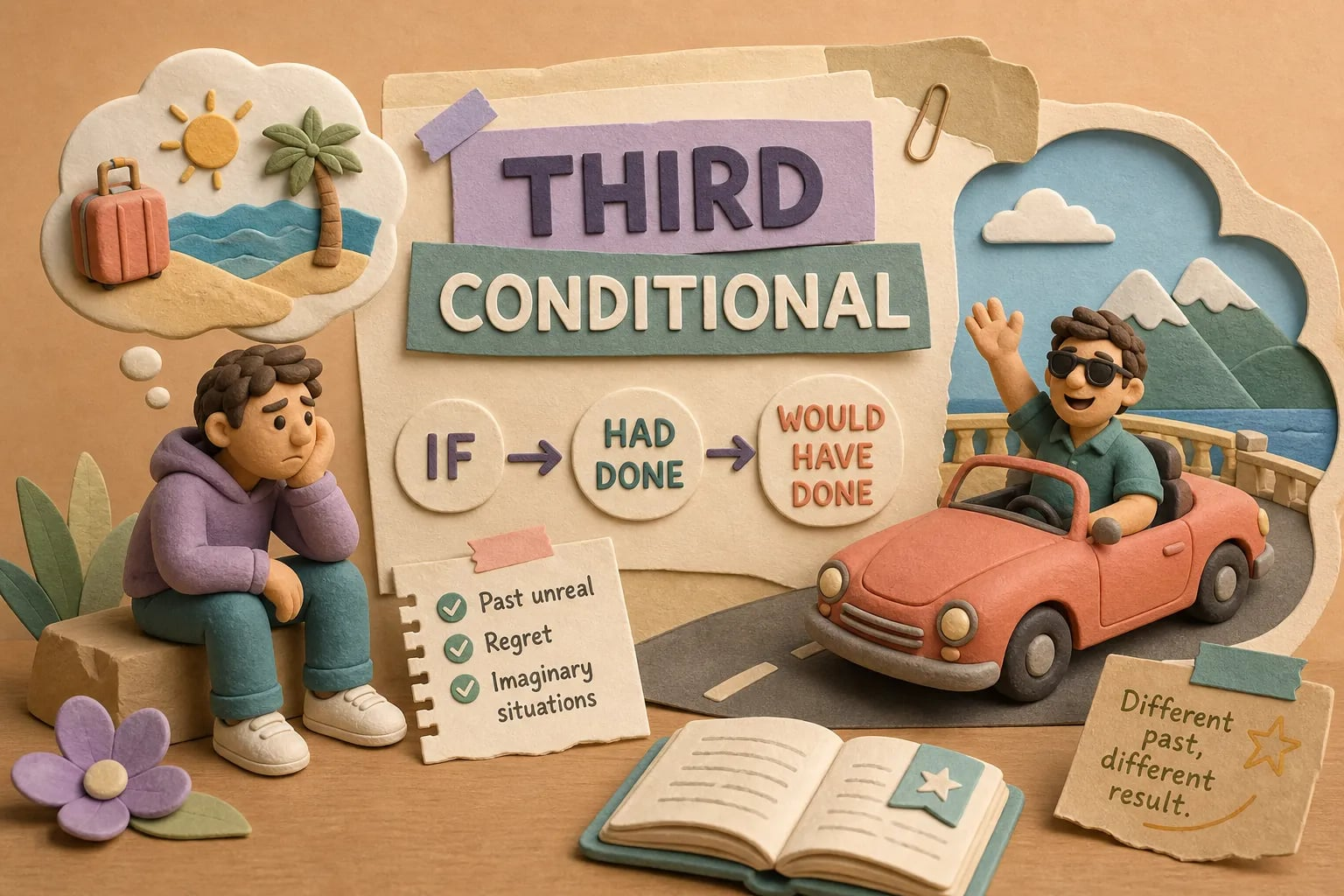
The formula for the third conditional (also called conditional III or the type 3 conditional) has two parts. The first part uses the past perfect (had + past participle, which describes a completed action before another past point). The second part uses the conditional perfect (would have + past participle, which describes the imagined result that didn’t happen). Here is the formula:
If + [had + past participle], [would have + past participle]
The if-clause describes the situation that did NOT happen. The result clause describes what WOULD have happened differently. Together, they let you talk about a past you can’t change.
The if-clause: building the past unreal condition
The if-clause is where you set up the imaginary past situation. Here are three third conditional examples using American contexts:
- “If I had prepared better for the meeting…”
- “If I had researched the company…”
- “If she had set her alarm…”
One rule learners forget all the time: never put “would” in the if-clause. The if-clause always uses had + past participle. That’s it.
The result clause: would have + past participle
Now you finish each sentence with the result clause. You can also use “could have” or “might have” to change the meaning slightly. “Would have” typically expresses that the imagined result was expected or likely under the counterfactual condition. “Could have” or “might have” indicate possibility or less certainty about that result.
- “If I had prepared better, I would have gotten the promotion.” (expected result)
- “If I had prepared better, I might have gotten the promotion.” (possible result)
Two ways to order the sentence
The if-clause can come first or second. When it comes first, use a comma. When it comes second, no comma is needed.
- “If I had known, I would have called you.”
- “I would have called you if I had known.”
Third conditional examples: when Americans use this structure
Grammar is only part of the picture. Knowing when and why native speakers reach for this structure helps you use it naturally yourself. Here are the most common real-world contexts.
Talking about regret after a decision
The past unreal conditional (another name for the type 3 conditional) is the natural way to say “I wish I had done something differently.” You’ll often hear this structure in American conversation when someone is expressing regret or wishing the past had gone differently.
- “If I had taken that job offer, I would have moved to New York.”
- “If I hadn’t rushed through the report, I wouldn’t have made those errors.”
- “If she had asked for feedback earlier, she could have fixed the problem.”
Regret is the most common everyday use of this structure. Pay attention to it when you hear Americans talking about the past.
Reflecting on job interviews and workplace moments
In reflective debriefs after interviews or difficult projects, speakers often use the third conditional to talk through what went wrong and what might have been different. It tends to carry a measured, professional tone rather than a dramatic or emotional one, though tone naturally varies by speaker and situation.
- “If I had prepared a better answer for that question, I think I would have gotten the offer.”
- “If we had set the deadline earlier, the team wouldn’t have been so stressed.”
This is how people in the U.S. process what went wrong and what they would do differently next time. For regular short lessons to build this habit, visit our Daily Grammar, Your Daily American section for daily practice and reminders.
Using it in storytelling and personal narratives
Americans also use the conditional III naturally when they tell a story about something that almost happened or went sideways. It makes the story more vivid and real.
- “If I had checked my email that morning, I would have seen the schedule change.”
- “If she hadn’t mentioned the discount, I would have paid full price.”
When you hear these sentences in a story, the speaker is showing you a turning point: a moment where one small change would have led somewhere completely different.
How native speakers say it in fast American English
Here’s where many learners get stuck. You may know the written rule perfectly, but when an American says it at normal speed, you can’t hear the structure at all. That’s not because you lack grammar knowledge. It’s because the words change in spoken English.
Common reductions: would’ve, could’ve, if I’d
In spoken American English, “would have” almost always becomes “would’ve” (sounds like “WOOD-uv”). “Could have” becomes “could’ve” (sounds like “KOOD-uv”). “If I had” shortens to “if I’d” (sounds like “if-EYE’D”). Here is what that sounds like in a full sentence:
- Written: “If I had known, I would have called you.”
- Spoken: “If I’d known, I would’ve called you.”
These reductions are not lazy or sloppy. This is standard spoken American English at normal speed. These forms are very common across many informal and semi-formal contexts, you’ll hear them in casual conversation and in business settings alike, though the degree of reduction can vary by speaker and register. You can also brush up on useful spoken shortcuts and fillers in our Filler Phrases Every American English Learner Should Know guide.
Why it sounds invisible, and what actually helps
Learners often miss third conditional sentences in conversation because the reductions blur the structure together. You hear “If I’d known, I would’ve…” and your brain doesn’t connect it to the grammar pattern you studied on paper. The sounds move fast, and the words you expect to hear aren’t there in full.
This is exactly where connected speech training makes a real difference. Many learners find that focused listening practice helps them catch reduced forms, which improves both comprehension and speaking fluency. At Your Daily American, understanding how American English sounds at real speed is a core focus, it’s where the written grammar and the real sound of American English finally come together. Once you train your ear to catch “would’ve” and “if I’d,” the whole structure becomes much easier to use yourself. If you want a clear external reference for the third conditional, the British Council’s third conditional guide is a helpful, trustworthy resource.
Third conditional vs. second conditional and mixed conditionals
Learners often mix up these three structures because they all use “if.” The key difference is time. Keep that one word in mind, and the rest becomes easier.
Second vs. third: the time that separates them
The second conditional talks about an unreal or unlikely situation right now or in the future. The third conditional talks about an unreal past situation that is already finished and cannot change.
- Second conditional (present/future): “If I had more time, I would study every day.” (I don’t have more time now, but this is still a present situation.)
- Third conditional (past): “If I had had more time last year, I would have studied more.” (That time is gone. I cannot change it.)
The core rule: the second conditional imagines a different present or future; the third imagines a different past.
Mixed conditionals: when past meets present
A mixed conditional connects two different time periods. The most common pattern uses if + past perfect in the if-clause and would + base verb in the result clause. You use it when a past action still affects the present situation.
- Mixed conditional: “If I had taken that job in Chicago, I would be living there now.”
- Third conditional: “If I had taken that job in Chicago, I would have moved there.”
Use the third conditional when both the condition and result are in the past. Use the mixed conditional when the past condition is still affecting your present life right now. For more on mixed forms and clear examples, see the Perfect English Grammar guide to mixed conditionals.
Common mistakes and how to fix them
These three errors are very common across learners from many first-language backgrounds. Knowing them ahead of time will save you a lot of confusion.
Putting “would” in the if-clause
- Incorrect: “If I would have known, I would have called.”
- Correct: “If I had known, I would have called.”
- Fix: The if-clause always uses had + past participle. “Would” never goes in the if-clause.
Forgetting “have” in the result clause
- Incorrect: “If she had studied harder, she would pass.”
- Correct: “If she had studied harder, she would have passed.”
- Fix: The result clause needs would have + past participle, not just “would” + verb.
Using the second conditional for past situations
- Incorrect: “If I studied more, I would get a better grade.” (Said about last semester.)
- Correct: “If I had studied more, I would have gotten a better grade.”
- Fix: When the situation is in the past and already over, use the third conditional, not the second.
For a concise overview of conditional sentence types and common errors, Grammarly’s conditional sentences article is a good quick read.
Third conditional exercises: test what you learned
Try these exercises before looking at the answers. Cover the answers, complete the sentences, then check your work. Five minutes of active practice like this will test your understanding far better than re-reading the rules.
Fill in the blank
- If I _______ (prepare) better, I _______ (get) the promotion.
Answer: had prepared / would have gotten - If you _______ (send) the invite, we _______ (not miss) the meeting.
Answer: had sent / would not have missed - If she _______ (know) about the job opening, she _______ (apply).
Answer: had known / would have applied - If the team _______ (set) the deadline earlier, we _______ (not be) so stressed.
Answer: had set / would not have been - If he _______ (practice) his answers, he _______ (pass) the interview.
Answer: had practiced / would have passed
Try it yourself
Now use the structure in your own words. Write two or three sentences for each prompt, then read them aloud using the reductions from the pronunciation section (“would’ve,” “could’ve,” “if I’d”).
- Think of one decision from the last year you wish you had made differently.
- Think of a job or class situation that didn’t go well. What would have been different?
- Think of a time you were late or missed something. What would have happened if the situation had been different?
If you want more interactive practice, try these third conditional practice exercises for extra drills and feedback.
Now you’re ready to use it
You now have what you need to use the third conditional accurately. The structure is if + past perfect, would have + past participle. The most common uses are expressing regret, reflecting on past decisions, and talking through what went wrong. And in real spoken American English, the sentence sounds like “If I’d known, I would’ve called”, not the full written form.
The best way to get comfortable with this structure is to use it. Write sentences about your own past. Say them aloud with the reductions. Then start listening for them in American TV shows, podcasts, and conversations. You’ll start hearing them everywhere once you know what to listen for. Also review a list of Common American Expressions Every English Learner Should Know, Your Daily American to help you recognize these structures in real contexts.
If you want to train your ear for exactly these kinds of spoken structures, check out the pronunciation and connected speech lessons at Your Daily American, and explore the third conditional practice exercises to keep building your fluency.