Picture this: your coworker walks past your desk and says, “I’ll swing by later to check on that report.” You smile and nod, but for just a second, you weren’t 100% sure what they meant. If that sounds familiar, you’re not alone. “Swing by” is a commonly searched phrasal verb among learners of American English, and it’s easy to see why: it shows up frequently in spoken conversation, but it rarely gets a clear explanation in the classroom.
By the end of this lesson, you will know exactly what “swing by” means, how to use it in a real sentence, and when to choose “stop by” or “drop by” instead. You will also learn the grammar rule that trips up a lot of learners, and you’ll get a chance to practice before you go. Once you’re comfortable with this phrase, you may start noticing it more often in casual spoken American English.
What “swing by” means in American English
Merriam-Webster defines “swing by” as “to make a brief visit” and labels it US, informal. That tells you two important things right away: this is an American English phrase, and it belongs in casual conversation, not formal writing.
In plain language, the phrase means you go somewhere quickly, usually while you are on your way to or from another place. You do not stay long. Here is a simple example: “I’ll swing by the coffee shop before I head to the office.” The person is not making the coffee shop their main destination. They are stopping there quickly on the way somewhere else.
The phrase is also an inseparable phrasal verb, a verb and particle that must stay together. You cannot split them apart. The place or person’s location always comes after “by.”
- Correct: “I’ll swing by the store.”
- Correct: “Can you swing by Maria’s?” (meaning Maria’s house)
- Incorrect: “I’ll swing the store by.”
One more grammar point worth noting: the past tense is “swung by.” This is an irregular form. “I swung by the office this morning” is correct. “I swinged by” is not standard English.
Swing by in everyday casual conversation
Americans use this phrasal verb in several very common situations: when picking something up from a friend’s house, when stopping at a store while driving past it, or when checking on someone briefly. In every case, the visit is short and has a clear purpose.
The phrase is commonly used to describe future or planned brief visits, “I’ll swing by,” “Can you swing by?”, and “I was going to swing by” are all natural, everyday forms. That said, past-tense forms like “swung by” are just as common when describing something that already happened.
Here is a short example dialogue that shows how the phrase sounds in a real text message exchange:
A: “Hey, I’m dropping Maya off at practice. Can I come by your place after to grab those books?”
B: “Sure! I’ll be home all afternoon.”
A: “Great, I’ll swing by around 3.”
The phrase signals a short visit with a specific goal: picking up books. The visit is not the main event of the day, it is a quick stop that fits into the speaker’s existing plans.
Here are five example sentences that show the full range of how it is used:
- “Can you swing by the pharmacy on your way home?”
- “She swung by the office to drop off the contract.”
- “I’ll stop by your desk after lunch.”
- “We swung by Jake’s place, but no one was home.”
- “Do you have time to come by later today?”
Can you use “swing by” at work?
Yes, but it depends on the situation. In casual American office culture, the phrase is perfectly normal between coworkers. “Can you swing by my desk?” or “I’ll stop by the meeting room to grab the cable” sound natural in everyday workplace speech. You will also hear it in Slack messages, team chats, and quick spoken requests with people you know well.
When it fits, and when it doesn’t
The key factor is your relationship with the other person and the culture of your company. In a relaxed, open-plan office where people talk casually, “swing by” works naturally. No one will think it sounds out of place.
However, avoid it in formal written communication. If you are sending an email to a senior manager, a client, or anyone you would address as “Dear Mr. [Last Name],” use more formal language instead. “Please come to my office at 2 PM” is more appropriate than “Swing by my office at 2.” The same applies to official meeting invitations and any written communication that will be saved or shared. If you’re curious about changing norms around formality in the workplace, this HR Dive analysis of workplace formality is a useful read.
Examples of “swing by” at work
Here is how this plays out between two colleagues in an office:
A: “Are you heading to the break room?”
B: “Yeah, in a few minutes.”
A: “Swing by my desk on the way. I have a form for you to sign.”
B: “No problem, I’ll be there in five.”
This works because it is a casual, spoken conversation between peers. Change it to an email sent to a vice president, and you would need to rewrite it entirely.
Stop by, drop by, and come by: how to choose the right one
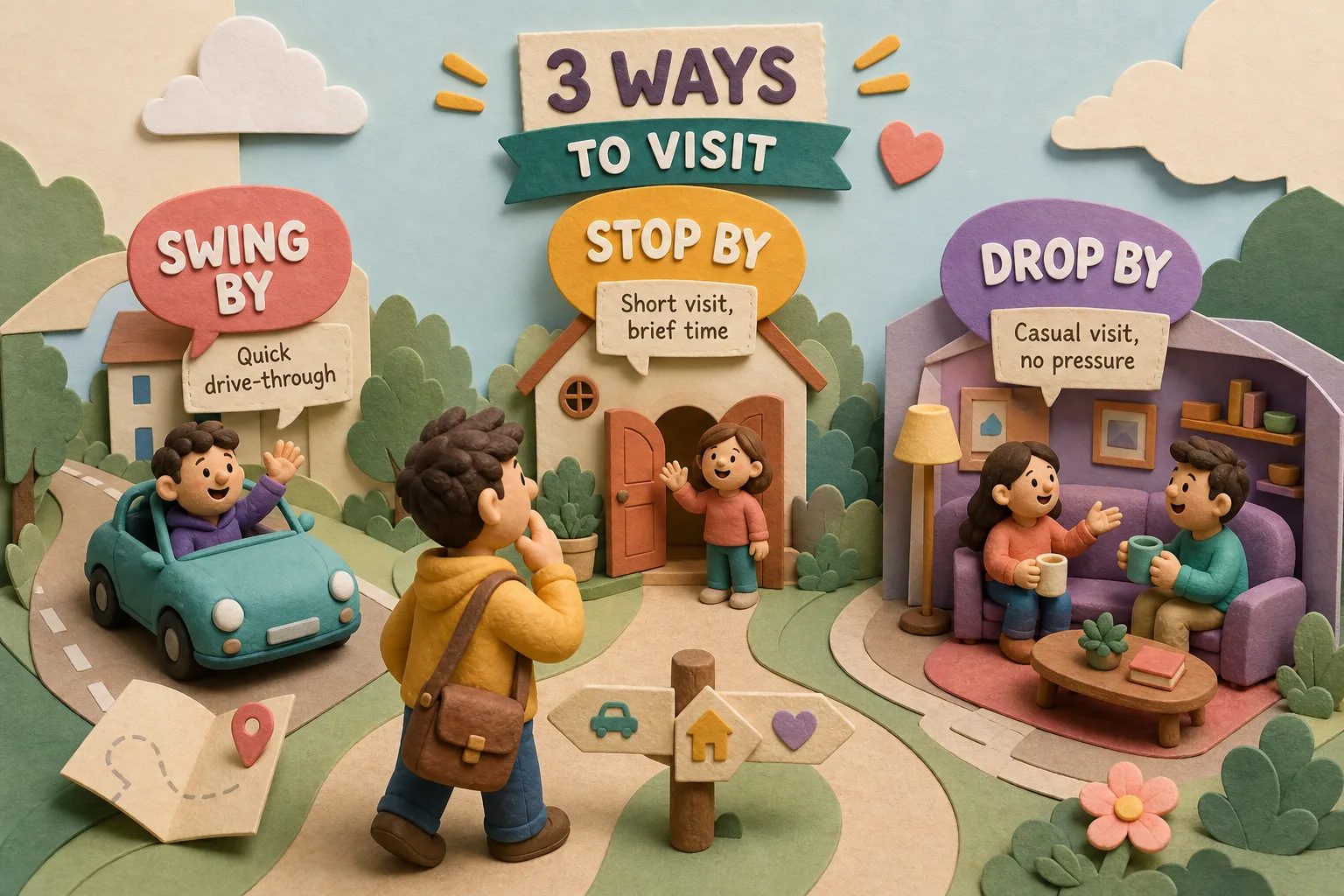
“Swing by” is not the only phrase for a short visit. Three other phrasal verbs carry similar meanings, but each one has a slightly different focus. Knowing the difference helps you choose the right phrase every time.
“Stop by” puts the focus on the visit as a detour. You are going somewhere else, and this is a quick side trip on the way. “I’m driving past your street later. Mind if I stop by?” The visit is brief and not your main destination. “Stop by” is slightly more neutral in tone, it works in casual speech and also in semi-formal writing, like a message to a colleague you do not know very well.
“Drop by” suggests a spontaneous visit with no appointment. You are not planning ahead; you just go. “I dropped by her apartment, but she wasn’t home.” The visit is unplanned, and there is no specific task involved. Of these four phrases, “drop by” feels the most casual and unscheduled.
“Come by” is the most neutral of the four. It simply means to visit briefly, with no implication about planning, route, or purpose. “Feel free to come by anytime.” It is a low-key invitation with no extra layers of meaning, just a visit. Adding a brief example can clarify the tone: think of a neighbor saying, “Come by whenever you’re free,” versus “swing by to pick up your mail.”
Here is a simple way to decide which phrase to use:
- Making a detour on your way somewhere? Use stop by.
- Showing up without a plan or appointment? Use drop by.
- Making a quick stop with a specific purpose (picking something up, dropping something off)? Use swing by.
- Just visiting briefly, no extra meaning needed? Use come by.
For authoritative dictionary definitions that match these explanations, see the Oxford Learner’s Dictionary entry for “swing by” and the Merriam-Webster entry for “swing by”.
Common mistakes to avoid with these phrasal verbs
The most frequent grammar mistake learners make is trying to separate “swing by.” Because some phrasal verbs in English are separable, “turn off the light” and “turn the light off” are both correct, for example, learners sometimes apply that same rule here. They write “I’ll swing the office by” or “I swung the store by,” but neither is correct. This phrasal verb is always inseparable. The place or person’s location always comes after “by,” never in the middle. You can check usage examples in the Cambridge Dictionary.
The second common mistake is using “swing by” in formal written English. Many learners pick up the phrase in casual speech and then use it in a professional email without realizing it sounds too informal for that context. A good rule: if you are not sure how casual the tone should be, replace it with “stop by,” “visit,” or “come to.” Those options are safe in more situations.
One more mistake worth noting involves the variant “swing past.” This form is uncommon in the sense of “visit briefly” and is not a standard idiom in American English. While “swing by” is the widely used form across American English, “swing past” is rare in this idiomatic sense regardless of dialect. If you want to be clearly understood by American speakers, stick with “swing by.”
Try it yourself: practice using these phrases
The best way to make a new phrase part of your natural speech is to use it right away, before you forget it. Read the three short scenarios below and write or say one sentence for each. Choose whichever phrase fits best: “swing by,” “stop by,” or “drop by.”
- You want to pick up a package from a friend’s house on your way home from work.
- A coworker asks if you have five minutes to look at something on their screen. How do you respond to tell them you’ll come to their desk?
- You want to invite a neighbor over briefly for coffee, but in a casual, low-pressure way.
There is no single right answer for each prompt. What matters is that you choose a phrase that fits the situation and use it in a complete, natural sentence. If you wrote “I’ll swing by your place on my way home” for the first one, you got it exactly right.
Phrasal verbs like “swing by,” “stop by,” and “drop by” are a common challenge for learners moving from classroom English to natural spoken American English. Native speakers use them constantly in conversation, but most learners only encounter them by chance. At Your Daily American, high-frequency phrasal verbs are taught exactly the way this lesson does: in context, with real dialogues, cultural notes, and grammar explanations that actually stick. If you want to go deeper, explore the platform’s section on everyday American English, built for learners who want to sound natural and confident, not just grammatically correct. For help with conversational filler and natural small-talk phrases, check our guide to filler phrases every American English learner should know.