By the end of this lesson, you will be able to recognize the mono prefix in new words and figure out their meanings on your own, without looking them up. That is a real vocabulary skill, and it pays off every time you read or listen in English.
The prefix appears in dozens of English words, from everyday conversation to science, business, and history. Words like monopoly, monolingual, and monotone all share the same Greek root. Once you know that root, you do not need to learn each word separately. You can decode them on the spot.
At Your Daily American, this is exactly how we approach vocabulary: understand the building blocks of English, and the language opens up much faster. This lesson covers the origin of mono-, its spelling variant mon-, key example words, and one use of this prefix that directly affects how you sound when you speak.
What the mono prefix actually means
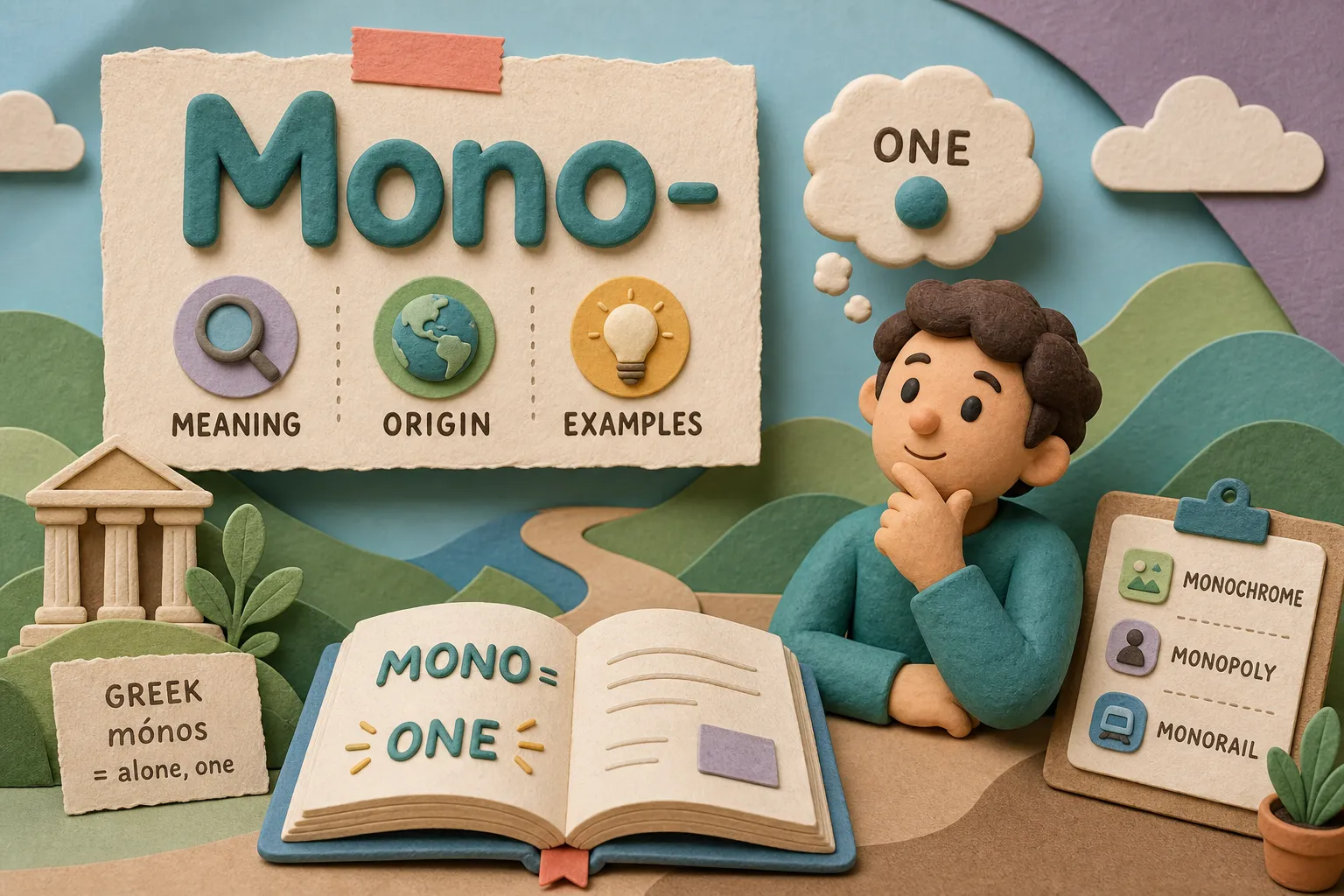
Mono- comes from the Ancient Greek word mónos (μόνος), which means “alone,” “single,” or “sole.” In English compound words, words built from two or more parts, it consistently signals the idea of one. That meaning has stayed stable for centuries, which makes it very reliable for guessing unfamiliar words. For more on the prefix’s history, see the etymology of mono-.
Two quick examples show this clearly. A monorail runs on one rail, not two. A monologue is speech from one person. The prefix does the same job in both words: it tells you that something involves just one of whatever comes next.
The practical skill here is simple. When you see “mono-” at the start of an unfamiliar word, your first instinct should usually be “one” or “single”, though context is always worth checking. Take monophonic, for example. You may not know that word yet. But mono- (one) plus phonic (related to sound) leads you directly to the meaning: sound through one channel. That is prefix knowledge working for you in real time.
When mono- becomes mon-: the spelling rule
You will sometimes see the prefix written as mon- instead of mono-. This is not a different prefix. It is the same one, just with a small spelling adjustment.
The rule is straightforward: when the root that follows starts with a vowel, mono- shortens to mon-. So mon- + -arch becomes monarch, and mon- + -gamy becomes monogamy. When the following root starts with a consonant, the full form stays: mono- + -tone stays monotone, and mono- + -rail stays monorail.
If you try to say “monoarchy” out loud, you will notice it sounds awkward. Two vowels colliding slow the word down, so English drops that extra vowel to keep speech smooth. Once you understand the reason, the change makes complete sense. A few more examples confirm the pattern: mon- + -oxide = monoxide; mono- + -chrome = monochrome.
Everyday words worth adding to your vocabulary
Here are some of the most useful words built with this prefix, organized by the situations where you are most likely to encounter them.
Words for daily life and conversation
Monopoly means exclusive control by one company or person over something, usually a market. You probably know the board game, which is a perfect memory hook: one player ends up controlling everything. In real use: “The government broke up the company’s monopoly on internet service.”
Monologue is a long speech by one person. You can use this word in many situations: describing a movie scene, commenting on a meeting, or calling out a friend who never stops talking. “His monologue at dinner lasted 20 minutes. Nobody else said a word.”
Monogamy means being in a committed relationship with one partner. The word combines mon- (one) with the Greek root -gamy (marriage or union). In practice, you will hear it in conversations about relationships and sociology: “In many cultures, monogamy is the legal and social standard for marriage.” It also appears in biology, where it describes species that pair with a single mate.
Monolingual describes someone who speaks only one language. Many readers of global English materials are multilingual, and that can be a genuine advantage. Research on second-language acquisition suggests that multilingual learners often draw on cross-linguistic awareness and cognitive flexibility that supports vocabulary work. “Many monolingual speakers struggle to see how grammar works because they have no other language to compare it to.” Either way, the word itself is useful any time you are discussing language backgrounds. For related academic research on communicative environments and vocabulary in early childhood, see this study on communicative environments and vocabulary.
Words for professional and academic settings
A monarch is a single ruler, such as a king or queen. The related noun monarchy refers to that system of government. Both words appear constantly in history, politics, and news. Forms of monarchy have existed in Britain for over a thousand years, making this vocabulary essential for anyone reading British history or current affairs.
Monosyllabic describes a word with one syllable, but in conversation it is often used to call out a short, unhelpful answer. “His reply was completely monosyllabic: just ‘fine’ and nothing else.” It is a precise word for describing someone who is not communicating openly.
Monopolize is the verb form, and it is very useful in workplace English. “She monopolized the whole meeting; the rest of us never had a chance to speak.” You will also see monograph in academic writing: it is a detailed study focused on one topic.
The same prefix knowledge carries over into technical reading. In biology, chemistry, and business, terms like monoxide, monoclonal, and monoculture all follow the same logic. Recognizing the prefix makes new terminology easier to decode on the first read.
Mono- vs. uni-: same idea, two different roots
If mono- means “one,” you might wonder: what about words like unicycle or uniform? The prefix uni- also means “one,” but it comes from Latin (unus), not Greek. English borrowed both prefixes, so now the language has two ways to express the same core idea.
Here is a side-by-side look at some common pairs:
| mono- (Greek) | uni- (Latin) |
|---|---|
| monologue (one person speaking) | unicycle (one wheel) |
| monochrome (one color) | uniform (one form) |
| monotheism (one god) | universe (one whole) |
| monarch (one ruler) | unify (make into one) |
You do not need to memorize which root each word came from. In practice, both prefixes are fixed: monologue is always mono-, never uni-, and universe is always uni-, never mono-. What matters is recognizing both prefixes and knowing they signal the same core meaning: one.
In general, mono- tends to appear in Greek-based and scientific terms, while uni- shows up more in Latin-based, everyday English words. For reading and listening, simply knowing that both mean “one” is enough to help you decode an unfamiliar word.
Why “monotone” is the word that can change how you sound
In spoken English, a monotone voice is flat and level, with pitch that does not rise or fall. Every sentence sounds identical, with no variation in tone.
Reduced pitch variation is a frequent pattern in non-native English speech, though it is not universal. It does not happen because a learner has a bad accent. It happens because English rhythm and intonation genuinely differ from many other languages. When speakers focus hard on pronouncing words correctly, they often stop moving their pitch naturally. The result sounds correct but flat, and flat speech is harder for listeners to follow.
Studies on speech perception have found that a monotone delivery increases the listener’s processing effort and can affect how credible and confident a speaker sounds, even when vocabulary and grammar are strong. In a job interview, a presentation, or a team meeting, that matters. For research showing how fluency and prosody affect listener understanding, see this study finds fluency outweighs pronunciation, and for peer-reviewed evidence on related speech perception effects, see this speech perception study.
The solution is not to perform or exaggerate. American English has specific patterns of sentence stress and pitch movement that give it its natural sound. Some syllables go up, some go down, and key words receive more emphasis than others. Learning those patterns is what separates “grammatically correct” from “sounds natural.”
This is exactly where Your Daily American can help. The platform’s Pronunciation and Listening section covers American intonation, sentence stress, and connected speech in detail. A practical starting point: record yourself reading one sentence out loud, then compare it to a native speaker’s version. Listen for where the pitch rises and where it falls. That exercise is a highly effective way to build awareness, far more so than studying a written rule in isolation. For related common pronunciation issues, you can also read English Words Non-Native Speakers Mispronounce Most Often, Your Daily American.
Quick practice: check what you learned
Reading about vocabulary is a start, but using it is how you remember it. Try these short exercises.
Fill in the blank
Use a word from this article to complete each sentence. Answers are in parentheses.
- “The CEO ___ the entire meeting. Nobody else spoke for 45 minutes.” (monopolized)
- “His answers were totally ___. He just said ‘yes’ or ‘no’ to every question.” (monosyllabic)
- “The speaker’s voice was completely ___. After five minutes, I stopped paying attention.” (monotone)
- “She’s ___. She has never studied any language besides English.” (monolingual)
Try it yourself
Write or say your own sentences using these words. There are no wrong answers; the goal is to produce language, not just recognize it.
- Use monolingual in a sentence about yourself or someone you know.
- Think of a time when someone around you was speaking in a monotone. Describe it using that word.
- Use monopolize to describe a situation at work, school, or in a conversation.
You now have a real vocabulary tool
Here is the core takeaway: the mono prefix, and its variant mon-, means “one” or “single.” It comes from Ancient Greek and appears across everyday conversation, professional English, and scientific writing. Once you know it, you can decode new words the first time you see them.
Morphological awareness, learning roots and prefixes, is one of the most efficient vocabulary strategies available to language learners. One rule unlocks many words at once. The same approach works with other common prefixes like pre-, re-, multi-, and sub-. For a broader overview, see our guide Prefixes and Suffixes: Unlock Thousands of English Words. You can also study similar patterns for related prefixes such as the Un- prefix: The Simplest Way to Expand Your Vocabulary.
Starting now, look for this prefix in the next article you read or the next meeting you sit in. You will find it. And if you want to use these words naturally when you speak, remember: vocabulary alone is not enough. The rhythm of your sentences matters just as much. Your Daily American is the place to work on both, with lessons on vocabulary, pronunciation, and the real patterns of spoken American English.