The word “small” is one of the first adjectives most English learners pick up. It works. It’s clear. But when you use it for everything, your writing and speech start to sound flat and repetitive. Native speakers have far more precise options, and choosing the right small synonym tells your listener exactly what you mean, the right size, the right tone, and the right level of formality, all at once.
This guide helps you pick the best small synonym for any context, organized by formality, meaning, and situation. You’ll find words for everyday conversation, formal writing, describing people and objects, and talking about amounts and importance. By the end, you’ll know how to choose the right word every time, not just the safest one. At Your Daily American, building a synonym bank like this is one of the most effective vocabulary strategies we teach, and we’ll return to that idea at the end.
Why using only “small” holds your English back
“Small” is a neutral, general word. It communicates size, but nothing else. Native speakers often reach for a more specific word because it adds meaning, tone, and context simultaneously. Consider these three phrases: “a small woman,” “a petite woman,” and “a slight woman.” All three describe someone with a small body, but each creates a different picture. Petite sounds elegant and positive. Slight suggests thinness and possibly fragility. “Small” alone gives the reader nothing extra.
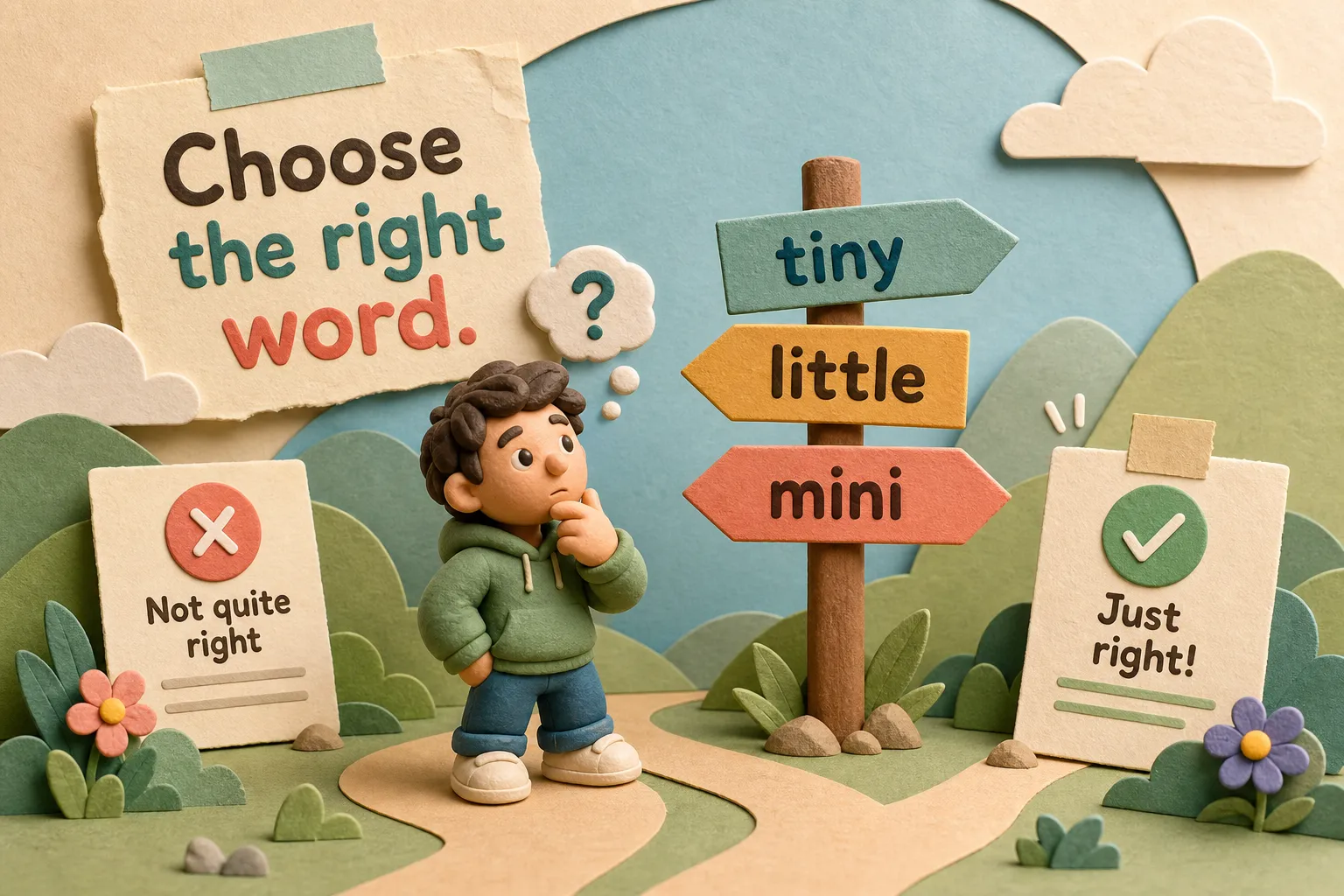
A useful tool to keep in mind is an intensity scale: small → smallish → little → tiny → minuscule. Each step moves from more general to more emphatic. “Smallish” signals an approximate or somewhat small size, it softens the description when you’re not committing to a precise measurement. “Little” is warmer and more personal. “Tiny” is clearly very small. “Minuscule” is the strongest option, used when you want to say something is almost too small to notice. Understanding this scale helps you choose the word that matches exactly how small you mean.
Casual small synonym choices for everyday American speech
In everyday conversation, “tiny,” “little,” and “teeny” are among the most common and natural options. “Tiny” is the neutral choice when something is very small. It works in most situations and sounds natural with both people and objects. “The café has a tiny kitchen” and “She found a tiny crack in the window” are both perfectly natural sentences. For more common conversational phrases that pair well with casual synonyms, see 25 Small Talk Phrases Americans Use Every Day, Your Daily American.
“Little” adds warmth or affection. Americans often use it for things they feel fond of or protective toward. “My little brother just started school” sounds warm and personal. “A little dog ran across the street” sounds endearing. Be careful, though: using “little” in a professional context can sometimes sound too informal or even condescending.
“Teeny” (and its longer form “teeny-tiny”) is colloquial and playful, often used in informal contexts such as conversations with children or among close friends. “Can I have just a teeny piece of cake?” sounds friendly and casual. Avoid it in formal writing or workplace communication.
Three more casual words are worth knowing. “Wee” means small and is occasionally heard in some U.S. dialects, but it is much more common in Scottish and Irish English, ESL learners should recognize it but use it carefully in American speech. “Smallish” means somewhat small, not very small: “The apartment was smallish but cozy” softens the description without committing to a stronger word. “Dinky” is informal slang for something small in a slightly funny or negative way: “They gave us a dinky little table in the corner.” Use these three words only once you feel confident with the tone.
Small synonym options for people, objects, and spaces
When describing a person’s body, “petite,” “slight,” and “delicate” all suggest small, but each carries its own focus. “Petite” describes a person, most often a woman, who is small and neatly proportioned. In fashion and retail, “petite” is an official size category for shorter women. Natural collocations include: petite frame / build / figure.
“Slight” suggests a thin, light body, sometimes fragile-looking. “He had a slight build but moved quickly” is a natural use. “Delicate” focuses more on fragility than size alone: “She had delicate features and long fingers.” Use petite and slight in neutral to moderately formal writing. Reach for delicate when you want to emphasize refinement or fragility.
For objects and products, three words are especially useful. “Compact” means small and well-designed for its size. You hear it constantly in product descriptions: “a compact laptop,” “a compact car,” “a compact camera.” It doesn’t just mean small, it implies the small size is an advantage. “Pocket-sized” carries a similar meaning: small enough to carry easily, and common in marketing. “Pocket-sized dictionary” and “pocket-sized guide” are standard phrases.
“Undersized” carries a slightly negative meaning. It means smaller than it should be: “The undersized apartment had no room for a dining table.” Use this word when you want to signal a problem or disappointment, not just a fact about size.
Formal small synonym options for writing and professional English
For academic writing, reports, and professional emails, three words deliver real precision: “minute,” “minuscule,” and “diminutive.” “Minute” as an adjective means extremely small. The key thing to know is the pronunciation: it is my-NOOT /maɪˈnuːt/, not “MIN-it.” Learners may misread the pronunciation because the spelling matches the noun for 60 seconds, a common stumbling block (see English Words Non-Native Speakers Mispronounce Most Often, Your Daily American). Collocations include: minute traces, minute details, minute differences. “Scientists found minute traces of the chemical in the water.”
“Minuscule” is the most emphatic word on the scale. It means almost too small to notice. Use it when you want to stress just how small something is: “The chance of error was minuscule.” Common collocations: minuscule amount, minuscule fraction, minuscule chance. “Diminutive” means noticeably smaller than normal and appears frequently in literary and academic writing: “a diminutive figure,” “diminutive stature,” “a diminutive form.” It is more formal and descriptive than “tiny.”
For business writing, three additional formal words describe small amounts or degrees. “Negligible” means so small it can be ignored: “The cost difference was negligible.” “Marginal” means small but still present and worth mentioning: “We saw a marginal improvement in the results.” “Modest” is neutral or even positive: “a modest increase,” “a modest budget.” All three work well in reports, formal emails, and presentations. “Modest” in particular is useful when you want to sound encouraging rather than dismissive.
Synonyms for amount, importance, and degree
“Small” covers more than physical size. Sometimes it means a small quantity; other times it signals low importance. Choosing the right small synonym depends on which meaning you actually need.
For small amounts, the most common neutral options are “few” and “limited.” When you want to suggest barely enough, use “scant” or “sparse”: “scant evidence,” “sparse information.” When you want to suggest not enough, “meager” is the right pick. Notice the difference: “a limited selection” and “a meager selection” both mean few options, but “meager” signals disappointment or frustration. Match the tone of the word to the tone of your message.
For low importance, “minor,” “trivial,” and “insignificant” are your main options. “Minor” is neutral and very common: “a minor issue,” “a minor delay,” “a minor change.” “Trivial” carries a dismissive tone, it suggests the detail isn’t worth discussing. “Insignificant” is stronger and more formal. One common ESL mistake is using “small” in place of “minor” in professional writing. “We had a small problem” is understood, but “We had a minor problem” sounds more polished and natural in a business context. For a rundown of typical learner errors, see the 10 most common ESL mistakes.
How to practice these words and make them stick
The most effective way to learn any synonym is to study it alongside its most common partner words, not just its definition. Learning a word in isolation often means you can recognize it but can’t use it. Here are key collocations from this article to practice, these are also great starting points if you want to explore other words for small across different contexts:
If you want to check alternate synonyms or see usage examples, consult the Cambridge Thesaurus for “small” or Merriam-Webster’s thesaurus entry for “small”.
- petite frame / build / figure
- compact design / car / camera
- minuscule amount / fraction / difference
- slight improvement / build / change
- minor issue / delay / problem
- scant evidence / resources / information
Practice each phrase in a full sentence. Writing one sentence per collocation is far more useful than reading a list of definitions. The goal is to move from recognizing these words to using them automatically.
Building a personal synonym bank is one of the most reliable vocabulary strategies for reaching real fluency. The idea is straightforward: group words by meaning, note the formality level of each one, and review them regularly. At Your Daily American, this approach, understanding register, collocations, and context, is central to how learners move from “I know this word” to “I use this word naturally.” Start your synonym bank today with the words from this article, and explore more vocabulary strategies on the platform to keep building from there. For related vocabulary content, see Most Common American Slang Words Used in Daily Life, Your Daily American.
Putting it all together
“Small” is a useful word, but English gives you many more precise alternatives. Choosing the best small synonym for your situation depends on three things: what you are describing (a person, an object, an amount, or a level of importance), the register you need (casual or formal), and the specific feeling you want to convey (neutral, warm, dismissive, or emphatic).
Keep the intensity scale in mind: small → smallish → little → tiny → minuscule. For people, lean toward petite, slight, or delicate. For objects and products, try compact or pocket-sized. For formal writing, reach for minute, minuscule, or diminutive. For amounts and importance, use scant, meager, negligible, marginal, or modest.
Pick two or three new words from this article. Write your own example sentences with them. Then try to use at least one in real conversation or writing this week. Knowing the right small synonym, and using it at the right moment, is exactly the kind of upgrade that builds up over time into noticeably more confident, natural-sounding English.
Frequently asked questions about small synonyms
What is a good small synonym for formal writing?
“Minute,” “minuscule,” and “diminutive” are strong choices for academic or professional contexts. Each signals a high level of precision and is more appropriate than “tiny” or “little” in a report or essay.
What is the best small synonym for describing a person?
“Petite” is the most common and positive option for describing someone of small stature. “Slight” works when you want to emphasize a lean or delicate build. Avoid “tiny” or “little” when describing adults, as those words can sound informal or dismissive.
What is a small synonym that signals low importance?
“Minor,” “negligible,” and “marginal” all work well here, and the choice depends on degree. “Minor” is neutral, “negligible” implies the issue can be ignored, and “marginal” suggests it exists but barely matters.
Are there synonyms for small that describe quantity?
Yes. “Scant” and “sparse” suggest barely enough, while “meager” implies not enough and carries a negative tone. “Limited” and “few” are neutral alternatives for small quantities without added emotional weight.