If you’ve ever written “two mans” by accident, you’re not alone, and the man vs men distinction trips up even motivated learners. English is usually predictable: add “-s” to make a plural. But “man” breaks that rule completely. After reading this lesson, you’ll know exactly when to use “man” versus “men,” how to pronounce both words correctly in American English, and how to handle tricky situations like subject-verb agreement and the word “mankind.” This is the kind of practical grammar lesson you’ll find throughout Your Daily American, where every rule comes with real examples and clear pronunciation guidance.
Man vs Men: Why “man” doesn’t become “mans”
Singular “man,” plural “men”
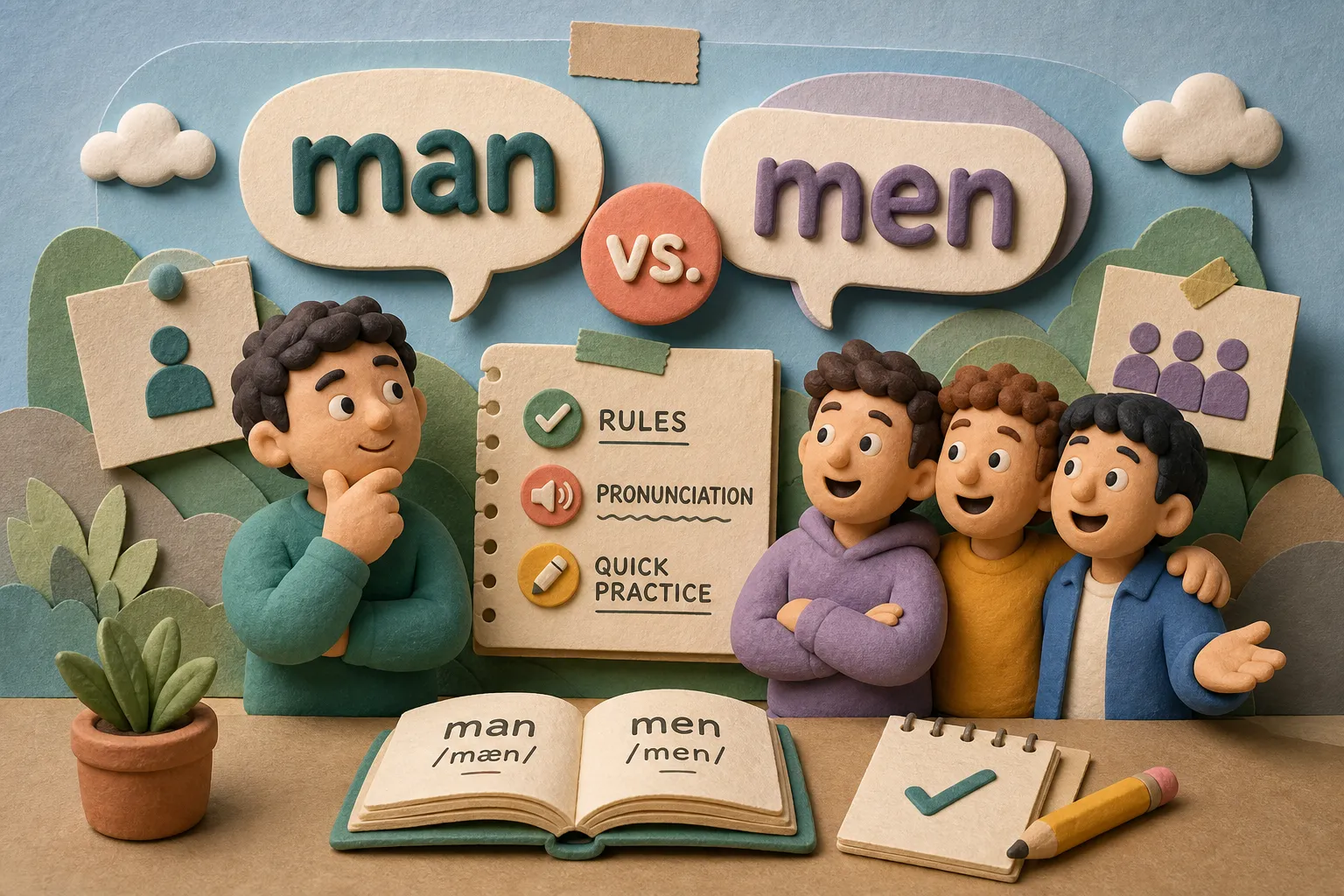
The rule is simple: use “man” for one adult male and “men” for two or more. The vowel changes from “a” to “e”, and that vowel change is the only signal. There’s no “-s” added, no suffix at all. There is no such word as “mans” in standard American English.
Four clear examples you’ll hear in everyday American life:
- A man is waiting outside the office. (one person)
- Three men are waiting outside the office. (more than one)
- The man at the café ordered black coffee. (singular)
- The men at the café ordered black coffee. (plural)
Notice the verb agreement too. “Man” takes a singular verb: “the man is.” “Men” takes a plural verb: “the men are.” Both the noun and the verb change together.
A quick note on where this pattern comes from
Hundreds of years ago, Old English formed some plurals by changing a vowel inside the word. The original singular was mann and the plural was manniz. The “i” sound at the end of the plural pulled the vowel forward, turning the “a” into “e.” Over time, the ending dropped off, but the vowel change stayed.
This process is called I-umlaut, vowel mutation caused by a following “i” sound. It sounds complicated, but only a small group of common English nouns follow this pattern: man, woman, foot, tooth, goose, mouse, and louse are the core set. “Man” and “men” are the most important pair to know, and the full list is short enough that you won’t feel overwhelmed.
Man vs Men Pronunciation: /mæn/ vs. /mɛn/
The vowel sounds in American English
These two words are not pronounced the same. In General American English, “man” is pronounced /mæn/ and “men” is pronounced /mɛn/. The difference is entirely in the vowel. If you want a quick reference on the features of the General American accent, that page summarizes the key vowel differences used in these examples.
Use these rhyme groups as anchors:
- “man” /mæn/: rhymes with can, ran, plan, pan. Your jaw drops lower. Your mouth opens wider.
- “men” /mɛn/: rhymes with pen, ten, when, then. Your jaw is a little higher. Your mouth is more relaxed.
For /æ/ (the vowel in “man”), drop your jaw as if you’re about to say “ah,” then spread your lips slightly. For /ɛ/ (the vowel in “men”), keep your jaw less open and let your tongue rest in the middle of your mouth. The difference is real and native speakers hear it clearly.
Why ESL learners often confuse these sounds (and how to fix it)
Many learners whose native language lacks the /æ/, /ɛ/ contrast treat the two sounds as identical. In practice, both “man” and “men” come out sounding the same, which causes real confusion in conversation.
The fix is to practice minimal pairs out loud. A minimal pair is two words that differ by only one sound. Say these pairs slowly, one after the other: man / men, pan / pen, ban / ben, bad / bed, sat / set. Record yourself and compare. When you can consistently hear the difference in your own voice, you’ve nailed it.
Getting this right matters in real conversations. If someone asks “Did you see the man?” and you say “Did you see the men?” the meaning changes completely. The vowel is doing important work.
Other English nouns that work exactly like “man” and “men”
Woman and women, child and children
“Woman” and “women” follow the same vowel-change pattern as “man” and “men.” The singular is woman and the plural is women. Never “womans.”
Here’s the big pronunciation trap: “women” is not pronounced the way it looks. The IPA is /ˈwɪmɪn/, which sounds like “WIH-min.” The “o” in “women” sounds like a short “i,” not like the “o” in “woman” (/ˈwʊmən/, “WUH-mun”). This is one of the most confusing spelling-pronunciation mismatches in English.
Examples in everyday American English:
- The woman at the front desk can help you. (one person)
- The women at the front desk can help you. (more than one)
“Child” works a little differently. It adds “-ren” to form the plural: child becomes children. This is still irregular because the regular rule would give you “childs,” which isn’t a word. Examples: One child is playing outside. Three children are playing outside.
Foot and feet, tooth and teeth
“Foot” and “tooth” use the same vowel-change rule as “man” and “men.” The vowel shifts in the plural rather than adding “-s.”
- My foot hurts. / My feet hurt.
- I lost a tooth. / She has healthy teeth.
A few other nouns follow this same pattern: goose becomes geese, mouse becomes mice. None of these plurals take an “-s” ending.
Common Man vs Men Mistakes ESL Learners Make
The “mans” mistake
This error happens because learners apply the regular plural rule automatically. The brain says: noun + s = plural. But “man” doesn’t follow that rule. When you see two or more adult males, the only correct word in standard American English is “men.” (The form “mans” does appear in some nonstandard slang and dialects, but it has no place in formal or professional writing.)
Two clear corrections:
- Wrong: Two mans are waiting in line.
- Correct: Two men are waiting in line.
- Wrong: I saw three mans at the park.
- Correct: I saw three men at the park.
Write “men” on a piece of paper and put it somewhere you’ll see it every day. Repeat it out loud five times. The more your brain hears and sees the correct form, the faster it becomes automatic.
Subject-verb agreement with “men”
“Men” is plural, so it always takes a plural verb. This trips up many learners because “men” doesn’t end in “-s,” so it doesn’t look plural. Grammatically, though, it is always plural. Study these correct and incorrect pairs:
- Wrong: The men is ready. / Correct: The men are ready.
- Wrong: The men was late. / Correct: The men were late.
- Wrong: The men has finished. / Correct: The men have finished.
The same rule applies to “women” and “children.” These nouns look singular because they don’t end in “-s,” but they are always grammatically plural and always take plural verbs. When you see men, women, or children as the subject of a sentence, choose are, were, and have every time. For more on common grammar topics like this one, see our Daily Grammar, Your Daily American section.
When “man” means all people
The traditional use of “man” to mean all humans
Historically, the word “man” was used to refer to all human beings, not just males. This shows up in older words and phrases you’ll still see in texts, news archives, and formal writing. Common examples include mankind (all human beings as a group) and man-made (created by humans, not nature).
You’ll also find this use in older sentences like “Man has walked on the moon” or “Man has always sought to understand the stars.” These sentences mean all people, not only males. Recognizing this use helps you understand older books, speeches, and historical writing. If you want a quick authoritative explanation of this traditional usage, check the Cambridge Dictionary entry on “man” and “mankind”.
What modern American English uses instead
Modern American English strongly prefers gender-neutral language in professional, academic, and public writing. Style guides, AP, Chicago, and APA, all recommend replacing “man” and “mankind” with more inclusive alternatives. See guidance on inclusive wording from the AP and Chicago on sexist language for practical recommendations.
The most useful replacements:
- Humankind (takes a singular verb): Humankind has always explored the unknown.
- Humanity (takes a singular verb): Humanity faces many challenges today.
- Human beings (takes a plural verb): Human beings have always sought connection.
- Human-made (replaces “man-made”): The lake is human-made.
If you’re writing an email, a report, or any professional document in the U.S., these alternatives are the safer choice. They are clearly understood and widely accepted in professional and academic writing.
Quick practice: test yourself before you go
Fill in the blank and choose the correct form
Read each sentence and choose the correct word. Write your answer before you look at the key below.
- One _______ (man / men) left his bag on the train.
- Two _______ (man / men) from the team won awards this year.
- The _______ (man / men) (is / are) waiting outside for the meeting.
- She spoke with three _______ (man / men) about the new project.
Answer key: 1. man / 2. men / 3. men are / 4. men. If you got all four right, you’ve got the grammar rule. If you missed one, go back to the first section and read it once more.
Say it out loud
This speaking drill takes about two minutes. Read each word pair aloud three times slowly, then use each word in a sentence out loud.
- man / men
- woman / women (remember: “women” = WIH-min)
- foot / feet
Record yourself on your phone, then check the IPA in the pronunciation section above. Listen for whether your /æ/ sounds open and low and your /ɛ/ sounds higher and more relaxed. For extra practice with minimal pairs you can use a focused minimal pairs practice list to train your ear and mouth.
What to remember
To recap the man vs men difference: “man” is singular, “men” is plural, and “mans” is not correct in standard American English. When “men” is the subject of a sentence, always use a plural verb, are, were, have. The same logic applies to women and children.
The man vs men pronunciation gap is real and worth practicing. “Man” uses the /æ/ vowel (rhymes with can, pan, ran). “Men” uses the /ɛ/ vowel (rhymes with pen, ten, when). Work through the minimal pairs out loud until the difference feels natural. And keep “women” = WIH-min locked in your memory, it almost never sounds the way it looks.
English has a small family of nouns, man, woman, foot, tooth, goose, mouse, that change their vowel in the plural instead of adding “-s.” These words appear frequently in everyday American speech and writing. Mixing up “feet” and “foots,” or “men” and “mans,” is one of the fastest ways to sound like a beginner; getting them right does the opposite. For more practical lessons like this one, visit Your Daily American and explore grammar, pronunciation, and vocabulary the way the language is actually used every day. You can also find more pronunciation drills in our Pronunciation & Listening, Your Daily American section, and if you want a deeper dive into word stress related to vowel differences, see our Word Stress in American English: A Complete Guide, Your Daily American.