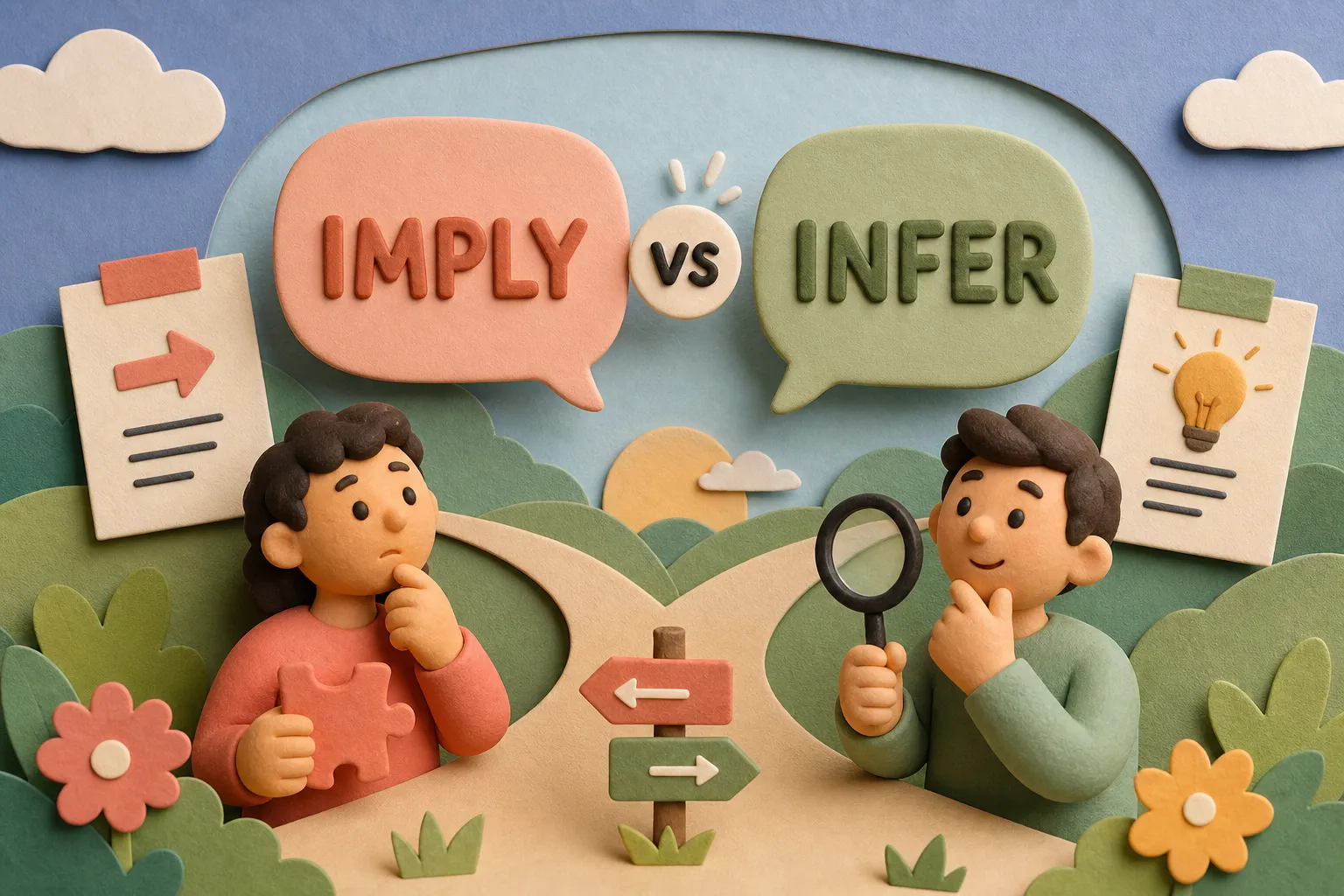
Imply vs infer is one of those word pairs that trips up even experienced writers, and getting it wrong in a professional setting can undermine an otherwise polished message. By the end of this lesson, you’ll know exactly when to use imply and when to use infer, you’ll have a simple memory trick that makes the choice automatic, and you’ll be able to spot and correct the misuse when it appears in your own writing. That last part matters more than you might expect.
Here’s a situation that comes up regularly in American workplaces. A manager finishes reading an email and says to a colleague, “He’s inferring that we missed the deadline.” Except the manager actually meant implying. That one word swap completely changes who’s doing the communicating. It sounds like a small slip, but in professional settings, some readers may interpret it as a lapse in precision. The error appears in published writing and in workplace communication across registers, from carefully drafted emails to polished presentations.
This is the kind of nuanced distinction often emphasized beyond basic classroom instruction, an example of how real fluency means knowing the details that live above the grammatical foundation. So let’s build on it.
Imply vs infer: the core distinction
The rule is clean and simple once you see it. The speaker or writer implies. The listener or reader infers. Both words live in the same space of indirect communication, but they describe opposite ends of the exchange.
According to Merriam-Webster, to imply means “to express indirectly”, to suggest something without stating it outright. To infer means “to reach a conclusion based on facts or premises”, to figure something out from the evidence available. Cambridge frames it the same way: implying is suggesting without saying directly; inferring is concluding from what’s been given. One person puts the message out; the other takes the meaning from it. Understanding the difference between imply and infer starts right there.
Imply: what the speaker or writer does
When you imply something, you are the one communicating. You’re sending a message without spelling it out, hinting, suggesting, or deliberately leaving something unsaid. Consider a manager who says in a Monday morning meeting, “The client presentation is Thursday, and I know everyone’s been very busy lately.” She never said, “You’re behind on your work.” But she implied it. The message lived in what she chose not to say directly, and everyone in the room received it.
Infer: what the listener or reader does
When you infer something, you are the one receiving and interpreting. You take information that was given to you and read between the lines, you’re the detective. If your coworker sends a one-word reply to your message, just “Noted.”, you infer from the brevity that something is off, even though they said nothing negative. You drew that conclusion from the evidence: the short response, the missing warmth, the period instead of an exclamation mark. That conclusion is your inference.
Imply vs infer in the real world: workplace and everyday examples
Seeing both words in realistic situations makes the distinction easier to hold onto. Here are three contexts where this plays out naturally.
In a workplace meeting
A project manager opens a status meeting by saying, “We’ve had some challenges with this client’s timeline over the past few weeks.” She doesn’t say who caused the delays. She doesn’t name names. But she is implying that someone on the team is responsible. The team members who walk out thinking, “She was blaming our department for the delays,” have inferred that from her phrasing. Same moment. Same message. Two different verbs, depending on whose perspective you’re describing.
In professional emails
Written communication is full of implied meaning. Diplomatic indirection is a common feature of professional emails in American workplaces, a way of signaling concern without direct criticism. Consider: “I wanted to make sure we’re aligned on expectations before the next deliverable.” The writer is implying that expectations were not met previously. A careful reader infers dissatisfaction from that phrasing, even though the word “disappointed” never appeared. Skilled communicators imply deliberately; skilled readers train themselves to infer accurately. Both skills are worth developing.
In everyday conversation
A friend texts back, “I’m not sure tonight is great for me,” when you ask if she wants to meet up. She never said no directly, but she implied it. You think to yourself, “She probably just wants a quiet night at home,” and decide not to push. That thought is your inference. This kind of exchange happens throughout the day in English, and recognizing which word belongs to which person makes the distinction feel natural very quickly.
The mistake even native speakers make
Here’s something worth knowing: this confusion is widespread. Usage guides describe the misuse of infer where imply is intended as “sadly common,” and one authority states flatly that “infer is constantly used where imply is intended.” If you’ve been mixing these up, you’re in very good company, including native speakers who write professionally.
How the mix-up usually shows up
The most common error looks like this: someone uses infer when they mean imply, putting the speaker in the wrong role. Here are three examples that usage guides flag as incorrect:
- Wrong: “My girlfriend inferred it was over without actually saying it.” Correct: implied. She was the one sending the message, so she implied it.
- Wrong: “In your letter, you infer that your partner is over 18.” Correct: imply. The letter writer is suggesting something indirectly, that means implying.
- Wrong: “I didn’t mean to infer by my remarks that the business doesn’t have the correct zoning.” Correct: imply. The speaker is the source of the suggestion, so they imply.
In each case, the subject of the sentence is the one sending the message. That always means imply.
Why this confusion keeps happening
Both words orbit the same gray zone: communication that isn’t direct. When you talk about an implied message, the person who implied it and the person who inferred it are often mentioned in the same breath. The concepts blur because they describe two halves of the same exchange. And because the confusion is common even among educated speakers, struggling with it doesn’t reflect a weak vocabulary. It reflects that you’re working at a level of nuance many learners haven’t even reached yet. Many speakers and writers, native and non-native speakers alike, confuse the pair.
One memory trick that makes the difference click
You don’t need a complex grammar rule here. You need one image that sticks.
Think of it as throwing and catching
The speaker or writer throws the implication. The listener or reader catches the inference. One person sends; the other receives. A throw only works if someone catches it, and a catch only happens if someone threw. If you’re putting the message into the air, use imply. If you’re reaching up and grabbing what someone else put out there, use infer. One quick sentence to lock it in: “She implied that I was late; I inferred from her expression that she was annoyed.”
The one-word association method
For a second anchor, try this: link imply to “input”, the sender puts something into the message. Link infer to “interpret”, the receiver draws something out. Both words start with “in,” but one is about putting in and the other is about drawing out. The AP Stylebook puts it plainly: “Writers or speakers imply in the words they use. A listener or reader infers something from the words.” That’s the professional standard, and it maps perfectly onto the throw-and-catch image. Pick whichever version sticks and keep it.
A quick self-check: try it yourself
Reading about a grammar point is useful. Using it is what builds the habit. Try these four sentences and choose the correct word before reading the answers.
Fill in the blank
- The silence after his presentation ________ that the team wasn’t convinced. (implied / inferred)
- From her hesitation, I ________ that she hadn’t finished the report. (implied / inferred)
- Are you ________ that I made an error in the budget? (implying / inferring)
- The email didn’t state a deadline, but we ________ from the tone that it was urgent. (implied / inferred)
Answers and explanations
1. Implied. The silence is the source of the message. It’s doing the suggesting, which means it’s implying. The team members who felt unconvinced were the ones inferring from it.
2. Inferred. You are the listener here, reading a signal from her behavior. You drew a conclusion from the evidence, so you inferred.
3. Implying. This is the most common mistake in real life. The person asking the question is accusing someone of sending a message indirectly, which means implying. Saying “are you inferring” would put the wrong person in the receiver role.
4. Inferred. “We” are the readers of the email, drawing a conclusion from what we received. The tone of the email implied urgency; we inferred it. Now try writing one sentence from your own workday or life using each word. That’s where real retention starts.
Frequently asked questions: imply vs infer
These are the questions that come up most often when learners work through this distinction.
- When do you use imply vs infer?
- Use imply when you’re describing what a speaker or writer is suggesting indirectly. Use infer when you’re describing what a listener or reader concludes from what they’ve received. The sender implies; the receiver infers.
- What is the difference between implication and inference?
- An implication is the indirect message a speaker or writer puts into their communication. An inference is the conclusion a listener or reader draws from it. Inference vs implication maps directly onto infer vs imply: one belongs to the sender, the other to the receiver.
- Is it ever acceptable to use infer to mean imply?
- Some usage commentators note that the interchange has a long history in informal speech, but major style authorities, including the AP Stylebook and Merriam-Webster’s usage notes, maintain the distinction in professional and formal writing. For workplace and academic contexts, keeping them separate is the safer, more precise choice.
- What does imply mean vs what does infer mean in a sentence?
- Imply meaning in use: “Her tone implied frustration.” Infer meaning in use: “I inferred from her tone that she was frustrated.” The imply meaning centers on output; the infer meaning centers on interpretation.
Putting it together
The difference between imply and infer is clean: the speaker or writer implies; the listener or reader infers. One person throws, the other catches. Both words describe indirect communication, but they belong to different people in the exchange. Many speakers and writers, native and non-native alike, confuse the pair, which means getting it right marks a genuine step forward in precision. Using imply vs infer correctly is one of those details that separates careful, confident language use from guesswork.
Knowing this distinction won’t just help you avoid a grammar slip. It moves you from “grammatically correct” into the territory of sounding like you actually belong in American professional settings, where word choice carries real weight. That gap between correct and natural is exactly what Your Daily American is built to close, with practical lessons like this one focused on how educated Americans actually use the language.
If this kind of nuance interests you, there are more lessons waiting. Explore the vocabulary and grammar sections on Your Daily American and keep building the kind of fluency that holds up in real conversations, real emails, and real rooms.