You’re writing a professional email to your manager and you pause mid-sentence: is it “do to technical issues” or “due to technical issues”? Is the report deadline the “do date” or the “due date”? You know the words, you’ve seen them a hundred times, but in that moment, your brain freezes. This mix-up trips up intermediate and advanced learners, not just beginners, and it makes sense why. These two words are identical in sound and close in spelling, yet they work completely differently in English.
By the end of this lesson, you’ll be able to identify which word belongs in any sentence, use “due to” and “because” correctly in professional writing, and apply a quick mental test before you hit send on your next email. This is exactly the kind of word-level precision that separates competent English from confident, professional English, and it’s the foundation of the professional writing content at Your Daily American.
Why “do” and “due” confuse even advanced learners
Before we get into the rules, let’s be clear: struggling with this distinction is not a sign of weak English. These two words are genuinely tricky because they look similar on paper and behave like complete strangers in grammar.
They sound the same in standard American English
In standard American English, “do,” “dew,” and “due” are commonly treated as homophones. All three are typically pronounced /duː/, sounding like “doo,” rhyming with “two” or “shoe”, though some speakers retain a slight “y” glide, making “due” sound closer to “dyoo,” particularly in careful or regional speech. Some British and non-American accents preserve that glide more consistently, which creates a subtle distinction. In everyday American speech, however, most speakers use the same sound for all three words. That means you can rarely rely on sound alone to tell them apart; grammar and context are your real guides.
Similar spelling, completely different grammar jobs
Even though these words look and sound alike, they play completely different roles in a sentence. “Do” is always a verb. “Due” most commonly functions as an adjective or as part of a fixed phrase, though it can also appear as a noun in expressions like “give credit where credit is due.” Using one where the other belongs can change the meaning of an entire email or make your writing look unprofessional to a native English reader. That’s a big part of why writers at various proficiency levels hesitate when they need to choose between them in a formal context.
What “do” means and how it works in a sentence
“Do” has two jobs in English: it can be the main verb in a sentence, or it can be an auxiliary verb that supports another verb. Understanding both roles makes it easier to recognize when “do” is the right choice.
“Do” as a main verb
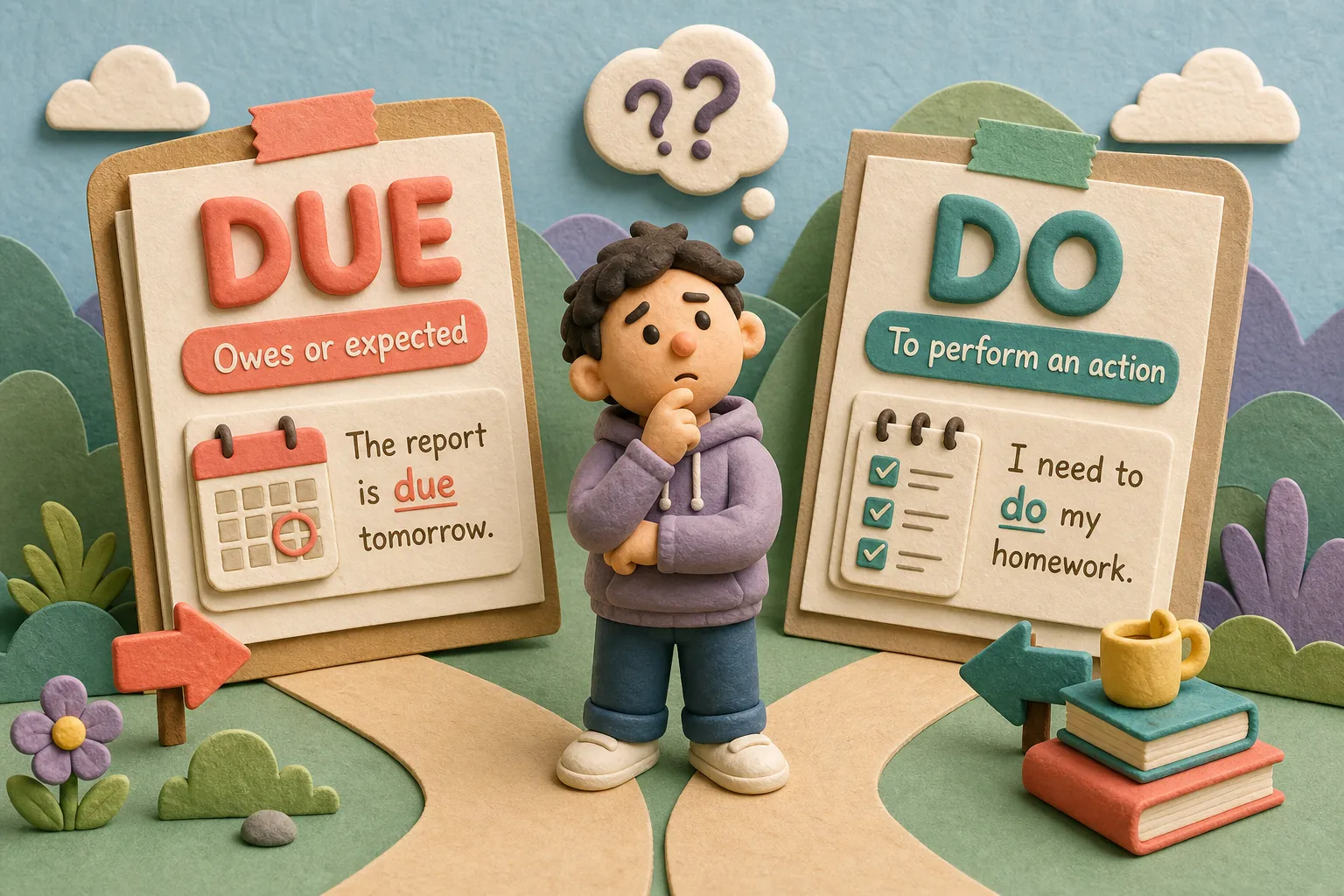
When “do” is the main verb, it means to perform, carry out, or complete something. It is always an action word. Here are some natural examples you’ll recognize from everyday life and work:
- I need to do my homework before the call.
- She always does her best in presentations.
- We did everything we could to meet the deadline.
- He’s been doing a great job on the project.
- Can you do me a favor and send that file?
Notice that “do” changes form depending on the subject and tense: do, does, did, done, doing. These are all conjugations of the same verb.
“Do” as an auxiliary verb
“Do” also functions as one of the most common auxiliary (helping) verbs in English. In this role, it doesn’t add meaning on its own; it supports another verb to form questions, negatives, and emphasis. You’ll encounter this regularly in workplace communication:
- Do you have a moment to review the draft? (question)
- I don’t have the updated file yet. (negative)
- I do understand your concern; let me explain. (emphasis)
Auxiliary “do” tends to be unstressed and easy to overlook when you’re speaking naturally, but recognizing it in writing helps you avoid swapping it out for “due” by mistake.
What “due” means and when to use it
“Due” works in two main situations: describing something expected or scheduled, and explaining a cause or reason through the phrase “due to.” Both uses are common in professional writing, which is why getting them right matters.
“Due” for deadlines, payments, and expectations
“Due” as an adjective answers the question: when is something expected or owed? This is the word in “due date,” “the report is due Friday,” and “rent is due on the first.” Here are clean examples from professional and everyday contexts:
- The report is due by Friday at noon.
- Your invoice payment is due on the 15th.
- The baby is due in August.
- The guests are due to arrive at 7:00 p.m.
- The final submission is due at the end of the quarter.
You cannot swap “do” into any of these sentences. “The report is do Friday” is simply not English. “Due” is the only correct choice when you’re talking about something expected, scheduled, or owed.
The phrase “due to” and what it means
“Due to” is a two-word phrase that explains the cause or reason for something. Think of it as a formal, written alternative to “because of.” It turns up throughout professional emails, reports, and workplace messages. These examples show exactly how it works:
- The delay was due to heavy traffic.
- The meeting was postponed due to a scheduling conflict.
- Her success was due to years of consistent practice.
- The flight was late due to mechanical problems.
Notice that “due to” is followed by a noun or noun phrase, not by a full clause with its own subject and verb. In formal writing, most style guides, including AP and Chicago, recommend keeping “due to” before a noun phrase rather than a full clause. That distinction leads directly to the next rule.
The “due to” vs. “because” rule that clears up the confusion
This is the grammar rule most learners need, and it’s simpler than most textbooks make it sound. The key is knowing that “due to,” “because of,” and “because” are not interchangeable, each has a specific job.
The substitution test you can use every time
Here’s a reliable mental shortcut: replace “due to” with “caused by” and check whether the sentence still makes sense. If it does, “due to” is likely correct. If the swap sounds awkward, reach for “because” or “because of” instead. Compare these examples:
- “The cancellation was due to bad weather.” Replace: “The cancellation was caused by bad weather.” That works. “Due to” is correct.
- “She missed class due to she was sick.” Replace: “She missed class caused by she was sick.” That doesn’t work. Use “because she was sick” instead.
- “The delay was due to a software update.” Replace: “The delay was caused by a software update.” Correct.
This test works because “due to” should modify a noun and carry the meaning of “caused by” or “attributable to.” When it’s followed by a full clause with its own subject and verb, it breaks down, and “because” is the right tool. Note that in casual, everyday speech you’ll sometimes hear “due to” used more loosely, but in professional and formal writing, sticking to the noun-phrase rule keeps your language clean and correct.
When “because of” beats “due to”
“Due to” should follow a linking verb and describe a noun phrase. “Because of” works before noun phrases when you’re explaining why an action happened. “Because” introduces full clauses with a subject and a verb. Here’s how that plays out in real professional writing:
- Wrong: I will be late due to the traffic is bad. Right: I will be late because the traffic is bad. / I will be late because of the traffic.
- Wrong: She missed the meeting due to she had a conflict. Right: She missed the meeting because she had a conflict. / She missed the meeting due to a conflict.
The rule is straightforward once you see the pattern: “due to” goes before a noun phrase, “because” goes before a subject-plus-verb clause, and “because of” goes before a noun phrase that explains why an action happened. Keep that in mind and you’ve removed most of the guesswork.
Common mistakes in professional writing, with corrections
The most common “do” and “due” errors show up in exactly the kinds of messages you send every day: status updates, deadline reminders, and professional emails. Here are the real errors learners make most often, corrected with brief explanations.
“Do date,” “do to,” and other professional writing errors
Common recurring mistakes include these three, which show up regularly in professional writing from ESL learners:
- Wrong: “Please confirm the do date for this project.” Right: “Please confirm the due date for this project.” (“Due date” is a fixed phrase; “do date” is not a phrase at all.)
- Wrong: “The system is down do to technical issues.” Right: “The system is down due to technical issues.” (“Do to” does not exist in standard English as a causal phrase.)
- Wrong: “The invoice was do yesterday.” Right: “The invoice was due yesterday.” (“Due” is the adjective for something expected or owed.)
Corrected email sentences from real workplace contexts
Here are six sentence-level corrections pulled from the kinds of professional messages learners write every day:
- “Please submit your report by the do date.” → “Please submit your report by the due date.”
- “The project was delayed do to budget cuts.” → “The project was delayed due to budget cuts.”
- “We apologize for the inconvenience do to the outage.” → “We apologize for the inconvenience due to the outage.”
- “Your payment is do on the 30th.” → “Your payment is due on the 30th.”
- “The deadline was moved do to client feedback.” → “The deadline was moved due to client feedback.”
- “The launch is do to happen next week.” → “The launch is due to happen next week.”
Patterns like these come up throughout workplace English. If you want to go deeper on professional email language, subject lines, opening phrases, closings, and the word-level choices that make native readers trust your writing, the professional email guides on Your Daily American are built around exactly this type of real-context practice.
A quick self-check before you write your next email
You now have everything you need to make the right call. Here’s how to lock it in with a fast self-check you can use anytime you write either of these words.
Questions to ask yourself before you write
Run through these questions whenever you reach for “do” or “due” in a sentence:
- Am I writing about a deadline or something expected? Use “due.” (Due date, due on Friday, payment due.)
- Am I writing about a cause or reason? Use “due to,” then test it with “caused by.” If that swap works, you’re good. If not, switch to “because” or “because of.”
- Am I describing an action or forming a question? Use “do.” (Do your work. Does she know? I don’t have it.)
Try it yourself: three practice sentences
Fill in the blank with either “do,” “due,” or “due to,” then check your answers against the rules above:
- “The invoice is ___ on Friday.”
- “The server outage was ___ a software update.”
- “___ you have the final file ready?”
Answers: 1. due | 2. due to | 3. Do
If you got all three right, you’ve already internalized the core distinction. If one tripped you up, go back to the section that covers that usage and read through the examples one more time. Repetition with real context is how this kind of precision becomes automatic.
The bottom line on “do” and “due”
“Do” and “due” sound identical in standard American English, but they work completely differently in grammar and meaning. “Do” is a verb. “Due” is an adjective used for deadlines and expectations. “Due to” is a causal phrase meaning “caused by,” and in formal writing it belongs before a noun phrase rather than a full clause. With the substitution test and the self-check questions above, you have a reliable process for making the right call, even in the middle of writing a professional email under deadline pressure.
Word-level precision like this is what separates grammatically correct English from English that sounds clear, polished, and professional to native readers. If you want to keep building that kind of accuracy, Your Daily American has a full library of professional English content, including workplace email writing, meeting phrases, and vocabulary lessons grounded in exactly this level of practical fluency. The difference between “do date” and “due date” is small on paper. In a professional context, it’s the kind of detail that native readers notice right away.