Two tiny abbreviations, four letters total, and yet the i.e. vs e.g. question trips up even confident English writers every single day, including native speakers. If you’ve ever stared at a sentence and wondered which one to use before just guessing, you’re in good company.
By the end of this guide, you’ll know exactly what each abbreviation means, when to use it, how to punctuate it correctly across AP, Chicago, APA, and MLA style, and how to avoid the mix-ups that quietly undermine professional writing. It’s the kind of detail Your Daily American covers regularly, because in workplace English, the difference between sounding polished and sounding uncertain often comes down to precisely this kind of choice.
What i.e. and e.g. actually mean
Both abbreviations come from Latin, but they do completely different jobs in a sentence. Getting that distinction locked in first makes everything else straightforward.
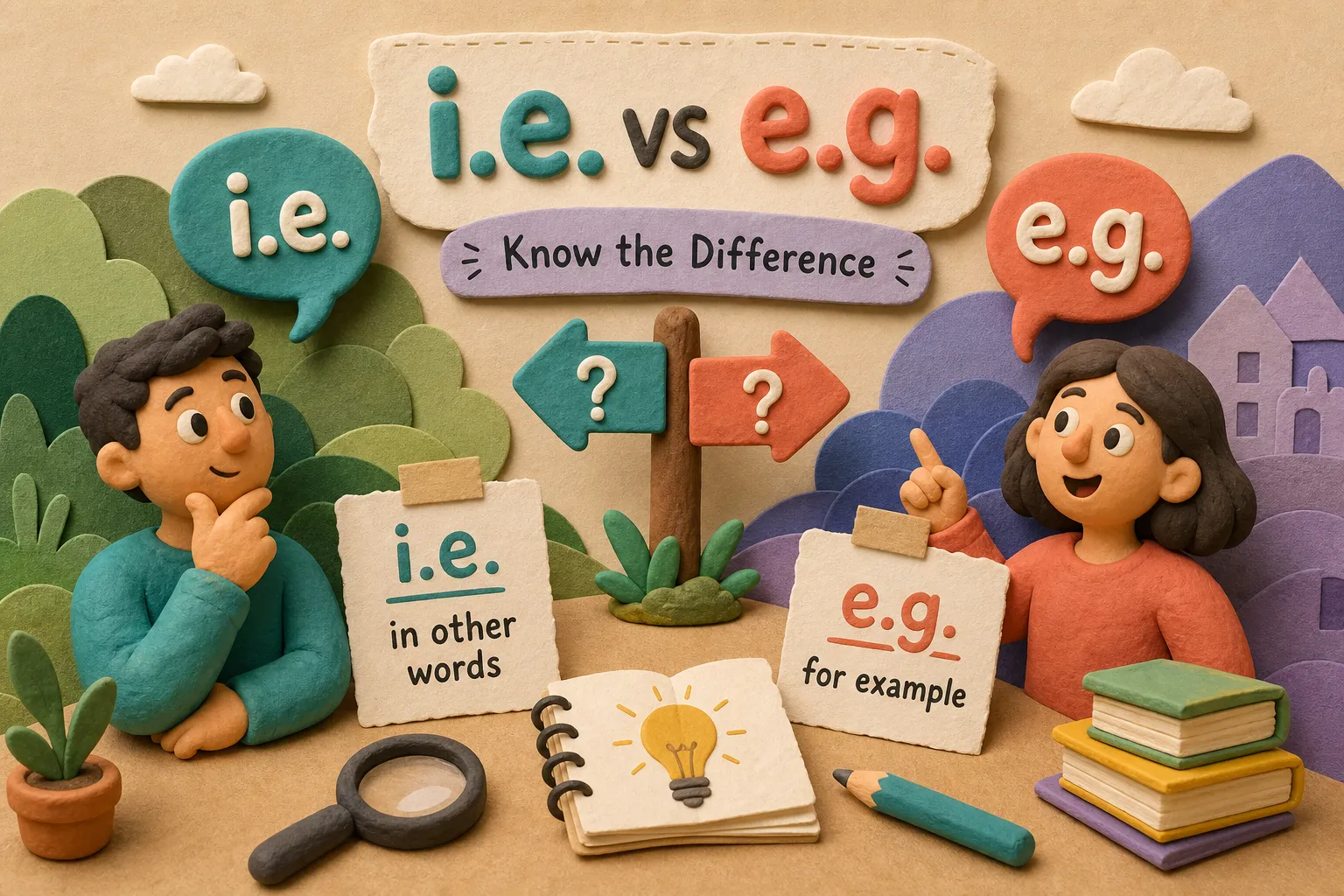
i.e. comes from the Latin id est, which means “that is” or “in other words.” You use it to clarify or restate something more precisely. e.g. comes from exempli gratia, meaning “for the sake of an example,” or simply “for example.” You use it to introduce one or more examples from a larger group. Knowing the Latin isn’t just trivia, it tells you directly what function each one performs in a sentence.
The fastest way to settle any doubt is a simple substitution test. Ask yourself: can you replace the abbreviation with “that is”? Use i.e. Can you replace it with “for example”? Use e.g. These two parallel sentences show the contrast in action:
- She lives in the Midwest, i.e., Indiana. (clarifies exactly where, Indiana is the complete answer)
- She likes Midwestern states, e.g., Indiana and Illinois. (gives examples; there are more she could have listed)
That’s the core difference: i.e. points to the only intended meaning, while e.g. points to some examples from a larger set, with an implicit “and so on” attached. When you’re unsure which applies, run the substitution test and the answer usually becomes obvious.
When to use i.e. vs e.g. in a sentence
Think of i.e. as a promise to your reader: “I’m about to tell you exactly what I mean, with no ambiguity left.” It restates or narrows a broader statement into its precise meaning. You’ll see it most often in formal documents, reports, and workplace emails where precision matters. (See How to Write a Professional Email in American English, Your Daily American.)
These examples show how i.e. works in practice:
- The meeting is open to senior staff only, i.e., department heads and above.
- We need one document, i.e., your signed contract.
- The project has one hard constraint, i.e., the budget cannot exceed $10,000.
Notice what each of these sentences does. The clause after i.e. doesn’t add new possibilities, it closes the meaning down and tells the reader: this, and only this, is what was meant. That’s the defining quality of the abbreviation, and it’s why swapping it carelessly for e.g. can genuinely change the meaning of a sentence.
e.g. does the opposite. It signals to the reader: “Here are some examples, but this list isn’t exhaustive.” When you write e.g. before a list, the reader understands that other items belong to the same category, even if you didn’t name them. That implicit “and more” is baked into the abbreviation itself.
You’ll find e.g. most useful when listing options, giving examples of acceptable items, or showing what you mean without committing to a complete inventory:
- Bring something to write with, e.g., a pen or a pencil.
- Several departments attended, e.g., Marketing and Finance.
- We reviewed communication tools, e.g., Slack, email, and shared project boards.
In the second sentence, e.g. tells the reader that Marketing and Finance were among the departments present, not necessarily all of them. That distinction matters in professional writing. If you used i.e. instead, you’d be claiming those were the only departments there, which may be exactly the wrong impression to give.
Punctuation rules for i.e. vs e.g.
The punctuation rules are consistent and worth knowing cold. Both abbreviations always take periods: i.e. and e.g. Writing them as “ie” or “eg” without periods is an error in formal writing, no matter how common it looks online. In American English, both are also followed by a comma: i.e., and e.g., respectively. The comma is not optional in professional contexts. (For a focused discussion on commas with i.e. and e.g., see this practical guide: Comma after i.e. and e.g., Daily Writing Tips.)
One thing worth addressing directly: “ex.” is not a standard abbreviation for “for example” in formal American English writing. It can be confused with “exercise” or “former,” and no major style guide accepts it in this role. Stick with e.g.
Here’s how the four major style guides handle these abbreviations:
- AP Style: Periods in both, comma after both. No special restriction on inline use.
- Chicago Manual of Style: Periods in both, comma after both. Prefers these abbreviations inside parentheses or notes rather than in the main body of a sentence. (See the Chicago Manual of Style discussion for more detail.)
- APA 7th edition: Periods in both, comma after both. Recommends using them in parenthetical material and spelling out “that is” or “for example” in the main narrative.
- MLA: Periods in both, comma typically follows. Similar preference for parenthetical use.
The practical takeaway: for general professional writing, always use i.e., and e.g., with a period after each letter and a comma after the full abbreviation. If you’re following APA or Chicago in a formal document, default to using them inside parentheses. For AP style or general business writing, inline use is fine as long as the punctuation is correct.
Common i.e. vs e.g. mistakes to avoid
The most damaging mistake is swapping one for the other. Using i.e. when you mean e.g. tells the reader the list is complete when it isn’t. Using e.g. when you mean i.e. implies uncertainty about something you want to define precisely. Here’s what that looks like side by side:
- Wrong: I need one thing, e.g., your signature. (implies your signature is just one of many acceptable options)
- Right: I need one thing, i.e., your signature. (your signature is the only thing needed)
That’s not a small distinction in a professional email. The first version suggests flexibility where none exists, the kind of error that quietly signals to native English readers that the writer isn’t quite sure what they’re saying, even if the content is otherwise strong. For a clear, practical overview of common misuses and how to avoid them, consult this concise guide: Grammarly, i.e. vs. e.g..
The second most common error is missing the comma. Writers frequently produce sentences like “We visited several cities e.g. Paris and Rome” without any commas around the phrase. The correct version is: “We visited several cities, e.g., Paris and Rome.” The comma before e.g. sets it off from the rest of the sentence, and the comma after is required by every major style guide in American English.
A third mistake: treating an e.g. list as exhaustive. Because e.g. already implies “and more,” following it with “etc.” is redundant. “e.g., Paris, Rome, etc.” is a common error. Let the abbreviation carry the “and so on” meaning on its own.
A cheat sheet to lock it in
Every time you’re unsure which abbreviation belongs, run through two quick questions. Am I restating or clarifying exactly what I just said? Use i.e. Am I giving examples from a larger group where the list isn’t complete? Use e.g.
If mnemonics help, two reliable ones: for e.g., think “Examples Given”, the letter E is your cue. For i.e., think “In Essence, it IS what I mean exactly.” The abbreviation points to the precise, complete meaning, nothing more and nothing less.
To make it concrete, here’s the contrast one final time in plain terms: “The report covers one topic, i.e., Q3 revenue” means Q3 revenue is the whole topic. “The report covers financial data, e.g., Q3 revenue and expenses” means Q3 revenue is one example among the financial data covered. Same sentence structure, different abbreviations, different meanings entirely.
This is exactly the kind of detail covered in Your Daily American’s professional English resources, because sounding polished in writing matters just as much as sounding natural when you speak. (See Study Tips & Methods, Your Daily American.) For more on spoken naturalness and phrasing, read Word Stress in American English: A Complete Guide, Your Daily American.
Before you move on, try this: open your last email or a recent document and look for any i.e. or e.g. constructions you used. Apply the substitution test. Would “that is” work? Would “for example” work? If the wrong one is sitting there, now you know exactly how to fix it.
The core lesson, restated cleanly
i.e. means “that is.” Use it to restate or clarify with precision. e.g. means “for example.” Use it to offer examples from a larger group. When in doubt, apply the ie vs eg substitution test: swap in “that is” or “for example” and see which one fits naturally. For additional authoritative usage notes, see Merriam-Webster’s usage guide: Merriam-Webster, i.e. vs e.g..
For punctuation, the rule is consistent across all four major style guides: both abbreviations take periods, and both are followed by a comma in American English. Never write “ex.” as a substitute for e.g. in formal writing, and never treat an e.g. list as exhaustive by adding “etc.” after it.
Get these two abbreviations right and you’ll catch errors you didn’t know you were making, the small, precise kind that native readers notice even when they can’t name why. Open something you wrote recently and run the substitution test. You may be surprised by what you find.