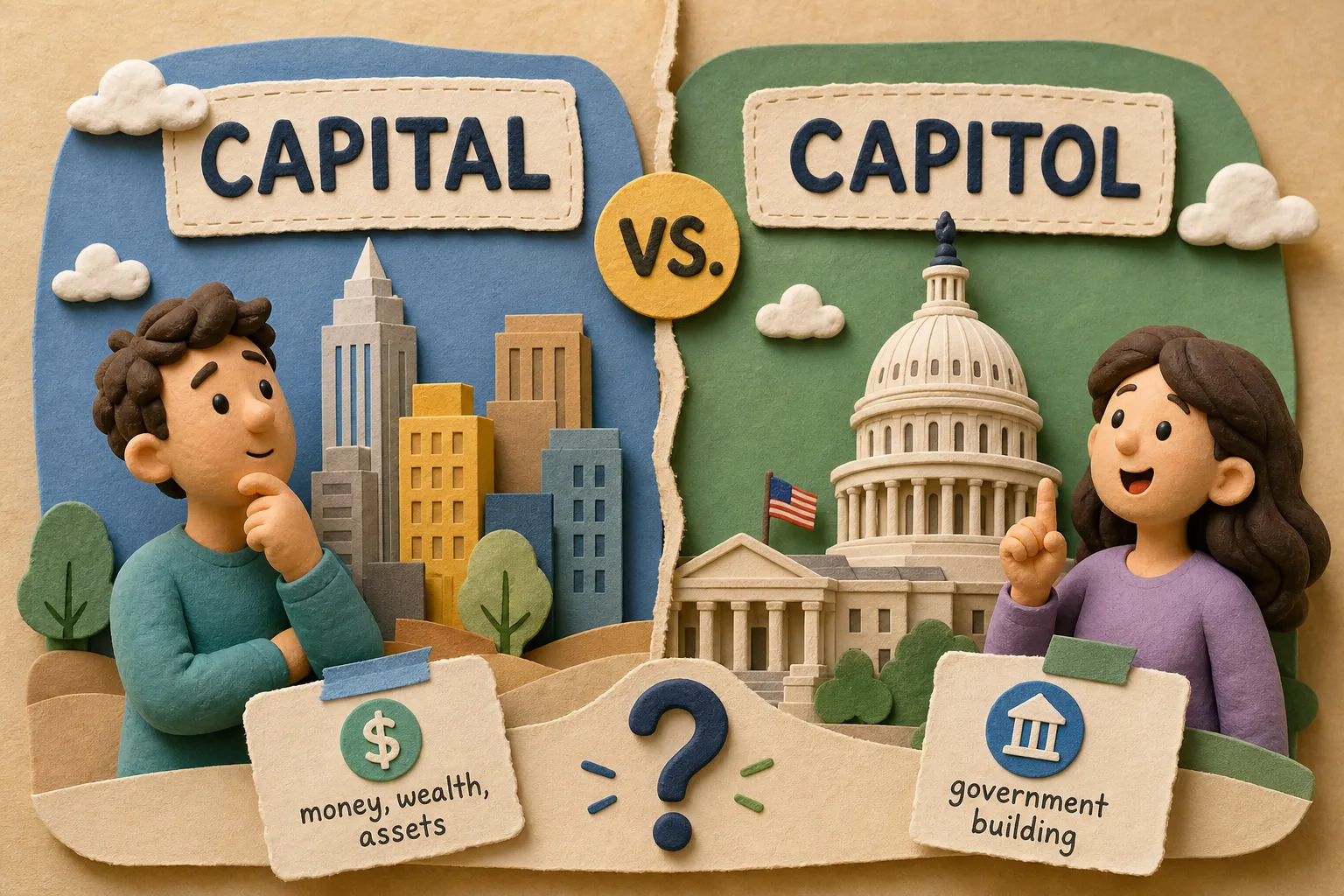
If you’ve ever paused mid-sentence wondering whether to write “capital” or “capitol,” you’re not alone. The capital vs capitol mix-up is one of the most common spelling questions English learners and even experienced writers run into, and for good reason. These two words look nearly identical, sound the same, and yet do completely different jobs in English. By the end of this lesson, you’ll know every meaning of “capital,” the one and only meaning of “capitol,” two memory tricks to keep them straight, and a one-line rule you can use to proofread your own writing.
Capital vs Capitol: Meanings at a Glance
Before diving into the details, here’s the short version: “capital” (spelled with an A) has multiple meanings covering cities, money, letters, and importance. “Capitol” (spelled with an O) has exactly one meaning: a building where a legislature meets. That’s the whole distinction. Everything else in this lesson fills in the details and makes it stick.
All the meanings packed into “capital”
“Capital” (spelled with an A) is a workhorse. It carries several meanings across different contexts, which is part of why this word trips up even experienced writers. Once you see how each meaning works, the whole picture gets much clearer.
Capital as a city and seat of government
“Capital” is the word for the city where a country, state, or region runs its government. Ottawa is the capital of Canada. Sacramento is the capital of California. Austin is the capital of Texas. Notice that “capital” refers to the city itself, not the building where lawmakers hold their sessions. That distinction matters, and you’ll see why in the next section.
You’ll run into this use constantly in news articles and travel writing. Phrases like “state capital,” “the nation’s capital,” and “capital city” are all standard. When someone says “Washington, D.C. is the capital of the United States,” they’re talking about the city, not any particular building inside it.
Capital in finance and business
“Capital” also means money, property, or assets used to grow a business or make investments. “The startup raised enough capital to hire its first ten employees.” “She invested her capital wisely and retired at 55.” This sense of the word is everyday vocabulary in business English and professional writing, so if you work with American companies, attend meetings, or read business news, you’ll encounter it regularly.
Capital letters and the adjective use
A capital letter is an uppercase letter, A, B, C rather than a, b, c. “Please write your full name in capital letters on the form.” Beyond typography, “capital” also works as an adjective meaning “chief” or “of greatest importance.” A capital offense is traditionally a crime punishable by death, though whether the death penalty applies depends on jurisdiction. A capital priority is the most urgent item on the list. These uses are less common in everyday conversation but appear regularly in formal writing and legal language.
The one job “capitol” does, and where it comes from
Capitol means one thing: a legislative building
“Capitol” (spelled with an O) refers specifically to a building where a legislature meets. Not a city. Not money. Not a letter. A building. The building where a state’s lawmakers gather is the state capitol. The building in Washington, D.C., where Congress meets is the U.S. Capitol. Every time you see “capitol,” a building is involved. That’s the whole story for this word.
When to capitalize: U.S. Capitol vs. state capitol
The capitalization rule here is straightforward, though worth a quick note on nuance. “Capitol” is capitalized when it’s part of a specific proper name: the U.S. Capitol, Capitol Hill. When referring to a state legislature building in a general way, lowercase is standard: “she works at the state capitol.” Major style guides, including the AP Stylebook and Merriam-Webster, support this approach, though some guides capitalize the names of specific state capitol buildings when used as full proper names. In practice: if you were writing a news article about protesters gathered outside the Texas statehouse, you’d write “state capitol.” If you were writing about Congress, you’d write “the U.S. Capitol.”
The Latin root that explains everything
“Capitol” comes from the Latin Capitolium, the name of the famous temple of Jupiter on Rome’s Capitoline Hill, a connection documented in Merriam-Webster’s etymology notes. The Williamsburg Capitol in Virginia, built in the late 1600s, is widely cited in American architectural history as the first building in the colonies to carry this name. Because the word was borrowed from a specific, iconic place, it never stretched beyond that architectural meaning. Understanding that “capitol” was always tied to one famous building explains why it stayed narrow while “capital” expanded in so many directions. Etymology isn’t just history trivia, it’s the clearest reason this distinction exists at all.
Capital vs Capitol: Two Memory Tricks That Make the Distinction Stick
Knowing the definitions is a good start. Having a quick trick your brain can reach for in the moment is even better. These two work together: one gives you a visual anchor, and the other covers everything else.
The dome trick: “O” stands for the round top
“Capitol” has an O, and many capitol buildings feature a dome. A dome is round, and the letter O is round. Picture the U.S. Capitol’s famous dome in Washington, D.C. Now picture the O in “capitol.” Connect those two images and hold them together for a second. That visual anchor is exactly the kind of association that makes vocabulary stick long-term, because your brain links spelling to an image rather than just memorizing an abstract rule.
This mnemonic appears in usage guides and dictionary resources, including references at Merriam-Webster, because it works: it’s physical, visual, and tied to one of the most recognizable buildings in the world.
Capital covers everything else
The second trick is even simpler. If you are not writing about a building where lawmakers meet, the answer is “capital.” Every time. Cities, money, letters, the adjective, every bit of it goes to “capital.” The one-line proofreading checklist you can run in your head is this: “Am I talking about a building where lawmakers meet? If not, use capital.” Ask that question before you finish any sentence using either word, and you’ll get it right every single time.
How these words look in real sentences
Definitions and rules make more sense when you see them working in real writing. Read through these examples carefully and notice how each word earns its place.
Capital across different contexts
- Canberra is the capital of Australia, not Sydney.
- The company raised $2 million in capital before its product launch.
- Please fill out the form using capital letters only.
- Water safety is a capital concern for communities in drought-prone regions.
- She moved to the capital for a government internship last spring.
- The investors were reluctant to commit their capital without seeing a business plan.
Notice the range: cities, money, letters, formal adjective use, everyday conversation. “Capital” slides naturally into all of them. When you’re writing and you’re not sure which spelling to use, that range is your cue: if the meaning fits any of these, you want “capital.”
Capitol in context
- The governor delivered her speech in the state capitol rotunda.
- Tourists lined up outside the U.S. Capitol on a clear January morning.
- Capitol Hill has been buzzing with debate over the new infrastructure bill.
- The state capitol building was renovated and reopened to visitors last spring.
Every one of those sentences is about a building where lawmakers work. No exceptions. That’s the clearest summary of this whole lesson: “capital” goes almost everywhere, and “capitol” goes to one place only.
Quick quiz: which word belongs here?
Read each sentence and decide: “capital” or “capitol”? Choose your answer before reading the key below. Take your time. The goal here is confidence, not speed.
Five sentences to test yourself
- The protesters gathered on the steps of the __________ building downtown.
- Phoenix is the __________ of Arizona.
- The tech company needed more __________ to fund its expansion into Europe.
- Please sign the document using __________ letters.
- The senator gave an interview outside the U.S. __________ this afternoon.
Answer key with brief explanations
- Capitol. The sentence refers to a building where a legislature meets, the exact and only meaning of “capitol.”
- Capital. Phoenix is a city, the seat of Arizona’s government. The word for a government city is always “capital.”
- Capital. This is the financial sense of the word: money used to fund business growth. “Capitol” has no financial meaning.
- Capital. Capital letters are uppercase letters. Nothing about this sentence involves a building.
- Capitol. The U.S. Capitol is a specific building and a proper noun. It gets both the “capitol” spelling and the uppercase C.
Five for five means the capital vs capitol distinction has already clicked. If one or two tripped you up, go back to the dome trick and run the proofreading question: “Am I talking about a building where lawmakers meet?” That question alone handles most real-world situations.
What to do next with other tricky word pairs
English has plenty of pairs like this one: affect vs. effect, then vs. than, principal vs. principle. In each case, one small letter changes the meaning entirely. The same approach you used here, learning the definitions, using a visual trick, and building a quick checking habit, works for all of them. Your Daily American’s vocabulary retention guides walk through proven techniques for making these distinctions stick for the long term, not just for a single quiz. That’s the logical next stop after this lesson. For a short lesson with extra examples and practice exercises, you can also try Study.com’s lesson on using capital vs. capitol.
You’ve got this
“Capital” covers cities, money, letters, and importance. “Capitol” covers one thing: a building where lawmakers meet. That’s the whole difference between two words that trip up native speakers and English learners alike.
Keep the dome trick close. Picture that round O sitting on top of a domed building. And before you hit send or submit on anything you’ve written, ask yourself one question: “Am I describing a building where a legislature meets?” If yes, use “capitol.” If no, use “capital.” That one-line checklist will handle this pair for the rest of your writing life.
Knowing when to write capital vs capitol, and why, is the kind of precision that separates a hesitant writer from a confident one. You now know both words completely: their definitions, their origins, how to remember them, and how to spot them in real sentences. Two words, one rule, one visual trick. That’s a lightweight toolkit with a long shelf life.
For more related reading from this site, see English Words Non-Native Speakers Mispronounce Most Often, Your Daily American if you’re interested in pronunciation pitfalls, and revisit the home page for more guides and lessons.