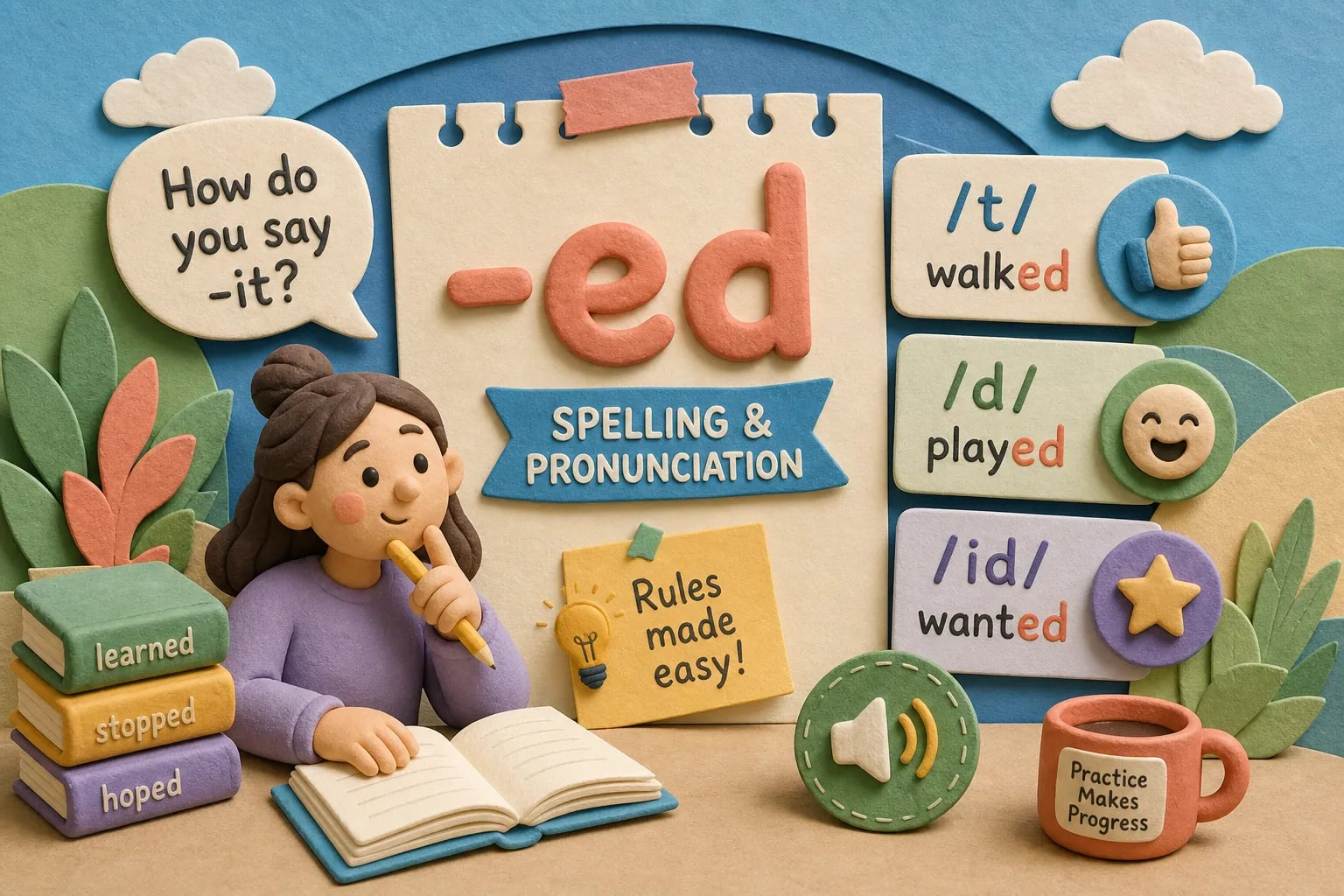
The -ed suffix is one of the most common endings in American English, and one of the most misunderstood. You’ve probably been adding -ed to verbs for years, but here’s something most learners don’t realize: that -ed ending makes three completely different sounds, and many native speakers may notice when you get it wrong. Learners often know that -ed marks the past tense, but few realize it sounds different depending on the word it’s attached to.
This article covers three things: what the -ed suffix does in American English grammar, how to spell it correctly every time, and how to pronounce all three of its sounds. By the end, you’ll have practical tools to fix the errors that make -ed sound unnatural in real conversation.
What the -ed suffix does in American English
The most common use: simple past tense
The -ed ending marks the past tense of regular verbs. Regular verbs follow a fixed pattern: walk becomes walked, call becomes called, finish becomes finished. The pattern is consistent and predictable, which is what makes them “regular.”
Irregular verbs work completely differently. Go becomes went. Eat becomes ate. Run becomes ran. These verbs do not use -ed in the past tense, and mixing them up is one of the most common learner errors. More on that in the common mistakes section below.
Beyond past tense: perfect tenses, passive voice, and adjectives
The -ed form, called the past participle, also appears in perfect tenses. In “She has worked here for two years,” the auxiliary verb has carries the tense and aspect information; the past participle (the -ed form) marks the completed action. In passive voice, -ed shows the subject received an action: “The report was signed by the manager.” The auxiliary verb was sets the tense; the -ed form carries the meaning of the action itself. For a concise reference on present and past participles, see a short guide to present and past participles.
The -ed ending also creates adjectives. “A bored student” and “a cooked meal” both describe a state or result. The -ed form is doing real grammar work across all of these uses, not just in simple past sentences.
Spelling the -ed suffix: three main rules
The three main spelling patterns
Master these three rules and most past tense spelling becomes automatic. For a quick review of general English spelling rules that support these patterns, you can consult a practical guide to spelling rules.
- Drop the silent e: If a verb ends in a silent -e, remove it and add -ed. Smile becomes smiled. Hope becomes hoped. Dance becomes danced.
- Double the final consonant (CVC rule): If a one-syllable verb ends in a single vowel followed by a single consonant, double the last consonant before adding -ed. Stop becomes stopped. Plan becomes planned. Hug becomes hugged. Doubling the consonant keeps the short vowel sound from changing.
- Change y to i: If a verb ends in a consonant plus y, change y to i and then add -ed. Cry becomes cried. Try becomes tried. Study becomes studied.
When the rules don’t apply
If a verb ends in a vowel plus y, just add -ed with no change. Play becomes played. Enjoy becomes enjoyed. Stay becomes stayed. Verbs ending in x or w also don’t double: fix becomes fixed, snow becomes snowed.
For multi-syllable verbs where the stress falls on the final syllable, like prefer becoming preferred, a similar doubling rule applies. This is a more advanced pattern, so focus on the three main rules first and build from there.
Pronouncing the -ed suffix: three distinct sounds
The -ed ending is not always pronounced the same way. There are three distinct sounds, and the correct one depends on the final sound of the base verb, not the spelling.
When -ed sounds like /t/
If the base verb ends in a voiceless consonant (any voiceless sound except /t/ itself), the -ed ending sounds like /t/. Voiceless consonants are sounds produced without throat vibration: /p/, /k/, /f/, /s/, /θ/ (as in “math”), /ʃ/ (as in “sh”), and /tʃ/ (as in “ch”).
- walked /wɑkt/ (“WAWKT”)
- helped /hɛlpt/ (“HELPT”)
- asked /æskt/ (“ASKT”)
- missed /mɪst/ (“MISST”)
- laughed /læft/ (“LAFT”)
When -ed sounds like /d/
If the base verb ends in a voiced consonant (except /d/) or a vowel sound, the -ed ending sounds like /d/. Voiced consonants produce a vibration in your throat when you say them.
- called /kɑld/ (“KAWLD”)
- loved /lʌvd/ (“LUVD”)
- played /pleɪd/ (“PLAYD”)
- climbed /klaɪmd/ (“KLIMD”)
- boiled /bɔɪld/ (“BOYLD”)
When -ed adds a full syllable: /ɪd/
This is the only case where -ed adds an extra syllable to the word. It happens when the base verb ends in /t/ or /d/. The reason is straightforward: you can’t smoothly say two identical stop consonants in a row, like /tt/ or /dd/, so English inserts a small vowel sound /ɪ/ (“ih”) between them.
- wanted /wɑntɪd/ (“WAHN-tid”)
- needed /niːdɪd/ (“NEE-did”)
- visited /vɪzɪtɪd/ (“VIZ-ih-tid”)
- ended /ɛndɪd/ (“END-id”)
Many learners find the /ɪd/ ending easier to hear in natural speech because it adds a clear extra syllable. That makes it a useful starting point when you practice listening for the -ed suffix in real American audio.
How -ed sounds in real, connected American speech
A simple trick to identify voicing
Place your hand lightly on your throat and say the final consonant of the base verb. If you feel a vibration, the sound is voiced, and -ed will sound like /d/. No vibration means the sound is voiceless, and -ed will sound like /t/. This self-check works anywhere, no equipment needed. For more examples and minimal pairs you can practice with, try a short guide on minimal pairs for t and d.
The key point is that the rule is about sound, not spelling. Compare missed /mɪst/ with moved /muːvd/. The base verb miss ends voiceless; move ends voiced. The letters look different, but it’s the final sound that determines how the -ed suffix is pronounced.
How -ed links to the next word in fast speech
In connected speech, how words link together in natural conversation, native speakers blend the -ed ending directly into the following word. “He walked away” sounds more like /wɑkt əˈweɪ/, with the /t/ linking smoothly into the vowel that follows. There’s no hard stop between words, which is one reason fast American speech can be difficult to follow.
The /ɪd/ ending remains the clearest of the three in fast speech because it carries its own syllable. The /t/ and /d/ endings blend quickly and are easier to miss when listening. This type of sound-level work, how endings link, reduce, and connect in real American English, is built into the pronunciation lessons at Your Daily American, where you can hear these patterns in full sentences and real contexts.
Common mistakes learners make with -ed
Pronunciation errors: treating all -ed the same
The most common pronunciation mistake is adding /ɪd/ to every -ed word. Saying “WALK-id” instead of “WAWKT” or “HELP-id” instead of “HELPT” makes speech sound choppy and slow. The opposite error is just as common: dropping the /ɪd/ syllable in words that need it, saying “want” instead of “WAHN-tid.”
A practical fix: sort your practice verbs into three columns, one for each sound. Say each column out loud until each one feels automatic. This builds the muscle memory that makes correct pronunciation happen without conscious effort.
Grammar and spelling errors
Overgeneralizing the -ed suffix to irregular verbs is one of the most common grammar mistakes at every level. Learners say “goed,” “eated,” or “runned” because they’ve learned the regular verb past tense ending and apply it too broadly. For a quick read on common learner errors and how they appear in writing, see an overview of most common grammatical errors.
In spelling, two errors come up often: forgetting to double the consonant (“stoped” instead of stopped) and forgetting to change y to i (“studyed” instead of studied). One more point worth noting: “I am bored” describes how you feel, while “The class is boring” describes a quality of the class. Mixing up -ed adjectives and -ing adjectives sends a different message than you intend, a mistake that trips up many intermediate learners.
Three quick activities to practice -ed on your own
Activity 1: The three-column sort
Write 15 regular verbs on paper. Add -ed to each one. Sort them into three columns by pronunciation: /t/, /d/, and /ɪd/. Say each word out loud as you write it. Then check your answers against the phonological rules in the pronunciation section above. This exercise forces you to focus on sound rather than spelling, which is where most learners need the most work.
Activity 2: Sentence dictation with a focus on endings
Find a short audio clip in American English, a podcast episode or a short YouTube video works well. Listen specifically for past tense verbs. Write what you hear, then check: did you catch the -ed ending? Which sound did you hear, /t/, /d/, or /ɪd/? Repeat the same clip two or three times and listen for different verbs each time.
Activity 3: Record and compare
Choose ten -ed words from each column in the three-column sort from Activity 1. Record yourself saying them. Play the recording back and listen closely. Do the /t/ words sound crisp and voiceless? Does the /ɪd/ column produce a clear extra syllable? Recording yourself is one of the fastest ways to hear exactly where your pronunciation differs from the target sounds.
Mastering the -ed suffix is one step in a larger skill: speaking with the smooth, connected rhythm of natural American English. Learners who want to go further can explore the full pronunciation training at Your Daily American, where this kind of sound-level practice is built into every lesson. You can also work on related areas like vowel contrasts, try resources on Mastering the /ɛ/ and /æ/ vowel sounds to round out your pronunciation skills.
Put it all together
You now have a complete picture of the -ed suffix. It marks the simple past tense for regular verbs, builds past participles in perfect tenses, forms passive constructions, and creates adjectives. You know the three spelling rules: drop the silent e, double the consonant in CVC verbs, and change y to i. And you know the three sounds: /t/ after voiceless consonants, /d/ after voiced consonants or vowels, and /ɪd/ after /t/ or /d/.
This matters well beyond grammar. The way you pronounce the -ed suffix directly affects how natural you sound in real conversation. Incorrect -ed pronunciation can make speech sound less fluent to some listeners, even when everything else in the sentence is correct.
Before you close this page, try a quick self-check. Pick five verbs you used in English today. Add -ed to each one. Which column does each belong in: /t/, /d/, or /ɪd/? Say them out loud. If you want to keep building this skill systematically, the pronunciation section at Your Daily American is the right next step, with lessons built around exactly this kind of sound-by-sound, real-world practice.