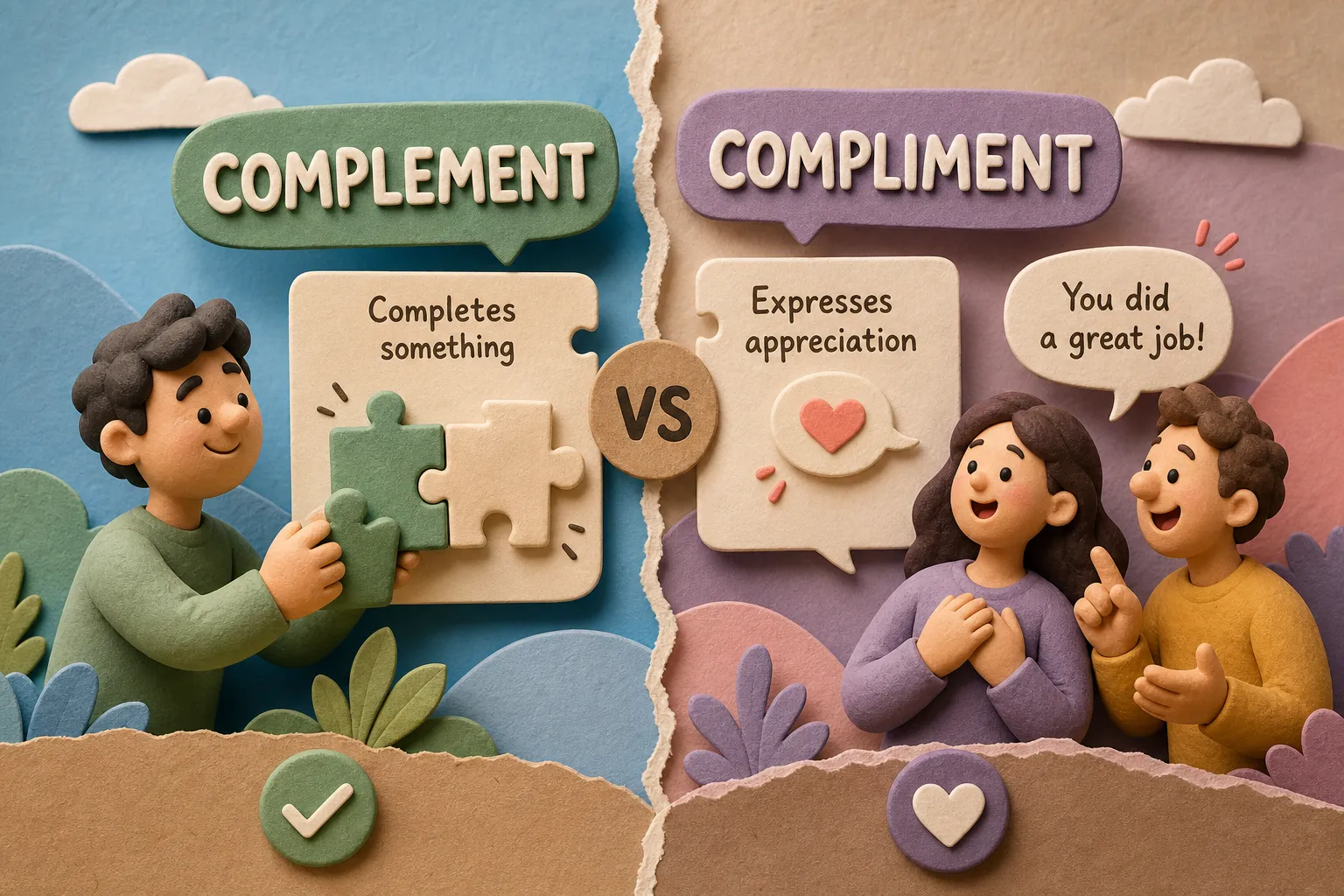
Complement vs compliment is one of the most common mix-ups in written American English, and it’s easy to see why. Both words sound identical when spoken aloud, but they mean completely different things. Use the wrong one in writing, and the sentence says something you never intended. By the end of this lesson, you’ll know exactly which word to use, and you’ll have two fast memory tricks so you never second-guess yourself again.
Here’s a contrast sentence that shows just how different these words are: “The sommelier said the wine complements the dish” versus “She paid him a compliment on his cooking.” Same sound, totally different meanings. One word is about fit and enhancement; the other is about praise. That single distinction is everything.
This complement vs compliment confusion commonly appears in written American English, in work emails, social media posts, menus, and reviews. Here’s how each word actually works in American English, so the right choice becomes automatic.
What “complement” actually means
The noun: something that completes or enhances
A complement is something that makes another thing better, fuller, or more complete by adding what it lacks. Think of it as the missing piece that makes the whole picture work. Common noun patterns include “a perfect complement,” “the ideal complement,” and “a natural complement.” (See the Merriam-Webster definition of complement.)
Real-life examples: “The scarf is a perfect complement to her coat.” / “Strawberries and cream are a classic complement to each other.” / “The quiet soundtrack was a natural complement to the film’s slow pace.” In each case, two things come together and each makes the other better.
The verb: to complete or enhance something
As a verb, to complement means to go well with something and bring out the best in it. The grammatical structure is simple: subject + complements + object, with no preposition needed. “Her calm approach complements his energy.” / “The illustrations complement the text beautifully.”
A common point of confusion for ESL learners: because both words can feel positive, learners sometimes reach for “compliment” in these sentences. In modern standard American English, complement is not used to mean praise, that sense belongs entirely to compliment. It’s about how two things fit together, not what anyone says.
What “compliment” actually means
The noun: a remark that expresses praise or admiration
A compliment is something kind or admiring that you say to or about someone. It lives in the world of spoken and written praise, not in the world of matching or fitting. “She received several compliments after her presentation.” / “That’s a real compliment coming from you.” (Compare with the Oxford Learner’s Dictionaries definition of compliment.)
Compliments are commonly given in work, school, social, and service settings across American culture, between friends, in classrooms, even with strangers at a coffee shop. Knowing this word well matters beyond grammar. It’s a real part of everyday social interaction in the U.S.
The verb: to praise someone directly
To compliment someone means to tell them something admiring or flattering. Notice the preposition pattern: you compliment someone on something. “I have to compliment you on how you handled that situation.” / “He complimented her on her cooking.” Note that “on” typically appears when you’re specifying what you’re praising, though “compliment” also works transitively without it, as in “He complimented her.” Either way, the verb always signals praise, never fit or enhancement.
One clean example puts both words side by side: “His tie complements his suit, and everyone complimented him on it.” The tie fits the suit perfectly (complement), and people praised his style (compliment). Two words, two jobs.
The one memory trick that separates these words for good
Use “complete” to remember “complement”
“Complement” and “complete” share the same Latin root, complēre, which means “to fill up.” They also share the letter e. If you want to see the historical connection, check the online etymology entry for the family of words. So the rule is direct: if the word could be swapped with “complete” or “go well with,” it’s spelled with an e. “This sauce completes the dish” and “This sauce complements the dish” carry the same essential meaning. Same “e,” same idea.
Two quick confirmation examples: “The colors complement each other” (they complete the palette together) and “Her experience complements his technical skills” (they fill in what the other lacks). Every time, the “e” in complement points you toward enhancement and completion.
Use “I like you” to remember “compliment”
Here’s a useful teaching trick: compliment has an i in it, and so does the phrase “I like you”, which is essentially what a compliment expresses. Think of it this way: “I” = admiration = compliment (with an i). That single connection is enough to lock in the spelling.
When you’re proofreading, ask yourself one fast question: “Am I talking about praise or about fit?” Praise goes with “i.” Fit and completion go with “e.” Apply that to this sentence: “She complimented (praised) his choice of wine, which perfectly complemented (matched) the entrée.” Both words in one sentence, each correct because the meaning matches the spelling.
Complementary vs complimentary: the adjective trap
Complementary: matching, completing, or balancing
Complementary is the adjective form of complement, so the “e” rule still applies. It describes things that go well together, balance each other, or bring out the best in one another. “Their personalities are complementary.” / “Yoga and strength training are complementary forms of exercise.”
In professional settings, you’ll hear this word often: “complementary skills on a team” or “complementary strategies in a business plan.” Any time two things work together because each one fills what the other lacks, complementary is the right word. For a clear, side-by-side explanation of these adjective forms, see this comparison of complementary vs complimentary.
Complimentary: free of charge, or expressing praise
Complimentary pulls double duty. It means either expressing praise or given for free, no charge included. Both meanings trace back to the “compliment” side of the family. “The hotel included complimentary breakfast.” / “The review was entirely complimentary.”
This contrast sentence makes both adjectives crystal clear: “The restaurant offered us complimentary wine, and the sommelier said it was complementary to the pasta.” The wine was free (complimentary) and it also matched the food perfectly (complementary). Quick test when you’re unsure: can you replace the word with “free” or “flattering”? Use the “i” spelling. Can you replace it with “matching” or “completing”? Use the “e” spelling.
Complement vs compliment: common mistakes and how to fix them
The most common mistake patterns to watch for
These mistakes appear regularly in writing, fluent speakers make them too:
- “The wine compliments the dish.” ✗, The wine isn’t saying anything nice to the dish. It enhances it. Fix: “The wine complements the dish.” ✓
- “She received a complement on her speech.” ✗, What she received was praise, not a matching element. Fix: “She received a compliment on her speech.” ✓
- “Their skills are complimentary.” ✗ (when meaning they balance each other), This sentence accidentally says their skills are free or flattering. Fix: “Their skills are complementary.” ✓
Each mistake happens for the same reason: the words sound identical, so the wrong spelling slips through without triggering any alarm. That’s exactly why building a habit around meaning, not just sound, is the reliable fix.
Key collocations that signal which word belongs
Collocations are fixed word partnerships that native speakers use automatically. Learning these makes the right choice much faster:
- Compliment collocations: pay a compliment, give a compliment, receive a compliment, return a compliment, accept a compliment
- Complement collocations: complement each other, a perfect complement to, complement the flavors, a natural complement
“Pay a compliment” is a fixed phrase in American English, the same way “pay attention” is fixed. You pay a compliment the way you pay attention: the word “pay” is locked in, and so is “compliment.” For more examples of collocations with “pay,” see this helpful list on collocations with “pay”.
Quick self-check: can you get these right?
Try these five fill-in-the-blank sentences
Read each sentence and choose the correct word: complement, compliment, complementary, or complimentary. Write your answer before reading below.
- The bold colors in the painting _______ each other beautifully.
- I want to _______ you on how clearly you explained that.
- Guests receive a _______ drink upon arrival.
- The two departments have _______ strengths.
- She wasn’t sure how to accept the _______ without seeming awkward.
Complement vs compliment: answer key and what your results tell you
- complement, The colors enhance each other; this is about fit, not praise.
- compliment, You’re expressing admiration directly to someone; praise uses the “i.”
- complimentary, The drink is free; “free” = complimentary with an “i.”
- complementary, The departments balance each other’s strengths; matching/completing = “e.”
- compliment, She received a kind remark; praise uses the “i.”
If you got all five, you’ve already internalized the core distinction. If one or two tripped you up, go back to the memory tricks: “e” for complete and enhance, “i” for “I like you.” These two anchors cover every case. And honestly, these words trip up experienced writers regularly. Getting them consistently right is a real mark of precision.
The bottom line on complement vs compliment
Complement is about fit, enhancement, and completion. Compliment is about praise and admiration. The spelling follows the meaning: “e” for enhance and complete, “i” for “I like you.” Apply that logic to the adjective forms too, and you’ve covered all four words at once.
Getting this right matters beyond avoiding a spelling error. Using the wrong word changes what your sentence actually says, and in professional writing especially, precision signals confidence and credibility. These are exactly the kinds of details that separate good English from truly fluent English.
English has dozens of word pairs like this one. The most effective way to get comfortable with all of them is through consistent exposure to real American English in context. Explore more lessons on commonly confused words and everyday American usage at English Words Non-Native Speakers Mispronounce Most Often, Your Daily American, read Common American Expressions Every English Learner Should Know, Your Daily American, and brush up on rhythm and pronunciation in Word Stress in American English: A Complete Guide, Your Daily American.