You’re in the middle of writing an email to your team and you stop cold. Should you write “let’s discuss this farther” or “let’s discuss this further“? Both feel almost right. Neither sounds obviously wrong. That half-second hesitation is exactly what this lesson is here to fix. Understanding the farther vs further distinction comes down to one core question: are you talking about physical distance or something figurative?
By the end of this article, you’ll understand the standard rule, see it applied in real American sentences, learn the one thing further can do that farther never can, and walk away with a memory trick that makes it all stick. You’ll handle the vast majority of situations with confidence, though as with most grammar distinctions, a few edge cases are worth knowing about too. The grammar guides at Your Daily American are built around exactly these kinds of close-but-not-identical word pairs, with lessons grounded in how American English is actually spoken and written.
The Core Rule: What Actually Separates Farther vs Further
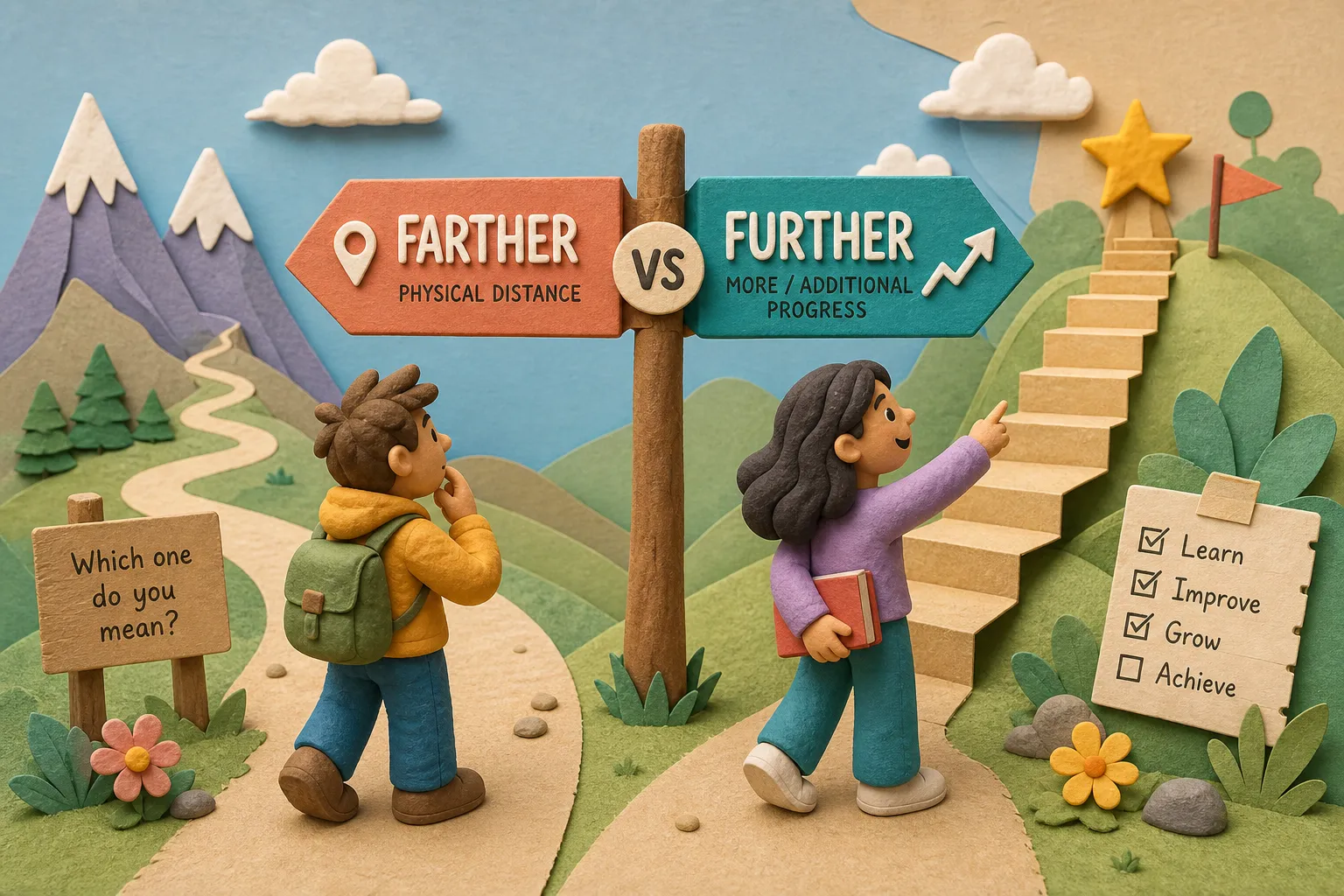
Farther is about physical, measurable distance
The traditional rule is straightforward: use farther when the distance is real and measurable, something you could put on a map, describe in miles, or walk with your feet. The test is simple: can you theoretically measure it? If yes, farther is your word.
- “The new office is farther from the subway than I expected.”
- “She ran farther than anyone else on the team.”
- “How much farther is the airport?”
In each sentence, the distance is real. You could time it, drive it, or measure it in feet. That physical, concrete quality is the signal to reach for farther.
Further is about degree, extent, and everything figurative
Further covers everything that isn’t physical distance: continuing a conversation, going deeper into a topic, adding more information, or extending something in time or concept. A reliable quick test: if you can replace the word with “more,” “additional,” or “to a greater degree,” you’re in further territory. (For comparisons and teaching resources that expand on this test, see a clear overview from Scribbr’s further vs. farther guide.)
- “We need to discuss this further before making a decision.”
- “The investigation went further than anyone anticipated.”
- “Do you have any further questions before we wrap up?”
None of those distances can be measured on a map. They’re about ideas, conversations, and the extent of something, which is precisely where further belongs.
Farther in Real American Life
When farther comes up in everyday conversation
You’ll hear farther most often when Americans talk about commutes, driving directions, hikes, and physical comparisons between places. Here are a few natural scenarios where it fits perfectly.
A coworker in the parking lot: “The parking is farther than I thought. We should’ve left earlier.”
A couple on a road trip: “Is the grocery store farther or closer than the pharmacy?”
Two friends after a hike: “How far did you go?” “We ended up going farther than planned, maybe six miles total.”
In every case, you’re describing something walkable, drivable, or measurable in real-world units. That physical quality is your green light for farther.
The comparison structure with farther
One of the most common patterns in American English is “farther than,” and it’s worth practicing specifically because it comes up so naturally in daily speech. You’ll also want to get comfortable with collocations like “a little farther,” “much farther,” and “farther away,” since native speakers use these constantly.
“Keep driving, it’s a little farther.” “The trailhead is much farther than the sign suggests.” These sound natural because farther is doing exactly what it’s built for: measuring real space.
Further in Everyday and Professional American English
Further in meetings, emails, and workplace conversations
Further is all over American professional English, and learning to use it naturally is one of the quickest ways to sound polished at work. These sentences will feel familiar if you spend any time in American workplace settings.
- “Let’s table this and discuss it further at Thursday’s meeting.”
- “Please don’t hesitate to reach out if you need further information.”
- “We need to look further into the numbers before we commit.”
- “I’ll follow up once I’ve reviewed this further.”
In each case, further signals continuation or additional depth. Nothing here is physically measurable, but every sentence is completely natural in a professional American context. If you’ve ever wondered why American colleagues and managers use further so often in meetings, this is why: it’s the go-to word for extending conversations and adding next steps. For related workplace language, see our article on Common American Expressions Every English Learner Should Know, Your Daily American.
Further as “additional” before a noun
There’s a specific adjectival use of further that trips up many learners, and it’s critical for formal writing. When further means “additional” and comes directly before a noun, farther can never replace it. There’s no workaround here.
- “The project is on hold pending further review.”
- “Until further notice, the Thursday meeting is canceled.”
- “We received no further complaints after the update.”
Phrases like “further notice,” “further details,” and “further review” are fixed expressions in American professional English. Swapping in farther would sound unnatural to any native speaker. If you see the word sitting directly before a noun and meaning “more” or “additional,” further is the only correct choice.
The One Thing Further Can Do That Farther Can’t
Further as a verb, advancing and promoting
Here’s the piece most grammar lessons skip: further works as a verb, meaning “to help something advance or develop.” Farther has no verb form at all. This isn’t a gray area or a stylistic preference; it’s a firm rule in American English. (See a practical, user-friendly explanation from Microsoft’s writing guide.)
- “She took on extra projects to further her career.”
- “The new funding will further our research significantly.”
- “He did everything he could to further the team’s goals.”
- “Her contributions furthered the movement toward equal protection.”
In each sentence, further is an action word, it means to push something forward, to help it grow or develop. You’ll hear this verb form regularly in American professional settings: performance reviews, strategy discussions, career conversations. Recognizing it as a verb, not just an adverb or adjective, gives you a much more complete picture of how the word actually works.
Why this matters for your professional English
The verb use of further is particularly common in American workplace English because so much professional conversation is about advancing projects, developing skills, and promoting goals. Sentences like “this initiative will further our mission” and “I want to further my skills in data analysis” are completely standard. Knowing that farther can never fill this role means you won’t hesitate when you need to write or say these sentences yourself.
The Trick That Makes the Farther vs Further Rule Stick
The mnemonic: FAR lives inside farther
Here’s the memory anchor: farther contains the word FAR. If the distance is real and you could theoretically measure it, far down the road, far from here, farther than expected, reach for farther. If you’re talking about ideas, additional information, or continuing something, reach for further.
Test the contrast: “The meeting room is farther down the hall.” You can walk that distance. It’s measurable. Farther is right. “Let’s take this further in our next call.” There’s no physical distance here. Further is right. That single anchor covers the vast majority of situations you’ll encounter in daily American life and work. For a concise, popular explanation with historical notes, see this piece from Mental Floss.
The gray area: when overlap is actually fine
To be fully accurate, Merriam-Webster notes that further and farther have historically been used interchangeably for distance, and using further for physical distance in informal speech isn’t a hard error. In casual conversation, most native speakers won’t notice or correct it. For formal writing and professional American English, though, following the traditional distinction keeps your writing clean and precise. Both AP Stylebook and the Chicago Manual of Style recommend it, farther for measurable distance, further for everything else. If you want a detailed style-by-style discussion, the AMA Style Insider article on farther vs. further is a helpful complement to those manuals.
Try It Yourself Before You Go
Practice sentences: farther or further?
Read each sentence below and decide which word belongs in the blank. Then say the completed sentence aloud. Training your ear is just as important as knowing the rule on paper.
- “The gym is _______ from my apartment than I realized.” (physical distance: commute/travel)
- “We’ll need to discuss the budget _______ before we approve anything.” (workplace meeting language)
- “The launch is delayed until _______ notice.” (further as “additional” before a noun)
- “Taking this certification will _______ her chances of a promotion.” (verb use)
- “Do you need any _______ clarification on the proposal?” (professional email language)
- “They drove _______ into the mountains than they planned.” (measurable, physical distance)
Answers: 1. farther, 2. further, 3. further, 4. further, 5. further, 6. farther. If you got all six right, the rule is already working. If one or two tripped you up, go back to the section that covers that use case and re-read the examples before moving on.
Where to keep building your grammar instincts
Tricky word pairs like farther/further, affect/effect, and since/for come up constantly in American English, and getting them right is what separates competent English from genuinely fluent English. Many native speakers pick up on these details even without pointing them out directly. The grammar section at Your Daily American is built around exactly these real-use distinctions: lessons grounded in how the language is actually spoken and written in American daily life and the workplace, not abstract rules pulled from a textbook. For continuing practice, visit our Daily Grammar, Your Daily American and our list of Essential Phrasal Verbs You Must Know, Your Daily American.
Wrap-Up
The farther vs further distinction comes down to this: farther is for physical, measurable distance, and further covers figurative meaning, degree, additional information, and verb use. As a rule of thumb, remember that FAR lives inside farther, if you can measure it, farther is likely your word; if you can’t, reach for further. The overlap in casual speech is real, but sticking to the traditional distinction will keep your formal and professional writing precise.
Practice both words in the context of real sentences you actually use, at work, in conversation, in writing. The distinction will become automatic faster than you think. These are the grammar details that quietly signal fluency to native speakers, and now you have the rule, the examples, and the memory trick to make them yours. For an additional, user-friendly comparison and tips for learners, see this quick guide from Mental Floss and the practical notes on usage from Microsoft’s writing advice.