You are writing a professional email to a colleague. You type the word “but,” and then you stop. Should there be a comma before it? Most learners pause here, and the question comes up constantly: comma before but, do I need one or not? At Your Daily American, it is one of the punctuation questions we get most often from people writing emails and reports in professional settings.
The good news: there is one core rule that covers most situations. Once you learn it, you will know when to add the comma, when to leave it out, and why. This article also covers two exceptions and ends with a short practice check so you can test yourself right away. By the end, you will know exactly when to put a comma before “but” and when to skip it.
The main rule: comma before “but” when both sides are complete sentences
What an “independent clause” actually means
An independent clause is a group of words with its own subject and verb that makes a complete thought on its own. It can stand alone as a sentence. For example, “I finished the report” is a complete thought. But “but couldn’t send it” is not complete because there is no subject. Who couldn’t send it? The reader has no way to know. For a related look at clause types and comma rules, see Adverbial Clauses: Types, Examples, and Comma Rules.
How to apply the test before you type that comma
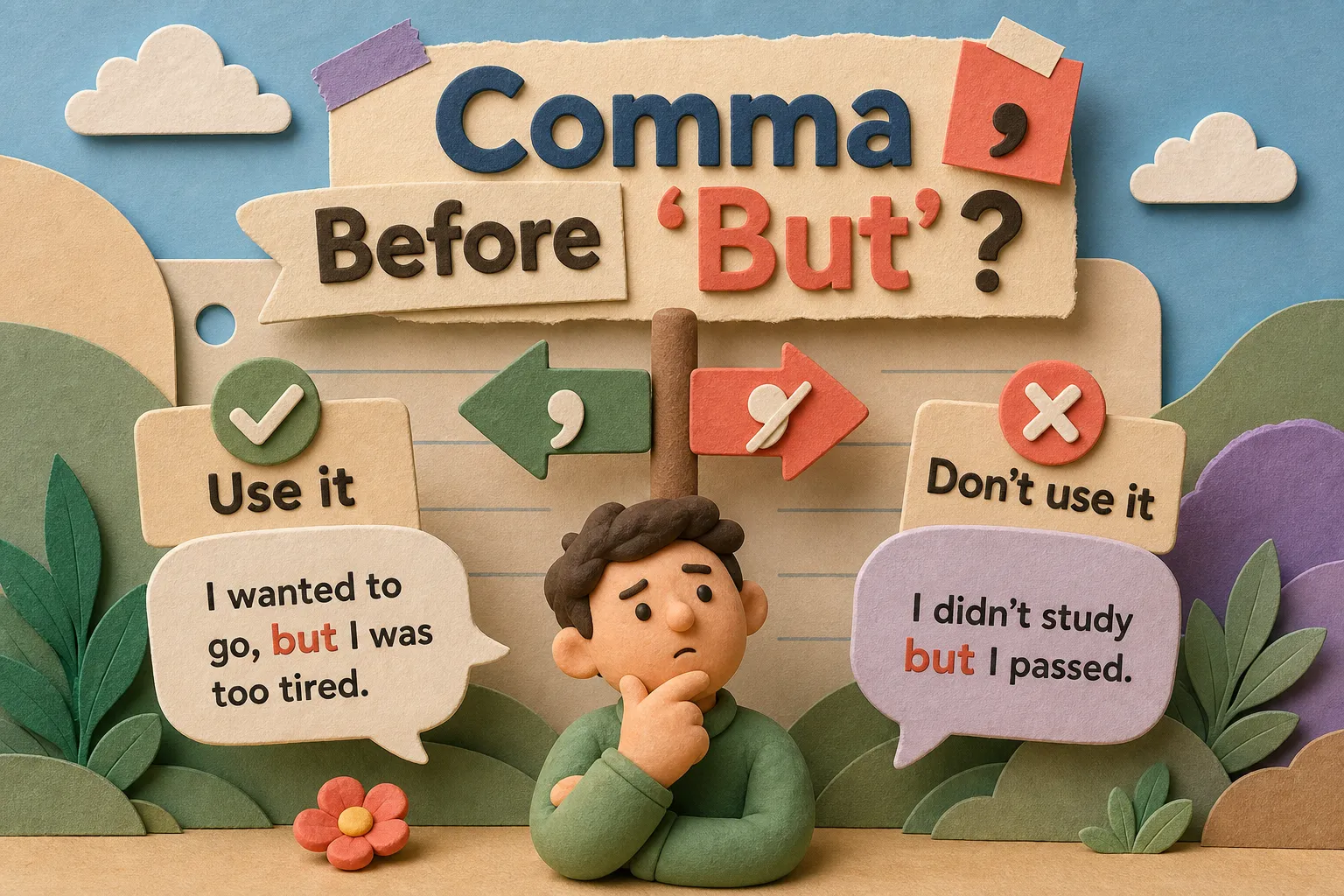
Use this two-part test: Can the first part stand alone as a sentence? Can the second part stand alone as a sentence? If both answers are yes, put a comma before “but.”
Look at these two examples:
- “I reviewed your proposal, but I have a few questions before we move forward.”, Both sides are complete sentences. Comma in.
- “I reviewed your proposal but found a few issues.”, The second part has no subject. No comma needed.
The first sentence has two full, complete thoughts joined by “but.” The second sentence has one subject (“I”) doing two things. That is a different structure, and it does not need a comma.
Quick guide: comma before but according to major style guides
Chicago Manual of Style Rule 6.22 states that a comma usually comes before a coordinating conjunction (like “but”) when it joins two independent clauses. The AP Stylebook follows the same rule. MLA does too. You do not need to guess which guide to follow. They all agree: two complete sentences joined by “but” need a comma before it.
When you can skip the comma before “but”
The compound predicate: one subject, two actions
A compound predicate is when one subject performs two actions in the same sentence. The second part is not a complete sentence on its own because it has no subject. In this case, you do not use a comma before “but”, as in: “She reviewed the report but didn’t send any feedback.”
The second part, “didn’t send any feedback,” has no subject. It is not a complete sentence, so there is no comma. Now compare that with this version: “She reviewed the report, but she didn’t send any feedback.” Here, the second part has its own subject (“she”), making it a complete sentence, and the comma is required. For more on similar sentence structures, see Compound Sentences Made Simple: Rules and 25+ Examples.
A fast subject-check you can do in 10 seconds
Cover the word “but” and everything before it. Read only the second half of the sentence. Does it have its own subject? If not, skip the comma. This is not a style choice. It is a grammar rule based on sentence structure.
Here are two pairs to compare:
- “I sent the email but forgot to attach the file.”, No subject in the second part. No comma.
- “I sent the email, but I forgot to attach the file.”, The second part has its own subject (“I”). Comma in.
Two exceptions that trip up even careful writers
Short clauses: when the comma is optional
When both independent clauses are very short and the meaning is clear, the comma before “but” is optional. The Adverbial Clauses: Types, Examples, and Comma Rules article shows how clause length affects punctuation, and some style guides note that short, closely connected clauses may read well without a pause. The UCLA handout on comma usage also covers situations where writers can omit the comma for short clauses; see the Rules for Using Commas for more examples.
For example, consider: “I tried but it didn’t work.” (no comma version). Both sides are technically complete sentences, but the clauses are very short. You can also write it as “I tried, but it didn’t work.” Both are acceptable.
In professional writing, adding the comma is always the safer, more formal choice. When you are not sure, use the comma.
Comma after “but”: the interrupter rule
An interrupter (also called a parenthetical phrase) is a word or phrase that adds tone or emphasis but can be removed without changing the sentence’s main meaning. When an interrupter comes right after “but,” you place a comma after “but” as well.
Example from a workplace email: “I wanted to approve the timeline, but, to be honest, I need another day to review the numbers.”
The phrase “to be honest” is the interrupter. Remove it and the sentence still works: “I wanted to approve the timeline, but I need another day to review the numbers.” The commas around the interrupter are separate from the comma before “but.” Both follow their own rules, and both are correct in that sentence. For more on comma placement around parenthetical phrases, see this comma guidance.
How this rule plays out in professional emails and reports
Email examples: comma in vs. comma out (side by side)
These are the types of sentences that appear in real workplace communication every week. Read each one and notice what changes.
- Comma in (two independent clauses): “I appreciate your feedback, but I’d like to revisit the budget section.”, Both sides are complete. Comma required.
- No comma (compound predicate): “I read your email but noticed a few errors.”, Second part has no subject. No comma.
- Comma after “but” (interrupter): “We are ready to proceed, but, as discussed, we need your sign-off first.”, “As discussed” is the interrupter. Commas before and after it.
Report writing: formal register and the safer choice
In a formal report, always use the comma when “but” joins two independent clauses. There is no gray area in formal writing. The comma signals that your sentence is well-constructed and that you understand the structure of what you wrote.
Skipping the comma in a formal document can make the writing feel rushed to a native-speaking reader. It is a small detail, but small details add up to an overall impression of care and precision.
If you want to keep building this kind of writing accuracy, the Professional English section at Your Daily American covers email and report writing in depth. It is a practical resource built specifically for learners who use English at work, with grammar guidance designed to help you communicate clearly in real workplace situations.
Quick self-check: practice before you go
Three sentences to test yourself
Read each sentence below. Decide whether a comma is needed before “but,” after “but,” or not at all. Then check your answers.
- She prepared the presentation but ran out of time to add the final slide.
- The client liked the proposal but she asked for a lower price.
- I agreed to the meeting but frankly I needed more time to prepare.
Answers with one-line explanations
Sentence 1: “She prepared the presentation but ran out of time to add the final slide.”, No comma. The second part (“ran out of time to add the final slide”) has no subject. This is a compound predicate.
Sentence 2: “The client liked the proposal, but she asked for a lower price.”, Comma before “but.” Both parts are complete sentences. The second part has its own subject (“she”).
Sentence 3: “I agreed to the meeting, but, frankly, I needed more time to prepare.”, Comma before “but” (two independent clauses) and commas around “frankly” because it is an interrupter.
If you got all three right, you are already writing at a level that impresses native-speaking colleagues. For more lessons like this one, visit the grammar section at Your Daily American and explore the Professional English resources built for learners who want to write with real confidence at work. You might also find the short guide Which or That? Mastering This Common Grammar Mistake useful as you refine other punctuation and clause choices.
What to remember going forward
The punctuation rule for but is straightforward: put a comma before “but” when both sides of the sentence are complete, independent sentences. Skip the comma when the second part shares the same subject and cannot stand alone. Those two situations cover the vast majority of sentences you will write.
The two exceptions are worth keeping in mind. Very short clauses with “but” between them can work without a comma, though adding one is always safe in professional writing. And when an interrupter follows “but,” place a comma after “but” to set the interrupter off correctly.
Grammar accuracy in writing is not about passing a test. It is a quiet signal to your reader that you know what you are doing. Every sentence you write with correct punctuation makes your meaning clearer and your writing more professional, and comma usage with conjunctions like “but” is one of the details that separates careful writers from careless ones. That is a skill worth building. For a practical overview of comma situations and common mistakes, see this comma-before-but guide and this general comma resource for extra examples and exercises.