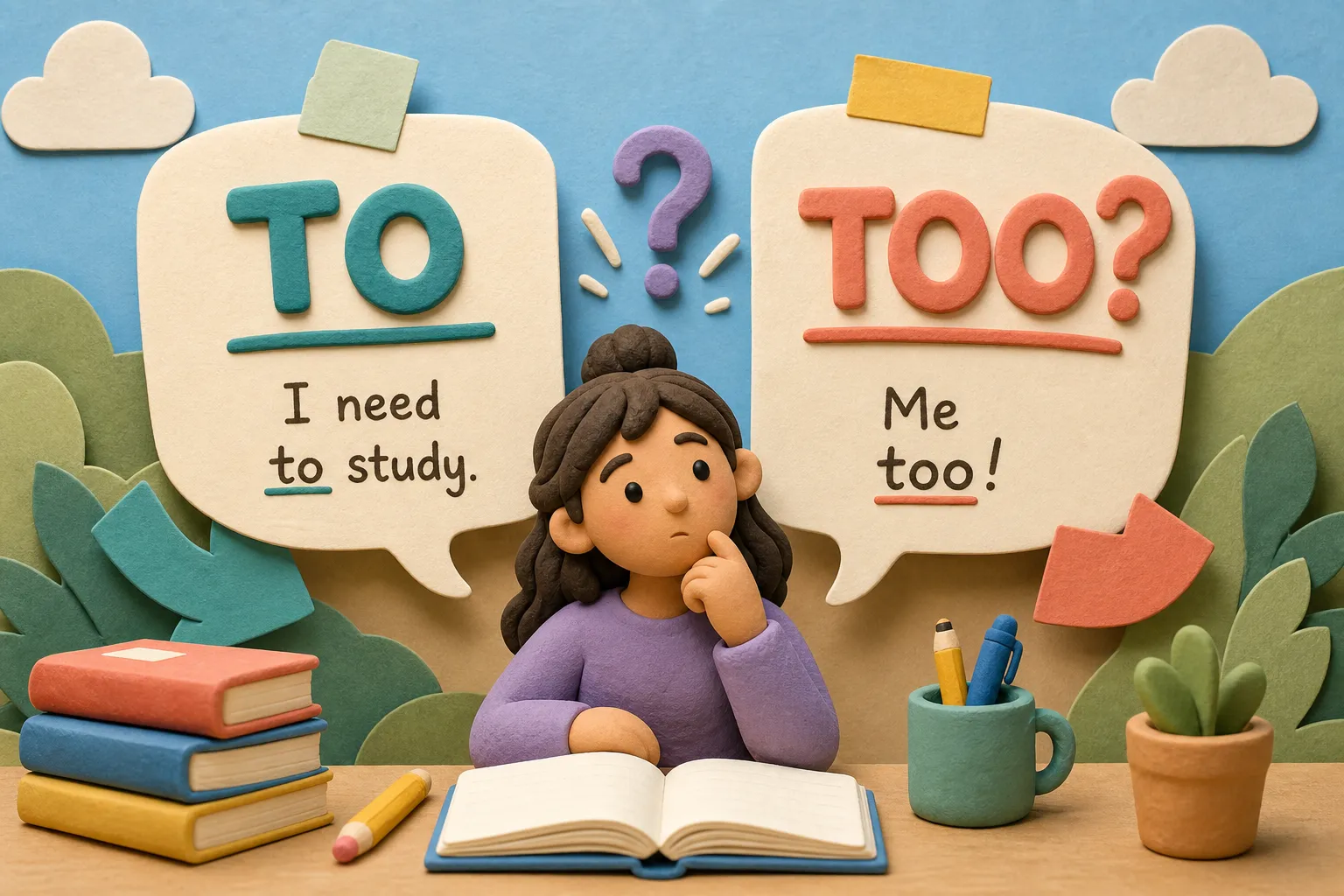
Mixing up “to” and “too” is one of the most common writing mistakes professional English learners make, and one of the easiest to fix once you know the rules. This quick guide to to vs too (and their sound-alike “two”) gives you clear definitions, real email examples, and three practical checks you can use while editing any message. By the end, you will know exactly which word to reach for and why.
At Your Daily American, the difference between “to” and “too” is one of the most frequent questions we hear from learners working on professional writing. That makes sense: it is a small detail, but getting it right makes your emails look noticeably more careful and polished.
What “to” does in a sentence
“To” is a very common English word with more than one job, which is why it shows up so often. The key is recognizing which job it is doing in each sentence.
When “to” shows direction or movement
“To” works as a preposition, a word that shows a relationship between things, when it points toward a place, person, or thing. Think of it as a small arrow showing where something is going.
- She walked to the office.
- Send the report to your manager.
- I’m heading to the meeting room.
When “to” introduces a verb
“To” also comes directly before a verb in its base form. This structure is called the infinitive (the “to + verb” form). You use it when you talk about what you want, need, or plan to do.
- I need to finish this report.
- She wants to improve her writing.
- We plan to schedule a call.
When “to” shows who receives something
“To” also tells you who gets something. If an action is directed at a person, “to” connects the action to that person. For example: “Please forward this to the team.” The team is receiving the forwarded message.
What “too” means and its two core uses
Grammar sources describe “too” as having two core functions, though usage can vary in phrasing and emphasis. Before you write “too,” ask yourself one question: does this mean also or more than enough? If the answer is yes to either one, you need “too.” If the answer is no to both, you need “to.”
For a concise explainer you can review later, see Babbel’s guide to “to” vs “too”.
“Too” meaning “also” or “as well”
When “too” means “also,” it adds something extra to the sentence. It often appears at the end of a sentence or clause, signaling that this person or thing is included in what was just mentioned.
- I want some coffee, too. (I also want coffee.)
- She is coming to the meeting, too. (She is also coming.)
- I would like to join the call, too. (I also want to join.)
“Too” meaning “excessively” or “more than needed”
When “too” means “more than needed,” it goes in front of an adjective or an adverb. This use of “too” signals a problem or an unwanted result. Notice the difference from “very”: “very” is neutral, but “too” means there is an issue.
- The email was too long. (It was longer than it should be.)
- He spoke too quickly in the presentation. (He spoke faster than was ideal.)
- The deadline is too soon. (There is not enough time.)
The third word that sounds the same: “two”
“To,” “too,” and “two” are homophones, words that sound exactly the same but have different spellings and meanings. Because all three words sound identical when spoken, the mix-up only ever happens in writing.
Why “two” is actually the easiest of the three
“Two” has only one job: it is the number 2. If your sentence is about a quantity or a number, use “two.”
- I have two meetings today.
- She sent two emails before noon.
Here is a simple rule: if your sentence is not about the number 2, remove “two” from your options entirely. Then choose between “to” and “too.” That cuts the problem in half right away. For more on using numbers correctly, see Numbers in English: The Complete Practical Guide.
To vs Too, Three Quick Tricks for Choosing the Right Word
These tricks are straightforward to apply while editing, and each one builds on what you already know about the two words. Use whichever feels most natural for the sentence in front of you.
The extra O trick
“Too” has two O’s. Think of those extra O’s as standing for “extra” or “more.” This connects directly to both meanings: “also” adds something extra, and “excessively” means more than you need. When you spot “too” in a sentence, those two O’s are a visual cue that something extra is happening. Many learners find this trick especially useful during a quick read-through, when there is no time to stop and analyze grammar.
For a clear comparison of the three homophones, see Dictionary.com’s article on “too vs to vs two”.
The substitution test
Replace the word in question with “also” or “as well.” Read the sentence out loud. If it still makes sense, use “too.” For example: “She is coming, also” still works, so the correct word is “She is coming, too.” If the replacement sounds wrong, as in “I need also finish this”, then “too” is not the right choice. Use “to” instead. This is a quick check that many ESL teachers recommend, though it works best for the “also” meaning of “too” rather than the excessive one.
This substitution approach is discussed in standard grammar references; see the Cambridge Grammar explanation of substitution for more examples and practice.
The direction and action check
Ask yourself two quick questions. First: can you replace the word with “toward”? Second: does a verb in its base form come right after the word? If the answer is yes to either question, choose “to.” For example: “She walked to the office” can become “She walked toward the office,” which confirms “to” is correct. Or: “I need to finish” has a verb right after it, so “to” is correct there as well.
To vs Too in Professional Emails, Where the Mistakes Show Up
These errors can be more noticeable in high-stakes or client-facing emails, where colleagues and managers are reading closely. A small mistake in that context can make a skilled professional appear careless. Among English learners working on professional writing, this is one of the most commonly reported error types. Fixing it is one of the fastest ways to improve how your writing reads at work.
Common email mistakes and how they look
Here are three examples of the error paired with the corrected version.
- Wrong: “I wanted to reach out to let you know I agree to.”
Right: “I wanted to reach out to let you know I agree, too.” - Wrong: “Please send this too John before Friday.”
Right: “Please send this to John before Friday.” - Wrong: “The deadline is two soon.”
Right: “The deadline is too soon.”
Each error has a different cause. The first drops “too” from the end of a sentence. The second uses “too” where a direction word is needed. The third reaches for the number word instead of the adverb. All three appear frequently in professional writing, even among experienced writers.
A simple habit for editing your emails
Before you send any professional email, do a quick search for every “to,” “too,” and “two” in the message. Apply the substitution test or the direction-and-action check to any instance that looks uncertain. Working through a short email this way takes very little time and helps you catch the most common errors before your message goes out.
If you want extra practice and exercises you can work through, try Preply’s to vs too guide for additional examples and practice items aimed at learners.
Quick practice: test yourself before you go
This short self-check will help you see if the rules have clicked. Read each sentence and choose the correct word: “to,” “too,” or “two.” Then check your answers below.
Five sentences to complete
- I need ___ send this document by 5 p.m.
- The presentation was ___ long for a 30-minute slot.
- She replied to the email, and her manager did ___ .
- We have ___ options for the project timeline.
- Please forward this report ___ the whole team.
Answer key and quick explanation
- to, it comes before the verb “send.” This is the infinitive use.
- too, it modifies the adjective “long” and signals excess.
- too, it means “also.” You can replace it with “as well” and the sentence still works.
- two, the sentence is about a number or quantity.
- to, it shows who receives the report. This is the direction or recipient use.
If you got all five right, you are ready to apply these rules in your own writing. If one or two felt uncertain, re-read the section on that word and try the substitution test again. The more you practice, the faster the choice becomes automatic.
Keep building your professional English, one detail at a time
“To” shows direction or action. “Too” means “also” or “more than needed.” “Two” is always the number 2. Those three rules cover the most common cases you will encounter in daily writing. When you are not sure, use the substitution test or look for the extra O in “too”, both checks work quickly and require no grammar knowledge beyond what you already have.
Small details like this add up over time. Getting the to vs too distinction right will not transform your English overnight, but it is part of building the kind of careful, clear writing that earns trust at work. Every error you catch is one less distraction pulling your reader’s attention away from your actual message. For more practice with professional writing, grammar, and the everyday English you need in real workplace situations, explore the full lesson library at Your Daily American. The professional English track is a natural next step from here, start with Professional English for the Modern Workplace. Also consider simpler word choices to improve clarity: Learn Simplified Words That Work Better.