You are writing an email or an essay. You want to say that your friend moved from Mexico to Canada to start a new life. You type the first few words and then stop. Should you write that she emigrated or immigrated? Both words look similar. Both involve moving to another country. And they both sound almost the same when you say them out loud. This is one of the most common points of confusion in American English, and understanding the emigrate vs immigrate difference will make you a more confident writer immediately.
At Your Daily American, lessons focus on exactly these moments of doubt, the words that look nearly identical but mean different things. By the end of this lesson, you will know which verb to use, which preposition pairs with each one, and how to write a correct sentence without hesitating.
Emigrate vs Immigrate: The One Rule You Need
Both verbs describe moving from one country to another. But each word looks at a different part of that move. One focuses on the country you left. The other focuses on the country you arrived in. That is the whole difference.
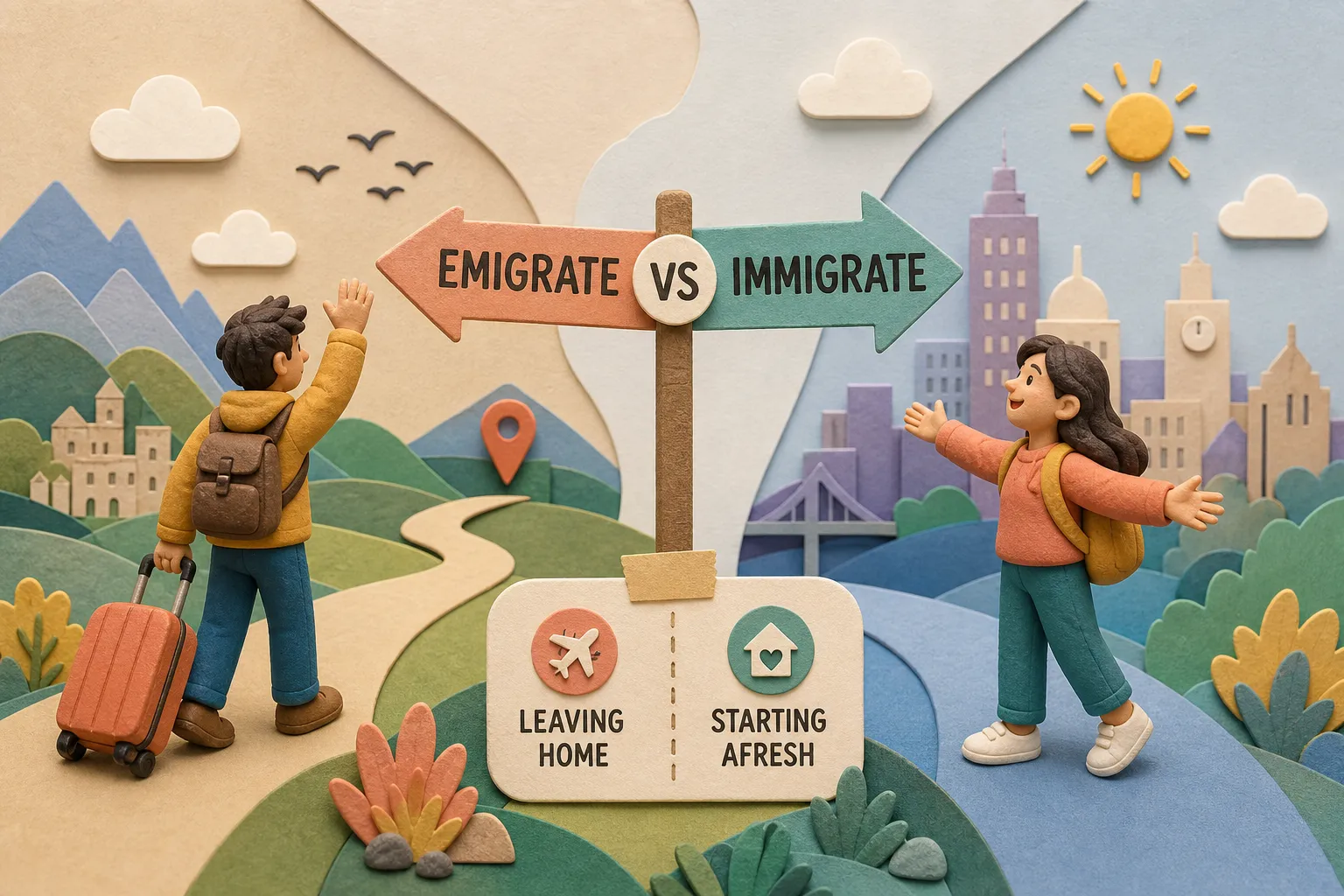
Emigrate means to leave
Emigrate describes the act of leaving your home country to live somewhere else. The focus is on the place you are departing from. Simple definition: emigrate = leave a country to settle in another place.
Immigrate means to arrive
Immigrate describes the act of entering a new country to live there. The focus is on the place you are arriving in. Simple definition: immigrate = enter and settle in a new country.
The letter trick that makes it easy
This is the one rule you need to remember. The E in emigrate comes from the Latin prefix ex-, which means “out.” The I in immigrate comes from the Latin prefix in-, which means “into.” So: E = Exit, I = In. Every time you feel unsure, check the first letter of the verb and ask yourself: am I talking about exiting or entering?
Emigrate vs Immigrate: Prepositions and Patterns
Once you know which verb to use, the preposition follows naturally. You do not need to memorize this separately. The logic of the word tells you which preposition to use.
Emigrate goes with “from”
Because emigrate focuses on leaving, it pairs with from . You leave from a place. The pattern is: emigrate + from + country of origin.
Example: She emigrated from South Korea.
Immigrate goes with “to”
Because immigrate focuses on arriving, it pairs with to. You arrive in a new place. The pattern is: immigrate + to + destination country.
Example: She immigrated to the United States.
One person, two correct sentences
Both sentences below describe the exact same move. One person, one journey, and two correct sentences, each looking at the move from a different perspective.
- He emigrated from Brazil in 2019. (Focus: leaving Brazil)
- He immigrated to the United States in 2019. (Focus: arriving in the US)
Neither sentence is wrong. They show the same event from two different angles. Think of it like a photo: one picture of the person waving goodbye at the airport in Brazil, and one of the person stepping off the plane in New York. Same trip, different moment.
Real Example Sentences That Make It Click
Reading one example is a start. Seeing a pattern across many sentences is what makes it natural. Below, you will find a variety of sentences using different countries, tenses, and structures.
Emigrate in real sentences
- My grandmother emigrated from Italy in 1965. (past tense, formal context)
- Did your family emigrate from Poland before the war? (question form)
- Thousands of people emigrate from Venezuela every year to find better opportunities. (present tense, general pattern)
- He did not emigrate from Germany by choice; the economic situation was very difficult. (negative form)
Immigrate in real sentences
- Her parents immigrated to Canada in the 1990s. (past tense, casual context)
- Why did your family decide to immigrate to the United States? (question form)
- Many professionals immigrate to Germany for career opportunities in engineering. (present tense, general pattern)
- They have not yet immigrated to Australia; they are still waiting for their visa approval. (present perfect negative)
The perspective switch: same story, different word
A family is leaving Vietnam and moving to Canada. Here are three ways to describe that same move, each using a different verb. Notice how the meaning and focus shift slightly with each one.
- The family emigrated from Vietnam in 2015. (Focus: leaving Vietnam)
- The family immigrated to Canada in 2015. (Focus: arriving in Canada)
- The family migrated to Canada in 2015. (General movement, no strong focus on leaving or arriving)
You will learn more about migrate in the next section. For now, notice that it works in that sentence but gives you less specific information.
How Migrate, Emigration, and Immigration Fit In
You will often see the words migrate , emigration , and immigration in news articles, books, and conversations. These are closely related to the two verbs you just learned. Here is how they connect.
Migrate: the broad, general word
Migrate means to move from one place to another. It does not tell you whether someone is leaving or arriving, making it the least specific of the three verbs. Use it when the direction of movement does not matter, or when you are talking about movement in general, including animals or people moving within a country. For example: Many people migrate to cities for work. Or, in a natural context: Whales migrate thousands of miles every year.
Use migrate when you want to describe general movement. Use emigrate or immigrate when you want to be specific about whether someone is leaving or entering a country.
Emigration and immigration: the noun forms
Emigration is the noun form of emigrate . Immigration is the noun form of immigrate . The same logic applies to both nouns: emigration describes people leaving a country, and immigration describes people entering one.
- Emigration from rural areas has increased in recent years. (people leaving)
- The government announced new immigration rules last month. (people arriving)
You will see immigration far more often than emigration in US news and government documents. That is because US policy and media tend to focus on people entering the country rather than people leaving it, see the US government immigration overview for more on how immigration appears in official records and history.
Common Mistakes and How to Fix Them
Most errors with these two words fall into one of two categories: using the wrong preposition, or mixing up the verbs entirely. Both are easy to fix once you know what to look for.
The wrong preposition: the most common error
Many learners write emigrated to or immigrated from. This happens because both words look and sound so similar that the prepositions get tangled up too. Here are the errors and their corrections:
- ❌ She emigrated to Germany.
- ✓ She emigrated from Germany. (She left Germany.)
- ❌ He immigrated from the US.
- ✓ He immigrated to the US. (He arrived in the US.)
The fix is straightforward: if you use emigrate , the next word is almost always from . If you use immigrate , the next word is almost always to.
Mixing up the verbs: how to catch yourself
Before you write, ask yourself one question: “Am I focusing on the country being left, or the country being entered?” If the focus is leaving, use emigrate from. If the focus is arriving, use immigrate to. You can also fall back on the first-letter trick: E = Exit (leaving), I = In (entering).
If you are not sure which perspective the sentence needs, migrate is always a safe general choice. It will not be wrong, even if it is less specific.
A short practice to lock it in
Try these three sentences. Choose the correct word and preposition for each blank. The answers follow immediately.
1. My uncle ________ Japan to start a new career. ✓ emigrated from Japan. (He left Japan. Focus: leaving.)
2. Her family ________ the United States in 1987. ✓ immigrated to the United States. (They arrived in the US. Focus: entering.)
3. Many workers ________ the capital city every year looking for jobs. ✓ migrate to the capital city. (General movement inside one country, no specific “leaving” or “entering” a different country.)
Frequently Asked Questions
When do you use emigrate vs immigrate?
Use emigrate when you are describing someone leaving their home country, always paired with from . Use immigrate when you are describing someone entering a new country to live there, always paired with to. If you are unsure, check the first letter: E = Exit, I = In.
Can the same person emigrate and immigrate?
Yes. The same move can be described both ways. Someone who left Brazil and settled in Canada emigrated from Brazil and immigrated to Canada. Both sentences are correct, they simply describe the same journey from two different angles.
Is migrate the same as emigrate or immigrate?
Not exactly. Migrate is a broader, less specific word. It covers general movement between places and is also used for animals. When you want to be precise about whether someone is leaving a country or entering one, choose emigrate or immigrate instead. For more on commonly confused words like this, see this helpful guide to emigrate vs immigrate.
You Now Have the Full Picture
The emigrate vs immigrate distinction comes down to perspective. Emigrate means leaving a country and goes with from . Immigrate means entering a country and goes with to. Migrate is the general word for movement, with no specific directional focus. When you feel unsure, check the first letter: E = Exit, I = In.
Even advanced English users sometimes mix up this pair, so understanding the rule puts you ahead of many writers. The best way to make it stick is to use it right now: if you have ever moved countries, write one sentence with emigrated from and one with immigrated to . If you have not, write about someone you know who has.
Small vocabulary wins like this one build real confidence over time. If you want more lessons on commonly confused words, American vocabulary, and the English you need for daily life and work in the US, there is a lot more waiting for you at About, Your Daily American. For related lessons on specific confusions and pronunciation, see Every Day or Everyday? A Simple Grammar Guide and English Words Non-Native Speakers Mispronounce Most Often, Your Daily American.
Small steps like this make a noticeable difference. Each lesson is designed to give you something you can use right away.