Here is a sentence many learners write: Because I was late. It looks right. It has a subject and a verb. But it is not a complete sentence, and that one small mistake can make your writing feel unfinished to a native speaker. At Your Daily American’s grammar section, this is the most common adverb clause error we see, and it is easier to fix than you think. Linguists and grammar educators use “adverb clause” and “clause adverb” interchangeably to describe the same structure: a dependent clause that functions like an adverb in a sentence.
By the end of this lesson, you will know how to identify an adverb clause, name the conjunctions that introduce one, classify the most common types, apply the right comma rule, and shorten a clause into a phrase when it makes your writing cleaner. One core idea connects all of this: understanding what makes a clause a clause, not just a phrase.
What an adverb clause actually is
An adverb clause (also called an adverbial clause or clause adverb) is a group of words with its own subject and verb that works like an adverb. It modifies, or describes, the main verb, an adjective, or another adverb in the sentence. Compare these two examples:
- Phrase: He left early in the morning.
- Clause: He left before the sun came up.
The first example has no subject-verb pair inside the modifying part. The second one does: the sun came up. That subject-verb pair is what makes it a clause. An adverb clause is also a dependent clause, a clause that cannot stand alone as a complete sentence. The word “dependent” is key. The clause needs the main clause to make complete sense.
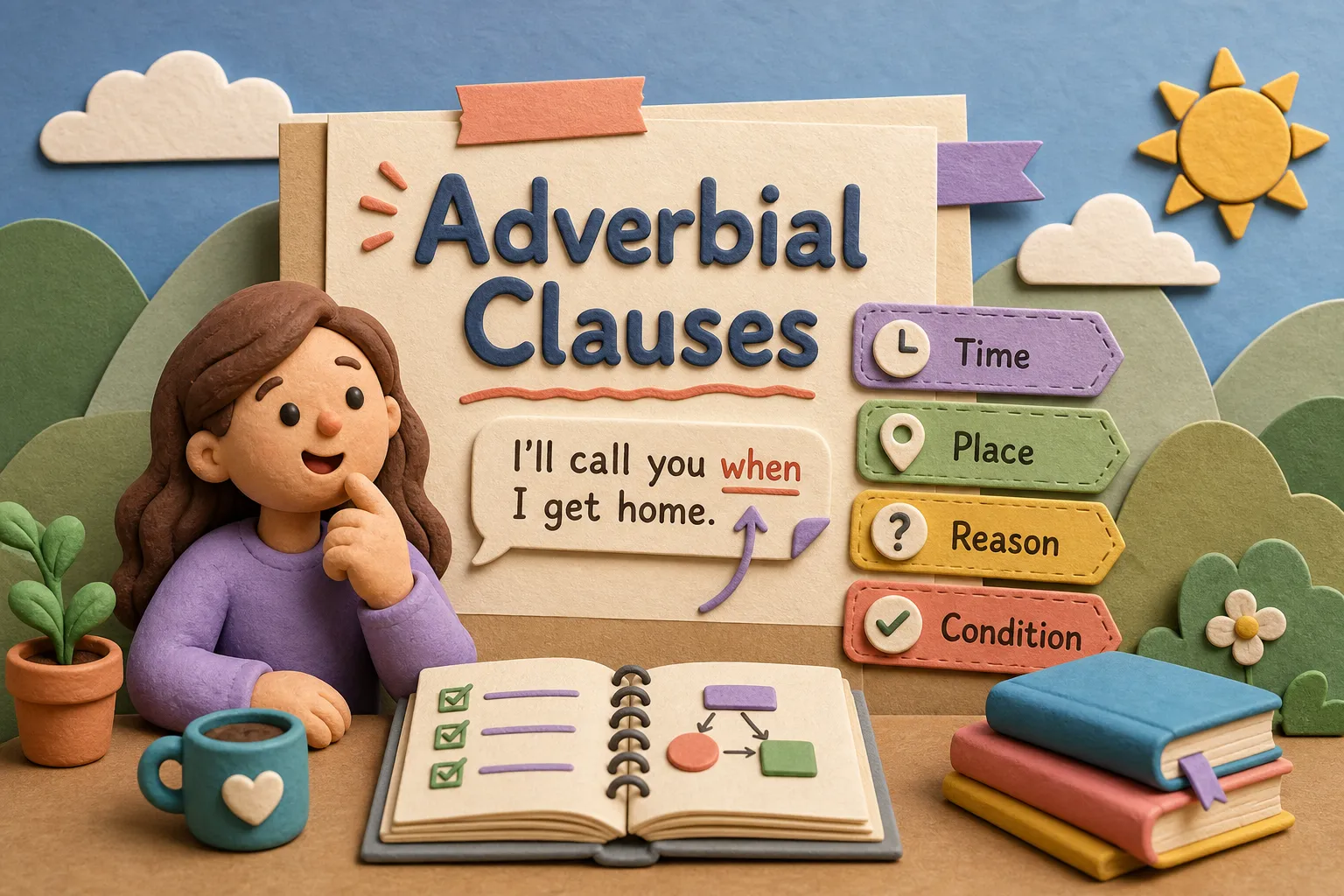
So what does the adverb clause actually do? It answers questions like when, why, how , and under what condition. For example: She called as soon as she landed answers when? In a professional email, you might write: Please reply by Friday so that we can finalize the schedule. That clause answers for what reason? The clause adds meaning, but it does not carry the sentence by itself.
The main types of adverb clauses with real examples
Most grammar sources recognize eight or nine types of adverb clauses. For everyday American English, three types come up most often.
Time, reason, and condition clauses
A temporal clause (time clause) answers when? It is introduced by conjunctions like when, before, after, while, as soon as, and until.
Example: I check my phone as soon as I wake up.
A reason clause answers why? and uses because, since, or as.
Example: She left early because her shift ended at four.
A conditional clause answers under what condition? and uses if, unless, provided that. These are especially important in workplace English, where decisions often depend on specific actions.
Example: Unless you confirm by Friday, we’ll cancel the reservation.
Concession, purpose, and manner clauses
A concession clause shows a contrast or an unexpected result. It uses although, even though, while, or whereas.
Example: He accepted the offer even though the salary was lower.
A purpose clause answers for what reason? and uses so that or in order that.
Example: She practiced daily so that she could pass the interview.
A manner clause describes how something happens and uses as if or as though.
Example: He presented as if he had done it a hundred times.
Place, comparison, and result clauses
A place clause uses where or wherever and is more common in writing than in speech. Example: Sit wherever you feel comfortable. A comparison clause uses than or as…as in comparative sentences. Example: The meeting ran longer than we expected. A result clause uses so…that or such…that to show an outcome. Example: She spoke so clearly that everyone understood. These three types are less common in everyday speech, but you will see them often in professional writing and longer conversations.
Subordinating conjunctions: the words that signal adverb clauses
A subordinating conjunction, a connecting word that introduces a dependent clause, always appears at the start of the adverb clause, not the main clause. The conjunction signals what kind of meaning follows. Here are the most common ones grouped by clause type:
- Time: after, before, when, while, until, as soon as, once, whenever
- Reason: because, since, as
- Condition: if, unless, provided that, even if
- Concession: although, even though, while, whereas
- Purpose: so that, in order that
- Manner/Comparison: as if, as though, than, as…as
- Place: where, wherever
Three conjunctions that confuse learners most
The words as, since, and while each carry more than one meaning. Context tells you which meaning applies, not the word alone. Here is how to tell them apart:
Since can signal time: Since I moved here, a lot has changed. It can also signal reason: Since you asked, I’ll explain.
While can signal time: While I was cooking, she set the table. Or it can show contrast: While he agreed with the plan, he had concerns. A useful test, if while can be replaced by although , it is showing contrast. If it can be replaced by at the same time, it is showing time.
As works similarly: it can mean because , while , or in the way that, depending on context.
Comma rules for adverb clauses
The comma rule for adverb clauses is one of the most practical grammar rules you can learn. It is consistent across major American style guides, APA, Chicago, and MLA all follow the same pattern, which means the rule applies equally to a workplace email and an academic submission.
When the adverb clause comes first
If the adverb clause opens the sentence, place a comma after it. The comma signals that the dependent part has ended and the main point is starting. Here are three examples using different clause types:
- Time: After the meeting ended, we grabbed coffee.
- Condition: If you need more time, just let me know.
- Concession: Although the flight was delayed, we arrived on time.
When the adverb clause comes last
When the adverb clause follows the main clause, you normally do not use a comma. Look at the same sentences in reversed order:
- We grabbed coffee after the meeting ended.
- Just let me know if you need more time.
- We arrived on time although the flight was delayed.
There is one exception. When the trailing clause creates a strong contrast or feels like an afterthought, a comma can help the reader. For example: She passed the exam, even though she had almost no time to study. In most cases, though, no comma is the right choice when the clause comes last.
Common mistakes ESL learners make with adverb clauses
Writing the clause as a complete sentence
This is the most frequent error. Learners write the adverb clause as a standalone sentence, which leaves the thought unfinished. Here is the mistake and the correction:
- Wrong: Because she was nervous. She forgot her lines.
- Correct: Because she was nervous, she forgot her lines.
A subordinating conjunction like because makes a clause dependent. The thought is not complete until the main clause joins it. Learners whose first language is Spanish, Portuguese, or Chinese often feel the logic is complete even without the main clause, because their language structures work differently. In English, the dependent clause always needs a main clause next to it. For a refresher on sentence types and how clauses fit together, see this guide on compound sentences.
Comma errors and wrong conjunction choices
Two more errors come up often. Some learners add a comma before the conjunction when the clause comes last: We stayed, because it was raining. That comma is not needed. Separately, using the wrong conjunction changes the meaning entirely. Although I studied hard, I passed says the result was surprising. Because I studied hard, I passed says the result was expected. These are very different ideas, one word does all of that work.
Quick self-check: Write three sentences using because, although, and if. Does each one have a main clause? If the adverb clause comes first, is there a comma after it?
How to shorten an adverb clause into a phrase
Clause reduction is a writing skill that makes sentences shorter and cleaner. It shows up mainly in professional and academic writing. In conversation, full clauses tend to sound more natural, saying Not knowing the answer, he stayed quiet aloud is grammatically fine, but it can feel slightly formal outside a presentation or speech.
The -ing reduction rule
You can reduce an adverb clause to a phrase when three conditions are met: both clauses share the same subject, the clause expresses time or reason, and the shorter form is still clear. The main change is replacing the full verb with an -ing form. Here are two examples:
- After she finished the report, she sent it to her manager. → After finishing the report, she sent it to her manager.
- Because he didn’t know the answer, he stayed quiet. → Not knowing the answer, he stayed quiet.
Notice that after is kept in the first example because it helps the reader follow the sequence. In the second example, because is dropped and the negative is moved in front of the -ing form. Both reductions keep the original meaning.
For a deeper look at the reduced adverb clause technique, consult a focused guide on reductions and examples.
When you can’t or shouldn’t reduce
Do not reduce a clause if the subjects are different. This creates a dangling modifier, a phrase that seems to describe the wrong subject. For example: While driving to work, the phone rang. The phone was not driving. The correct version is: While I was driving to work, my phone rang. Conjunctions like although and unless also do not reduce well, because the contrast meaning becomes unclear without the full clause. When in doubt, keep the full clause. Clarity always matters more than brevity.
What you can do from here
You now have the tools to work with an adverb clause confidently: how to spot one by its subject-verb pair, how to name its type by the conjunction and the question it answers, and where the comma goes depending on word order. That covers the structure from the ground up.
A few ways to practice from here: find one adverb clause in the next article or email you read and identify its type and comma usage. Take a few sentences you have already written and add an adverb clause to each one. Then write one conditional sentence and one concession sentence from your own life, and check that each has both a dependent clause and a main clause.
If you want to keep building, the grammar section at Your Daily American covers more patterns like this with examples drawn from real American speech. Each lesson focuses on how American English is actually used, so what you study connects directly to real conversations and writing, whether you are drafting a work email or preparing for a job interview.