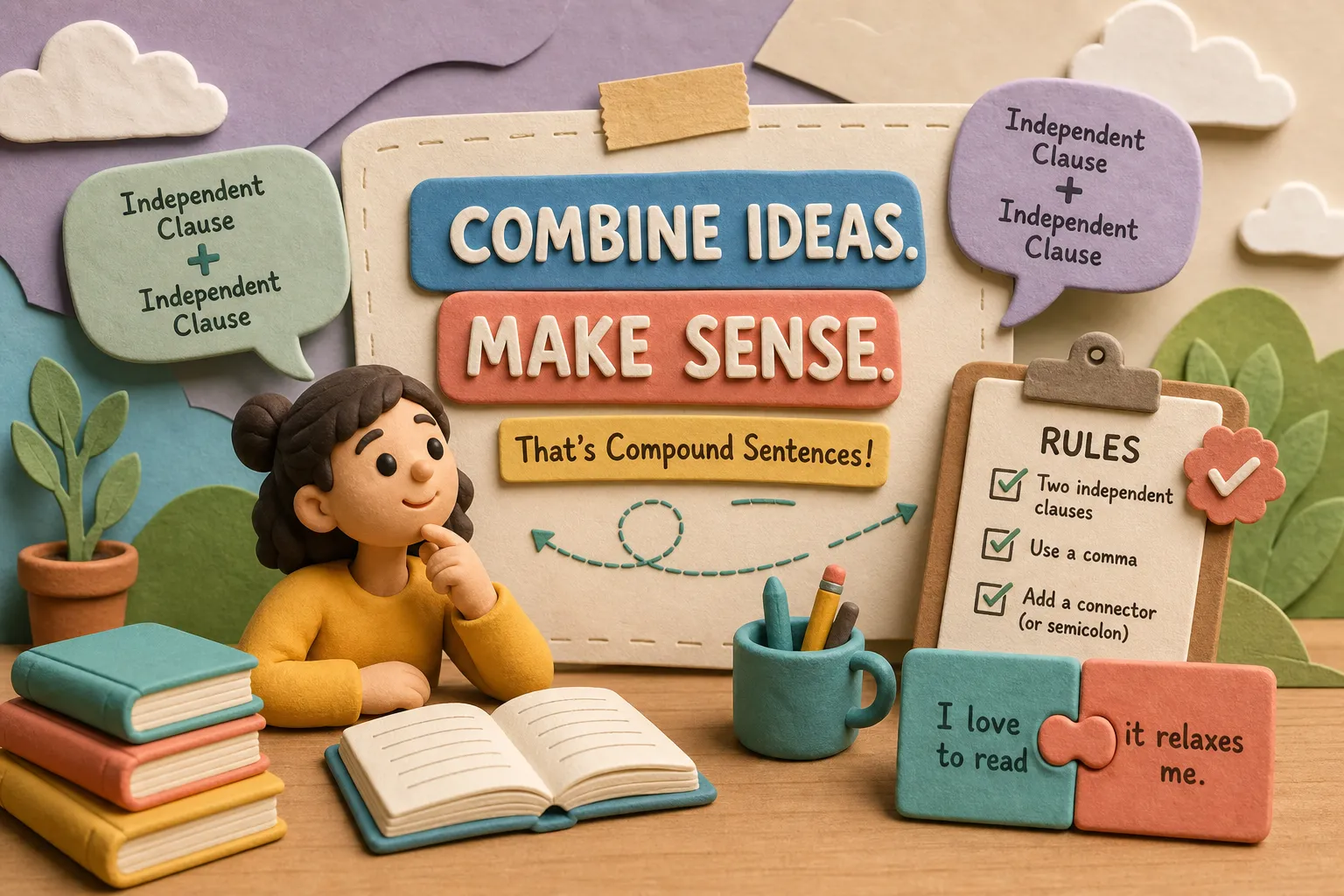
Read these two sentences: “I was tired. I kept working.” They are correct, but they feel flat. Now read this: “I was tired, but I kept working.” That small change makes the writing feel more natural and connected. That is the power of a compound sentence, a sentence that joins two or more complete ideas into one.
By the end of this lesson, you will be able to do four things: identify independent clauses, join them correctly using FANBOYS or a semicolon, fix common errors like comma splices, and write your own compound sentences with confidence. This is the kind of practical grammar that shows up in texts, emails, meetings, and everyday conversation. At Your Daily American, this is exactly how grammar is taught, through real language you will actually use.
What a Compound Sentence Actually Is
The Independent Clause: One Complete Idea
Before you can build a compound sentence, you need to understand an independent clause, a group of words with a subject and a verb that expresses a complete thought and can stand alone as a sentence. Look at these examples: “She drinks coffee.” “He works late.” “The meeting starts at nine.” Each one is a complete sentence on its own. You have been writing independent clauses since you started learning English. You just may not have known the name for them.
The quickest test: can the sentence stand alone? If yes, it is an independent clause. If you need more words to finish the idea, it is not, for example, “Because I was tired” cannot stand alone, which makes it a dependent clause, not an independent one.
Quick Comparison: Simple, Compound, and Complex
A simple sentence has one independent clause: “She studied.” A compound sentence has two or more independent clauses joined together: “She studied, and she passed.” A complex sentence has one independent clause plus a dependent clause (a group of words that cannot stand alone): “She studied because she wanted to pass.” Notice that all three sentences use the same basic idea. The structure is the only thing that changes.
The key difference between compound and complex is this: in a compound sentence, both parts can stand alone. In a complex sentence, one part cannot. This article focuses entirely on compound sentences and how to build them correctly.
How to Join Two Ideas Using FANBOYS
The Seven Coordinating Conjunctions
FANBOYS is a memory tool that stands for the seven coordinating conjunctions, words that connect two independent clauses as equals: For, And, Nor, But, Or, Yet, So. Each one changes the relationship between the two clauses. “And” adds information. “But” and “yet” show contrast. “Or” shows a choice. “So” shows a result. “For” gives a reason. “Nor” connects two negative ideas. Note that “for” and “nor” are less common in casual spoken English than the other five FANBOYS, but it is useful to recognize all seven.
The Comma Rule: Where It Goes and Why
When a coordinating conjunction joins two independent clauses, put a comma before the conjunction, not after it. According to standard American grammar guides such as Purdue OWL, this comma signals where one independent clause ends and the next begins. Here are three examples with the comma in the right place:
- She was hungry, so she ordered lunch.
- I called him, but he did not answer.
- You can take the train, or you can drive.
Now look at the same sentences without the comma: “She was hungry so she ordered lunch.” It is harder to read. The comma gives the reader a small pause that shows where one idea ends and the other begins. Always place the comma before the conjunction, not after it.
When You Don’t Need a Comma
Here is one exception that confuses many learners. When “and” or “but” joins two verbs or two nouns, not two full independent clauses, no comma is needed. Compare these two sentences: “She laughed and clapped.” versus “She laughed, and he clapped.” In the first sentence, one subject (she) does two actions. In the second, there are two different subjects (she and he), so each part is a full clause and needs the comma. This is a very common over-correction in ESL writing.
Using a Semicolon to Connect Two Clauses
The Basic Semicolon Rule
A semicolon can replace the comma + conjunction completely when two independent clauses are closely related. The important rule: do not put a coordinating conjunction after the semicolon. Grammar authorities including the Chicago Manual of Style treat this as a standard punctuation convention. Here is how it works:
- “I finished my work. I went home early.” → “I finished my work; I went home early.”
- “The coffee was cold. I drank it anyway.” → “The coffee was cold; I drank it anyway.”
The semicolon signals to the reader that two ideas belong together. The logical connection between them, whether it is contrast, sequence, or cause and result, comes through from context alone. This structure feels slightly more formal than using “and” or “so,” and it is very common in professional writing and emails.
Adding Conjunctive Adverbs: However, Therefore, and More
You can also add a conjunctive adverb (a transition word like however, therefore, moreover, consequently, as a result) after the semicolon. The pattern always looks like this: [independent clause]; [conjunctive adverb], [independent clause]. Notice the semicolon before the conjunctive adverb and the comma after it. Here are some examples:
- The report was late; however, the client was satisfied.
- She practiced every day; therefore, her pronunciation improved.
- The price increased; as a result, fewer people bought the product.
- The team was new; nevertheless, they finished the project on time.
- The office was quiet; moreover, everyone was focused.
These words are very common in American professional and academic writing. Learning to use them correctly will make your emails and reports sound much more polished and precise. (See MLA style on semicolons and conjunctions for more guidance.)
Two Mistakes That Trip Up Most Learners
What a Comma Splice Is
A comma splice happens when you join two independent clauses with only a comma and no conjunction. Example: “I wanted to go, I stayed home.” This is wrong because a comma alone is not strong enough to hold two complete ideas together. Many ESL learners make this mistake because it feels natural to pause with a comma between two ideas. The pause is right; the punctuation is not enough.
What a Run-On Sentence Is
A run-on sentence happens when two independent clauses are connected with no punctuation at all. Example: “I wanted to go I stayed home.” Both the comma splice and the run-on share the same root problem: the writer knows the two ideas are connected but has not used the right tool to show it. They are two separate errors, but the fix is the same.
Four Ways to Fix Both Errors
Take this example sentence: “I wanted to go, I stayed home.” Here are four correct ways to fix it:
- Add a period. “I wanted to go. I stayed home.”
- Add a comma + coordinating conjunction. “I wanted to go, but I stayed home.”
- Replace the comma with a semicolon. “I wanted to go; I stayed home.”
- Use a subordinating conjunction (a word that makes one clause dependent). “Although I wanted to go, I stayed home.”
All four versions are correct. The one you choose depends on the tone you want and how the sentence fits with the ones around it.
Compound Sentence Examples from Easy to Advanced
Easy: Comma + Conjunction (FANBOYS)
These sentences use everyday topics and all seven coordinating conjunctions. Notice where the comma goes in each one.
- I wanted to go for a walk, but it started raining.
- She studied hard, so she passed the test.
- The dog barked, and the cat ran away.
- We can order pizza, or we can cook dinner.
- He was tired, yet he finished his homework.
- I packed an umbrella, for the forecast looked stormy.
- The lights were off, nor could anyone hear a sound.
- She wanted to stay, but her bus was leaving.
- The children laughed, and the teacher smiled.
Medium: Semicolon Only
In each of these sentences, the two clauses are closely related. The reader can understand the connection without a conjunction. That is exactly when a semicolon works well.
- The sky was clear; the stars were bright.
- I finished my work; I went home early.
- He missed the train; he took a taxi instead.
- She wrote the report; her partner edited it later.
- The museum was crowded; we decided to return the next day.
- The road was icy; driving was dangerous.
- The books were heavy; the backpack was almost full.
Advanced: Semicolon + Conjunctive Adverb
These sentences use the full pattern: [independent clause]; [conjunctive adverb], [independent clause]. Pay attention to where the semicolon and the comma go each time.
- The train was delayed; therefore, we missed the meeting.
- He practiced every day; consequently, he improved quickly.
- The team played well; nevertheless, they lost the game.
- She forgot her notes; as a result, she spoke without them.
- The weather was warm; moreover, the sky stayed clear all afternoon.
- It was a difficult assignment; however, she was ready for it.
- We arrived early; therefore, we had time to review our notes.
Try it yourself: Take these two independent clauses: “The presentation was long. The audience stayed focused.” Connect them three ways: once with a comma + coordinating conjunction, once with only a semicolon, and once with a semicolon + “however.” All three versions will be correct, and each one will feel slightly different. That difference is part of building your writing style in English.
You Now Have the Tools to Write Compound Sentences Correctly
This technique of sentence combining, taking two closely related independent clauses and joining them into a single, well-structured compound sentence, is one of the most practical writing skills you can develop in English. You covered independent clauses and how to recognize them, how to join them with FANBOYS or a semicolon, and how to fix comma splices and run-ons using four reliable options.
Mastering one compound sentence at a time adds up quickly. Native speakers use this structure constantly, in texts, emails, casual conversations, and Professional English. The more you notice compound sentences in real American English, the more natural they will feel to write.
At Your Daily American, every grammar lesson is grounded in the kind of everyday and professional American English that helps you communicate with real confidence, not just pass a test. Once compound sentences feel comfortable, your next step is exploring compound-complex sentences, where you combine what you learned here with a dependent clause. When you are ready, that lesson picks up exactly where this one left off.
Advanced readers who want to study how non-native speakers handle related issues can read about common pronunciation errors in our post on English words non-native speakers mispronounce most often.