Picture this: you are in a work meeting and your manager says, “Let’s schedule a deep dive on the Q3 numbers before we make a decision.” You understand each word separately. But what exactly did she just ask for? A long meeting? A detailed report? A specific kind of analysis? If you are not sure, you are not alone. This phrase comes up constantly in American offices, and knowing how to use it correctly can make a real difference in how you communicate at work.
“Deep dive” is one of the most common phrases in American business English right now. You will hear it in meetings, read it in emails, and see it as a slide title in presentations. At Your Daily American, this kind of focused, practical lesson is exactly what we teach: not just vocabulary, but the full picture of when, why, and how native speakers use a phrase in real situations. By the end of this article, you should be able to define the phrase, use it correctly in speech and writing, recognize common grammar mistakes, and follow a simple framework for running a deep-dive session at work.
What “deep dive” means in plain English
Merriam-Webster defines “deep dive” as “a thorough examination of a subject or topic.” Cambridge says it is “a detailed examination of a subject.” Both definitions point to the same core idea: you go past the surface and look at something closely and completely. The opposite would be a quick look or a general overview.
The key idea is this: a deep dive is not just a long meeting or a big report. It is a structured, focused effort to fully understand one specific topic before making a decision or recommendation. Here are two natural example sentences: “We need to do a deep dive into last quarter’s numbers.” “The team conducted an in-depth analysis of customer complaints before redesigning the app.” Notice that the phrase describes a serious, organized effort, not a casual conversation.
How this phrase moved from the ocean to the office
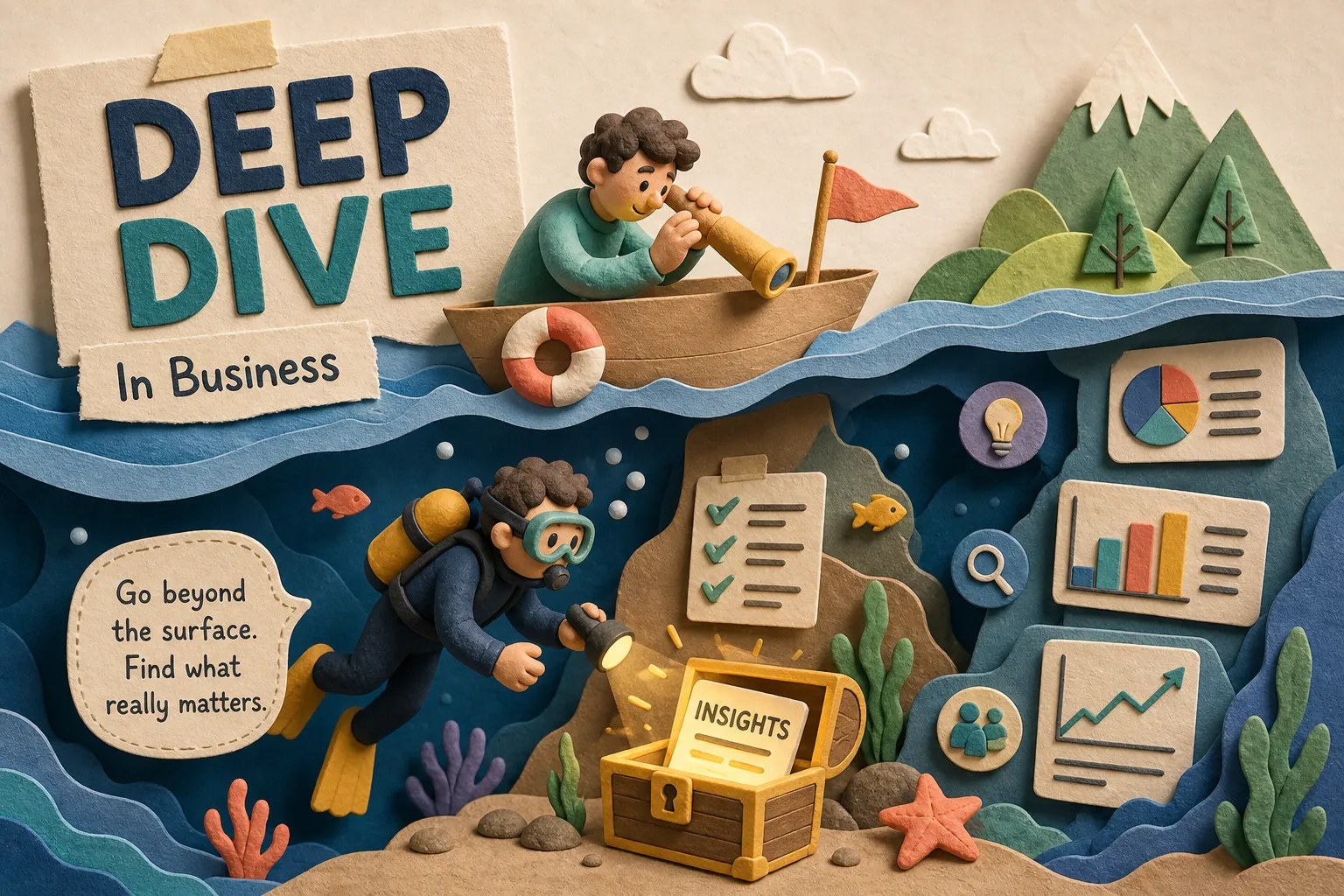
Originally, the term was literal: a diver going far below the surface of water to explore what is there. The figurative meaning developed naturally from that image. Going deep into a topic mirrors going deep into water. You leave the surface behind and examine what lies underneath. That visual connection made the phrase easy to understand and easy to remember.
The figurative use was already appearing in American business and journalism by the late 20th century, and Merriam-Webster notes that much of the early evidence for it comes from business writing. Today, it is completely standard vocabulary in meetings, presentations, emails, and written reports across many industries.
In many U.S. business contexts, concise phrases like “deep dive” are used to signal a deliberate shift from fast decisions to careful analysis. The expression is also notably compact, shorter and more idiomatic than “comprehensive in-depth analysis,” while carrying the same meaning. This is why learning phrases like this matters so much: one expression can do a lot of work in a room full of native speakers.
Where and how “deep dive” shows up at work
In meetings, the phrase is used when scheduling or introducing a working session. You might hear: “Can we block two hours for a deep dive on the pricing strategy?” or “Today’s session is a thorough examination of our Q2 retention data.” In presentations, it often appears as a slide title or agenda item to signal that the next section goes into full detail rather than a quick summary. A presenter might say, “Now let’s do a deep dive on the three main causes we identified.”
In written communication, the term labels a section that provides detailed analysis, data, and findings. In professional emails, it appears in subject lines like “Deep Dive: Supply Chain Risks, Q3 Report” and in the body of messages like “Please review the attached report before Thursday’s meeting.” One useful thing about this phrase is its flexibility: it is common in both spoken and written business contexts, though it can sound informal in very formal communications, so read the room before using it in high-stakes written correspondence. For quick reference to common dictionary definitions you can consult a dictionary definition.
Deep dive, deep-dive, or “dive deep”: which form is correct
This is the part where many ESL learners make mistakes, so pay close attention. The form you use depends on how the phrase functions in your sentence.
As a noun, do not use a hyphen. “We did a deep dive into the data.” This is the most common form, the one you will hear most often in meetings and read most often in reports. The phrase is the object of the verb, and no hyphen is needed.
As a modifier before a noun, use a hyphen. “She prepared a deep-dive report.” “We held a deep-dive workshop.” The hyphen shows that both words together are describing the noun that follows. A simple rule to remember: if the phrase comes before a noun to describe it, add the hyphen. If it stands alone as the object of a verb, leave the hyphen out. Note that Chicago style generally hyphenates compound adjectives before a noun, while AP style recommends hyphenation primarily when it aids clarity, but in practice, hyphenating attributive compounds like “deep-dive report” is the safer choice under both guides. For a quick hyphenation reference, see this hyphenation guide.
Now, what about “dive deep”? This form is less standard in professional writing. ESL learners sometimes reverse the word order and say “Let’s dive deep into this.” Native speakers do use this in casual speech, but it is not the preferred form in most professional contexts. In formal settings, prefer “do a deep dive into” or “conduct a deep dive on.” One more common mistake: using the phrase as a verb without a preposition, for example, “We need to deep-dive this.” Unless your audience routinely uses that compressed jargon, the safer form keeps the preposition: “deep-dive into” or “do a deep dive on.”
How to run a simple deep-dive session step by step
Knowing the phrase is one thing. Knowing how to actually lead or participate in this kind of focused analysis is even more useful. Here is a practical four-step framework you can use at work.
Step 1: Define the question clearly
Before anything else, agree on the exact question you are trying to answer. A vague topic leads to a vague result. Write it as one specific sentence: “Why did customer churn increase by 12% in Q2?” Starting with a clear, focused question keeps the entire session on track.
Step 2: Gather and organize your evidence
Collect all relevant data, documents, and observations. Then group them into three simple categories: evidence that supports your current theory, evidence that contradicts it, and evidence that is not yet clear. This structure keeps the discussion focused and prevents the session from becoming a directionless conversation.
Step 3: Challenge your assumptions
Every conclusion rests on assumptions. Make those assumptions visible. Ask: “What would have to be true for this explanation to be correct?” Then test whether it actually is. This step is what separates a real in-depth analysis from a simple review of information that confirms what you already believed.
Step 4: Synthesize and decide
Pull your findings together into one clear conclusion or recommendation. A thorough examination like this should end with a decision, a next step, or a clear answer to the original question. If it ends with “we need more information,” that is also a valid outcome, but be specific about what information is needed and who will get it. Every session should produce something actionable. For practical business examples of how teams use deep dives to solve problems, review these real-life deep-dive examples.
One phrase is not enough: building real workplace fluency
Learning “deep dive” is genuinely useful. But American business English is full of phrases like this: “circle back,” “take this offline,” “put a pin in it,” “move the needle.” Each one is simple on its own. Together, they form the real language of American workplaces. ESL learners who study only grammar rules often feel lost in real meetings, not because the vocabulary is too advanced, but because the professional phrases and cultural patterns are unfamiliar. To build phrase knowledge more broadly, start with lists like Essential Phrasal Verbs You Must Know that show how common multi-word expressions function in real speech.
This is exactly what The Fastest Way to Become Fluent in American English is built for: the platform offers a true in-depth look at American professional English, the phrases, communication patterns, cultural context, and situational language that most textbooks skip entirely. From meeting phrases to email writing to pronunciation, you learn not just what to say, but when, why, and how native speakers actually say it. If you want to go from understanding English to using it with real confidence at work, that is where the journey continues.
What to remember and use next time
Here are the key takeaways from this lesson. “Deep dive” means a thorough, focused examination of a specific topic. Use it as a noun without a hyphen: “We did a deep dive into the data.” Use a hyphen when it modifies a noun: “a deep-dive report.” Avoid reversing the word order, and in most professional contexts, include a preposition, the forms “deep dive into” and “conduct a deep dive on” are the safest choices, though more casual speech may drop the preposition.
You can also use the four-step framework the next time your team needs to analyze a problem: define the question, gather and organize the evidence, challenge your assumptions, and synthesize your findings into a clear decision or recommendation.
Now you are ready to use this phrase correctly in your next meeting, report, or presentation. And if you want to keep building the professional vocabulary that makes a real difference at work, keep coming back to Your Daily American. There is always more to learn, and every phrase you master brings you one step closer to sounding natural and confident in American English.
Quick practice: try it yourself
- Write one sentence using “deep dive” as a noun. (Example: “The marketing team did a deep dive into the campaign results.”)
- Write one sentence using “deep-dive” as a modifier before a noun. (Example: “We scheduled a deep-dive session for next Tuesday.”)
- Think of a problem at your job or in your studies. Write the one clear question you would use to start an in-depth analysis of it.