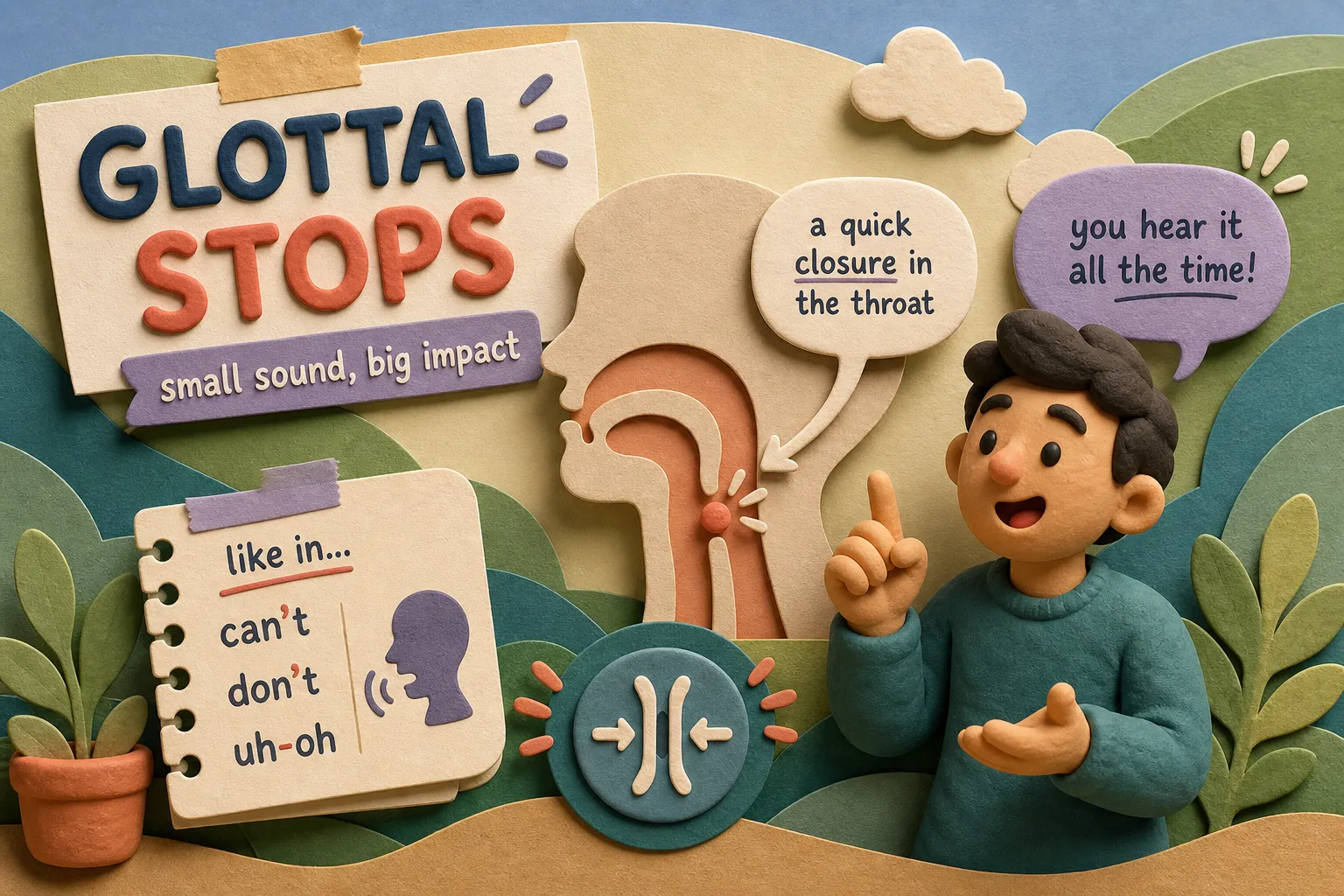
Say “uh-oh” out loud. Feel that small pause between the two syllables? That tiny catch in your throat is a glottal stop, one of the most common sounds in everyday American English, and you just produced it without even trying.
By the end of this lesson, you will know exactly what a glottal stop is, where it shows up in American speech, how it differs from similar sounds in British English, and how to start hearing it in real conversations. Once you recognize this sound, ordinary words that used to slip past you will start to click into place.
What a glottal stop actually is
The ʔ symbol and what it means
A glottal stop is a brief, complete stop of airflow that happens in your throat, not at your lips or tongue. In the International Phonetic Alphabet (IPA), the glottal stop is written as ʔ. Linguists classify it as a glottal plosive and a type of glottal consonant, meaning the place of articulation is the glottis itself, not the teeth, lips, or palate. You will see the ʔ symbol in pronunciation guides and advanced dictionaries, such as the Cambridge Dictionary definition of “glottal stop”.
The word “glottal” comes from glottis, the opening between your vocal cords (also called vocal folds). Closing the glottis stops sound entirely; when it opens again, you get the glottal stop. The sound is very short and happens deep in your throat, not at the front of your mouth. For a technical, research-focused discussion of glottal behavior and glottalization, see this open-access study on glottalization.
What your throat does to make this sound
Your vocal cords press together completely, blocking airflow for just a fraction of a second; when they open, the air releases, the whole event takes less time than a blink.
You already know this feeling. When you say “uh-oh,” there is a small catch between the first and second syllable. That catch is glottal closure, your vocal cords coming together and then separating. That separation is the glottal stop. This physical connection is the most important thing to hold onto as you read the rest of this lesson.
Where glottal stops appear in American English
The most common pattern: words like “button” and “mountain”
The most frequent place you will hear a glottal stop in American English is before a syllabic /n/. A syllabic /n/ is an /n/ sound that forms its own syllable without a vowel before it. When the letter T comes just before that /n/, most American speakers replace the T with a glottal stop, a process sometimes called glottalization or the glottal T.
These common words all follow the same pattern:
- button → BUH-ʔn
- kitten → KIH-ʔn
- mountain → MOUN-ʔn
- cotton → KAH-ʔn
- mitten → MIH-ʔn
- written → RIH-ʔn
Notice that the /t/ is not simply dropped or skipped in these words. There is a small but real throat closure before the /n/. That closure is the glottal stop. This pattern appears across American dialects and shows up in both casual conversation and broadcast speech.
Recognizing glottal stops in everyday speech
“Uh-oh” is the clearest example of a glottal stop you can feel right away. The stop sits between the two syllables and creates that clean separation. Most learners are surprised to discover that this familiar sound has a name and a defined place in linguistics.
Some American speakers also use a light glottal stop at the start of stressed vowel words when they want to add emphasis. Saying “absolutely” or “every single one” with strong stress can bring out a brief glottal closure before the first vowel. Start by noticing the sound in the common words listed above; awareness of other cases will follow naturally from there. If you want a short practical explanation of how glottal stops show up in real speech, this Babbel article on glottal stops is a useful, learner-friendly read.
How American and British English use this sound differently
The broader British glottal T pattern
In many British accents, the glottal stop replaces /t/ in a much wider range of words and positions, not just before syllabic /n/. British speakers across many regions, not only London, use a glottal stop in words like “water,” “butter,” “better,” and “late.” You can also hear it in phrases like “that one” or “get out.”
The Geordie accent from Newcastle, England, is a well-known example. In Geordie speech, the glottal stop can replace nearly all voiceless stop consonants in everyday conversation, making the British use of this sound far more widespread than the American pattern. For a focused overview of this British pattern, see the Wikipedia article on T‑glottalization.
Why the American pattern is narrower
In American English, the T in “water” or “butter” does not become a glottal stop. Instead, it becomes a quick sound called a flap T (written as ɾ in IPA), which sounds a lot like a fast D. This is a different feature called T-flapping. So “water” in American English sounds more like “WAH-der,” not “WAH-ʔer.”
This difference matters for learners who studied British English and are now working on American English. You may expect a glottal stop in positions where Americans use a flap T instead, and that mismatch can make words sound unfamiliar or cause you to produce something that sounds off to American ears. Knowing which pattern belongs to which variety keeps your speech and listening consistent.
Why recognizing this sound makes you a better listener
The link between hidden sounds and real comprehension
Native American speakers never announce that they are using a glottal stop. The sound appears automatically in fast, connected speech. If you expect a clear /t/ in “button” or “mountain” and hear a throat closure instead, the word can sound incomplete or even like a different word entirely.
Understanding glottal stops closes that gap. Once you know what the sound is and where it appears, words that felt blurry in fast speech start to sound clear. Learners who understand American sounds at this level stop mishearing everyday words and follow conversations with much less effort, a genuine, practical improvement in listening ability.
Going deeper into American pronunciation
The glottal stop is just one example of the many sound features that make American English sound the way it does. The flap T, vowel reductions, and connected speech patterns all work the same way: invisible to most learners, but very noticeable once you know what to listen for.
If you want structured practice with these patterns, the pronunciation series at Pronunciation & Listening, Your Daily American is built around exactly this kind of real-feature teaching. Each pattern gets a clear explanation, real examples, and audio context so the sounds become familiar rather than confusing. For another feature-focused lesson, see How to Pronounce TH in American English (θ and ð): Full Guide, Your Daily American.
Simple exercises to start hearing and using glottal stops
Build your ear first
Start with “uh-oh.” Say it at normal speed and feel that catch in your throat between the two syllables. That physical sensation is glottal closure. Repeat it three or four times and pay attention to the feeling. This connects a sound you already make to a concept you now have a name for.
Then find a short American English video or podcast. Listen for words that end in “-ton,” “-ten,” “-tain,” or “-tten”, words like “button,” “kitten,” “certain,” “mountain,” and “forgotten” come up often. When you hear one, pause and replay it. Notice that the T does not sound like the T in “top” or “time.” There is a brief stop, then the /n/ follows. That brief stop is the glottal stop.
Practice with real words
Work through this short list. Say each word slowly, feel the throat closure just before the /n/, then say it at natural speed:
- button, kitten, cotton, mitten
- mountain, written, bitten, rotten
After a few passes through the list, record yourself and compare the recording to a native speaker saying the same words. The difference between a clear /t/ and a glottal stop is easy to hear on playback. If your version has a sharp, crisp T in the middle, try softening it into that throat catch instead.
Set realistic expectations at this stage. The goal right now is recognition and awareness, not perfect production. Noticing the glottal stop once in a real conversation is genuine progress. Awareness comes first; natural use develops with time and repeated listening.
What you now know, and where to go next
Glottal stops are a real, common feature of everyday American English. They appear in words you hear and use all the time: “button,” “kitten,” “mountain,” “uh-oh.” These are not exceptions or sloppy speech, they are standard American pronunciation.
The American-British contrast is also worth keeping in mind. Americans use the glottal stop before syllabic /n/ and in certain other positions, while British speakers use it much more broadly across many word types. Knowing which pattern belongs to which variety helps you sound more consistent and understand both accents more accurately.
Once you know this sound exists, you will start catching glottal stops in American speech everywhere. That shift in awareness is exactly what separates a learner who understands English from one who follows native speakers naturally. Keep exploring these real American sound patterns at Your Daily American, one feature at a time, and your listening skills will keep growing in the same direction. You might also enjoy related lessons like The American R: Why It Sounds So Different, Your Daily American to broaden your pronunciation work.